I’ve been so foolish. I’ve been worrying that once the critical mass of data centers is built, sales will start to stall, since the equipment should last once installed. However, AI gives these kinds of figures:
Switches and routers: 5-10 year rip & replace, but this is mainly due to the need for upgrades rather than breakage.
Pluggables: 3-7 year lifespan, averaging 5.7 years.
I encountered a pleasant surprise with pluggables—they are practically consumables. InP (Indium Phosphide) can withstand higher temperatures, but conversely, it breaks down faster in high heat. That might be why they’ve been hyped, and a significantly lower TCO (Total Cost of Ownership) than competitors could matter even more. It’s actually a really good product if it generates recurring revenue due to replacements.
I was worried for a moment about the period following the data center build-out, but I don’t believe optics can be challenged anytime soon, especially in environments that run hot. Perhaps others have realized this already, which is why optics are being hyped, while I, like a fool, was just holding until now without proper justification. Just kidding. This just nudged my personal target price slightly upward.
Outside of data centers, optics do serve for the 10-30 years I had previously imagined. It’s possible that 3-7 years is optimistic after 1.6TB, but fortunately, Nokia is already reacting by packing ports into smaller spaces.
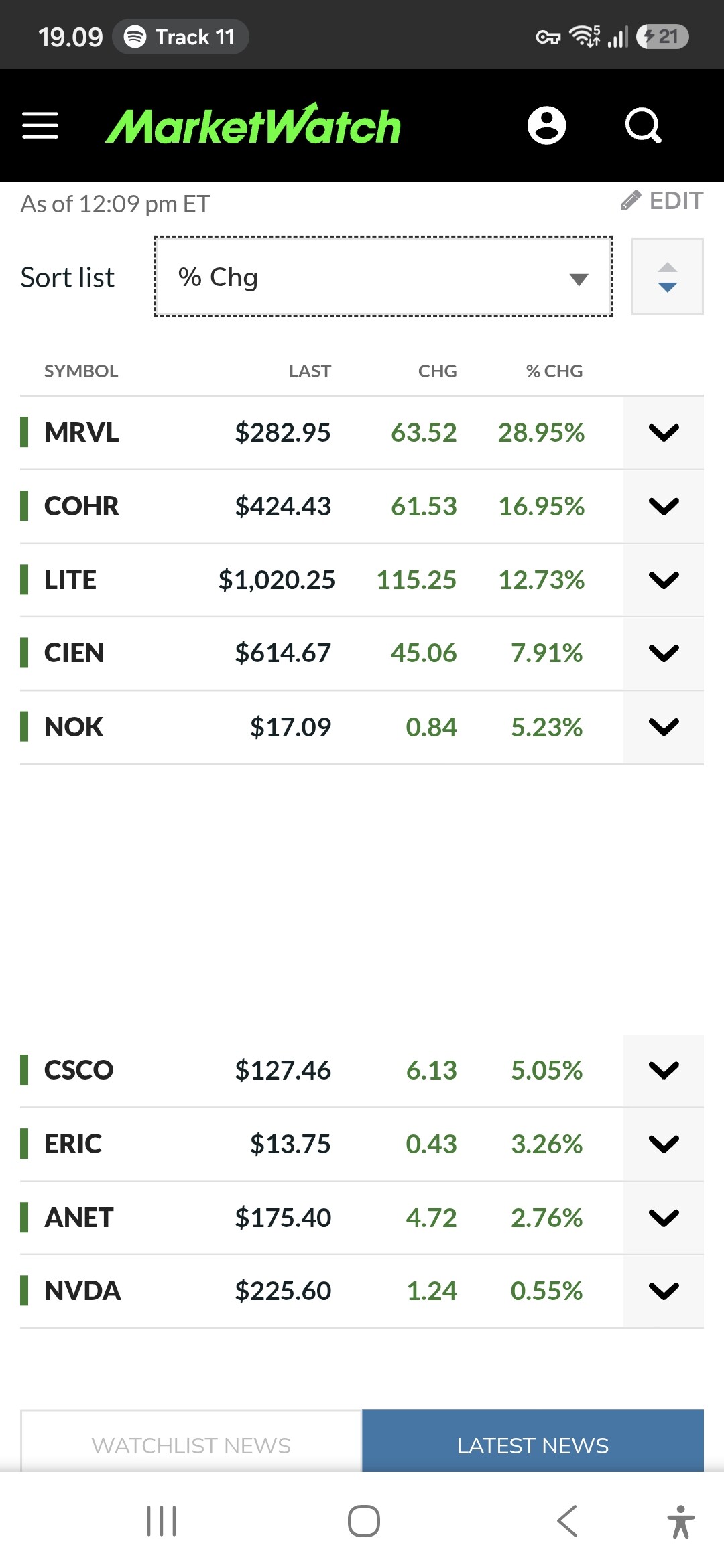
Should we be disappointed with the US session (so far)? Only in 5th place (among the peer group), though at least ahead of the sister (Nokia) and Erkki (Ericsson)
Surely for the sake of the weekend we should make it onto the podium
There are good reasons to believe that Justin Hotard is one of the best, perhaps THE best, CEO that Nokia has had in modern times. There are likely many of us who hope he remains in his position for a very long time.
At the same time, he has a history of moving on quite frequently. For instance, was he even at HPE for a full year? How do the forum’s experts view the risk of him seeking new opportunities again after a short time at Nokia? On the other hand, this is presumably his first CEO post, and there are clearly plenty of ingredients in place for great success, which in itself might motivate him to stay.
The situation at Nokia is certainly encouraging, both professionally and financially. It’s not worth leaving for just any minor role. And the guy seems to be enjoying his time at Nokia. There shouldn’t be any shortage of things to do, either.
A few years ago, Nokia experienced a so-called meme surge, which the company also commented on. Now, the rise has been many times greater, yet the company remains silent. Does this mean the share price looks right even in the eyes of management?
Perhaps, at least this time, Nokia has a leadership that also understands what is in the best interest of the company’s shareholders. They aren’t intentionally shooting down a rally, instead of at the very least keeping their mouths shut.
In principle, matters concerning owners or the share price are not the management’s concern. Of course, owners influence management through the board and general meetings to advance their own interests.
In principle, yes. The company’s management is obligated to act in the best interest of the company, and in practice, this means: increasing long-term value and developing the business in ways that directly benefit the shareholders.
The money-go-round… Nvidia, Coreweave —> Nokia. 5 GW! CoreWeave revenues we’ll be seeing already in Q2: Short-Term Goal: They are on track to double their footprint to 1.7 GW of active power by the end of 2026, funded by a projected $30 billion to $35 billion capital expenditure boom.
If HPE and Dell are raking in the $, no doubt it’s coming. Interesting video…
Background via Gemini:
CoreWeave’s 5 GW expansion plan directly translates into a massive, multi-year financial runway for Nokia. Because CoreWeave has selected Nokia as its global networking backbone partner, CoreWeave’s skyrocketing capital expenditure (CapEx) directly fuels downstream revenue for Nokia’s IP and Optical Networks divisions. With CoreWeave planning to scale from 850 MW to over 5,000 MW (5 GW) by 2030, their annual CapEx is booming—projected at $30 billion to $35 billion for 2026 alone.
Why This Spells Major Downstream Value for Nokia Full-Portfolio Adoption: CoreWeave is not just buying individual components; they are deploying almost Nokia’s entire high-performance network portfolio. This includes 7750 Service Routers (driven by their flagship FP5 routing silicon), 1830 Photonic Service Interconnect (PSI) systems, and the Network Services Platform (NSP) for automation.The Wide Area Network (WAN) Multiplier: Every time CoreWeave opens a new data center campus or adds gigawatts of power, those massive AI clusters must connect to each other across the U.S. and Europe. Nokia is the exclusive architect building out this ultra-low-latency WAN backbone.
The Energy Efficiency Win: A primary reason CoreWeave selected Nokia over competitors like Arista and Cisco was power efficiency. Nokia’s hardware allows CoreWeave to move 30% more data traffic within the exact same energy envelope—a critical advantage when scaling to a massive 5 GW footprint.Long-Term Revenue Visibility: Building 5 GW requires a multi-year construction roadmap. Because hardware, software, and optics must be deployed ahead of the GPUs going live, Nokia secures highly predictable, downstream enterprise revenue over the next four years.
The text below is a quote from today’s Kauppalehti. I personally started acquiring Nokia shares after becoming convinced of Nokia’s future following Rajeev Suri’s presentation at the CMD in Barcelona. The presentation was graphical and quite difficult for a layman to understand.
Siilasmaa, who has spoken about the AI breakthrough for years, said in the broadcast that data centers and AI were already part of the considerations during that deal.
“This was one of the key reasons why the Alcatel-Lucent acquisition was made, because they had optical technology and data center interconnect technology. Its growth was strong and profitability was good, and Nokia wanted to get involved in that business,” he recalled.
“So, in itself, this (Nokia’s rise) is the result of long-term work and is based on the belief that the significance of AI will grow and more data centers will be needed. This was at least one assumption upon which the acquisition was made. It is always nice when assumptions prove to be correct.”
Nvidia’s Huang commented on copper vs. optics, and the stock market is listening
Optical interconnect stocks are surging Tuesday after Nvidia CEO Jensen Huang made a surprise appearance at Marvell’s Computex 2026 keynote in Taipei and delivered a clear verdict on the future of AI data center connectivity, driving Coherent Inc (NYSE:COHR) up 17.3% to $425.59, Lumentum Holdings Inc (NASDAQ:LITE) up 13.3% to $1,025, Corning (NYSE:GLW) up nearly 12% to $197.88, and Ciena Corp (NYSE:CIEN)up over 8% to $616.46.
Huang’s remarks crystallized a hierarchy that Wall Street is now pricing in aggressively. “We should use copper as much as we can, for as long as we can, but copper has its limits,” he said. “The right strategy is to scale up with copper as long as you can — after that you scale up further with optics, you scale out with optics and you scale across with optics. So you use optics wherever you must, you use copper wherever you can.”
And the only reason I keep mentioning the CoreWeave deal, is because it’s the only really massive contract in this particular sector we’ve heard about, due to hyperscaler confidentiality… I’m pretty sure there’s a lot more, specifically DCI contracts and even similar contracts to the CoreWeave one we’re not hearing about (maybe google also).
But as the video mentioned, at 5GW CoreWeave too will be classed in the Hyperscaler category. Roll on Q2! Good back to back quarters is the real key now to unlock more investor confidence. Yesterday we didn’t see the same confidence in Nokia during NYSE trading, as we saw in it’s main competitors (as ruuki pointed out), following Jenson Huang’s “copper wall” comments.
I was chewing over that comment from the “leather jacket man” (Jensen Huang) with a friend, stumbled upon this link, and only now is the significance of that vertical integration starting to truly click. Others have probably realized this already, but here it is for the rest of us slow learners
Nokia operates one fab and has another in development (the newly expanded six-inch indium phosphide facility in San Jose), as well as an advanced packaging center in Pennsylvania. In an era where “sovereign AI” and supply chain resilience are paramount, being the only Western vendor with this level of vertical integration should act as a strategic moat.
Adding some AI-generated insights to follow up:
3) InP + Own Fab = THIS is the real “hidden optionality”
Facts:
Nokia (Infinera) operates InP photonics fabrication
Well, back then it was probably a case of short squeezes. Now there are underlying changes in the business operations. It is appropriate, and perhaps even necessary, for the CEO to manage expectations a bit, especially if they seem to be losing touch with reality.
Nokia Corp. CEO Pekka Lundmark is one of many corporate chiefs who has been watching helplessly from the sidelines as their stocks have been whipsawed in the short-selling frenzy that has engulfed Wall Street.
The volatility in our share price “has nothing to do with our business,” he told Bloomberg News. “As a CEO, what can I say? The only thing I can do is focus on my business.”
The foundation for this rise was built during the previous management’s tenure, so a little credit belongs there as well.
Fantastic article and you’d not bet against Nokia now, in this current market (bottleneck), with those enablers! I think the power saving technology, full stack (sovereignty), adaptability, scalability, plus multiple design wins, will be key in driving massive growth for Nokia and forcing a market rethink away from the more traditional vendors.
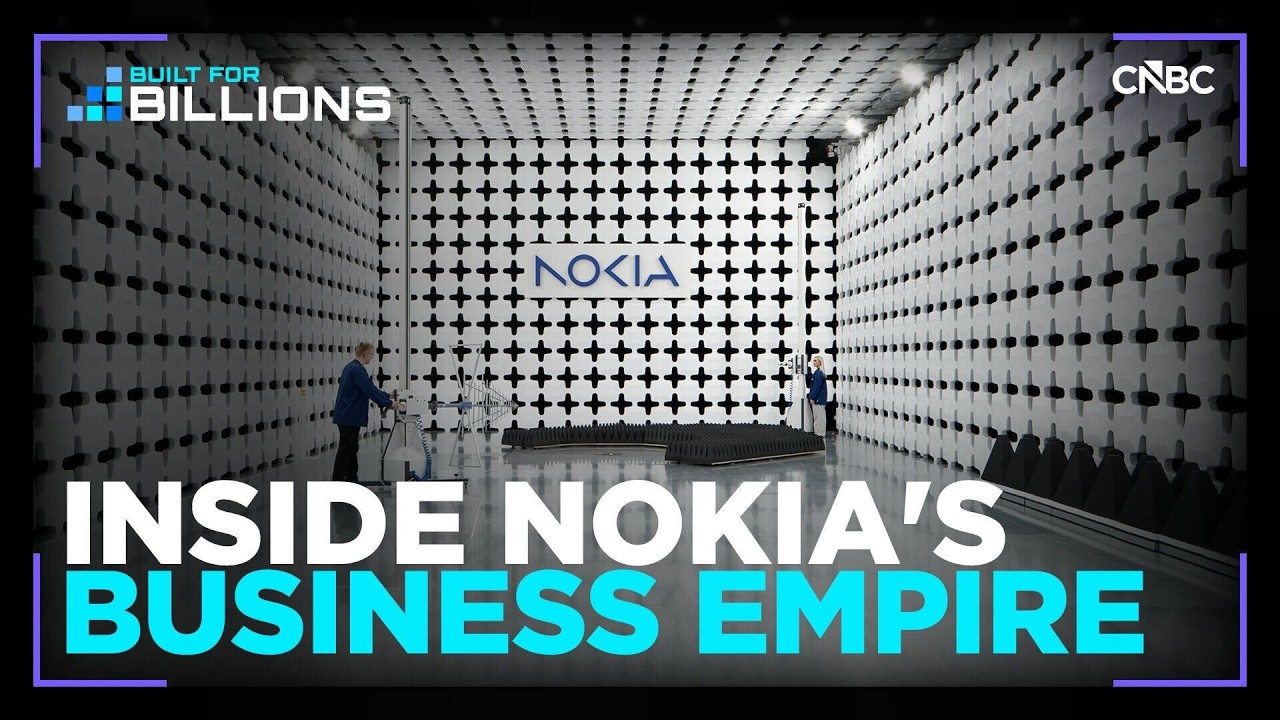
Nokia is gaining positive visibility on CNBC as well, in the form of a video series. The first episode of the series has been released:
This video covers Nokia’s history, the fate of the mobile phone business, and the significance of the network infrastructure acquired through the Alcatel-Lucent deal in the current situation, where the focus is heavily on networks.
The video is approximately 11 minutes long, and the talking heads include Nokia executive Justin Hotard.
One could certainly think that way, but Hotard’s timing also happened to coincide quite well with the rising AI wave. Some of the decisions driving the share price up were likely made during Lundmark’s tenure. I believe the AI hype will come in 4–5 waves, and if there is demand for Hotard elsewhere, the transition to the next wave could happen quite quickly.



 3) InP + Own Fab = THIS is the real “hidden optionality”
 Additionally: