I watched Atte and Werner’s video clip on Nokia’s valuation. It’s undeniably a bit ridiculous how the share price just keeps rising while Inderes stays in its trenches. It’s understandable in a way, but why do the big players see things differently then?
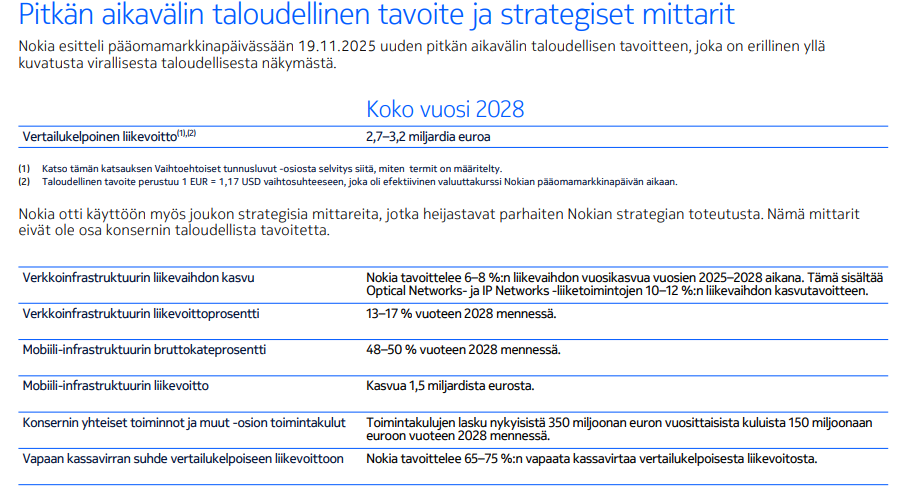
Other actors are not just looking at current figures or relying on Nokia’s own cautious guidance for 2028. That guidance will likely be trashed before long, just like previous growth forecasts were last week.
What if Nokia does a Ciena and runs up to 15€, for example, before the numbers change This really tests the analyst’s credibility. It’s also quite pointless to sugarcoat things and simultaneously wish for Nokia to rise… somehow it just creates a contradictory feeling.
My opinion is that if you still value the stock at €6, you have failed badly in your assessment. It can be difficult to admit that you have been very wrong about Nokia.
Top margins in Nokia’s AI cluster!
![IMG_0463|264x500]
(upload://jg8hrsjSkpQjIWZv8jZ8aXysPm8.jpeg)
0431 GMT – SK Hynix could see prices of its DRAM and NAND—the two major memory-chip types—peak in 2027, Morningstar’s Jing Jie Yu says in a note. The analyst expects strong artificial-intelligence demand to support memory-chip prices and profit margins through 2027, before they decline over the subsequent years due to supply growth. Morningstar estimates the South Korean chip maker’s operating margins at 75.7% in 2026 and 77.3% in 2027—up from 48.6% in 2025. It expects SK Hynix to raise its dividend payouts to 15,000 won a share in 2026 and 16,000 won in 2027, from 3,000 won in 2025, on an expected improvement in free cash flow margins. (kwanwoo.jun@wsj.com)
Should the analysis emphasize market reaction instead of company performance, since the market cannot be wrong? When MI is included, there is no basis for current multiples. Q126 performed even weaker than Q125 if the one-time compensation paid to XXX XX in the latter is excluded from the comparison.
Market reactions are indeed not meant to dictate the target price, but they should serve as an impetus for thought and scenario building. When at least on a principal level, all actors have the same data available, different assumptions about the future lead to differences in future assessments. If one’s own view differs significantly from others’ views, for example based on the target price, it is worth analyzing what others see that one does not, and how to approach this. It is advisable to challenge one’s own ways of thinking, especially in situations where the outcome differs significantly from the general consensus. However, disagreeing does not mean being wrong.
Didn’t the analyst themselves say at some point that the market is right when the stock plunged Quite a few people look at multiples differently when the stock rises.
In my view, it is purely a positive thing if an analyst clearly explains that the current share price is not based on the company’s current performance or does not correlate with the guidance provided by the company.
It’s reasonably self-evident that the share price isn’t correlating with the numbers at the moment. It doesn’t take a rocket scientist to understand that.
Let’s remember that Nokia has guidance for this year and targets for 2028. The former was adjusted last week, while the latter was not. It’s quite natural for guidance-related matters to be updated more frequently than long-term targets, but that doesn’t mean that time hasn’t passed Nokia’s current targets by in light of the new Q1 information.
It is often said that everyone in the market has roughly the same information. This, of course, is not true. Major players (analysts at major banks, funds, etc.) have a completely different level of visibility into companies’ business operations. They have virtually unlimited resources to investigate distribution channels, inventory levels, etc., if necessary… and access to company management often yields new information between the lines that others don’t have. In that sense, Inderes’s cautious approach can be somewhat understood.

 This really tests the analyst’s credibility. It’s also quite pointless to sugarcoat things and simultaneously wish for Nokia to rise… somehow it just creates a contradictory feeling.
 Quite a few people look at multiples differently when the stock rises.