Nokia as an investment (Part 4)

There’s been a lot of talk about that, and it’s likely to happen. That 3-4 billion is probably just a rip-and-replace cost, taking into account the fair value of the equipment in 2028, when the 5G renewal cycle will also be approaching in Europe and hardware would be updated anyway. The liberation of market shares in the renewal cycle and 6G is, in my opinion, the big deal, and someone smarter might be able to say how much potential market share/revenue will be freed up in euros. Billions per year in any case.

Huawei has about a 30% market share in mobile in Europe, and that will be partly divided between Ericsson, Nokia, and Samsung. Possibly something extra from fixed networks and/or data centers as well. It will truly be a heyday for owners in 2028-2030 when so many positive things materialize at once. This phasing out of Huawei will, of course, be visible earlier, as operators at this point should no longer buy equipment from them, as the final decision is already expected.

13 Likes

On another forum, someone asked if Nokia’s upcoming interim report will tell us if Nokia’s strategy is working. The answer is: no. Seasonality is strong, and Nokia itself has guided for a larger than usual quarterly decline for the first quarter (Q1). This article focuses on Nokia’s current engine: optical networks.

Over the next few quarters, more crucial will be leading indicators: order intake, comments on hyperscaler demand, and any signs of Cloud RAN progress, which requires greater and more tightly synchronized fiber capacity. These are the signals that will indicate whether the strategy is truly working.

The market situation is already strong. For example, Ciena has built an order book of approximately $7 billion, with new deliveries extending into 2027. This indicates that optical demand, especially from data centers, already exceeds short-term supply. This alone supports Nokia’s commercial progress already in 2026.

At the same time, Nokia is putting important structural pieces in place. The San Jose factory is preparing for commercial production in late 2026, bringing with it a transition to 6-inch InP (Indium Phosphide) wafers. If yields stabilize, this should improve unit costs and support margin expansion over time. It also strengthens vertical integration by improving supply security, margin growth, and the integration between optical and IP networks.

Nokia is also preparing a significant product refresh. Expected in the second half of 2027, the new application-optimized optical platform will be built around several coherent building blocks tailored for different distances and use cases. This should enable significant total cost of ownership (TCO) improvements and strengthen competitiveness.

Progress therefore seems likely to be staggered:

  • 2026: Demand-driven momentum and order growth, supported by a tight supply situation for optical components.
  • 2027: Lower chip costs (San Jose ramp-up) + market entry of the new optical platform.
  • 2028+: Financial impact as volumes grow and cost advantages translate into results.

It is therefore not about a single quarter proving the strategy’s effectiveness, but a series: first demand, then product refresh, and finally results.

The key risk for investors is not necessarily the strategy failing, but rather that progress is misread because results lag behind the actual drivers. If execution is strong, however, the market may reward progress long before the full financial impact is visible.
13 Likes

Today, 07:54

Share

Jefferies raises Nokia target price to 8.80 euros (7.20), reiterates buy

newsroom@finwire.se

Finwire News Agency

22 Likes

Today, 06:18

Share

SEB Lowers Nokia to Hold (Buy), Price Target EUR 7.40 (6.10)

newsroom@finwire.se

Finwire News Agency

15 Likes

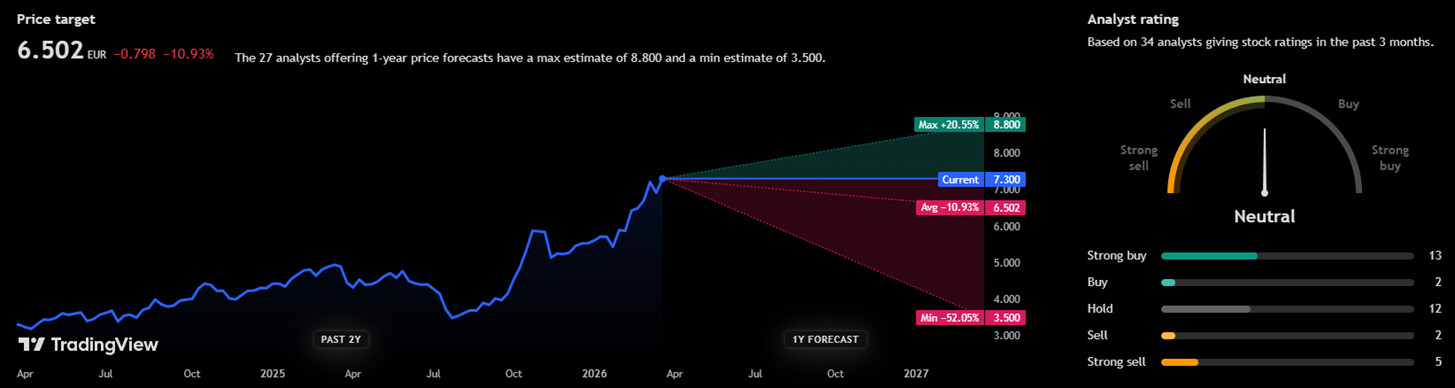
And here is the current recommendation distribution with target prices.

15 Likes

Mar 26, 2026 4:07 AM Eastern Daylight Time

Stelia and Nokia collaborate to advance AI for enterprise

https://www.businesswire.com/news/home/20260326934628/en/Stelia-and-Nokia-collaborate-to-advance-AI-for-enterprise

6 Likes

The range of recommendations is striking. At Nokia, the different emphases of analysts stand out. Some use mathematics/Excel, while the other extreme envisions future potential.

5 Likes

I have noticed that Inderes looks in the rearview mirror and at the present. Of course, no one has a crystal ball, but they could at least verbally jump out of reality occasionally and paint possible scenarios. Maybe they can’t be directly translated into recommendations, but at least speculated on.

At least with Nokia, they are firmly grounded. The same is perhaps observable with Bittium. However, the success rate in estimates has been poor with many companies. E.g., Neste, Tieto, QT. I myself have struggled with these aforementioned recommendations, and by contrarian investing, I have achieved good results.

10 Likes

Here’s the rationale from a Swedish publication:

Jefferies has raised Nokia’s target price to EUR 8.80 from EUR 7.20. According to the analysis, the increase is based on signals of stronger-than-expected growth in the optical networks market.

The bank notes that the company raised its outlook for the addressable market at the OFC conference compared to last November’s Capital Markets Day. Jefferies sees potential for Nokia to gain market share thanks to its strong product portfolio, partnerships, and capacity expansion.

The company’s own forecasts are considered conservative, and Jefferies believes they will be exceeded, especially from 2027 onwards, when the new factory begins to support growth.

The buy recommendation is reiterated.


It should be noted that the target price of EUR 8.80 is currently a double-digit figure in US dollars, approximately USD 10.15.

21 Likes

In the morning, there was also this quick supporting news (Kauppalehti):
Kepler Cheuvreux raises Nokia’s target price to 8.20 euros (previously 8.00), reiterates buy recommendation.

20 Likes

Nokia is Morgan Stanley’s ‘top pick’ when it comes to Europe and light-related matters, as copper’s capabilities are insufficient.

Investing.com – European semiconductor stocks are quietly positioning themselves at the heart of the AI infrastructure buildout, not through chips, but through light. A new Morgan Stanley report argues that optics is emerging as the critical bottleneck in AI datacenters, as explosive demand for connectivity outpaces what copper-based systems can physically deliver.

With a forecast ~40% CAGR for Europe’s addressable optical market through 2028, the brokerage sees a multi-year growth cycle that the market has yet to fully price in.

Nokia is the brokerage’s top pick, and the bull case is straightforward: management’s own revenue growth guidance for its Optical and IP division of 10-12% looks too conservative.

Morgan Stanley sits at 13%, with optical alone growing above 20%, driven by hyperscaler demand. Potential new partnerships beyond existing Microsoft and NVIDIA agreements could be a further catalyst. The stock is rated “overweight” with a €8.50 price target implying 16% upside.

https://www.investing.com/news/stock-market-news/european-chip-stocks-poised-to-ride-ai-optical-boom-morgan-stanley-says-93CH-4581536

15 Likes

More Nokia in

6 Likes

Nokia is cutting thousands more jobs this year

About 4,000 jobs have yet to be cut from Nokia’s headcount under the program initiated by its former CEO, according to recent statements.

https://www.lightreading.com/5g/nokia-is-cutting-thousands-more-jobs-this-year

5 Likes

Santander lowers Nokia’s rating to “underperform” (from “outperform”), target price 6.85 euros – BN
Today at 09.14 ∙ Finwire

4 Likes

https://www.citybiz.co/article/823902/odc-raises-45m-series-a/

. The investment was led by a premier syndicate of global technology and infrastructure powerhouses, including Booz Allen, Cisco Investments, Nokia, and NVIDIA, alongside Tier-1 telecoms AT&T, MTN, and Telecom Italia.

2 Likes

The AT&T case is interesting.

https://www.sdxcentral.com/analysis/att-sees-agentic-ai-making-iot-sexy-again/

That would only refer to Cisco+AT&T collaboration in fixed networks.

I don’t believe they will return to Nokia in mobile anytime soon, as their collaboration with Ericsson is already quite deep.

Cisco and NVIDIA: AT&T is working with these firms to develop network-based edge AI. This enables real-time AI inference at the edge, specifically for video analytics in manufacturing, public safety, and transportation.”

^It would have been good to be involved in that from the very beginning. Nokia will likely supply fiber-optic equipment, but I still hope that we can achieve a competitive position against Cisco in switches and routers. That is probably part of a longer-term goal, but we can celebrate that later. Edge AI on a switch should be sufficient for industrial latencies.

1 Like

https://www.telecoms.com/ai/nvidia-says-6g-will-be-a-software-upgrade-if-telcos-buy-ai-ran

This is an older article, but I don’t recall seeing it here or anywhere else. Interesting sales pitches and new things for me.

Some reading for a cold day, maybe it’ll warm you up. I’m happy as long as it doesn’t go much below 6.5€/share, as I don’t have extra funds to buy more at the moment. :slight_smile:

Nokia’s mobile division worries me a bit, but luckily a clear uptrend is expected elsewhere.

1 Like