No worries, Wall Street analysts are well on top of the drivers for future growth this time, and it shows in their target prices. The knowledge and expertise are there this time around. Of course, AI tells and explains a lot. Thanks again @Lexus @ruuki @Oxymoron_007 and many others for refining the information; it’s very timely.
13 Likes
Don’t these hypes always drive up the stock? In my opinion, this analysis is once again typical negative commentary on Nokia. They only look at the numbers, not the future and the potential within this whole picture. By any logic, Nokia is not worth 5.2e, not by any means.
5 Likes
Overall, however, Nokia’s outlook remains stable.
When an analyst, such as Atte Riikola, sets a low target price and a ”sell” rating, expectations are already low. In such a situation, negative scenarios are often already priced into the stock, and even a minor positive surprise can support the share price.
From a contrarian perspective, this could be a buying opportunity.
2 Likes
Looking at the performance of Inderes’ model portfolio, recommendations, timing of sales and buys, e.g., Neste & Qt, I would see this small dip as an excellent buying opportunity  I don’t own Nokia myself at the moment, but I might soon return as a shareholder.
11 Likes
I also asked Gemini to analyze NI’s increased R&D investments:
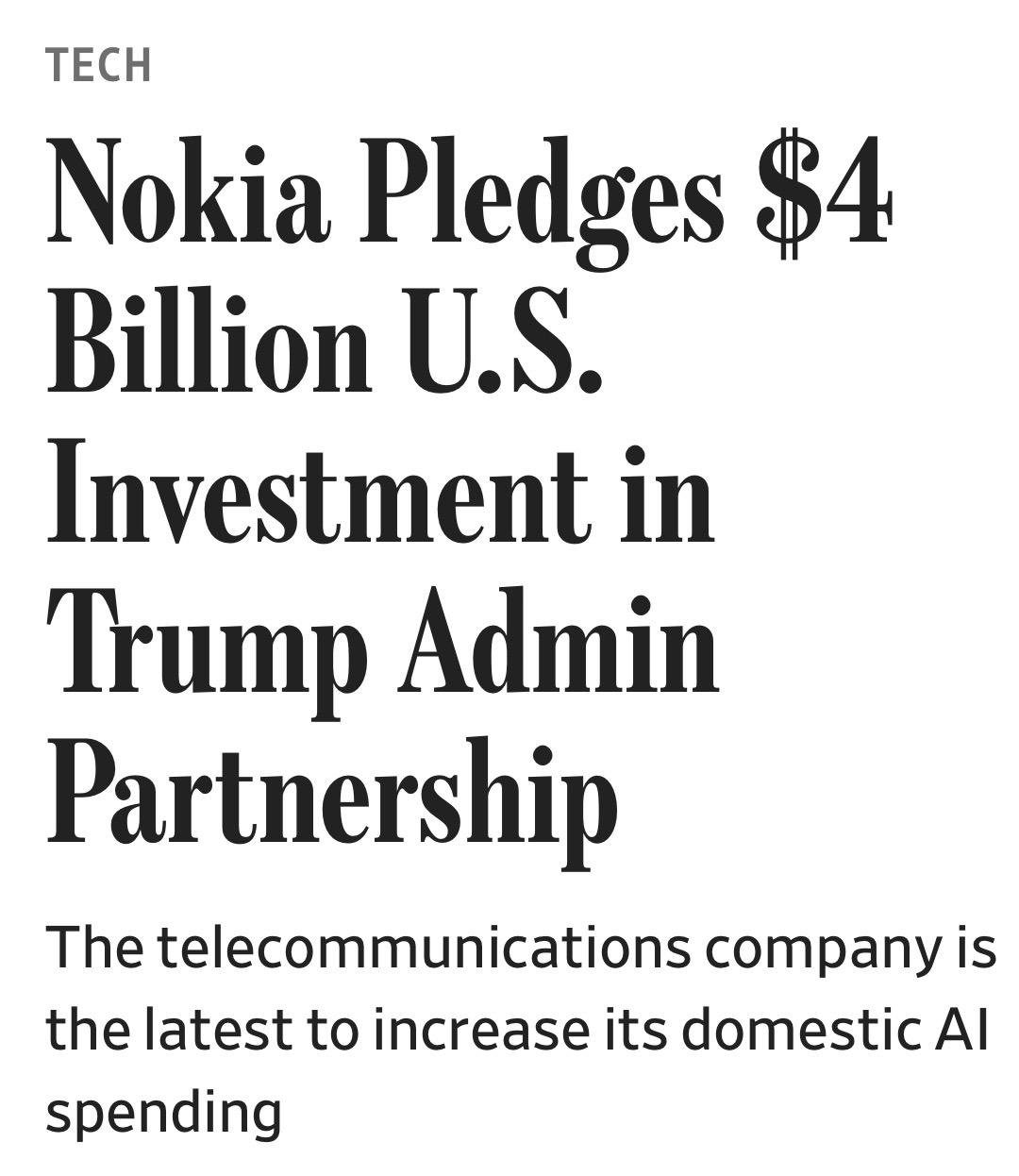
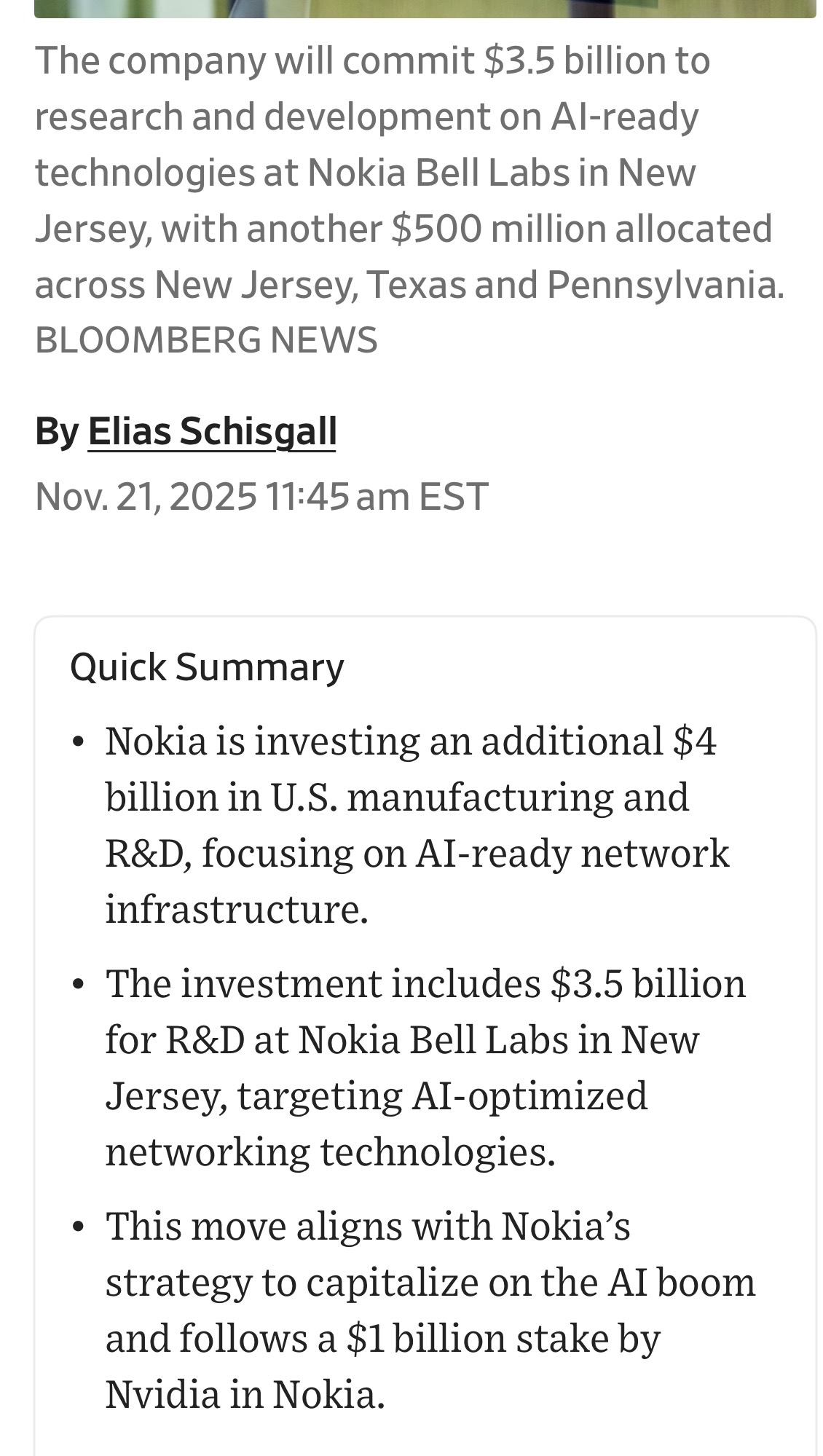
Nokia’s Network Infrastructure (NI) unit’s R&D investment is projected to rise to approximately €1.74 billion ($2 billion) by 2026. This represents a significant increase from the 2024 level (€1.21 billion). The financing of the investment program is on a sustainable footing, as the NI unit’s 2025 operating profit (€780 million) clearly exceeds the annual increase in R&D expenses. The unit is thus operationally self-sufficient in its technological acceleration and does not require transfers from other parts of the group. The investment is a direct response to market conditions where AI investments are increasing demand for network capacity, while the main competitor, Ciena, is suffering from capacity constraints in its 2026 deliveries.
The economic core of the strategy is the San Jose factory’s transition to a 6-inch Indium Phosphide (InP) wafer platform, which enables significant economies of scale and lower component manufacturing costs compared to traditional 3 or 4-inch wafers. Although the San Jose factory, the Bethlehem packaging facility, and the Aurelis management platform will improve Nokia’s delivery reliability and cost structure as early as 2027, investors must consider the investment lag: the new 1.6T product portfolio will not be widely available until 2H/2027. The resulting volume growth and the margin jump from vertical integration will therefore only materialize in the financial year 2028 figures. The current R&D growth should thus be seen as a front-loaded investment, whose financial successes will only be measured over a couple of years.
10 Likes
Nokia’s $2.3 billion takeover of Infinera is paying off, according to Nokia executives speaking at OFC in Los Angeles.
12 Likes
Date of transaction: 2026-03-19
Trading venue: TGAT
Instrument type: SHARE
ISIN: FI0009000681
Nature of transaction: DISPOSAL
Detailed information of transactions
(1): Volume: 33500 Unit price: 6.9944 EUR
Aggregated details of transactions
Volume: 33500 Average price: 6.9944 EUR
3 Likes
Ciena continues its ascent, but Nokia has paused for a breather. Is the second half of 2027 (when Nokia’s new 1.6T product portfolio becomes widely available) unbearably far away for the markets? It might be, but the markets won’t wait until 2028 to re-price Nokia if the order book for the new portfolio starts to swell in late 2026 and throughout 2027. Ciena’s 270 percent rise in half a year happened because the markets anticipated AI demand, which the growing order book partly reflected.
Nokia will have more significant vertical integration than Ciena with the chip factory in San Jose going into commercial production late this year. This, and hopefully a strongly growing order book, could lead to Nokia being re-priced before a single next-generation product has been delivered.
10 Likes
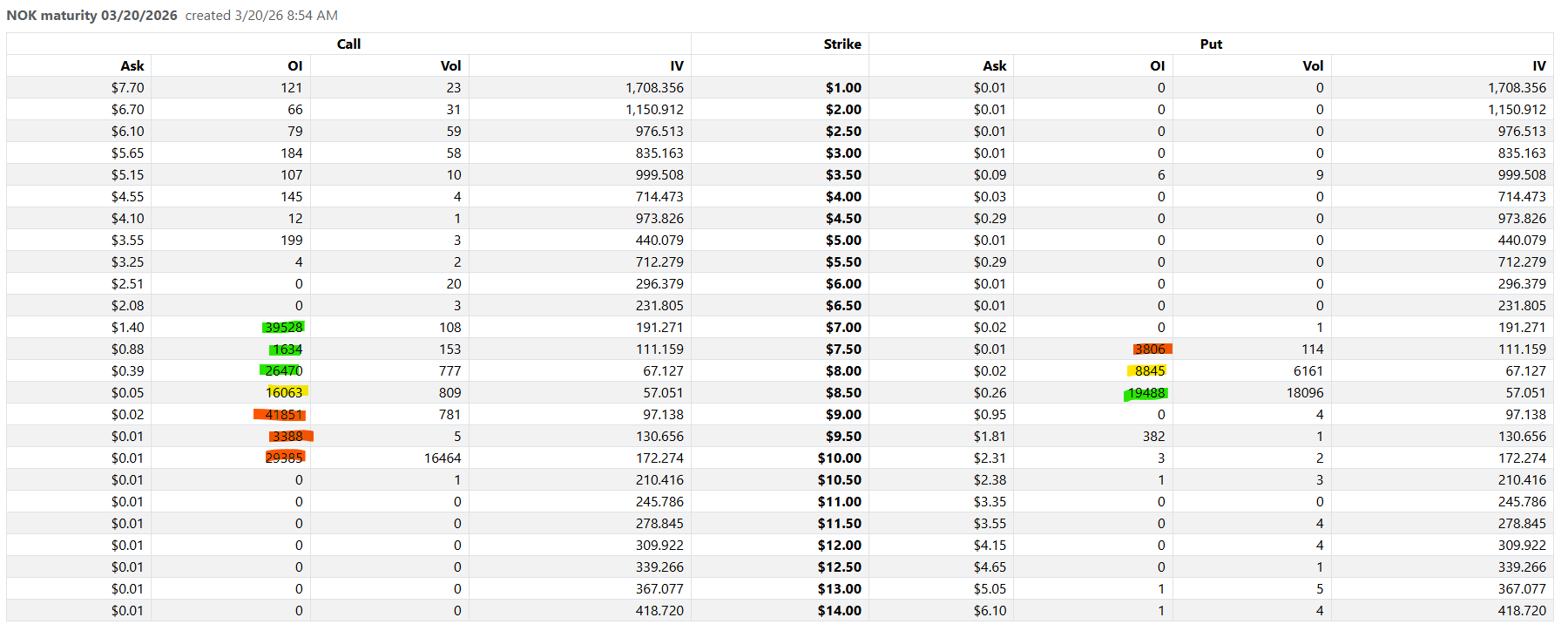
Today we’ll see if Triple Witching Day manages to weigh down the price. In my experience, history here has been bleak… or is Wall Street’s view on Nokia stronger than those aiming for Max Pain?
3 Likes
it doesn’t look realistic that it would be profitable to push to max-pain; in my eyes, a realistic max-pain is closer to $8.25 
 (i.e., those $8 calls and $8.50 puts) within that range.
Volume is higher today, but the direction could be anything? (maybe red could be more realistic regarding the world situation, but what do I know  ChatGPT’s guestimate was slightly positive
This is now an exceptionally “macro-driven” day, meaning we can actually make a pretty good guestimate, because the drivers are clear (oil + war + interest rates).
Summary
Let’s get straight to it without unnecessary fluff 

 The most important data point right now
-
oil spiked strongly, but
-
down today (relief from supply measures) (Reuters)
-
at the same time:
- war is escalating (Hormuz, Iran, strikes on infra) (The Washington Post)
 this = contradictory signal

 Market’s main forces today
 NEGATIVES (pulling down)
1. Oil → inflation → rates
-
oil still >$100
-
Fed cautious / hawkish (Reuters)
this is clearly bearish equities
2. Geopolitics
-
Hormuz practically disrupted
-
strikes on energy
increases:
-
tail risk
-
risk premium
 POSITIVES (supporting the market)
1. Oil is no longer rising today
- even some decline
important: “bad news peak” may be momentarily behind us
2. USA’s relative advantage
- USA = energy exporter
withstands the shock better (Empower)
3. Market has already priced in some of it
-
over the last few days:
- drops seen as oil rose (The Wall Street Journal)

 Pattern from recent days (important signal)
-
oil ↑ → stocks ↓
-
oil ↓ → stocks ↑
almost an “inverse correlation” at the moment (Barron’s)

 Best guestimate for THIS day
 Base case (most likely)
slightly positive / choppy up day (USA)
why:
-
oil pulls back slightly today
-
market catches its breath
-
short covering possible
 Scenario:
-
open:
- slightly uncertain / flat
-
day:
- upward pressure
-
close:
- +0.3% – +1% range
Bear case (if it turns bad)
trigger:
-
new strike / headline
-
oil back up
then:
- quickly -1% or more
 Bull case (less likely)
trigger:
- clear de-escalation signal
then:
- +1–2% (relief rally)
 Sector-specific outlook (this is more important than the index)
Strong today:
-
energy (if oil doesn’t collapse)
-
defense
-
some AI/tech (dip-buying)
Weak:
-
airlines / travel
-
consumer
-
Europe (more dependent on energy)

 Big picture (most important insight)
Market doesn’t fear war
but inflation coming through oil
Bottom line
today’s best estimate:
-
US market: slightly green / volatile
-
driver:
- small drop in oil → relief
 One important investor insight:
This is not a “trend day”
but part of something bigger:
oil → inflation → rates → equity reset
11 Likes

As of February 2026, Nokia agreed to have UK courts set the terms for a global patent licensing deal with
Warner Bros. Discovery and Paramount regarding video technology. This followed litigation where Nokia asserted its patents against Warner Bros. streaming services (Max, Discovery+). The agreement covers the entire video patent portfolio.
5 Likes
4 Likes
This marks a first in the history of the telecommunications industry.
Langaton Backhaul 
5 Likes
Here is a summarized translation of my Reddit post.
Nokia: AI-RAN – A Win or a Win-Win Situation?
Summary
Orange CTO Bruno Zerbib recently suggested in a Light Reading article that GPU computing should be centralized in hubs instead of being placed at each cell site: “Something that is 20, 30, or even 100 kilometers away from the end-user would still provide very low latency.” This thinking follows the long-standing C-RAN (Centralized RAN) trend in the industry, where baseband processing is moved from cell sites to centralized switching centers.
However, one technical prerequisite is critical: real-time baseband functions (Distributed Units / DU) cannot be located more than 20 kilometers from the radio mast. The 5G error correction cycle consumes the entire latency budget at this distance. Only less time-critical functions (Centralized Units / CU) can be located further away. This architecture existed even before the AI trend.
Key Conclusions:
-
C-RAN centralizes baseband processing from cell sites to hubs, reducing the equipment needed at the cell site. Virtual RAN accelerates this by replacing proprietary hardware with software on standard servers.
-
AI-RAN can be implemented either in a distributed manner (at the cell site) or centrally (in hubs). If the hub model prevails, the same infrastructure can be used for both radio and AI processing (GPU).
-
Nokia is the only major equipment vendor committed to Nvidia-based AI-RAN. Nvidia offers a lightweight version for cell sites (ultra-low 1 ms latency) and a more robust version for hubs (RTX 6000).
-
Both C-RAN and AI-RAN require massive upgrades of fiber optic connections (fronthaul) from cell sites to hubs. Nokia’s optical business (NI) directly benefits from this, regardless of where the actual computation takes place.
-
If Nokia’s Nvidia-based AI-RAN is successful, it will generate high-margin software revenue (MI segment).
-
If operators reject Nvidia, Nokia will still benefit from the optical network upgrade cycle (NI segment) as the hub architecture becomes more common.
12 Likes
Elve’s TWVA technology is indeed quite a revolution for wireless backhaul networks. In fact, it’s not the first wireless backhaul (cf. traditional microwave links between base stations) but the first wireless backhaul that can challenge fiber performance (Fiber-Equivalent) over long distances and in difficult conditions.
According to Gemini, current E-band radios (such as Nokia’s Wavence series) can achieve speeds of 10–20 Gbps, but only over short distances (usually 1–3 km). If it rains, the connection easily cuts out. Elve’s TWTA (vacuum electronics) technology is the first to bring fiber-level power (ten times the transmission power) to high frequencies. This enables speeds of 10–100 Gbps over distances that previously required physical fiber. Elve combines 3D printing and precise nanoscale alignment, making the technology commercially viable.
Hopefully, the joint demo will lead to a deeper partnership between Nokia and Elve. In addition to being able to connect two data centers 5-15 km apart in days without expensive excavation work, the technology can be applied to, for example, defense and satellite communications.
As an example of signal propagation from a GPU cluster to an antenna, Gemini presented the following chain:
GPU - InfiniBand Switch - FP6 Router - Ontario DSP/ICE-D Module - Wavence radio - TWTA Amplifier - Antenna. Quite a lot of Nokia technology in this fronthaul-level (latency, capacity) backhaul network 
4 Likes
3 Likes