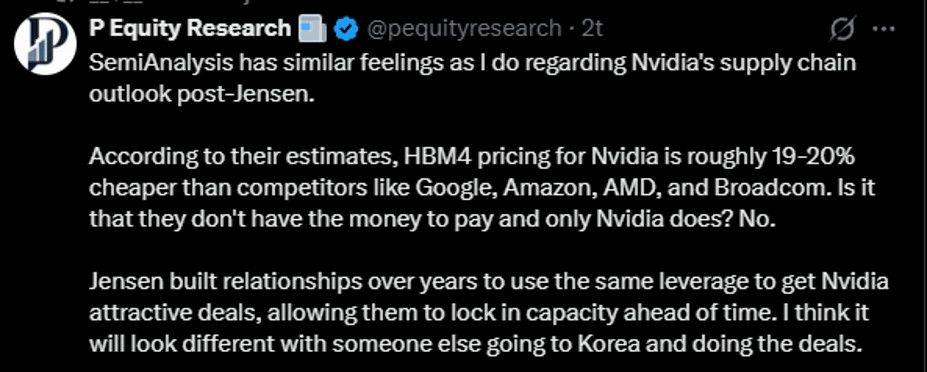
Yes, personal relationships certainly matter. How close to the inner circle J.H. can get. Probably not as the next CEO, though, even if the initials match. 
And what does AI-RAN mean for the next CEO—or does it mean anything at all…
Yes, personal relationships certainly matter. How close to the inner circle J.H. can get. Probably not as the next CEO, though, even if the initials match.
And what does AI-RAN mean for the next CEO—or does it mean anything at all…
There are two interesting points here.
In order of priority:
The further time goes on and everything is indicated to be progressing as it should, the better year 2027 and beyond we can expect.
Well, look at that, the word “directional” has appeared here. BofA also believes the potential is higher, provided that point 1 goes well.
Then, Nvidia. I’m surprised by today’s news. However, the company set its future direction quite some time ago, so I’d be surprised if the AI-RAN narrative changed in any way. Surely this has been protected by contracts as well. One noteworthy thing, though, is that the new Nvidia might not necessarily be as good at negotiating contracts as the old Nvidia. Still, this hardly has any negative repercussions for Nokia, at least. In the end, results and money are what matter.
Edit: Here is most likely the reason why Nokia hasn’t made datacenter deals with Nvidia. Partners are essentially relegated to subcontractors—better prices can be found elsewhere.
Edit: Fixed a few typos
Former Nokia analyst Kuittinen assesses the situation as follows:
“Nokia expert Tero Kuittinen estimates that Nvidia’s crisis could strengthen its need to hold onto existing partnerships. This is good news for Nokia.”
There seem to be quite a few of those partnerships. The new CEO will inevitably have to look into where all of our money is tied up. Among all that, Nokia’s billion is just a rounding error. But let’s hope the new CEO (from within the company?) shares the previous one’s vision.
Apparently, more powerful and banned AI components have ended up in China. If this partly explains the Chinese developers’ strong capabilities, one could imagine that going forward, this will play into the hands of Western AI developers as component availability gets restricted…
Press Release 13 Nov 2026
Nokia Federal Solutions awarded Department of War RAPID contract to advance multi-domain threat awareness
Parties to the contract and purpose: Nokia Federal Solutions has been awarded a contract by the U.S. Department of War’s (DoW) FutureG Office for the RAPID project, aimed at developing and testing the detection of uncrewed aerial vehicle (UAV) and other threats.
Technological solution (ISAC): The project leverages Nokia’s AI-RAN platform and Integrated Sensing and Communication (ISAC), enabling existing 5G and future 6G networks to be used for detecting and tracking targets.
Purpose and benefits: The goal is to apply commercial cellular network infrastructure to the protection of critical infrastructure and to enhance the defense administration’s real-time situational awareness against drone threats.
Partners: The project involves an extensive ecosystem that, in addition to Nokia’s own subsidiaries, includes Texas Tech University, DeepSig, Hidden Level, and Future Technologies.
Masthead Oy, a joint venture established by Elisa and SensoFusion, is doing something similar in Finland. Apparently, though, this doesn’t utilize the 5G network for sensing; instead, it uses the mobile network’s mast infrastructure and the network as a physical platform to deploy SensoFusion’s own radio frequency sensors into an extensive, comprehensive network. So, sensor fusion between AI-RAN and SensoFusion’s RF sensors is still missing.
Why AI-RAN is essential here: sensor fusion is real-time AI inference, and a drone won’t wait for data to travel to a distant cloud. This enables low latency as well as data sovereignty and cybersecurity. AI-RAN brings GPU computing to the radio access network, allowing the fusion to happen right where the data originates. In defense applications, GPU power consumption and unit cost matter far less than performance and keeping data local, which eliminates the main objection operators have against AI-RAN. And the programmability of GPUs is valuable here as well: improvements can be delivered via software updates without the need for new hardware.
The size of the contract is, of course, practically negligible for Nokia, but funding from the DoW opens the door for AI-RAN into defense budgets rather than relying solely on operator capex.
Perhaps this DoW opening will also encourage NVIDIA to keep going.
“Will NVIDIA Still Bet on Telecom Without Jensen?
Jensen spent eight years betting on telecom as a global AI distribution network. The radio market is tiny for NVIDIA, but he saw something much bigger. Will his successor share that vision?”
Sebastian Barros
Nov 14
Preview