This is actually a European strength that ought to be reinforced even further. The current risk is that regular citizens will end up paying a fortune for expensive electricity, and the increasing use of fossil fuels anywhere in the world will make dystopias a reality very soon. With high-speed connections, one can certainly reach hell in no time.
2 Likes
Now I really don’t understand how cyclical power generation is a strength, or what else you might have meant. I’m not really a proponent of fossil fuels either, but rather dispatchable nuclear power. Of course, that too would quickly turn dystopias into reality, if that’s what one chooses to believe.
It would be better if those data centers had their own gas turbines or distributed nuclear power plants, and if district heating became more widespread elsewhere in Europe and the United States as well, if we truly want to act in the interest of the environment here.
I’m open to discussing energy production and whatnot with varying levels of interest via private messages. It’s now strongly tied to Nokia as well, but these topics have a nasty habit of stirring up political fervor among laypeople. I have a degree and experience in the subject, not ideology.
9 Likes
The potential NVIDIA Brightspeed project already comes with the energy envelope locked in and the DSX architecture, plus the fact that it’s highly distributed and will (possibly) combine Nokia’s full AI stack (including RAN, which also has a designated power supply) means the future requirements of the Nokia/NVIDIA blueprint will be highly favoured… you would think! The fact that Musk is scaring the Telco’s with his vision and partnered by Qualcomm, will no doubt act as a catalyst to this edge buildout. Dems + Musk in my opinion are good news for Nokia!
4 Likes
For some Friday entertainment, here’s a video that “proves”  how in touch internet company CEOs are with the times.
4 Likes
Looks like Two Sigma reduced their shorts a bit yesterday, 0.79 0.77
6 Likes
ARGA investment holds 21.8 million shares in Nokia. They bought 17.1 million of those shares in Q3 and It now makes up 5.6% of their total portfolio, their 7th largest position. They weren’t the only hedge fund buying in Q3 either.
Isot tankkaa.
22 Likes
https://www.fierce-network.com/cloud/nokia-wants-ais-optical-gold-rush-and-it-already-has-lasers
Nokia’s strategy: Nokia is still in the “technical playground phase” and has not made a final decision on whether it will manufacture complete NPO/CPO solutions or operate in the industry solely as a component supplier, i.e., providing external laser sources.
Competitive landscape: If Nokia opts for the role of a pure laser supplier, it will compete with Lumentum, Coherent, and Chinese manufacturers. In turnkey NPO solutions, its competitors would include Ciena, Cisco, as well as startups in the field (e.g., Lightmatter). However, US hyperscalers’ desire to avoid Chinese suppliers could open up a significant market niche for Nokia.
Rob Shore, head of Optical Networks Solution Marketing for Nokia Network Infrastructure, told Fierce the company isn’t a one trick pony.
“Anything that involves a laser, there’s no reason Nokia should not be part of that.”
" I think it’s safe to say Nokia will get into that market"
Gives more confidence in this scale-up theme, but is it really still in such early stages..?
11 Likes
I was also surprised that they stated outright that no decision has been made on next steps. So it’s hard to assess what Nokia’s role will be, but one scenario is that Nokia builds an NPO engine and remains a component supplier in the CPO market with its lasers. If NPO development begins in mid-2027, when Nokia’s new optical product portfolio (four DSPs) starts to be ready, and development takes the same 18-month cycle as for the DSPs, Nokia’s NPO could hit the market in the second half of 2028. If they decide to move forward in CPO by building a CPO engine after the NPO engine, they would enter CPO by 2030 at the earliest. By then, competitors would have already pulled ahead by years: Ciena is already marketing its Vesta 200 CPO engine, and Nvidia delivered its CPO switch to customers in June 2026. Whether that is too late is, of course, an important question.
8 Likes
Good reasoning, but I really don’t believe Nokia would only be at that stage. LPO is ready.. NPO is certainly a safer alternative than CPO. I suspect that development and testing are already underway with various hyperscalers, such as Google. The cards are being kept close to the chest. On the other hand, if Lumentum bows out of supplying lasers, that could also turn out to be a lucrative avenue.
16 Likes
True, keeping their cards close to their chest doesn’t mean there isn’t at least a preliminary decision, or that testing isn’t already underway together with hyperscalers.
Interestingly, the day before the Fierce article (Nov 5), Nokia published a blog post by Teresa Monteiro, where the final paragraph is the most relevant:
“Nokia’s goal is not to declare a single architecture, laser configuration, or material platform as the winner. The goal is to apply our strong track record in optical connectivity, semiconductor technology, and PIC manufacturing innovations to develop a portfolio of solutions that help meet the diverse power, reliability, serviceability, manufacturability, and openness requirements of AI data center connectivity.”
The first sentence is cautious, while the second provides a hint of the strategy: a “portfolio” points to multiple products, not just one.
Monteiro is the Director of Optical Marketing at Nokia, with a background at Coriant and Infinera. According to her profile, she is expanding her focus to optical subsystems and intra-data center connectivity. That is, of course, an expansion of marketing responsibilities rather than a product decision, but it shows that intra-data center optics is now gaining more attention at Nokia.
12 Likes
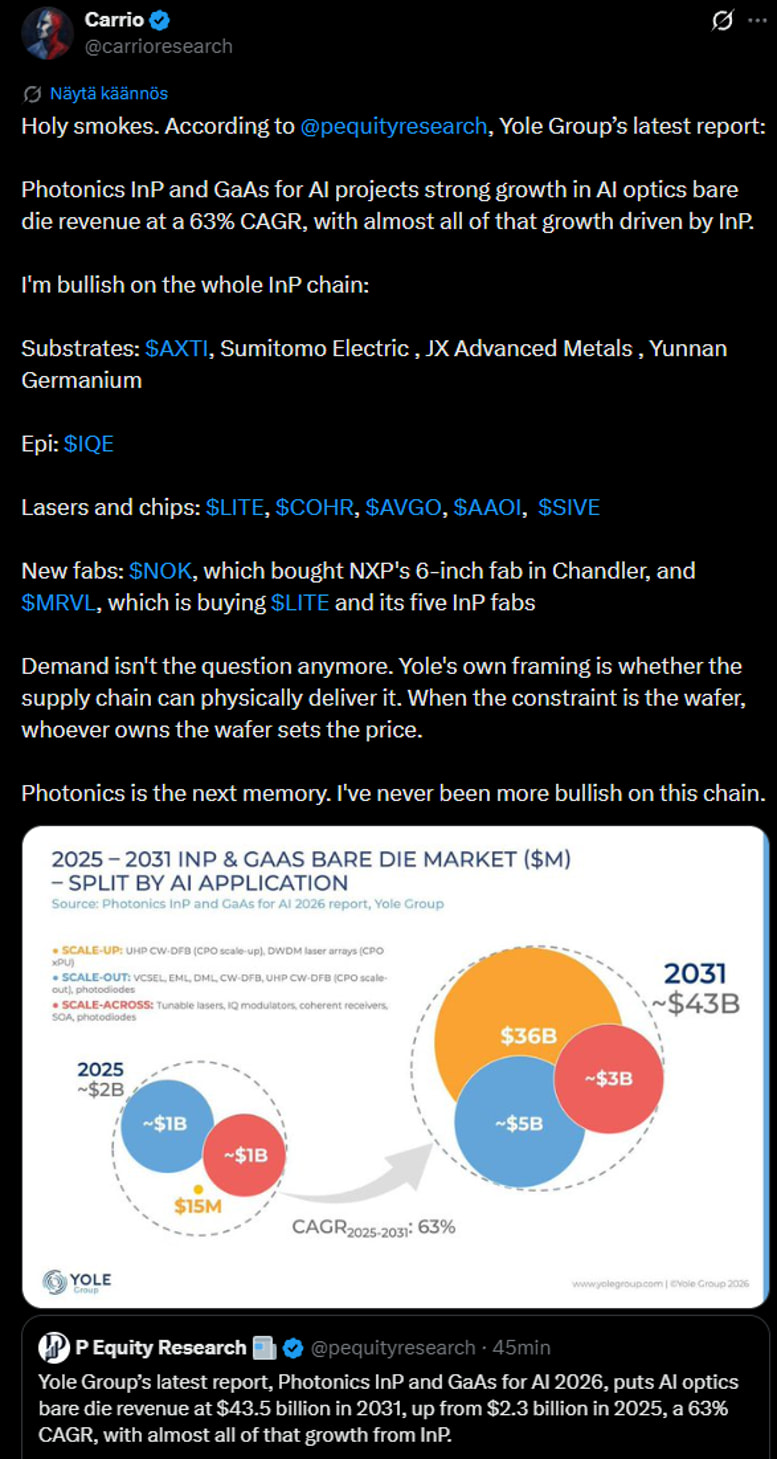
According to Yole Group’s report, the chip-level market for InP components (Bare Die) will grow from 2B (2025) \rightarrow$ ~$43B (2031) (CAGR 63%). However, across the optical chain, the value multiplies.
And according to AI:
- Bare Die → Optical modules (2.5x – 4x): The InP laser accounts for approx. 25–35% of the module’s bill of materials (BOM). The market for finished optical modules will simultaneously rise to the ~$110–130B level.
- Bare Die → Full system infrastructure (5x – 8x): In routers and switches, the total value increases by 5–8 times. The market for optical AI infrastructure will reach the ~$150–200B+ range.
In my opinion, this is a reasonably credible outcome, even if it’s genuinely of the “Holy smokes” variety. If this holds true, Nokia’s optical business would multiply, and even that would likely be a conservative estimate.
23 Likes
Another source goes deeper into the matter. Roy Dagher, Semiconductor Technology and Market Analyst at Yole Group:
“Value in AI optics is shifting away from traditional pluggables. By 2031, intra-rack scale-up links will represent 83 percent of bare die value, and three InP technologies – CW DFB lasers, DWDM laser arrays, and IQ modulators – will capture 88 percent of that. The winners will be the companies that master these components at volume.”
In other words, the value of optics is shifting to a layer where Nokia has a presence in terms of InP, but not yet with a product: ICE-D includes DFB lasers and serves precisely intra-rack links, but Nokia sells it as a PIC (photonic integrated circuit with integrated light sources and modulators) to module manufacturers, not as a standalone laser for CPO. Since Ciena is marketing its Vesta engine and Nvidia is already shipping its CPO switches, the first-generation design wins will likely be awarded quite soon.
Perhaps Nokia should pursue a two-track approach: sell lasers into the CPO ecosystem and build NPO. Later on, producing CPO could also be considered.
5 Likes
The way I see it, progress is being made on truly many fronts, with Nvidia’s solutions probably being pretty much the only ones this visible. Nvidia’s own vertically integrated and closed ecosystem (such as NVLink) is one part of the market. In that respect, the playing field is starting to be carved out now – everyone supplies their own small part, and Nvidia reaps the most direct benefit.
Alongside it, an open ecosystem (e.g., AMD, Broadcom, Google, Meta…) based on open standards is growing at a rapid pace. It seems that Nokia’s goal is to be a major player specifically in this camp. Furthermore, I believe hyperscalers (Meta, Google, Microsoft) do not want to be 100% dependent on Nvidia’s closed system.
Many analysts believe that pluggables will remain the most reliable and widely used technology for many years to come – though Nvidia certainly already has some CPO involved. In the longer term, however, optics will likely push its way into every nook and cranny, and in that regard, the cards are still wide open. Right now, things are being designed and tested, and Nokia is definitely in the mix. If for no other reason than the fact that there will be a massive shortage of InP lasers over the next couple of years – along the lines of demand being 2x what can actually be delivered. Therefore, Nokia will certainly get a seat at the negotiating table – assuming they are able to deliver.
21 Likes