Nokia as an investment (Part 4)

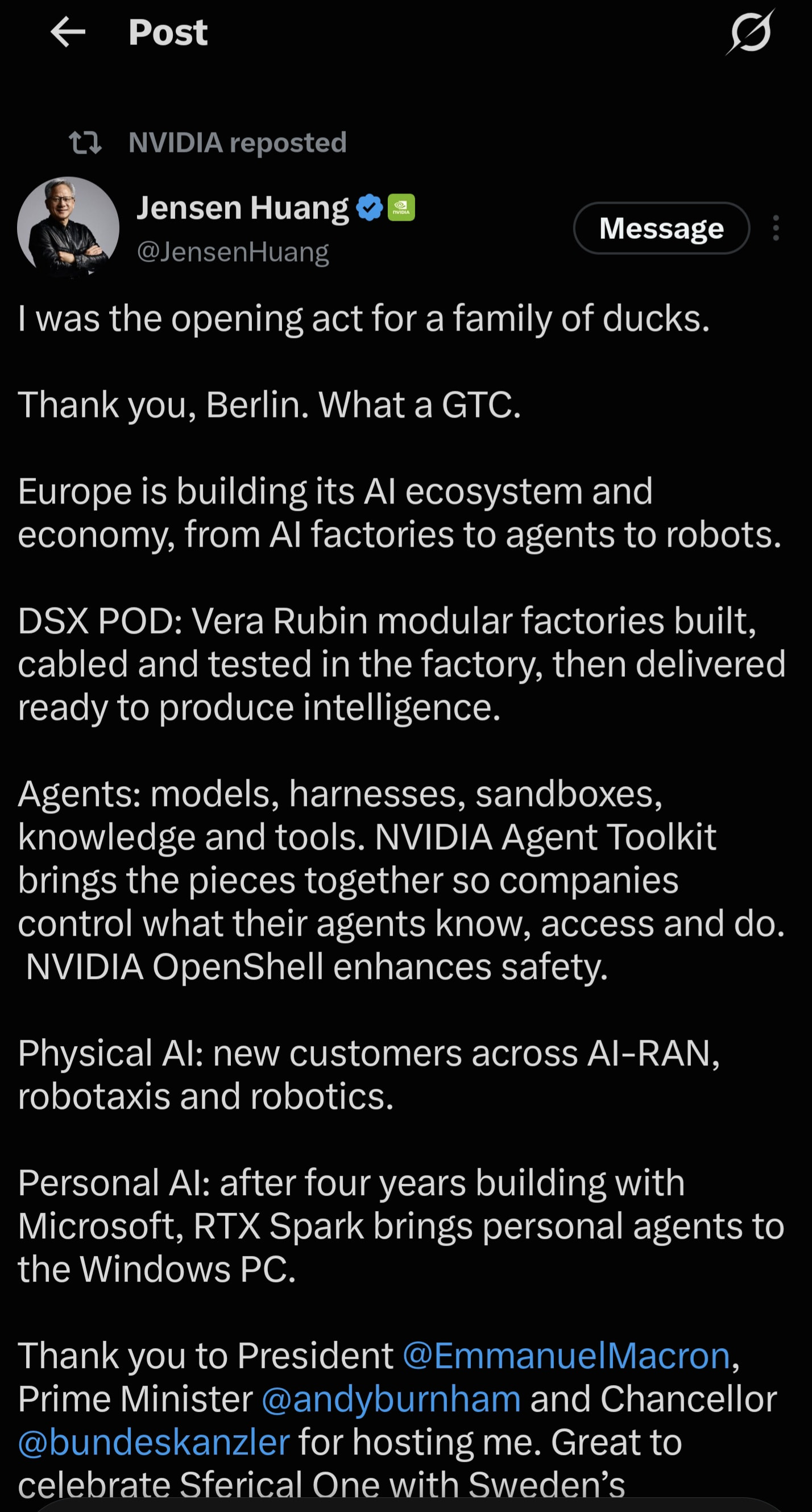
Have you thought about why that wouldn’t make sense? The AI-GRID - DSX architecture being sold on a massive scale would be my top argument against. I noticed Finland have a new defense agreement with Japan also… this architecture is looking like being extremely important for future growth. These things are incredibly high up on Jensen Huang’s list too… probably top priority!

Have a look at Nokia’s role in Zankore!

https://x.com/JensenHuang/status/2114773600574279837

I must have missed that reasoning. I still believe that a merger would make a lot of so-called industrial sense. There would certainly be plenty of challenges as well.

Unfortunately, these “Nokia badly” and “desperately needs” stories seem to keep recurring now. It doesn’t bode well for Nokia’s stock if this continues.

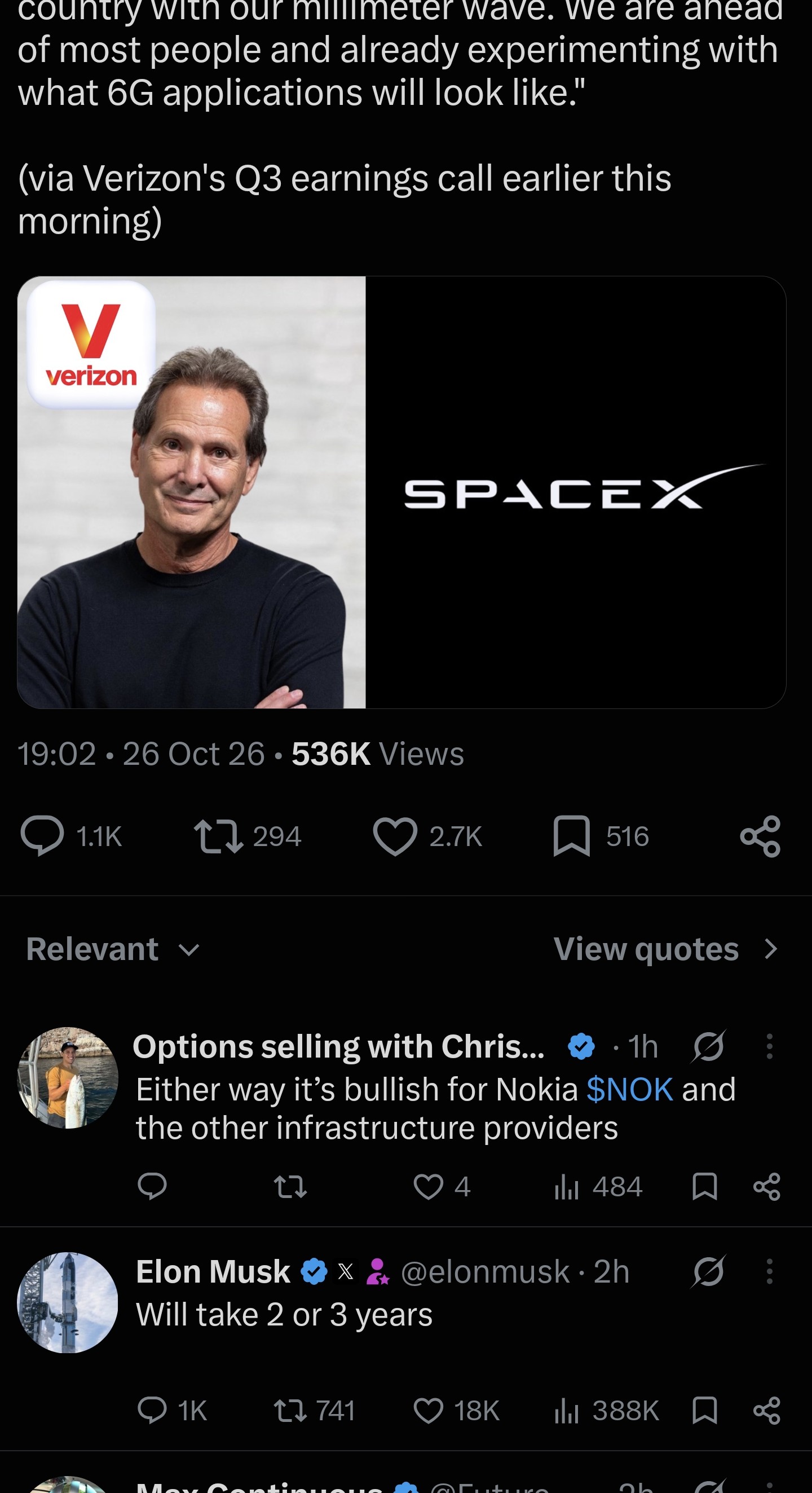
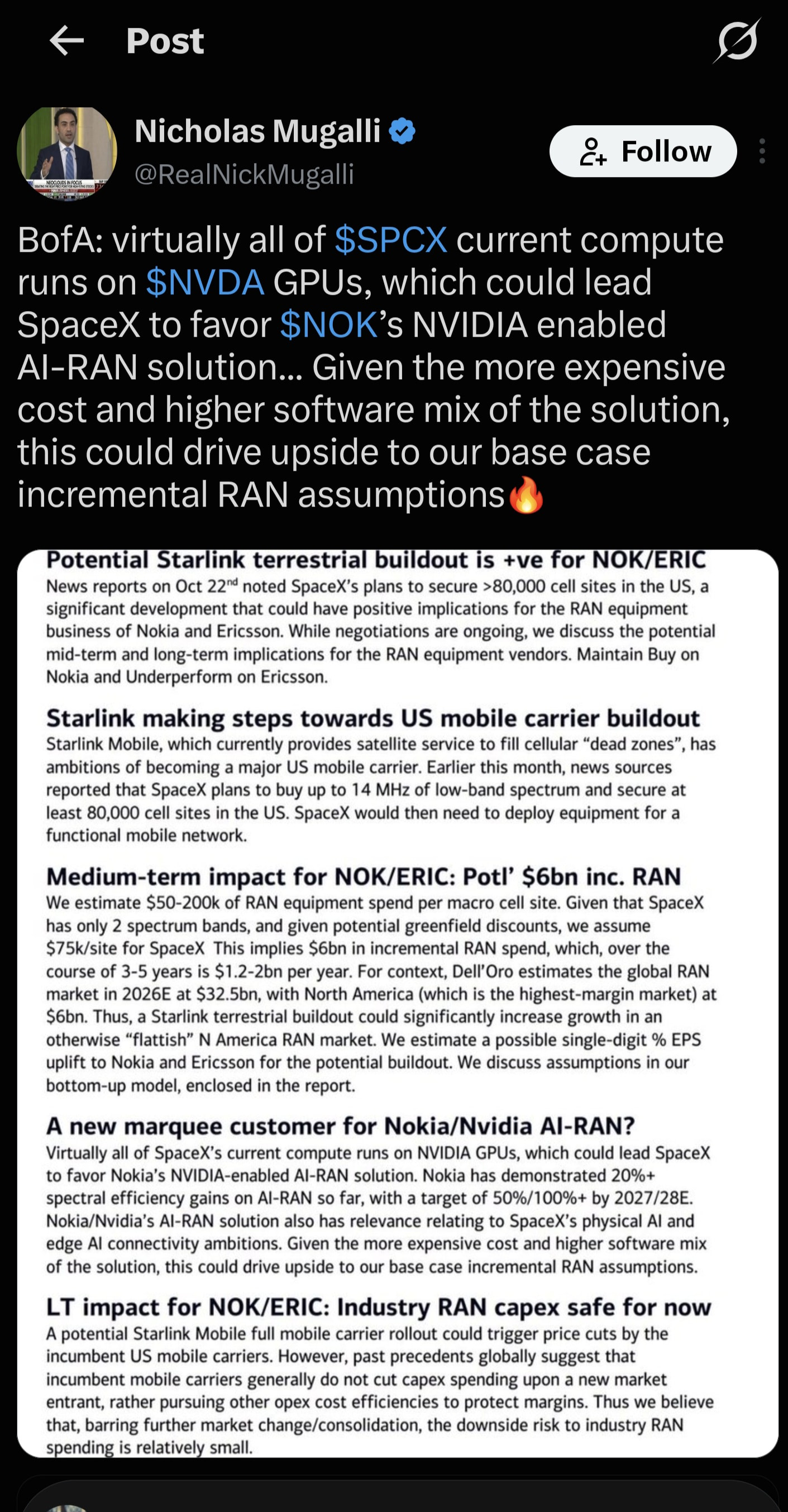
“Starlink is looking for terrestrial sites in the US. Nokia desperately needs a big radio deal, and Huang knows both sides. But Musk already builds his own radios.” Barros Newsletter preview oct 26.

1 Like

Hmm.. Nokia’s MN really does need those big AI-RAN deals. I believe they will come eventually, it’s just still too early.

Basically, though, this is once again one of those things focused on the mobile networks side. The market is pricing MN pretty much at zero. In the market’s view, the value right now lies on the NI side, more specifically in optical and IP networks. And understandably so, since over the next few years earnings will pretty much come just from there. Granted, patents churn out a steady operating profit of well over a billion.

And I’m inclined to believe that AI-RAN can succeed and could become a new pillar for Nokia. But the market isn’t thinking about it or pricing it that way right now, so I’d argue Nokia’s share price won’t crash because of AI-RAN. I don’t know if that was just a sensational headline or something else. But the situation is definitely not desperate.

Morris really is an unfailing Nokia bear. :laughing:

8 Likes

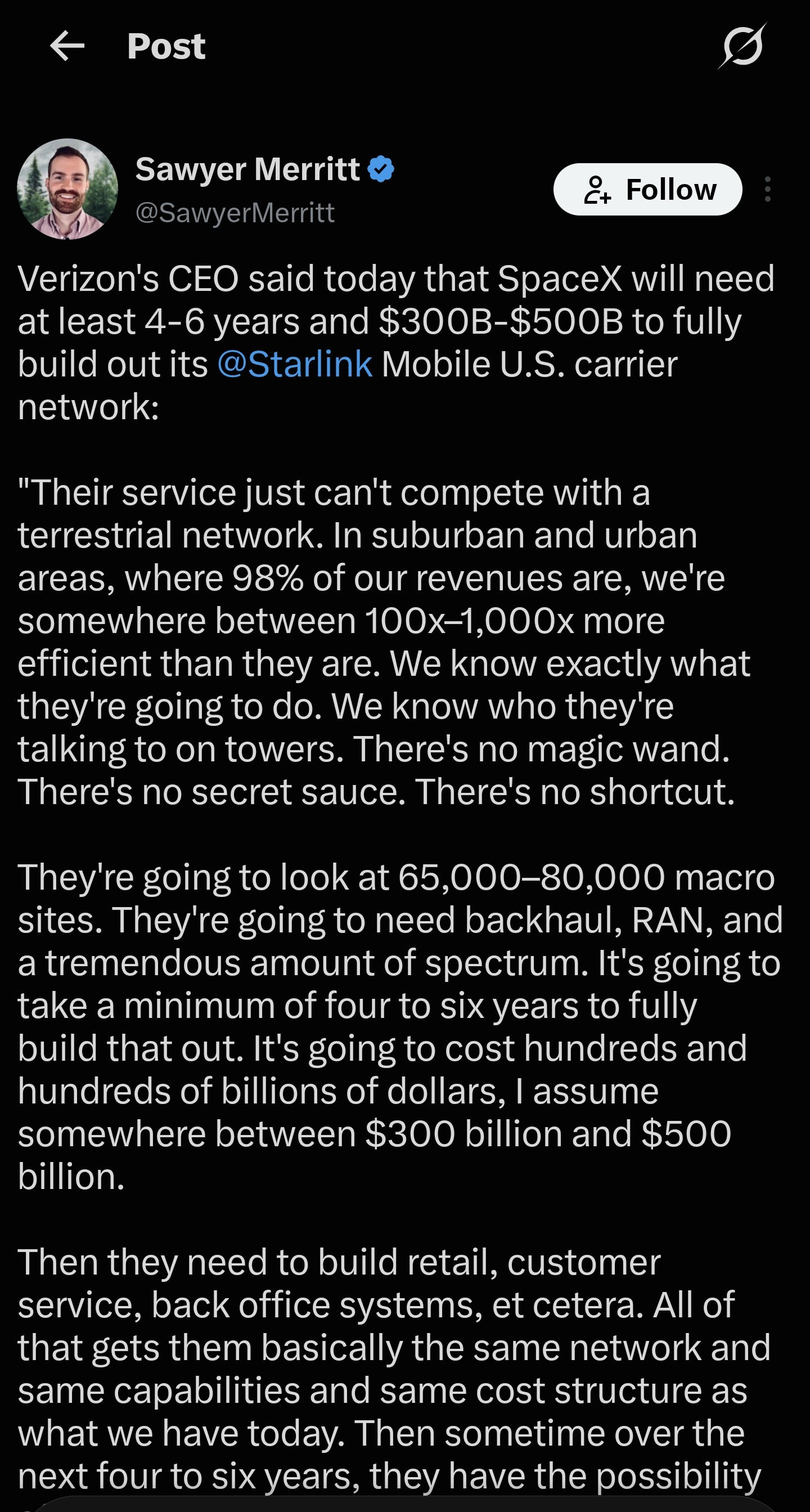
https://x.com/SawyerMerritt/status/2114764647052308783

I’m not concerned, and I don’t think Jensen Huang or Justin Hotard will be either. They seem to putting the wheels into motion now, I’m expecting news relating to AI-RAN to start turning a lot more positive. Interesting war of opinions going on here…


1 Like

What I meant was that first, an expectation is created as if Nokia were about to land the Starlink deal, and then the headlines say that Nokia didn’t get it after all. It vaguely brings to mind AT&T, which wasn’t really possible for Nokia to win, but according to the market, apparently they still should have… So it’s about short-term market reactions that you can’t necessarily make much sense of.

1 Like

If Nokia doesn’t land the Starlink deal, I don’t think it’ll make much of a difference. Right now, Nokia’s share price lives and breathes datacenter news.

Sure, commercial news on the AI-RAN front could give the stock a boost, as, like I wrote, I think it’s currently being valued at pretty much zero.

Edit: Just a moment ago, we didn’t even know about any Starlink plans to build ground-based base stations. How much did the share price rise back then on that news? Was it a couple of percent? And now we’re probably around -20% lower after the sell-off in the AI space.

7 Likes

Hopefully you’re right :slight_smile: You just see quite a lot of this talk about the RAN side right now.

1 Like

Nokia didn’t go up, but the telcos dropped. Until it was realized that Starlink can’t manage on its own. After which the speculation started: on whose networks and with whose gear… maybe Nokia? That’s how quickly this happens.

2 Likes

In my opinion, the article also contained a great deal of positive news for Nokia, even though there was plenty of skepticism as well. Selected positive points in English:

AI-RAN products developed by Nokia and Nvidia could be a natural fit for Starlink

According to news reports, Starlink has been in talks with tower companies like Crown Castle for access to up to 80,000 tower sites. In the US market, this is a massive number — roughly equivalent to the macrocell footprint operated by one of the current Big Three mobile carriers (AT&T, T-Mobile, and Verizon). The share price of each of these companies has swung like a nervous patient’s ECG whenever Musk or another Starlink executive has dropped the slightest hint about their terrestrial network intentions. However, the concrete and steel of a tower don’t transmit a signal. To do so nationwide, Musk would also have to invest billions of dollars into the necessary electronics.

In a recent earnings call, SpaceX COO Gwynne Shotwell echoed Musk’s vision, describing a future where networks do far more than just connect people. “We expect the communications market to become much larger than just the human-to-human communications we traditionally think of,” she said. “Connecting cars and robots, and the deployment of superintelligence, will increase communication needs not by percentages, but by multiples,” Shotwell continued. “We expect Starlink alone to represent a significant portion of global internet traffic in the coming years.”

If Nvidia’s chips are expensive, keeping pricing at historical levels could hurt Nokia’s profitability. However, Nvidia may be willing to swallow these costs. “A few hundred million dollars in revenue from Nokia’s use of Nvidia GPUs for baseband processing is not even a rounding error for Nvidia,” noted independent analyst and former Huawei technology expert Alok Tripathi in a LinkedIn post. “I therefore believe that Nvidia is prepared to support (subsidize) Nokia — as long as it stays away from the Marvell-CEVA collaboration — so that the price of GPUs never becomes a dealbreaker.”

T-Mobile — Nokia’s only remaining US mobile customer and by far its most important one — has been the most vocal about the potential attractions of GPU RAN technology. However, the company has also stated that it does not foresee a significant increase in network investments before the arrival of 6G in 2030. The commercial rollout of GPUs next year looks likely to be targeted rather than broad-scale.

The same cannot be said for Starlink’s potential mobile network rollout. If the two JHs — Justin Hotard and Jensen Huang — could convince Musk to invest in a GPU-based RAN, and its advantages over the 5G networks run by current telcos were to become quickly apparent, other companies would have good reason to follow suit. Following the latest news about the 80,000 towers, negotiations with Musk should be a high-priority matter for Nokia.

10 Likes

I also thought it was a fairly balanced article. It probably makes sense to go talk to Musk, but "But Musk has a rather annoying habit of building things himself… Barros News.

Another matter entirely is how a close connection to Musk would affect other endeavors.

2 Likes

The TowerCo advantage is largely about timeline. Scouting a new cell site, handling permitting processes, and construction can take up to a couple of years. Utilizing an existing tower site makes it possible to deploy a base station in just a couple of months. Capital investments are also required, but they are relatively smaller because it only involves a small amount of low-band spectrum, and low frequencies allow for fairly wide coverage relatively quickly.

2 Likes

I glanced through Inderes’ latest analysis, and I see the following matter quite differently.

Nokia stated the following regarding AI target market growth assumptions in connection with its Q1 report: “We now expect the target market for our AI and cloud customers to grow at an annual rate of 27% (2025–2028), compared to the 16% we estimated in November.”

I would venture to say that since the spring, forecasts certainly haven’t decreased—most likely the opposite. This is, for instance, because Lumentum stated the following regarding the InP shortage in early October: “is unable to meet about 70% of demand for some products through next year”. On the eve of summer, that same figure was reported to be over 30%. Growth expectations in the market have therefore accelerated.

Nokia also estimated the following at the OCP Global Summit 2026: “Based on customer feedback, the volume demand for InP components is estimated to grow 10-fold by 2030.”

From today’s perspective, the addressable markets are set to grow extremely aggressively over the coming years. On top of everything, this is easy to believe, as the conversion of data centers to optical is only just beginning because copper has reached its performance limits at distances beyond about 2 meters. In addition, the scale-across market is exploding.

Inderes does expect growth in both Optical and IP markets in the coming years, but their forecasts are based on the premise that current demand and order backlog are pent-up, which will then eventually unwind. Their assumption is that AI & Cloud orders will peak this year at €6,454M, dropping from there to, for example, €5,600M next year in 2027. And after that, the figures were €6,000M (year 2028) and €6,400M (year 2029).

It is true that target market size is not evaluated solely through order intake. Regardless, I assume these correlate strongly. Therefore, if you reflect on this through the spring forecast, assuming that orders this year are an amount of X, by 2029 they should be 1.27^3x, or 2.05X. This calculation exercise implies that Nokia could achieve over 13 billion euros in AI orders in 2029.

Since lead times exist—which are apparently now in the range of 12–18 months for optical products—this naturally won’t unfold so linearly. Regardless, in my opinion, future market growth is currently being underestimated by Inderes. For 2027, they dared to apply the multiples because Nokia provided guidance, and the order backlog is filling up. But after that, growth would ostensibly stall.

Nokia and other market participants are currently stating that the market is growing aggressively, as we will witness the world transitioning to optical. Through Inderes’ current analysis, Nokia would simply capture none of this future growth and instead remain at their current market position. Personally, I see that growth rates for both the optical and IP businesses will remain extremely high on a YoY basis (25–40%) throughout the coming years—not just in 2027.

So, I strongly disagree here. And I want to challenge this, so I’m also tagging the current analyst in this post. Ping @Tommi_Saarinen
32 Likes

Nokia’s anyRAN architecture is fully O-RAN (Open RAN) compliant and cloud-native. This would hypothetically allow the US government to plug sovereign defense layers directly into commercial towers without needing to redesign the physical hardware. T-Mobile is already building an extremely rugged network and will be rolling out Nokia/NVIDIA AI-RAN at the turn of the year.

Elon Musk publicly clarified that Starshield is directly owned and controlled by the U.S. government, confirming that any operational limits are dictated by the U.S. military or the White House rather than SpaceX itself.

ICEYE also have a US arm and Nokia Federal Solutions (NFS) has secured massive, structural anchors, as a prime contract holder for the US Missile Defense Agency’s Scalable Homeland Innovative Enterprise Layered Defense (SHIELD) program. So there are plenty of options on the table… all good for Nokia in my opinion.

https://investor.t-mobile.com/news-releases/news-release-details/t-mobile-adds-new-ai-powered-intelligence-and-resilience-make

https://www.t-mobile.com/news/network/t-mobile-advances-stronger-smarter-network-for-americans

5 Likes

You referred to Alok Tripathi in your comment. Here are a couple of excerpts from his reaction to Morris’s article.

“Cell phones are also incredibly difficult to connect to satellites hundreds of kilometers away given a mobile phone’s low antenna gain and transmit power. Starlink satellites with the Direct to Cell payload are equipped with innovative new custom silicon, phased array antennas, and advanced software algorithms that overcome these challenges…”
SpaceX GPU AI-RAN on Ground?
Driven by custom SpaceX-designed silicon and phased array antennas, the next generation of Starlink Mobile satellites - V2 - will support thousands of spatial beams and higher bandwidth capability, enabling around 20x the throughput capability as compared to the first-generation satellite.

Musk may be a big fan of NVIDIA GPUs for orbital Al-DCs, but I suspect he would trust his purpose-built custom ASICS for satellite RAN-and would likely lean towards the same approach for terrestrial cell towers."

Conclusion: in this case as well, Nokia’s opportunities lie rather in Musk’s space data centers than in Starlink.

3 Likes

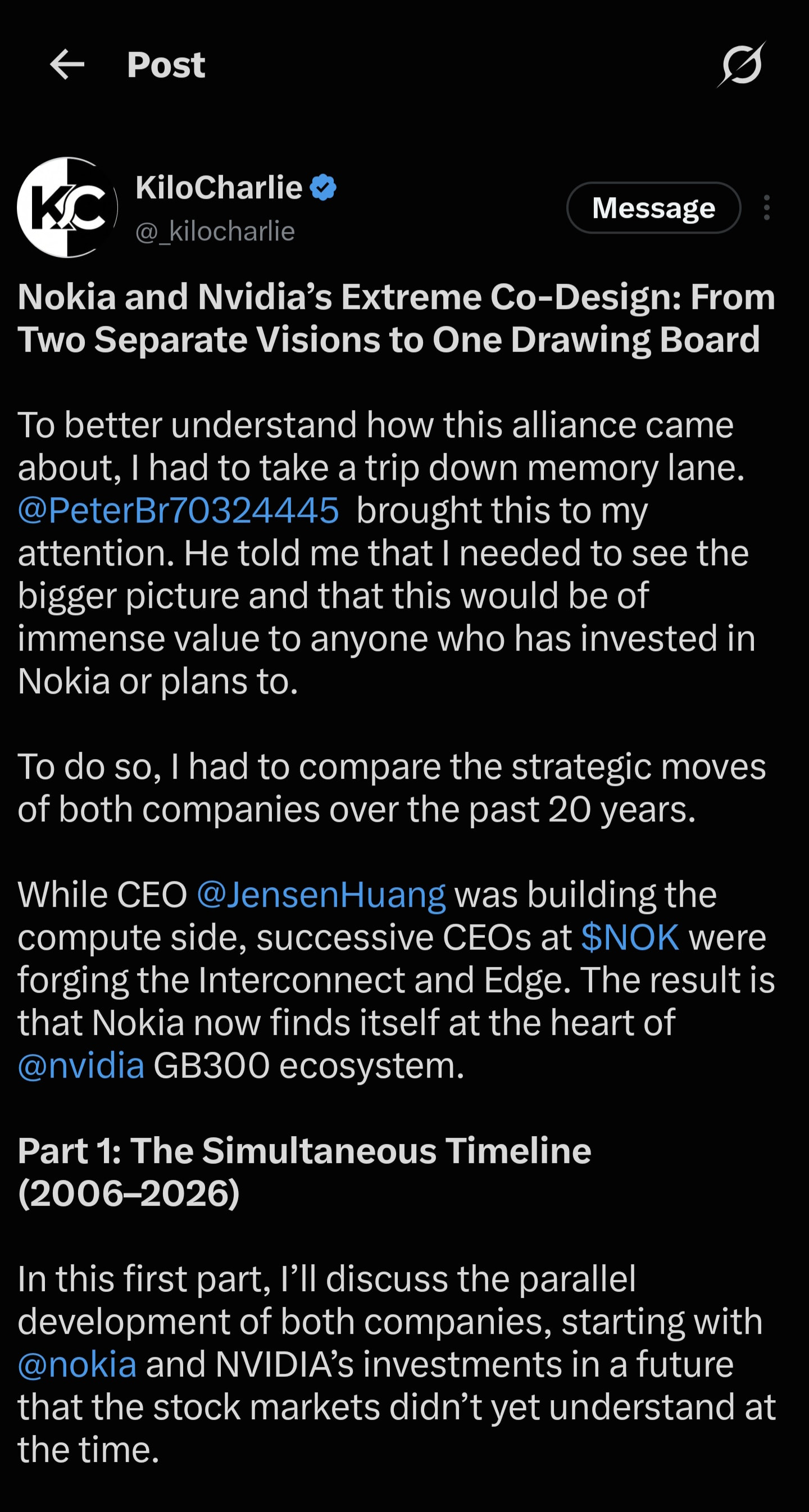
BTW I’ve been doing a bit of collaboration on X with KiloCharlie… he’s a bit more technical and a much better wordsmith than I am. I’m more geopolitical first and a bit too forward thinking… Anyway we’ve done an “extreme co-designed” post which traces the joint NVIDIA/Nokia vision of a platform right back into history to the current DSX blueprint. Drop us a like (if you like) and let us know what you think…Hopefully you find it interesting anyhow.

https://x.com/_kilocharlie/status/2114813298654728338

8 Likes

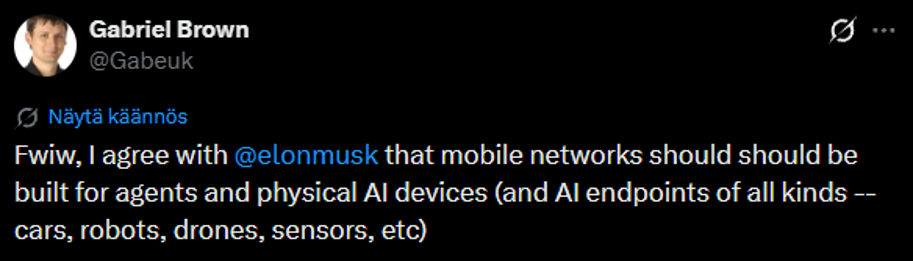
Here is a concise summary of Elon Musk’s and SpaceX’s broader plan based on the article:

Elon Musk’s Plan: A Global AI-Era Connectivity Platform

Musk’s goal is not merely to establish another traditional telecom operator, but to build a seamless hybrid network (satellite + terrestrial RAN) that eliminates coverage blackspots across the entire globe.

1. Why is Musk doing this? (The Big Picture)

  • Securing Physical AI infrastructure: This is not just about people’s smartphones, but about millions of Teslas, Optimus robots, drones, and autonomous vehicles. These machines require continuous connectivity, completely regardless of where they operate.

  • Strategic independence: Musk wants to control the connectivity layer himself so that his AI and robotics vision does not remain reliant on legacy operators.

  • Massive market potential: SpaceX estimates its target addressable market to be $1.6 trillion ($1.6T) (Starlink Broadband + Mobile).

2. How will he execute it? (Satellites + Terrestrial Coverage)

  • Satellites (NTN): With its fleet of over 11,000 satellites, Starlink provides exceptional geographical coverage, which is economically impossible for terrestrial networks to achieve in sparsely populated areas.

  • Terrestrial Networks (Terrestrial Small Cells): Due to the laws of physics, satellites alone cannot provide dense urban capacity (capacity density). Therefore, SpaceX plans to deploy small cells alongside Starlink terminals and utilize its acquired 800 MHz spectrum.

3. Major Challenges

  1. Physics and capacity density: Satellite signals cannot deliver as much data capacity per square kilometer in dense urban areas as traditional cellular networks.

  2. Spectrum and legacy infrastructure: Traditional operators have a decades-long head start in spectrum bands, cell tower infrastructure, and fiber backhaul.

  3. Ecosystem: Roaming, regulations, emergency calls, and device certifications require substantial operational capabilities.

4. Impact on the RAN Market and Legacy Operators

  • The future is hybrid: Due to physical constraints, terrestrial RAN will still carry more than 98% of global mobile traffic through 2030. Satellites and D2D (Direct-to-Device) will supplement it in dead zones.

  • Margin pressure on operators: While SpaceX won’t replace terrestrial networks, it could eat into legacy operators’ revenue and force them to rethink their investment models.

  • Long-term disruption (2030+): If robots and autonomous devices see massive adoption, machine-generated data traffic will drive future network investments rather than human usage.

This is not just about people’s smartphones, but about millions of Teslas, Optimus robots, drones, and autonomous vehicles. These machines require continuous connectivity, completely regardless of where they operate.

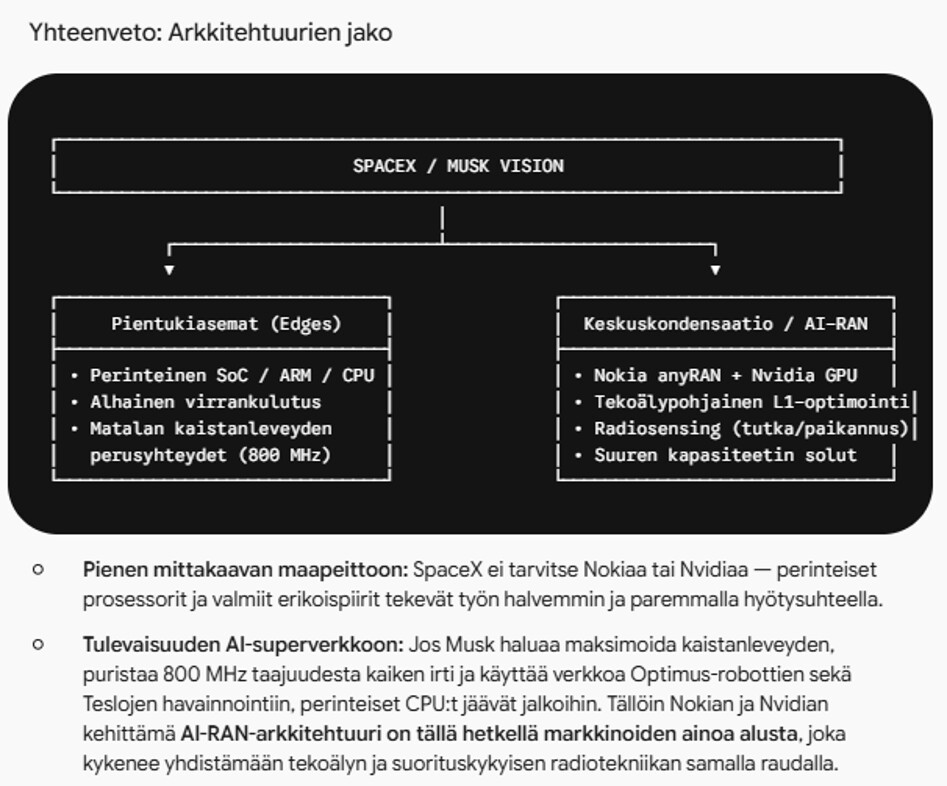
If the vision consists of robots, autonomous cars, drones, and various sensors—essentially things that sound like Elon Musk—traditional SoC CPUs will definitely fall short for that use case. Even if it takes “only” 2–3 years for Musk to get the terrestrial network up and running, these use cases are already planned years in advance. I see a good opportunity here for Nokia to capture very significant AI-RAN business from this. I doubt the schedule allows for Musk to build everything purely in collaboration with Nvidia—they will need other partners as well.

Still, I view this as an option. Since analysts assign zero value to mobile networks anyway, it can hardly deliver a negative surprise. Though investors, of course, are a different story than analysts.

15 Likes

Yes, that’s what I was thinking also! Great breakdown @Lexus

The combination of the AI race with China and all sorts of other technology duplication issues arise also. NVIDIA made the move at the right moment, Musk was too late maybe… some kind of workaround is surely more beneficial to all parties, and like I mentioned earlier, the DoD/US government could force his hand in any case!

5 Likes

https://x.com/RealNickMugalli/status/2115031324918796799

Quite timely…

6 Likes

In addition to the fact that building Starlink’s terrestrial network may require significant additional investments in radio access networks (RAN and AI-RAN), these investments also require complementary investments in optical and IP transport networks to connect radio masts to the core network. In other words, a very attractive potential customer for Nokia.

7 Likes