As I see it, Jensen Huang highlighted not only AI-RAN but Nokia’s entire edge computing strategy in a very positive light in the Kauppalehti interview:
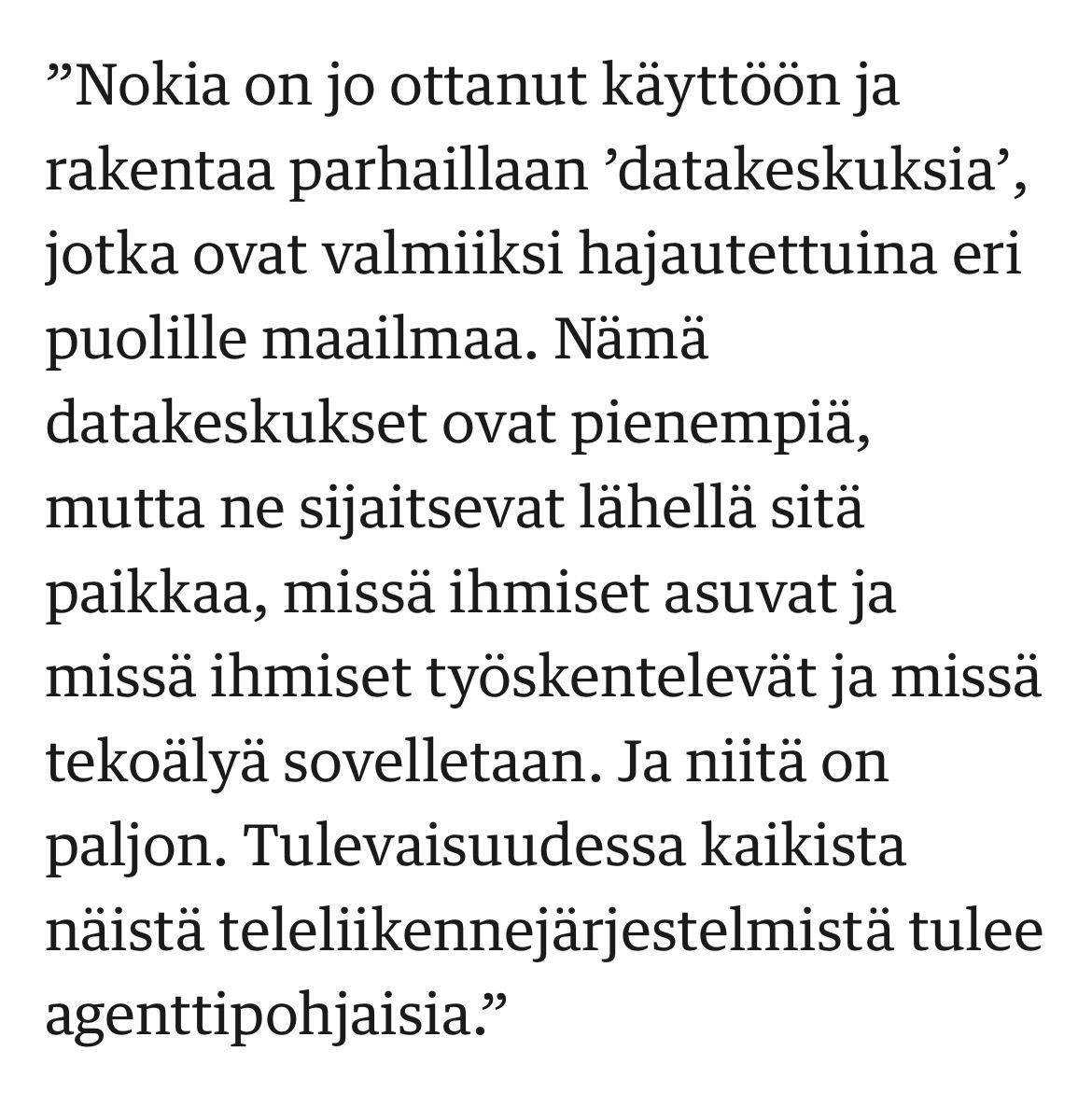
Here is Gemini’s summary of Nokia’s new edge computing strategy following the sale of ECE. It includes much more than just AI-RAN.
1. Far Edge (Cell Site):
Where: At radio masts and base station shelters.
Nokia’s role: AI-RAN, AirScale compute, and instantaneous, millisecond-level radio interface optimization.
2. Telco Regional Edge (Telco Edge / Edge Data Centers):
Where: Micro-data centers operating in connection with municipalities, cities, and the operator’s own switching centers (e.g., Telefónica’s 17 nodes in Spain).
Nokia’s role: Data center networking hardware and software (Data Center Switches & Routers, SR Linux). Nokia still does not own the server hardware itself (like Dell/HP servers), but supplies all the critical networking infrastructure used to interconnect the servers and link them to the operator’s network.
3. Public Cloud & Hyperscalers (Cloud Edge):
Where: AWS Outposts, Google Distributed Cloud, or Microsoft Azure Stack.
Nokia’s role: Seamless orchestration and network APIs that allow cloud giants’ applications to directly interface with the Nokia-managed network.
Summary
The Telefónica project demonstrates that despite the ECE sale, Nokia remains very strongly positioned in the edge data center market. A distinct takeaway is that while Nokia has stepped away from selling application-level industrial servers, it has strengthened its position as the networking infrastructure backbone for all these edge data centers and as a provider of AI-ready data center networking solutions.