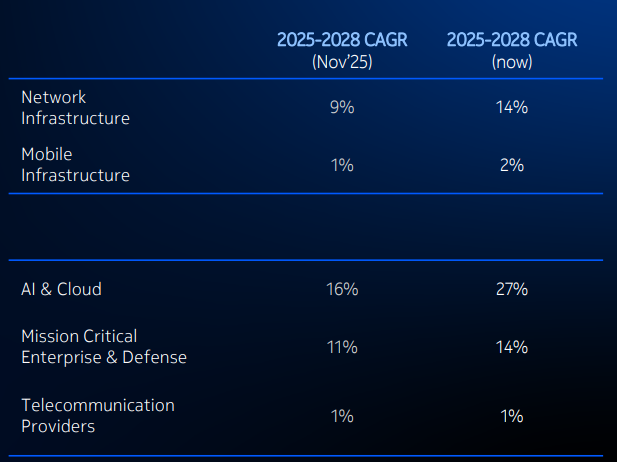
That slide was presented at the OFC event in March. However, in April, in connection with the Q1 report, new winds were blowing: the growth forecast for the AI/C market in four years was no longer 81%, but 160% (1.16 vs. 1.27 to the power of four). Of course, this figure only applies to the share of AI/C, but that is precisely Nokia’s actual growth engine. Nor does the figure apply only to optical networks. AI/C sales are targeted above all (perhaps even over 90%) at the Optical and IP Networks businesses.
However, for two reasons, NI’s sales will not grow by 27% per year: 1) the Fixed Networks business unit is not included here (although Optical and IP Networks are), and 2) the current customer base includes a large share of traditional telecom sales, which do not fall under AI/C. For this reason, Hotard said in the Q1 report presentation that NI’s addressable market is growing at an annual rate of 14% (the November CMD forecast was 9%): the AI/C market is running hot, while the traditional telecom market is largely stagnating. Gradually, as the share of AI and cloud sales increases, the average growth rate of NI’s total market will edge closer to the 27% level.
However, assuming that NI’s sales grow by 14% annually, i.e., in line with market growth in 2025–2028, from the 2024 baseline of €6,518 million, it would reach approximately €11,008 million in 2028. In other words, in four years, NI would grow by a whopping 69%. If the midpoint of Nokia’s target operating profit margin range for 2028 of 13–17%, i.e., 15%, is realized, NI’s operating profit in 2028 would be approximately €1,651 million, compared to €780 million in 2025. In NI, that would mean more than doubling the operating profit (+112%) in just three years. However, Ciena’s strong margin outlook (operating profit of 25-27% in 2007) may mean that the 15% margin modeling is too conservative.