Nokia as an investment (Part 3)

Crucially regarding this, and the same thing I have also suspected about the recent rise:

High-rolling investors have positioned themselves bullish on Nokia.. such a significant move in NOK often signals that someone has privileged information.

So I suspect that some group has more information about the future development of Nokia’s optical business, and possibly in connection with Nvidia.

Nokia’s stock ended yesterday in the US with a strong rise, and at a clearly higher level than where the stock closed in Helsinki. And this again happened with strong volume, and exceptionally, the volume was strong also towards the evening. This next upward wave is thus strongly underway now - let’s see how far it takes us. I will most likely make some moves along with this wave. In the short term, I think the stock is now approaching fair valuation.

However, in the long term, Nokia has positioned itself in a unique position, which means that in a positive scenario, it is possible the company is at the beginning of a long-term success story. The stock price just behaves irrationally sometimes, and it is also heavily influenced by external factors.

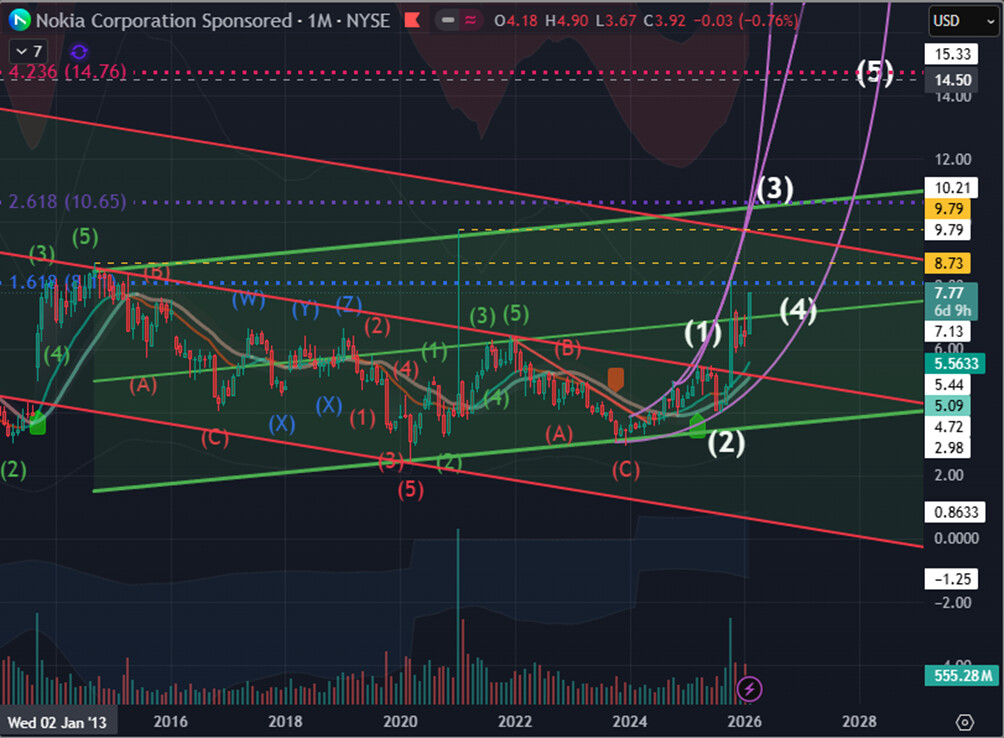
The chart is on a monthly level, but on a daily level, the ADR closed yesterday at the same price as on the day the Nvidia deal/investment was announced. And on the other hand, the last time there was a close this high was in May 2015.

17 Likes

And I just came across this article.

As of early 2026, Nokia is no longer defined by the hardware in consumers’ pockets, but by the invisible, intelligent infrastructure that powers the global economy.

Valuation & Debt: Nokia maintains a robust investment-grade balance sheet with a net cash position of approximately €5 billion. Its forward P/E ratio sits at 12.5x, which many analysts view as a discount compared to its high-growth peers in the optical networking space.

Justin Hotard, formerly an Executive Vice President at Intel, took the helm as CEO. Hotard’s appointment signaled a shift from “telecom traditionalism” to “silicon-first infrastructure.” His strategy, “Connecting Intelligence,” emphasizes AI-native software and silicon photonics.

As we look through the lens of 2026, Nokia has successfully navigated the most difficult decade in its history. By shedding its consumer legacy and leaning into the AI-driven future of infrastructure, the company has repositioned itself as an essential provider of the world’s digital nervous system.

For those watching the ticker NOK, the story is no longer about a fallen giant, but about a reinvented architect of the future.

6 Likes

The LightReading article linked above explains how Ericsson has implemented several “AI for RAN” algorithms on its operational BB units, i.e., building the radio network itself does not yet require a dedicated AI GPU, let alone the challenges that using current GPUs in radio and BB would cause.

The (re)building of the world, which N+N is pushing, is then a completely different story, and one shouldn’t hold their breath waiting for it to materialize. Fortunately, there is momentum in NI, which gives MI additional time to implement its plans.

1 Like

Proprius Partners’ review from yesterday. You can get them by simply joining the mailing list https://proprius.fi/ Copying is prohibited, so I am only summarizing.

The title of the letter is “buy the dip earnings season.” Nokia is discussed: “A new page turns… the dip on earnings day was recovered within a few days and it has risen higher… guidance… nicer to surprise positively… AI… valuation is only slightly elevated… by gradually reaching growth targets, one can expect an improving result, a classic buy the dip…”.

So they have been reading the thread. Validation.

The last time in the thread was “Mr. Market’s turn to speak” written by Viitikko from Proprius 2 years ago (let bygones be bygones…)

Nokia (19 billion euros)

“The Finnish record (SE) for kicking the can down the road is approaching, but there is a risk of stepping on the can. Finnish tech companies… perhaps not the most vibrant place to be. Valuation is cheap – yeah, I was listening to the same chatter even when Apple started to truly displace Noksu. I remind you that in tech firms, looking at valuations leads to stepping into such value traps that 5G cycles won’t help much. And anyway, these new Gs are of no use to these hardware firms – all the money is sunk into R&D (T&K) and you never get it back.”

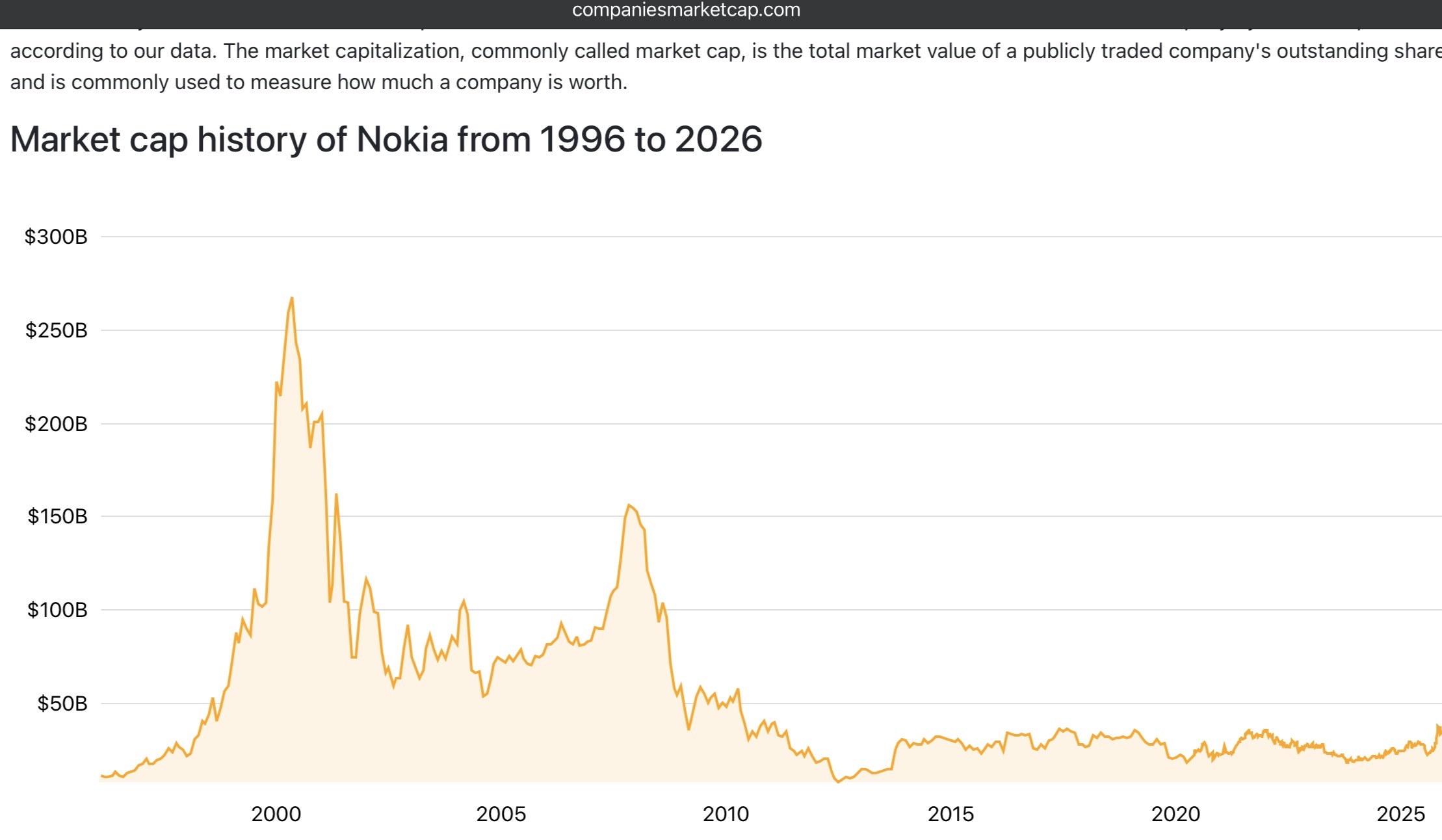
The new article doesn’t actually say that it is in a dip anymore. We are currently at the same price levels as in 2014-2016. The phones had been sold, the Alcatel-L deal was made, and the number of shares likely increased significantly, so the market cap (m-cap) is probably higher now. The impact of inflation in the comparison is offset by dividends, which also had to be canceled in some years, and that is when buying opportunities arose because things were so miserable.

But it is perhaps misleading to compare the numbers, because we are a different company than 10 years ago and than 25 years ago.

Signed, on board for longer than 10 years.

7 Likes

This is completely true and that’s how I see it as well. On the other hand, I believe the world will surprise us; future usage requirements will quickly demand dedicated edge computing. In that case, traditional SoCs or FPGAs will likely fall short.

To be honest, Morris’s perspective over the years has certainly aimed to be honest in a way, while simultaneously first hyping Huawei and later leaning towards Ericsson. At no point has he really discussed Nokia in a very encouraging manner. And of course, the analysis is still entirely focused on mobile. Regarding Nokia’s current success, it is not relevant (assuming development matches the current state) - in the future, there will come a time (perhaps starting sometime in 2027 or 2028) when there will be a reason to pay more attention to this again.

Roughly sketching a curve into the future, Nokia could be worth 8.5–13 euros per share, largely thanks to NI. If development continues further (20 €), assistance from MI will be required. Of course, it’s still a bit difficult to grasp the positive scenario for the optical side (NI) - at its best, the scope could be surprisingly large. Assessing realism is therefore difficult - however, it’s becoming certain that the scenario is not negative.

8 Likes

Good post once again, thanks @Lexus

I’ve also been considering selling a small portion at around €7/share.. Do you have a selling price in mind?

Nokia itself has stated that the H1 2026 results will be weak due to investments etc.
On the other hand, I’m wondering if the stock market might make a correction, like gold and bitcoin for example..

3 Likes

Thanks, @Matkaaja.

This is certainly a bit of a game of nerves for those investors who have hung on for a long time and managed to keep believing in a turnaround. And I don’t have a crystal ball either; instead, I’m trying to form a picture based on the sum of many different factors.

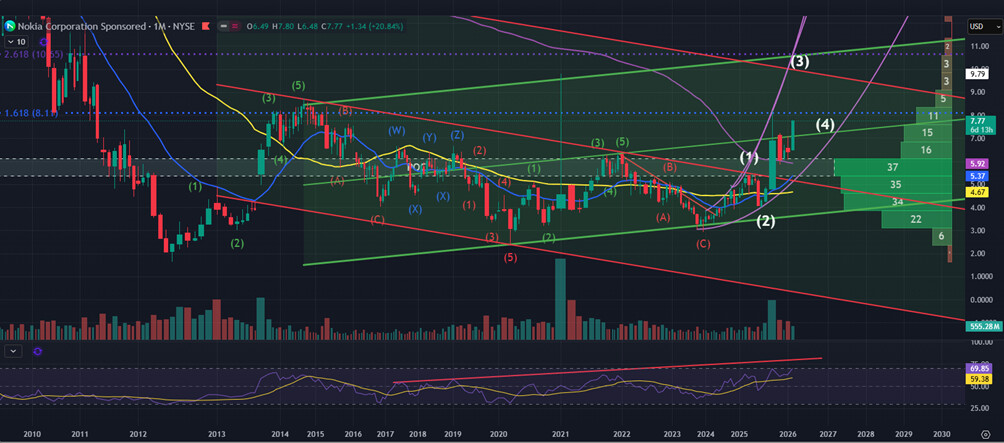
You can look for some clues from the chart above. By studying technical analysis trends, it is likely that:

  1. The 09/2014 peak will be exceeded, meaning we will rise above 8.73 USD. In euros, this is currently 7.46 €.
  2. If the WSB rise is NOT interpreted as an outlier, the trend should lead to a rise above 9.79 USD, or over 8.31 € (of course, currency quotes will change).
  3. If we rise to the upper edge of the trend channel in the current wave, the quote would be around 10.50 USD, depending on the timing. The 2.618x first-wave Fibonacci level shown in the image would also land there.

I consider the levels in points 2 & 3 likely at least at some point (reversal points for many analysis styles coincide there). But since we’ve already seen a good rise, I think everyone needs to weigh how they feel about things. If the higher levels don’t materialize (for example, a black swan appears and the whole market turns sour)… for this reason, I will utilize diversification, and I don’t think I’ll exit the position completely at all. But this is just my own style—and I haven’t locked anything in yet.

The scenario is also still possible that the aforementioned levels ultimately turn out to be meaningless, and we target roughly that 4.236x first-wave Fibonacci.

11 Likes

I think the same, but it requires flawless execution. Below is a draft of a post that I had translated from English.

Ciena vs. Nokia – Repricing of AI Infrastructure

Ciena (CIEN) has risen from around $90 (August 2025) to over $335 (Feb 20, 2026) – representing approximately +270% in six months. The market has effectively repriced Ciena as a pure-play winner in AI optical infrastructure.

It tells us one thing: the AI super-cycle isn’t just about GPUs – it’s about optical transport capacity and energy-efficient data movement.

What sets Nokia apart?

Ciena is a specialized optical company. Nokia’s Network Infrastructure (NI), on the other hand, is optics + IP routing + fixed networks.

In 2026, the competition will shift from the question of “who was first in 1.6T” to “who can deliver the most efficient comprehensive solution at scale”.

1) Speed Parity

Nokia lagged behind Ciena in 800G shipments. Now, Nokia’s PSE-6s engine brings the company into the same 1.6T class. 800G transport over 2,000 km has been demonstrated – meaning it’s no longer just a laboratory feat, but actual long-haul traffic between AI data centers.

2) Integrated Stack

Nokia also designs its own routing chips (FP5/FP6). When optics and routing are designed together (“coherent routing”), the goal is significantly better power-per-bit than with standalone solutions. Energy is currently the true bottleneck for AI data centers.

3) Industrial Leverage – San Jose Fab

Nokia is the only Western optical player with its own InP (Indium Phosphide) chip fab in the United States.
A California state document describes a project where PIC (Photonic Integrated Circuit) capacity is being increased tenfold. This has an impact on supply security and Nokia’s cost structure.

The transition from 3-inch wafers to 6-inch is designed to improve production volumes per run and aims for a significant cost-per-bit improvement, provided yields are successful. In other words, once production is ramped up, the cost structure of optical networks will lighten significantly, which will have a margin-boosting effect.


Valuation Perspective

Ciena’s market capitalization (~$45–47 billion) has risen to a level that approaches or exceeds the entire Nokia Group (~$42 billion). This means the market is effectively valuing a specialized optical player higher than Nokia’s entire NI + patent portfolio + mobile networks combined.

If the AI build-out is a multi-year cycle and if NI can demonstrate:

  • recurring hyperscaler demand
  • margin expansion towards the 13–17% target range
  • the appeal of IP routing alongside optics

the market could very well conclude that the current valuation gap is not structurally sustainable. We may have already begun to “hear” the prelude to a valuation correction recently.

So, it’s not a question of whether Nokia is “fully priced” right now – but whether the repricing of AI transport infrastructure is only just beginning for Nokia as well.
11 Likes

Nokia’s advantage over Ciena is its vertical integration. Ciena is, for instance, heavily dependent on InP lasers purchased from Lumentum.

Additionally, Nokia has a ready product for inside the data center, namely the ICE-D. Ciena has been strong in pluggable products, but I’m not sure how ready they are for the inside of data centers. They don’t have component-level manufacturing like Nokia does. Nokia, on the other hand, has repeatedly emphasized their specialization at this level, with PIC (Photonic Integrated Circuit) expertise being essential. I suspect that in future CPO (Co-Packaged Optics) development, Lumentum will be involved regarding InP lasers, at least in the initial phase. But Nokia could be in a strong position regarding PIC engines, meaning this ready ICE-D product. The market doesn’t seem to anticipate this at all right now, IF this is indeed the case. But then what is Ciena’s role in this; can they get involved at the component level at all, as internal optical development in data centers is, in my view, heading in that direction?

By the way, I’m under the impression that Nokia’s FP5/FP6 is not suitable for the inside of data centers, at least currently. They are silicon-based (Silicon Photonics), and they don’t withstand heat as well as InP. So Nokia’s current pluggables development comes mainly through Infinera as InP-based—namely ICE-X.

9 Likes

Nokia completed the acquisition of Infinera almost exactly a year ago, and it seems to have been a very successful one, and perfectly timed at that. When it comes to corporate acquisitions, however, things haven’t always been so successful; some have been incredibly expensive (e.g., Navteq), and others completely pointless (e.g., Withings).

Furthermore, company integrations haven’t always been entirely smooth; it was claimed that they had certainly learned from NSN, yet it still took ages to integrate ALU into Nokia. A miserably long time, and costly..

In terms of price, the Infinera acquisition looks good. In terms of timing, the acquisition also seems very good. But how about the integration—how is it progressing now, one year after the acquisition? What do the experts on this forum say?

6 Likes

I’m certain. I know the product. But as I said, NVIDIA has so many switch projects underway that there’s definitely room for Nokia too. At this stage, however, Nokia is only involved in the pluggables. The rack is full of them, so no worries. A billion is on the way.

7 Likes

Cisco shouldn’t be forgotten. Cisco also has a unit that manufactures coherent optics. These four are basically competing for that slice of coherent optical interfaces. I’m sure a Chinese copycat will soon emerge there as well to drive pricing.

Another significant expansion for Nokia is Ethernet-based rack switches. There, the toughest competitors are Arista and Cisco. Nokia now seems to be taking market share from others, and the competition is intensifying.

Based on this information alone, I have finally ventured to load up on Nokia in my portfolio after nearly ten years.

There will be growth this year. Unfortunately, I predict a total collapse of the entire AI sector for next year. This “big boys’ game,” where investments flow from one to another and the same money circulates within the circle, cannot continue for much longer. Money would need to flow into the circle from the outside, and that doesn’t look very promising.

8 Likes

Aren’t AI projects multi-year, so even if stock prices take a hit, the projects won’t just come to a grinding halt? On the other hand, demand for AI will certainly continue to grow in the future; it’s another matter what the business models of various players will look like as competition intensifies.

7 Likes

I personally still believe that data centers will be built now and in the future. The kind of complex setup NVIDIA has built on the enterprise side doesn’t really affect Nokia that much yet, but I bet this is also a quid pro quo deal where NVIDIA brings Nokia into data centers in exchange for getting their GPUs into radios—so a bit of an “incestuous” business there too.

Nokia is a supplier, however, so the losses won’t hit until people stop building and repairing data centers, and I don’t see that happening anytime soon. New players might enter the market, like Nokia now, and then of course valuation multiples will be reset. Data centers are here to stay, though, and it’s good to be involved in them. It doesn’t matter to me even if the valuation multiple goes back to crawling if the AI bubble bursts, because it will rise from there along with increased earnings and margins. The losers will be those who can’t find a return on the capital they’ve invested in their fancy data centers. SaaS, centralized computing, etc., are coming, however. I’m willing to pay €5/month if it makes my €100 handset work like a €1000 device.

It remains to be seen whether NVIDIA’s GPU in a radio is a good or bad thing—meaning, whether participating in this “incestuous” setup brings a plus on the data center side but a beating in mobile. I’m quite sure they’ve thought of some applications for it that make it attractive to customers. I don’t know if the idea is to push it mainly to the private side (incl. military) and leave other options for operators.

7 Likes