NIBE, the giant of ground source heat pumps and energy-efficient solutions from Sweden

In my opinion, NIBE has long deserved its own thread, as it is the market leader in the heat pump industry, and many Finnish detached houses, terraced houses, and apartment buildings use NIBE technology. The company was founded almost 70 years ago in Markaryd, southern Sweden, where it still operates today. NIBE introduced its first heat pump in 1981, and it was listed on the stock exchange in 1997. Since then, the company has grown into a multinational conglomerate through dozens of acquisitions.

In the 2020s, NIBE’s share price saw a typical rapid rise and fall of crisis years; at times, heat pumps were snatched up, and NIBE faced significant delivery difficulties due to high demand and a simultaneous component shortage, and as often happens, after the rise, NIBE also experienced a hangover. As of this writing, the share price is far from its peak valuations, and analysts have been concerned about overcapacity in the industry and the stock’s valuation level.

In the long term, however, NIBE’s position in the green transition is extremely interesting. In northern latitudes, there is not enough cheap energy available in winter, and that is precisely when homes and industrial premises need to be heated. At the same time, for example, product development for ground source heat pumps has progressed so that the products are increasingly efficient, wells can be drilled deeper, and increasingly larger properties are switching from district heating to ground source heating. If this development continues, it is possible that in the medium term (perhaps 5-10 years), NIBE could achieve a new growth spurt, as ground source heat pumps last longer than before and are easier to maintain.

At Inderes, NIBE is followed by Lucas Matsson, and I warmly encourage readers of this thread to familiarize themselves with his excellent reports. The recommendation as of this writing is “reduce,” but it will be interesting to see Lucas’s update after the Q2 / 2025 report. A big ship is known to turn slowly, but on the other hand, this is an industry that will certainly have enough growth in the coming years and decades, and I see no reasonable reasons why NIBE would not be among the winners. So, for long-term and patient investors, steady growth should be expected in the coming decades, if NIBE only keeps up with industry developments. I can’t immediately think of reasons why NIBE wouldn’t be able to do this, but I can think of many reasons why NIBE will continue to be at the forefront of the industry.

19 Likes

I owned Nibe from 2020-2023, but decided to divest the stock due to its high valuation. I haven’t planned on returning as an owner (even though the price is at a 5-year low), because I no longer consider the company a quality company.

The bottom line could not be defended as revenue declined (unlike Harvia, which manufactures simpler sheet metal containers). In 2024, Nibe’s revenue decreased organically by 16.4% and inorganically by 13.1%, but earnings decreased by almost 75%.

2 Likes

Regarding Nibe, it’s essential to consider how many one-time costs there will be and if they will eventually cease?

Few companies have such an impressive growth curve over several decades. I haven’t really delved into the company, but are sales so tied to new production that the recent stagnation is largely due to that?

2 Likes

I have tried to dissect the company’s abundant investor material and interim reports, but I haven’t found a direct answer to the question above. Overcapacity, the competitive situation, and market uncertainty are indeed lamented, but how much is about the markets and how much about NIBE’s poor performance is an open question for me. I at least hope that Q2/2025 will already be a report that doesn’t heavily rely on external reasons.

2 Likes

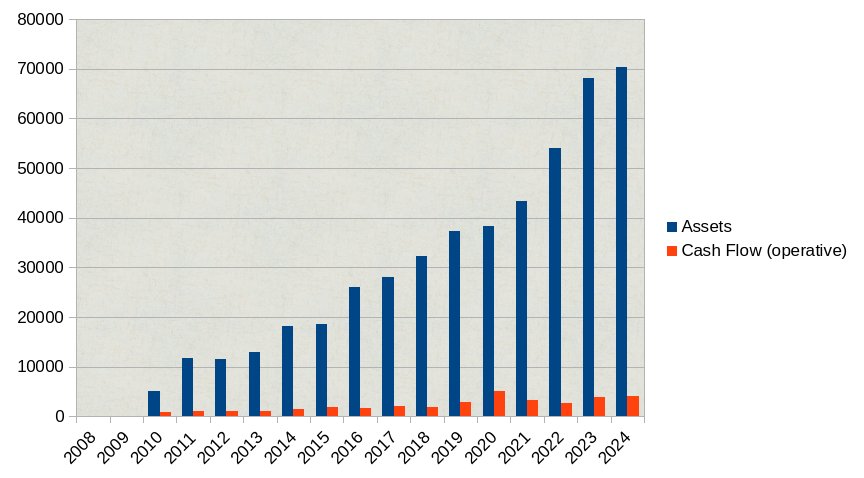
I’ve followed this a bit sometimes (Nibe Industrier). Revenue and profit developed really nicely for over a decade, until 2024. However, operating cash flow was still quite decent in 2024.

image
image

4 Likes

Yes, quite good growth, which is only partly organic though. I believe that Q2 2025 could be the quarter for Nibe that restores the company to a healthy growth and earnings trajectory, and then we’ll just enjoy the ride.

These equipment manufacturers faced difficulties (generally speaking, I don’t know more about this Nibe, nor have I followed it this year) when interest rates rose, customer financing became difficult, and cheap LNG gas continued to flow from, among others, Russia (these simultaneously 2023-2024). It seems that the LNG sector saw the highest import volume ever from the eastern neighbor last year (and at least in the early part of this year, the growth only continued?). Now there is some political EU agreement that imports would be phased out by the end of 2027.

News on the import phase-out schedule:
https://www.reuters.com/sustainability/boards-policy-regulation/eu-readies-ban-russian-gas-imports-by-end-2027-2025-06-17/

EU natural gas price development:

1 Like

Yes, the matter has been discussed in those reports

Clear reasons to the demand fluctuations
To control the high inflation, central banks around the world have raised
interest rates very significantly and comparatively very rapidly, which
has led to lower consumption generally, as well as a sharp downturn in
new housing production. For example, new housing output in Sweden
is now at the same level as during the severe bank crisis in 1992-1993.
The sharp increase in energy prices at the beginning of 2022, caused
by Russia’s abhorrent invasion of Ukraine, resulted in a corresponding
increase in demand for products, with a particular focus on fossil-free
climate control (heating, ventilation, cooling) of residential properties.
Manufacturers were initially unable to keep up with the spike in demand
and the distribution chain attempted to cover their backs by over-or-
dering. By the middle of 2023, when manufacturers had finally managed
to safeguard the supply of component capacity, energy prices started
to fall again, while distributors started to realize that their inventories
had grown too large compared to actual customer demand and the
manufacturers’ restored delivery performance. The painstaking work of
restoring a more proportionate balance between manufacturers, dis-
tributors and end-consumers began as mentioned in the third quarter
and carried on in the fourth quarter.
The third factor is the back-and-forth situation regarding the politi-
cal will needed to replace the fossil fuels used in the climate control of
housing with sustainable alternatives such as heat pumps. Many Euro-
pean countries have been in a stop-go situation for most of the year
when it comes to a long-term approach.

If one considers a positive scenario, demand will gradually recover, and with organizational changes, excess has been cut after strong growth years, and the result will eventually return to a growth trajectory quickly.

If one looks at forecasts, for example, Inderes’ website predicts new record results only in the latter half of the decade. Based on earnings, calculated from a few years of peak results, the P/E ratio hovers somewhere between 16-17, which is not necessarily bad depending on when we can get back to growth.

2 Likes

Yes, a turn for the better will come in this industry at some point. My own experiences from the growth slowdown/disappearance in 2000 are such that it takes a long time (back then, many IT/telecommunications stocks took 3-4 years and showed -80-90% from their peaks) before the rebound slowly started. The most important thing then was the normalization of inventory levels, which is probably still the same remedy.

1 Like

This might be possible already during the second quarter. In addition to this, I would emphasize that ground source heat pumps have quietly developed over the years to become increasingly efficient, which in turn opens up entirely new types of targets and markets for the product. The sector is not very prominent and development is slow, so it easily remains under the headlines. However, an increasing number of apartment buildings and industrial sites have switched to using ground source heating, and the potential market is likely to grow in the future as well.

2 Likes

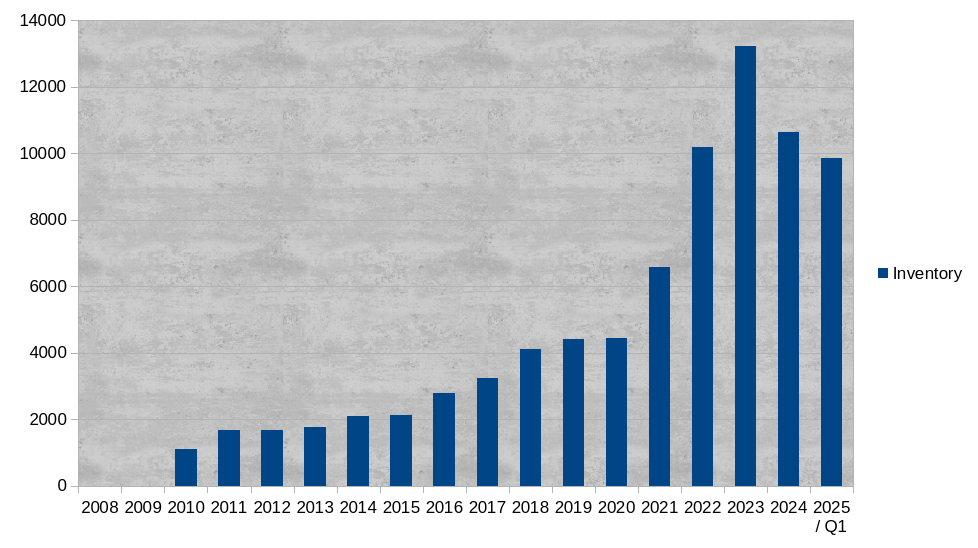
Yes, the trend in total inventories for 2024 and Q1/2025 was clearly decreasing. The year 2023 clearly stands out from other years.

image

3 Likes

While waiting for the interim report, good news from Sweden: the heat pump market is growing in Sweden, according to the headline, Nibe’s largest market area.

2 Likes

I don’t know if NIBE is in the right company on this fresh short list (see position 13 below), but the sentiment doesn’t seem to be at its peak before the upcoming interim report. We still have exactly two weeks to wait before Q2/2025 is released. YTD is 3.31% at the time of writing, so there’s no glorious past or glorious future in sight if you ask the short sellers. NIBE feels like a somewhat larger cigarette butt in many people’s opinion.

today at 2:59 PM ∙ NyhetsbyrĂ„n Direkt

STOCKHOLM (NyhetsbyrÄn Direkt) NyhetsbyrÄn Direkt publishes a list of the 15 most shorted stocks on the Swedish market at the end of each week.

The list is based on short positions of 0.1 percent of capital or more reported to the Swedish Financial Supervisory Authority (Finansinspektionen).

The parentheses in the list refer to the shorting percentage last Friday.

  1. Hexatronic 13.5% (13.7)

  2. SBB 12.5% (12.7)

  3. Electrolux 11.4% (10.4)

  4. Elekta 7.8% (8.0)

  5. Xvivo 7.8% (7.4)

  6. Vitec 7.1% (7.1)

  7. Castellum 7.0% (7.2)

  8. Truecaller 6.5% (5.7)

  9. Yubico 6.3% (6.4)

  10. Embracer 6.0% (5.8)

  11. Fabege 5.9% (5.3)

  12. Better Collective 5.9% (5.9)

  13. Nibe 5.8% (5.9)

  14. SKF 5.5% (5.1)

  15. JM 5.4% (5.5)

1 Like

Lucas Mattsson has given his preliminary comments as Nibe publishes its results on Friday. :slight_smile:

We have made minor forecast adjustments to NIBE’s short- and medium-term forecasts due to a slower-than-expected recovery. In our view, short-term drivers remain weak, and the stock is already pricing in sufficient high earnings growth (2025e P/E: 33x). As a result, we believe the risk-reward ratio is weak. Consequently, we are downgrading to a Sell recommendation (previously Reduce) and reiterate our target price of SEK 40.0 for the stock.

@lucas.mattsson: New company report from after NIBE’s Q2. :slightly_smiling_face:

NIBE’s Q2 report was largely in line with our expectations, and we made only minor forecast revisions. The company’s performance, outlook, and market indicators continue to show signs of recovery. However, in our view, the pace of recovery will remain slow due to weak consumer confidence, a sluggish new construction market, currency headwinds caused by a strengthening SEK, and uncertainty regarding subsidies in certain markets. In our view, short-term drivers remain weak, and the stock already prices in sufficient earnings growth (2025e P/E: 34x).

2 Likes

The slow-motion film called “NIBE Turnaround” is progressing just as sluggishly as analyst Lucas Mattson discusses above. A surprise could come in the form of a faster-than-expected recovery in construction, and conversely, unexpected structural arrangements in the industry would revitalize the market. Yet another example that turnaround stories sometimes progress very slowly, if they progress at all.

2 Likes

In this news linked in Nordnet, information about recommendation changes after Nibe’s earnings report:

1 Like

Here is a new company report on NIBE by @lucas.mattsson. :slight_smile:

In our previous update following the Q2 report, we reiterated our Sell recommendation for NIBE, and since then, the share price has fallen by approximately -20%. As a result, we believe the valuation has declined to more neutral levels. However, at current valuation levels, we consider the total return expectation to be roughly in line with our required rate of return. Consequently, we change our recommendation to Reduce, but reiterate our target price of SEK 40 for the share.

2 Likes

Hi! My name is Lucas and I am responsible for analysis monitoring at NIBE. Since our forum has now switched to multilingual mode, you can ask me questions and I will participate in the discussion here.

14 Likes

Let’s dive straight into the deep end. How on earth can this market leader underperform quarter after quarter? There’s nothing wrong with the products, but not enough is left below the line. Is the fault with NIBE or is there a permanent and persistent overcapacity in the market?

4 Likes