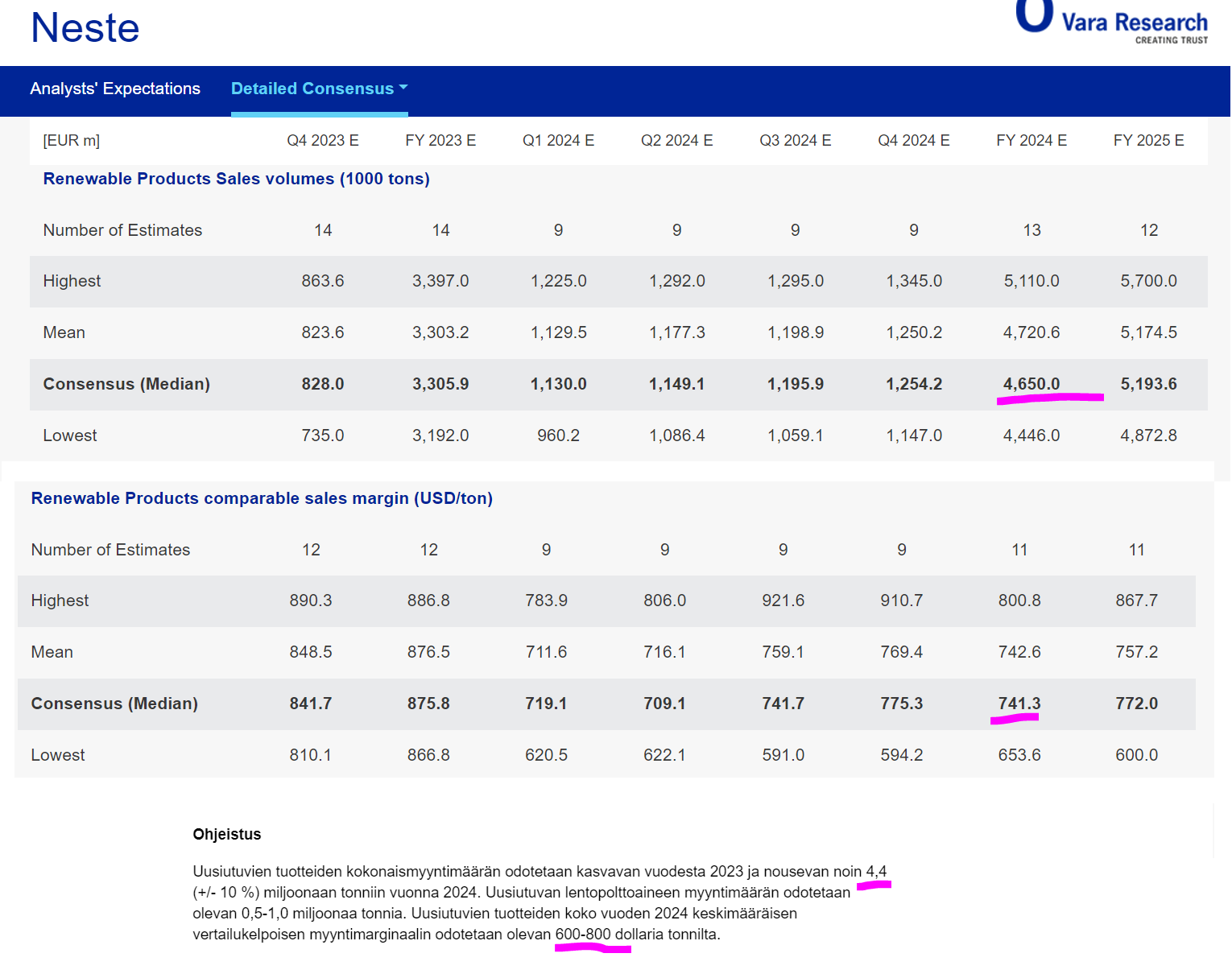
Next year’s outlook seems to be weighing on the stock. Copied from the financial statements bulletin: “The total sales volume of oil products in 2024 is expected to be lower than in 2023. This is affected by the planned major turnaround at Porvoo in the second quarter. The total refining margin for oil products for the full year 2024 is expected to be lower than in 2023.”
I’m not particularly pleased about this myself either. This will probably soon be one of the companies that has generated the biggest losses in my portfolio, if it isn’t already.
The drop in oil product sales volumes and margins was indeed factored into consensus expectations. It seemed like the consensus was pretty much on the mark overall. The share price reaction is certainly brutal.
The guidance for the current year regarding Renewable Products is a clear disappointment, and the Q4 result was qualitatively slightly weaker than expected. By this, I mean that Renewables was softer than expected, which Oil Products compensated for. The market clearly gives Renewables a much higher weighting because it is the source of growth and value creation in the long run, whereas Oil Products is a declining business.
This same logic applies to the guidance, meaning it is more important for Renewables than for Oil Products, so I would highlight that, @Sol_Aeternus, instead of Oil Products.
The dividend does not play a significant role for Neste, and missing the consensus doesn’t essentially drive investors.
Today is busy with results from two companies, but I could put together some more extensive thoughts here when I have time. But briefly: yes, the share price is now paying the price for the weak communication. In addition, a few unpleasant surprises are making the situation worse.
To put it simply: if you take roughly 5% off both volumes and margins, the resulting change in the earnings forecast ends up being quite similar to today’s share price movement
As I said during the live stream, time will tell how Neste’s historically somewhat conservative guidance policy plays out this year, and of course, the company itself signals with that (+/-10%) that forecasting for the full year is not easy. But the market is generally driven by the midpoint of the range.
“Neste’s policy is to pay a competitive and over time growing dividend.”
It doesn’t seem like either pillar of the dividend policy is being realized now — in general, companies’ dividend policies are often completely meaningless, as there is a high probability for various reasons that they won’t act according to the policies regarding dividends, at least not for very long.
Technically, a special dividend of 0.50 EUR was paid last year. So the base dividend is increasing from 1.02 EUR → 1.2 EUR, meaning the dividend is growing. In my opinion, a dividend yield of over 4% is a commendable level for a company that is expected to invest significantly in the future.
“Over time” is open to interpretation, which I personally see as meaning an upward trajectory over a multi-year period. It’s the same as when the stock market fluctuates; one year you’re lower, and then you catch up and pull ahead, but over time the return is growing.
But as I said, it’s a term open to interpretation.
Somehow I feel that Neste investors are partly burying their heads in the sand when it comes to anticipating the company’s future. In many respects, the entire case seems very contradictory. On one hand, even analysts describe oil refining as a declining industry—and on the other, the company has announced it will abandon it entirely. Only the timeline remains open. So shouldn’t the company’s value be based solely on renewables, with everything else providing only financing (after the state’s greedy hand takes its share)?
What does that world look like where Neste’s business flourishes without oil refining? When will that time come? What will the Saudis and other Arabs, Russia, US producers, Venezuela, etc., do—and what will they eat?
What about the BPs, Totals, Exxons, Lukoils, Shells, Chevrons, and many others?
Can you create that rosy model for the future?
If the consumption of oil products ultimately drops significantly, it’s a “race to zero” in any case. Regardless of how these products are manufactured. There are no winners in that race—there never have been.
I understand the share price performance all too well.
If you listen to analysts of American companies, you hear one thing regarding dividends from almost all of them. If the company’s share price and value don’t rise, then at least the dividend must grow by 5% per year. The aim is for the dividend to increase at least in line with inflation. In my opinion, Neste should reach that level.
That’s probably the case, if Neste is no longer seen as a growth company in renewable fuels. This is exactly what the market has started pricing in since the pandemic-era peaks. At this rate of decline in the share price, that magical 5% level will be reached quickly. We are currently at the 4.3% level.
I understand that logic well and have been thinking about it myself.
On the other hand, I’ve seen slides where renewable fuels are needed in massive quantities for several decades to come. Of course, there are always risks associated with the future; everything doesn’t always go as currently anticipated. But other companies face the same future risks—will we still be using similar smartphones in 20 years, from which Apple is currently raking in huge amounts of money? What kind of companies will Neste and Apple be in 20 years, and what will their spearhead be then? At least my crystal ball doesn’t reach beyond educated guesses.
In any case, renewable fuels will be “the thing” for a long time, and demand is expected to grow substantially in the coming years, which is a favorable setup for Neste.
Regarding the slides we’ve seen: Neste showed similar slides at their Capital Markets Day, and this caused the share price to collapse. The issue with this slide was that, in addition to demand, it showed projected future capacity, which exceeded demand in the short term.
What’s the situation with the new refineries? Isn’t there a lot of new capacity coming online this year and next? I admit I haven’t bothered to look into it out of laziness, as I expected to find it in the CEO’s ramblings.
In my target scenario, Neste will over time phase out fossils and grow renewables. The market will notice that aircraft are not being electrified, and heavy transport and machinery only very slowly. Hydrogen might not be a real alternative there, and synthetic fuels still cost way too much. In that scenario, I believe Neste will be a winner. The distribution mandate for aviation is negligible, but the use of renewables will grow tremendously if/when companies and consumer behavior drive choices. Based on these assumptions, I have ended up adding to my Neste position (most recently today).
Neste released its Q4 results this morning. The results slightly beat expectations, but guidance was soft. Senior Analyst Henri Parkkinen discusses the company’s Q4 report and near-term outlook in more detail in the video.
I think I’ve written about this once already. In my opinion, talking about the green transition has become a kind of mantra that is repeated constantly. Biofuels and wind power will solve everything. Personally, I don’t believe this at all. Take air travel as an example. It is predicted to triple by 2050. If this were to happen, it is not possible to increase the volume of biofuels in the same proportion. This is because resources will simply run out, meaning the only way is to replace it with oil. And since you only get 0.1l of kerosene from 1 liter of crude oil, it can be quickly noted that oil pumping will only increase in the future.
What a blatant overreaction from the market, -12%, but that’s a good time to load up. It won’t be long until the Singapore refinery is in full operation and the consumption of renewables grows in the future; then margins will also improve. Demand exceeds production and that’s when Neste’s share price will shoot up..
Well, these are the moments when you can double your investment.