Black and Grey Swans

Let’s open a dedicated thread for Black and Grey Swans. By definition, these are either impossible or difficult to predict, or at least to time. Their consequences are also difficult, if not impossible, to foresee.

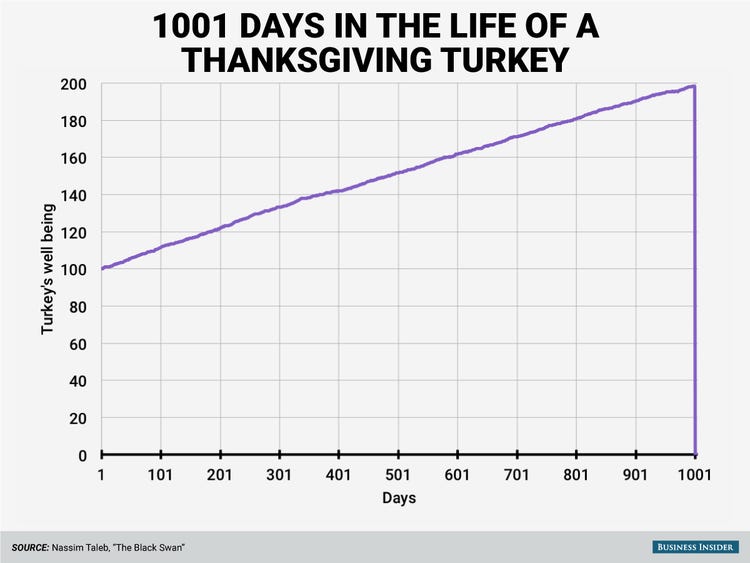
Nevertheless, pondering these could be useful, as we, as investors, certainly don’t want to be “turkeys”. The turkey example is famous: how a long-lasting rise (here, the turkey’s well-being, in the stock market it would be a long bull market) can suddenly end for the turkey on Thanksgiving. All the “well-being” accumulated over the previous 1000 days is wasted in a single moment:
A Black Swan is, by definition, a phenomenon,

i) which is very difficult to predict and comes completely out of the blue. There are many kinds of phenomena. For example, the WTC attacks were a Black Swan for everyone else, except, of course, the terrorists who carried out the attack. The rise of a company like Google to dominate our lives in a couple of years is also a Black Swan: impossible to predict beforehand.

ii) whose probabilities are difficult, if not impossible, to estimate

iii) which has massive long-term effects

iii) and which are rationalized in hindsight: “it was foreseeable”.

A Grey Swan is a “Black Swan” that we can anticipate but not necessarily time. For example, a pandemic is a Grey Swan: it was relatively clear that at some point in an interconnected global world, a local epidemic would get out of hand. The timing, however, was impossible.

There are slightly different descriptions of the Black Swan, but this is, to my understanding, closest to the description by Nassim Taleb, who coined the term (note: prior to this, there was already the Black Swan problem, which relates to inductive reasoning).

In itself, a thread where we try to guess these is therefore somewhat contradictory: the Black Swan is one of the best arguments for why making big predictions is rather futile and actually makes us fragile to surprises. Thus, a big role in the discussion is also how to build one’s stock portfolio/wealth in such a way that it withstands completely unexpected shocks and doesn’t become “turkeys”.

34 Likes

Solar storms; I’ll link my comment here

6 Likes

Now that we’ve experienced what life in quarantine feels like, next could be a year without electricity (case solar wind), followed by life without GPS (Kessler syndrome (though it would mostly affect LEO and GPS is higher, so the risk is small)). Teslas, cargo ships, airplanes, and Wolt food couriers might have trouble navigating then.

I remember about five years ago, when the guys from DLR and ESA talked about the potential domino effect risk, where space debris hitting Envisat or a similar larger satellite would cause a devastating chain reaction. The situation is unlikely to have improved, as in recent years, if I recall correctly, the Americans (and India?) have tested their anti-satellite weapons, i.e., deliberately blown up satellites in orbit. At the same time, Elon Musk’s plans for a colossal Starlink have turned from sci-fi to reality, as huge fleets of satellites have begun to be launched into the sky. Waiting for the end of the world and anarchy.

What color swan is climate change, or is it rather a catalyst from which those swans are born?

6 Likes

Corona is the first pandemic to shake the stock market in this era. Yet, this pandemic is not even one of the most dangerous. In the Middle Ages, the plague raged, killing an estimated 60% of Europe’s population. There has been the Spanish flu, smallpox, and many others. Imagine if the Ebola that raged in 2014 had spread globally. Even then, there was a small, but not significant, drop in the stock markets.

Pandemics are sure to increase in the future, as viruses and bacteria evolve, and people develop antibodies against them. So, I don’t believe this will be anywhere near the last drop caused by some different disease.

Natural disasters can occur and can be devastating. A very destructive black or grey swan could be the massive Yellowstone volcano under US soil, which should have erupted already when comparing eruption intervals throughout history. Likewise, a meteorite could strike Earth and wipe out all of New York. Although the probabilities are small, these are possible.

Human actions and economic events, in general, are sometimes unpredictable and sometimes quite predictable. As an investor, the best way to keep up is by diligently following the news and the stock market. There are also many good forums here.

The best way to avoid large losses is by selling. Situations must be recognized early enough, and one must dare to sell off shares, even if one has become deeply attached to them over the years. Many have said this.
So, quick moves and following the markets go a very long way in various crisis situations. When black or grey swans fly in the sky, one must dare to act. In my opinion, this is how one avoids the biggest losses. So, let’s have lots of discussion! :slightly_smiling_face:

5 Likes

We’re already talking about such disasters that very few people on the stock market are interested in their holdings one bit because the struggle for survival will truly begin :laughing:

4 Likes

Slightly related to this, but as a completely separate comment.
Systematic risks and their prediction are sometimes described by the Grain of Sand problem.
“Consider grains of sand piling on top of each other. The pile is stable for a long time and then suddenly a single additional grain collapses everything. But can we work out which grain will do this? The science for finding out is known as agent-based modelling and is starting to be applied to financial systems to understand how they can appear stable for a long period and then brought down by a single small inflection.”

But another component of this analogy is that in the original mathematical model, grains of sand are dropped onto a table, and sand falling off the table is described as a crisis. In financial circles, the table is forgotten, but it is extremely essential. When the table is small, we constantly get small collapses because the sand cannot accumulate into large piles.
When the table is very large, we get collapses very, very rarely, but their impact is much greater, and the predictability problem grows exponentially.

In this model, the FED increases the size of the table; it does not prevent the accumulation of grains of sand (systemic risks).

6 Likes

Could the San Andreas Fault also be a grey swan, like this kind of natural disaster? The area also has a nuclear power plant (at least Diablo Canyon, I don’t know if there are others). Although it’s known that earthquakes will happen, a proper nuclear disaster could be enough to make opposition to nuclear power rise to new levels worldwide again. A bit like the disaster in Japan, back then all old nuclear power plant related disasters were dug up and reported in newspapers for weeks, and there was speculation about where things could go wrong.

3 Likes

I’ve often thought about the situation in California; it would hit the core of the current tech economy, meaning all the Microsofts, Googles, Apples, etc., would be right in the middle of it, and thus the impacts would be enormous.

On the other hand, it would lead to an unprecedented raw material boom with reconstruction, meaning steel, copper, and so on would be consumed in absolutely crazy amounts.

3 Likes

On a side note, the great storybook of investing is full of various animal characters. Black swan, turkey, cod, bear, bull…

If I continue with the animal theme, perhaps the most interesting black swans nest around big changes. The consequences of global warming - how does it affect the plant and animal kingdoms? There has been talk of a strong decline in pollinators and especially problems with insects. (Yes, pesticides also have their effect.) If nature’s ecosystem is in disarray, it has its own ripple effect on human life and the economy.

News focuses on the big and spectacular phenomena of global warming, such as storms and winds. These are concrete and measurable things. What happens at and below the Earth’s surface? It’s a more complex, decentralized world and harder to measure. However, different pieces of the ecosystem are linked to each other and the effects accumulate. This is not a nothing-works dystopia, but in economic terms, a disruption in the biological supply chain.

I don’t have enough information about the effects of the risk, and I am by no means an expert in assessing them.

3 Likes

Now we might be entering the realm of science fiction, but one thing I’ve been thinking about is the impact of machine learning development on future markets. Digitalization and HFT have significantly changed the nature of securities markets in recent decades. However, the field is young, and the amount and quality of data, computing power, resources, and models are growing and developing at a significant pace annually.

Renaissance Technologies has demonstrated for over 30 years its ability to identify anomalies in markets. One could simplify this by saying that the company’s model is capable of predicting the future. In recent years, the strongest AI systems have successfully challenged the world’s top players in StarCraft, Go, and chess. An interesting new milestone has also been reached in poker, where DeepStack, Pluribus, and Libratus (developed by Finnish Tuomas Sandholm, a professor at Carnegie Mellon University) have successfully beaten professionals – in a game that is exceptionally challenging for AI due to hidden information (the opponent’s hand). In 2017, Yle reported on this:

Roman Jampolsky, a computer expert at the University of Louisville, did not rejoice in the computer’s victory over humans.
– I’m not worried about poker. But what about when machines challenge us in economic and military matters, that’s what I’m worried about, Jampolsky said.

Most AI pioneers consider AI gaining power to be science fiction, but they see other significant promising and threatening impacts in the future (these likely include black swans). With a sufficient amount of data, Facebook is said to be able to identify things about a user that the user’s loved ones or the user themselves may not even be aware of. Natural Language Processing is developing rapidly, and quite promisingly, social media data has been used to predict and identify, among other things, users’ mental health disorders.

Even if it’s not a black swan, I wonder what role will be left for humans in future investment markets if computers can anticipate both the prospects of companies and the economy, and the effects of market psychology.

5 Likes

If you believe in this type of development, then it’s worth adding companies that could potentially benefit from the AI revolution to your portfolio for a long-term hold. Like an ETF, you would invest by diversifying into several companies.

Of course, that way you can ensure you benefit from this trend. The problems for society will still materialize. Fortunately, AI will also bring a lot of good things.

1 Like

Tokyo or some other major city that could be hit by a very severe earthquake could trigger a fairly strong reaction. Japan seems to have quite a lot of investments around the world, which might need to be pulled out to finance reconstruction.

I don’t know if political maneuvering is too slow to be a swan, but support for protectionist and nationalist extremist movements has been rising for a long time, and the recession caused by corona and its side effects certainly won’t reverse this trend.

For those interested, here’s some Midsummer reading:

https://www.marketwatch.com/story/theres-a-one-in-three-chance-of-a-massive-disaster-that-could-be-worse-than-covid-19-says-deutsche-bank-2020-06-17?mod=newsviewer_click&link=sfmw_tw

3 Likes

2 Likes

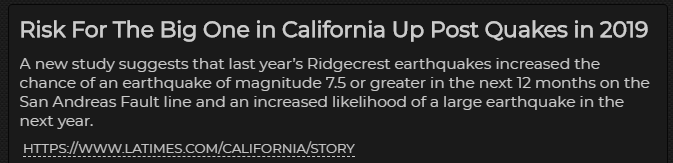
“The model estimates that in the year after Ridgecrest, there was an an eight percent chance of a magnitude 7.7 event along the Garlock. While that did not come to pass, the work suggests a greater risk still remains than previously recognized. In the upcoming year, the chance of such a quake remains at 2.3 percent, about 100 times as large as previous models found.”

A large earthquake in that area would certainly cause some movement in the stock market, as Silicon Valley, for example, is located in California.

2 Likes

California is the world’s fifth-largest economy and the largest single U.S. state by GDP.

As far as I know, natural disasters have caused temporary dips, but unless the disaster is of Emmerichian levels like 2012 or The Day After Tomorrow, activity, recovery, and rebuilding should quickly boost the economy.

As a curiosity, it’s worth mentioning that Bank of America, later the world’s largest and most highly regarded bank, sowed the seeds of its success in 1906 when a massive earthquake leveled San Francisco. The bank lent to “ordinary people” from amidst the ruins when the need was greatest, while competitors fled the scene. At that time, it was known as Bank of Italy, and it has little to do with the current Bank of America, although the name has lived on.

10 Likes

Looking at history, black swans could perhaps initially be roughly divided into two categories: those originating from humans and those coming from outside. By those originating from humans, I refer to triggers related to weaknesses in societal structures or systems, such as a financial crisis, and by those coming from outside, things like natural disasters. Sometimes, a series of events can involve elements from both categories. For example, coronavirus, although I would not classify it as an actual black swan because history knows numerous epidemics, where a virus developed into an epidemic affecting the global economy. Perhaps in the case of coronavirus, which could be classified as a grey swan to some extent, the most significant element was not the actual external virus, but the weaknesses in societal structures and the unprecedentedly strong restrictive measures included in the response.

It is easy to imagine external threats, but I would pay more attention to black swans or events enabled by human and societal structures that, like coronavirus, can activate some societal weakness and lead to unpredictable consequences.

Example.
Society is increasingly dependent on electricity, telecommunications, and electronic devices year after year. History knows at least two powerful solar storms, the 1859 Carrington event and the 2012 coronal mass ejection that could have destroyed the global power grid if it had hit Earth. Here too, like with coronavirus, there are two dimensions: an external trigger and a societal weakness.

Bachelor’s thesis encountered: Effects of geomagnetic storms on the power grid
Rahkonen.pdf (841.3 KB)

2 Likes

In relation to this, a master’s thesis: “Calculation of geomagnetically induced currents in the Finnish transmission grid”

3 Likes

The investor’s big storybook, or rather animal fable, truly includes the bull, the bear, the cod, the Thanksgiving turkey, the lame duck, and the black swan. Couldn’t the grey swans be left out of the fable, though? At least SARS2 is not the fault of grey swans, but of Chinese bats. Anyone who has followed the family life of whooper swans knows that grey swans are cygnets or young swans. :wink:

3 Likes

Potential black swans in 2021:

Rapidly accelerating inflation

For some reason, Corona is not being defeated by vaccines

2 Likes