You can find a list there of what works and what doesn’t in Nordnet, i.e., experiences so far:
2 Likes
I’ll probably have to open a new third AOT at Osuuspankki. Mandatum doesn’t allow buying those either.
Many are available for purchase through Nordea, and there have been no issues. 
3 Likes
BTC 75%
ETH 13.5%
SUI 11.5%
If you don’t dare to buy BTC now, you never will. Let’s see where the big money goes. The goal is to get rid of ETH and SUI positions within a year.
6 Likes
It’s time for the semi-annual review again! I was surprised by how many changes have occurred in half a year, even though it feels like I’m not doing anything and sitting on my hands (as it should be). Hopefully, there will be even fewer changes in the next half-year.
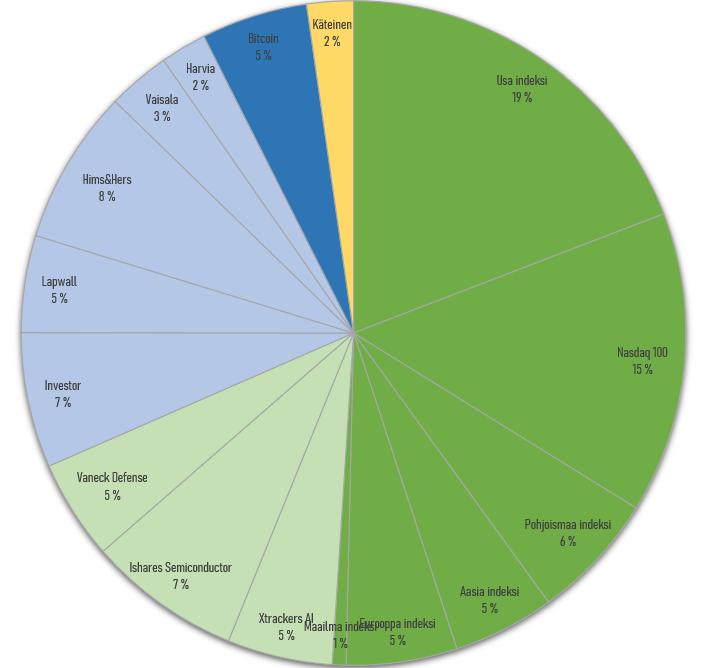
Fodelia, Canatu, Marimekko, and Applied Materials have left the portfolio. I aim to keep the entry screen for my portfolio strict and the number of positions small. I didn’t feel like buying more of these, so out they went. You don’t get rich with small positions. Additionally, the S&P500 healthcare index has left. I realized that an aging population doesn’t automatically benefit the largest holdings in this sector; rather, there might be a couple of variables, so to speak, that I don’t have the ability to anticipate.
During the April dip, I learned that it’s always good to have cash. Therefore, a cash line has been added to the portfolio, cash reserved for taking advantage of dips. In the long term, the equity weighting will remain 100%.
Harvia has been added to the portfolio as a new entry. Growth, megatrends, good margins, and good return on equity. Rarely available. Let’s see if the position grows further.
In the ETF sector, a view has been taken by adding a touch of the defense sector. This has performed reasonably well. I need to consider whether to realize profits from this, as I’m not good at holding thematic ETFs and can no longer say if its momentum is growing. On the other hand, the diversification benefit and “insurance feature” still exist.
Semiconductors have now been included via an ETF; my view on this is strong, and I expect strong growth towards the end of the decade.
In the usual style, over half of the portfolio is protected from my own follies in index funds. The OP-Maailma-indeksi (OP World Index) has been added there; I’m testing how much I can accumulate into the world index pot through micro-saving during the year.  Additionally, the Europe index, my own pessimism regarding companies in this continent has faded away.
18 Likes
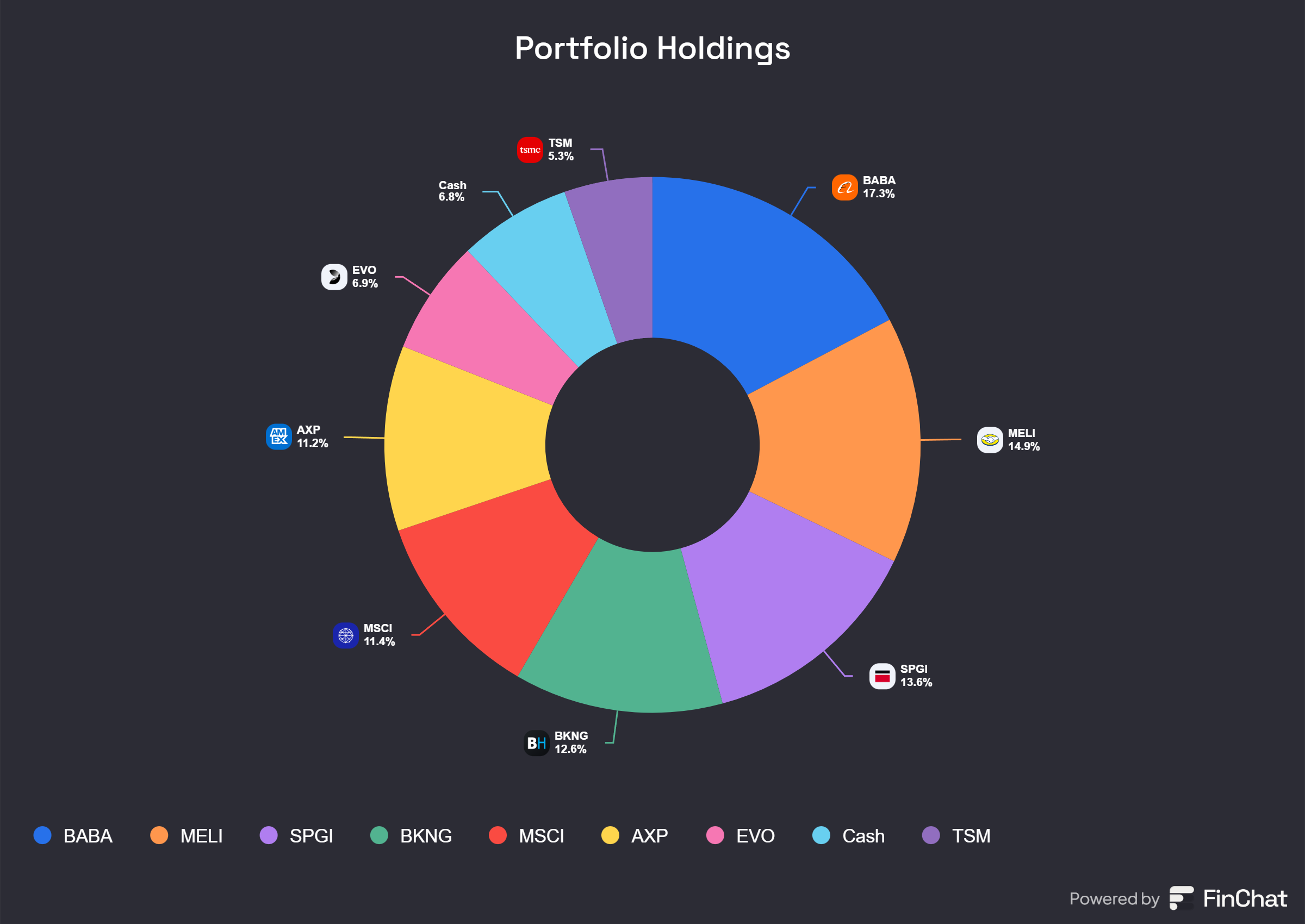
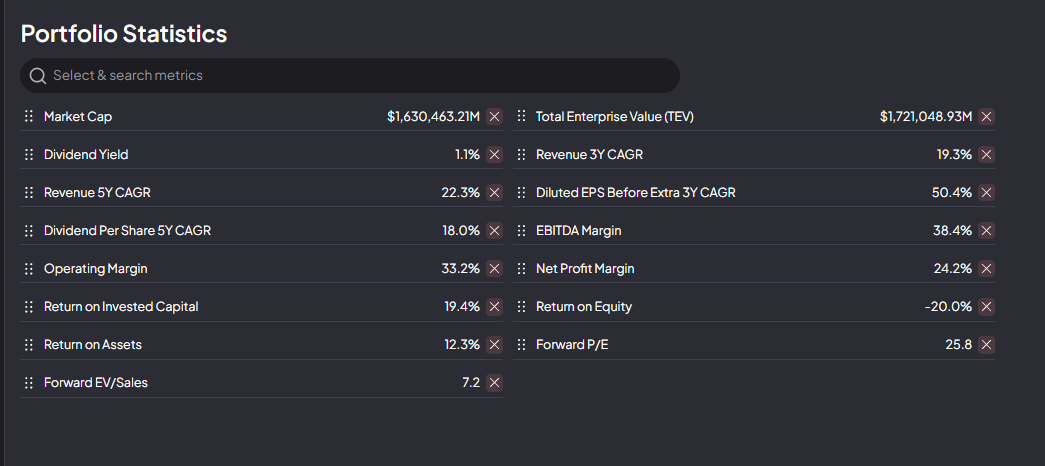
My investment philosophy centers on investing in companies with wide moats and high barriers to entry. My goal is to find companies that can maintain and grow their market position over the long term. My criteria are as follows:
-
Growing revenues and cash flow: I look for companies that demonstrate continuous growth in revenue and free cash flow.
-
Strong management that creates shareholder value: I favor companies whose management allocates capital efficiently and creates sustainable value.
-
No share dilution or excessive stock-based compensation: I avoid companies that diminish shareholder value through excessive share issuances or unreasonable compensation.
-
High barriers to entry: I choose companies with strong competitive advantages, such as technological lead, network effects, or brand power.
S&P Global (SPGI)
S&P Global is a leading provider of financial data and analytics, known particularly for its credit ratings, market indices (such as the S&P 500), and extensive data service offerings. The company holds a strong position in global markets, as its services are critical for banks, investors, and businesses. S&P Global benefits from high barriers to entry because the reliability of its data and its brand are unparalleled in the industry. The company has demonstrated steady revenue and cash flow growth, and its management is committed to creating shareholder value.
American Express (AXP)
American Express is a global payment services company that focuses on the premium customer segment. It distinguishes itself from competitors with its strong brand and loyal customer base, which values the exclusive benefits offered by the company. The company has high barriers to entry due to network effects and brand power. Management is known for disciplined capital management, which supports long-term value creation.
MSCI
MSCI is a leading provider of indices, analytics, and ESG (Environmental, Social, and Governance) solutions. The company serves institutional investors, such as pension funds and asset managers, by providing tools to support investment decisions. MSCI’s business is highly scalable, and its indices, such as MSCI World, are industry standards, creating a strong competitive advantage. The company has consistently grown its revenue and cash flow, and its management has demonstrated the ability to create shareholder value. A Q1 2025 customer retention rate of 95.3% indicates that it is not easy to disengage from the company’s products.
Evolution (EVO)
Evolution is a market leader in the development and provision of live casino games for online gaming platforms. The company has revolutionized casino gaming with its technological expertise and innovative game concepts. Evolution’s strength lies in its technological lead and brand power, which make it the industry’s top player. The company has high barriers to entry because its game selection (Crazy Time, Lightning Roulette, etc.) is particularly difficult to replicate. Evolution has rapidly grown its revenues and cash flow, and management focuses on sustainable value creation. Recently, Kenneth Dart has purchased shares in the company and currently owns over 15% of the company. I believe Dart will emphasize shareholder value creation even more.
Taiwan Semiconductor Manufacturing Company (TSM)
TSM is the world’s leading semiconductor manufacturer, producing microchips for most technology companies, including Apple and Nvidia. The company holds a unique market position, as it is technologically ahead of its competitors and has the capacity to meet global demand. TSM’s competitive advantage lies in its scale and continuous investment in research and development. The company has steadily grown its revenue and cash flow, and its management is committed to creating shareholder value for shareholders. Large investments in the United States mitigate geopolitical risks.
Booking Holdings (BKNG)
Booking Holdings is a leading online travel booking service that operates brands such as Booking.com and Priceline, among many others. The company benefits from network effects, as its platform connects millions of travelers and service providers worldwide. Booking Holdings has high barriers to entry due to its extensive network and brand recognition. The company has demonstrated strong revenue and cash flow growth, and its management is known for efficient capital allocation. Share buybacks are executed as much as possible.
MercadoLibre (MELI)
MercadoLibre is Latin America’s leading e-commerce and fintech company, often referred to as the “Amazon of the region.” It operates a marketplace, a payment platform (Mercado Pago), and a logistics network. The company has a strong competitive advantage due to its regional presence and network effects. MercadoLibre has rapidly grown its revenue and cash flow as e-commerce and digital payments become more widespread in Latin America. Management has demonstrated the ability to innovate and create shareholder value.
Alibaba (BABA)
Alibaba is China’s leading e-commerce and cloud services company, operating platforms such as Taobao and Tmall, as well as the cloud service Alibaba Cloud. The company holds a strong position in the Chinese market, and its network effects and infrastructure create high barriers to entry. Alibaba has grown its revenues and cash flow, despite facing regulatory challenges. The company’s management is committed to long-term growth and shareholder value creation. The Cloud segment has good guidance for 2025. I believe I will sell about half of this position later this year, as it is significantly overweight.
The following companies are on my watchlist: $NOW, $CRM, $V, $MA, $APH $MSFT $GOOG $MCO.
45 Likes
Here is another portfolio review coming up, it’s already been over a year since the last one. The previous one was on April 12, 2024, and now here is the portfolio review with values as of May 29, 2025. For the first time, the total value of my portfolios has crossed the 900,000 euro mark, and I’ve also added the development of my salary income at the end.
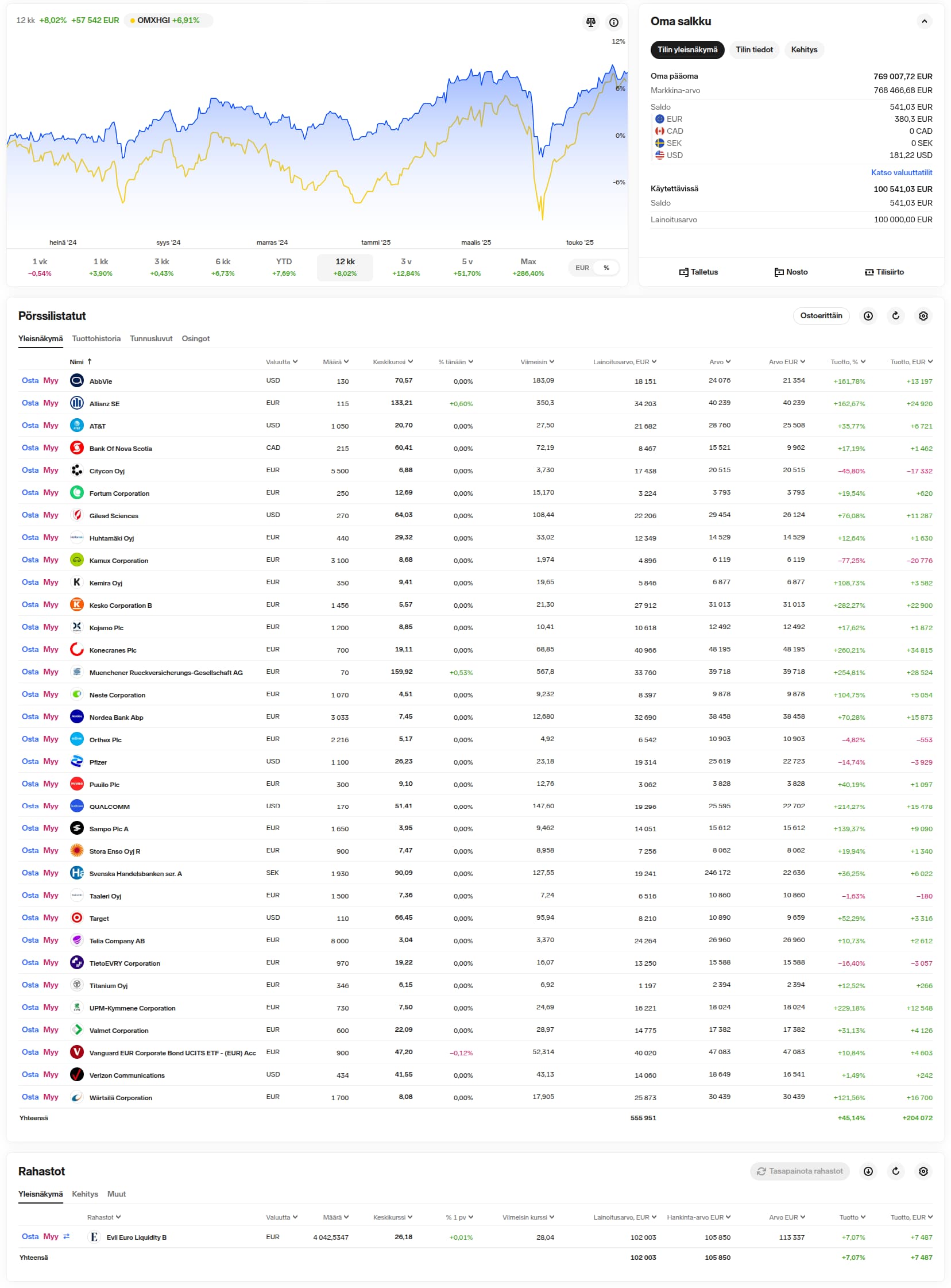
Tax-exempt equity savings account (AOT) in Nordnet (May 29, 2025):
Equity Savings Account (OST) in Nordnet (May 29, 2025):
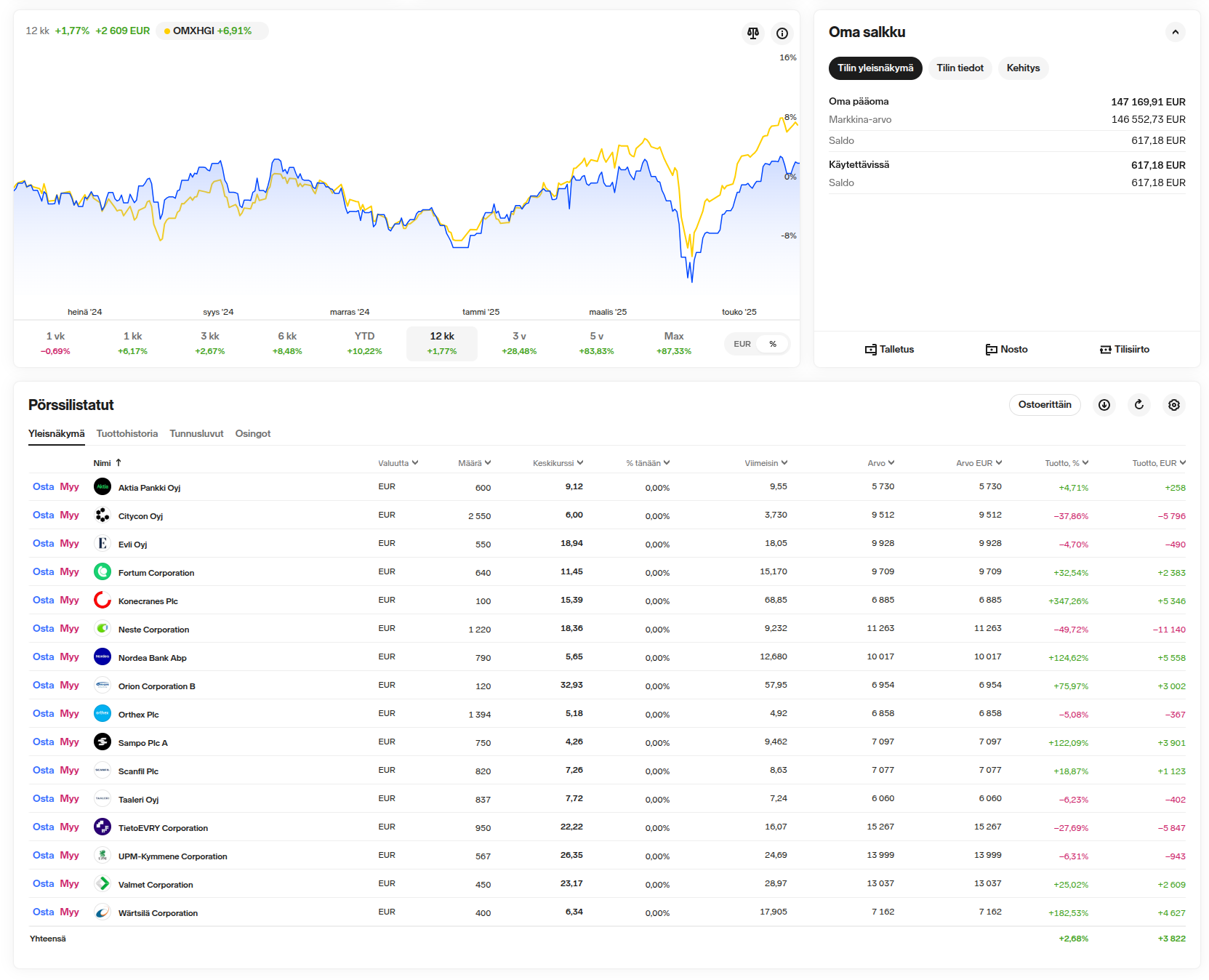
Dividends in Nordnet (May 29, 2025):
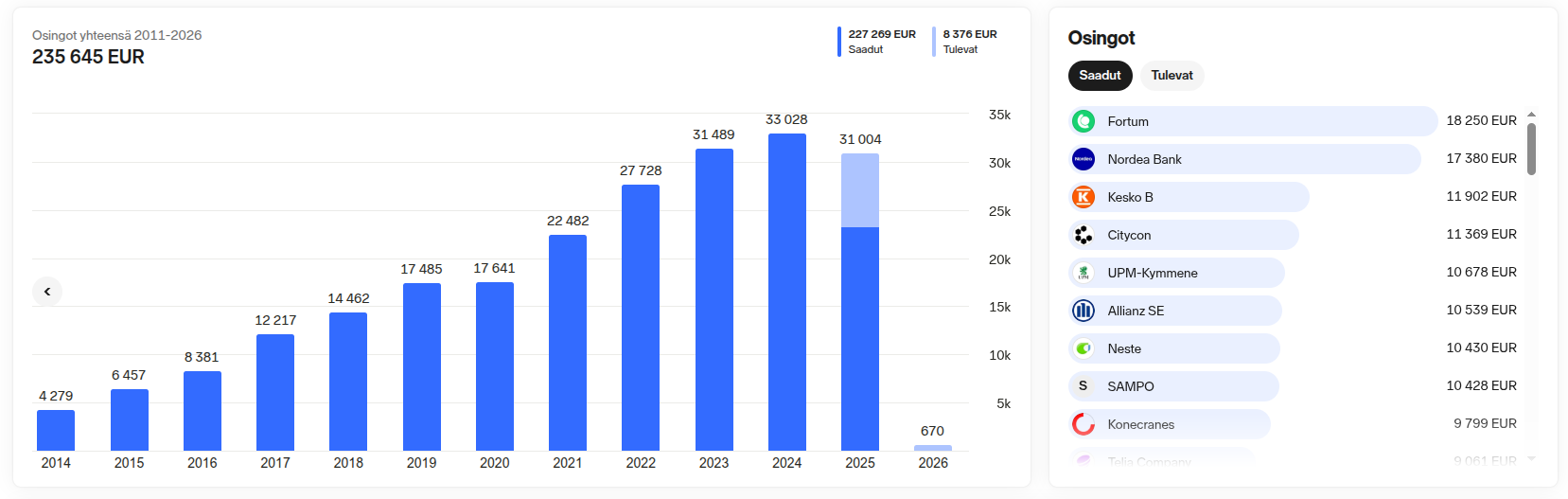
Events and insights from roughly the past year:
Overall, the portfolio has performed pretty much at the same pace as the comparison index OMXHGI. The OST 12-month return is +1.77% and the AOT +8.02%. This time, the OST performed worse than the AOT, whereas last time it was the other way around.
Surprisingly, there have been quite a few sales and purchases over the past year: 105 transactions in total. I have trimmed and traded positions a bit more than usual, although the main strategy continues to be traditional “buy and hold” and membership in the dividend party. However, I calculated that through trimming and short-term trading over the past 12 months, I made around €20,000 in profit, a little over half of which is accounted for by trimming Wärtsilä and Konecranes. Due to price appreciation, they had grown a bit too large in my portfolio over the long term, so minor trimming was in order. There have also been plenty of various smaller short-term sales that generated capital gains, including Stora, Kalmar, Terveystalo, and the sale of a Treasury bond.
Over the past 12 months, I have bought these for the long term:
- Aktia OST
- Evli OST
- Neste OST
- UPM OST
- Scanfil OST
- Orthex AOT+OST
- Taaleri AOT+OST
- Target AOT
- Stora AOT
- Pfizer AOT
- Huhtamäki AOT
- Kojamo AOT
- TietoEvry AOT
- Fortum AOT
- Puuilo AOT
I trimmed these:
- Scanfil OST
- Konecranes OST+AOT
- Valmet OST+AOT
- Fortum OST
- Wärtsilä OST+AOT
Short-term trades:
- Tokmanni, Evli, Stora, Aktia, Anora, Kalmar, Nokian Renkaat
Clean exits from the portfolio when my view changed:
- Kamux
- Terveystalo
So, from the sales, I trimmed some large positions that I perhaps bought a bit too much of back in the day, including KC, Valmet, Wärtsilä, Fortum, Scanfil. Fortunately, I managed to sell my Kamux shares out of the OST at pretty much +/-0 return in the summer of 2024 – this was perhaps one of the best moves, because unfortunately, Kamux remained on the AOT side, where it is one of the biggest trash positions. On the OST side, it would have really pissed me off if the Kamux shares had stayed there, because you can’t deduct capital losses there for tax purposes anyway.
I will sell the Kamux shares off the AOT someday, and that will result in nice capital losses (around €20k), but it’s still a bit open when and at what price – does it make sense to wait for better times anymore, because at least for my part, I lost faith in the company a long time ago. Who would have thought that it would suffer Intrum-level losses. Kekkonen would say “fucking idiots” when people don’t know how to run such a simple business properly. To Pajuharju, I would say thank you and goodbye – deliver results or get out.
Terveystalo also yielded pretty decent profits – I might buy it back someday if I can get it cheap, but it’s not a very appealing company to me due to political risks. My purchases of Neste for the OST have also been poorly timed, but I haven’t given up on it yet, though I won’t be buying anymore either.
On the fixed-income side, I have kept all other fixed-income investments except for the “iShares $ Treasury Bond 20+yr”, which I sold with a pretty good profit – and a good thing too. I won’t be touching that thing during Trump’s term. During the worst of Trump’s tariff shenanigans, I bought this and that stock from the dip pretty much at the bottoms and even managed some quick gains when the daily movements of some stocks were around +/-10%. If Trump serves up more dips, I will continue to take advantage of them. Even though Trump is a complete lunatic and has ruined the reputation of the US for a while, I don’t believe he can completely destroy the entire system, and perhaps with some luck, something good could come out of this in the long run.
I bought Kojamo quite a few times into falling prices, and it has performed quite well so far. I have already trimmed it a bit, taking profits home, but I will let it sit in the portfolio for a while longer until the situation in the housing market clearly improves from this. I consider Kojamo purely a housing investment even though it is a stock: I will probably never buy and rent physical apartments, and I also steer well clear of housing funds, but I think Kojamo is a good, liquid instrument if you want to take a view on the Finnish housing market. I’d rather buy apartments through this at a discounted price than take on high risk and debt with individual apartments.
Most of this year’s dividends have already arrived, but some will still drop into the account later in the year. Currently, the amount of cash in Nordnet is very low, meaning almost everything is tied up in stocks and fixed-income funds. Since the last portfolio review, it looks like I only put about €18,000 of new money into Nordnet, and on top of that, dividends came in at around €30,000 I suppose, meaning almost €50,000 in new money has entered the portfolio since the last review, with the rest being price appreciation. I have a €40,000 war chest waiting in a Collector savings account.The combined market value of my stock portfolios (tax-free equity savings account [AOT] + share savings account [OST]) has now stayed slightly above the €900,000 mark, standing today at €914,979, although it must be taken into account that I am now also including fixed-income funds in Nordnet, which amount to a little over €160,000. Around 17% of the portfolio’s value is now in fixed income, which still sounds very sensible to me at the moment. I aim to keep this around the 10-20% range as long as fixed-income investments provide a reasonable yield. However, I am no longer buying more fixed-income assets because the best moment has already passed.
Fixed-income holdings are now roughly:
- €40k in cash in Collector Bank’s savings account at a 3.25% interest rate (dropping to 2.75% in June)
- €113k in short-term fixed income in Evli Likvidi B, approx. 2.99% YTM (a year ago it was 4.8% YTM)
- €47k in semi-long-term fixed income in EUR Corporate Bond, approx. 3.2% YTM (vs. a year ago 3.7% YTM) + positive leverage if interest rates fall
Interest rates have fallen quite a bit since the last portfolio review; for example, the YTM of Evli Likvidi B has dropped from 4.8% to 2.99% and will probably fall further from there. At best in recent years, the YTM was probably 5.04% for Evli Likvidi B and 4.24% for Vanguard’s Corporate Bond. I think I made my fixed-income investments at a pretty optimal time, and the return/risk ratio has been really good. My annual return has been 4.6% in Evli Likvidi and 6.6% in the Corporate Bond. I have considered selling fixed-income funds, but I can’t find anything attractive enough to buy in the stock market to shovel such large sums into it. As long as the YTM stays around 3%, I think I’ll just sit on my hands with the fixed-income assets for a while longer. I figured I might offset Kamux’s upcoming capital losses perhaps at some point by selling fixed-income funds next year.
Instead of the portfolio’s price development, I follow the development of dividends with greater interest, as I can influence that more than the price chart by buying more companies that pay growing dividends. Last year, I received €32,614 in gross dividends (€26,001 net). Nordnet counts the interest income paid out by the Treasury Bond as a dividend because technically it was a dividend, but I personally count it as interest income, which is why there is a difference between Nordnet’s and my own calculations regarding dividends. Dividend flow for this year should be approximately €34,862 gross (€27,909 net). Interest income last year was much higher than expected: I initially estimated around €7,000–€9,000, but the fixed-income funds performed much better and interest income turned out to be just over €13,000 (incl. savings account interest and fixed-income fund returns/appreciation in 2024). In other words, total passive income last year was €45,945 gross (incl. dividends and interest). This year we will hardly get that much interest income, but dividends + interest this year will also quite certainly be closer to €42,000 gross. The next goal could be, say, to get over €30,000 in net dividend income, which could be achieved perhaps in a couple of years. It would also be nice to see a portfolio worth over a million euros, but I can’t really influence that myself as market movements are what they are, and that goal doesn’t even really feel like anything anymore…
What will I do for the rest of the year then? It probably depends a lot on Trump’s antics and whether good buying opportunities arise. If the markets are calm, I’ll probably grow my war chest in Collector’s savings account towards €7,000 [Note: €70,000], which is the largest I planned to grow it. At the same time, I will also invest the incoming dividends by making small additions to current positions. Otherwise, I am quite happy with the current portfolio, except that I really want to get rid of Kamux. I would also like to trim some positions just a little, but at a better price (Citycon, Neste, Pfizer, Telia, Tieto) – I am in no hurry with these, so I will wait for better spots to trim. I haven’t made any shopping list yet of what I would buy if a bear market were to hit. If interest rates fall a lot more from here, I’ll have to think about when selling fixed-income funds would make sense – though I don’t think I’ll do anything with them this year, but maybe next year. If some major crash occurs, I’ll slowly start liquidating Evli Likvidi B and transfer money from it to stocks and maybe some index ETF.
Right now, I’m mostly trying to enjoy the summer and avoid glancing at stocks over the summer.
Below is the traditional development of the portfolio, dividends, and interest income from the beginning:
Portfolio market value development:
01.03.2011: 0 e
01.04.2011: 21,000 e
01.12.2011: 40,000 e
01.01.2012: 50,000 e
01.12.2012: 74,000 e
01.04.2014: 100,000 e
01.12.2014: 140,000 e
01.11.2015: 174,000 e
01.08.2016: 211,000 e
01.12.2016: 256,000 e
01.12.2017: 308,000 e
01.12.2018: 330,000 e
23.03.2019: 355,833 e
28.11.2020: 503,148 e
01.01.2021: 502,015 e
02.07.2021: 601,904 e
31.12.2021: 609,729 e
04.06.2022: 596,525 e
31.12.2022: 593,880 e
04.08.2023: 627,523 e
02.12.2023: 731,735 e
12.04.2024: 803,420 e
29.05.2025: 914,979 eGross dividend development:
2011: 1,370 €
2012: 3,170 €
2013: 3,770 €
2014: 4,270 €
2015: 6,450 €
2016: 9,320 €
2017: 11,260 €
2018: 13,920 €
2019: 17,150 €
2020: 17,600 €
2021: 22,650 €
2022: 27,740 €
2023: 31,477 €
2024: 32,614 €
2025: 34,862 € (forecast)
Gross interest income development:
2011: 434 €
2012: 149 €
2013: 161 €
2014: 0 €
2015: 0 €
2016: 0 €
2017: 732 €
2018: 773 €
2019: 402 €
2020: 461 €
2021: 553 €
2022: 832 €
2023: 4,725 €
2024: 13,331 €
2025: 6,000 - 8,000 € (forecast)
As a new addition, I’ve also included the development of my salary income below, since this information was so easily accessible from Ilmarinen’s earnings statement. So this is the gross annual salary from work, excluding capital income. It includes wage income subject to withholding tax, including all benefits such as company phone, lunch vouchers, etc. taxable income. The total sum of salary income received up to the year 2024 is a total of €870,890:
2005: €6,240/year
2006: €6,500/year
2007: €6,254/year
2008: €6,146/year
2009: €8,335/year
2010: €8,666/year
2011: €12,984/year
2012: €25,023/year (permanent job started, prior to this summer and part-time jobs)
2013: €42,322/year
2014: €47,369/year
2015: €48,367/year
2016: €48,643/year
2017: €51,154/year
2018: €53,286/year
2019: €61,964/year
2020: €64,155/year
2021: €65,238/year
2022: €71,009/year
2023: €70,981/year
2024: €74,254/year
2025: €76,000/year (forecast)
2026: €77,500/year (forecast)
126 Likes
Every time I see the name of this thread, it comes to my mind to answer the question in the title honestly. What do I have in my portfolio? - Losses, a hell of a lot of losses.
61 Likes
Let’s revisit the portfolio after a long time. It includes all listed stocks except Inderes. In practice, these are on most accounts, but I usually look at things as a whole pie chart. There’s quite a bit of change from last time, as I’ve familiarized myself with the offerings of the German stock exchange. My initial reaction to the trade war also caused a significant churn in the portfolio, where some stocks flew out, and some flew back in from the other side of the house a moment later as the situation became slightly less worrying.
As an aside. I’ve colored the slices according to the companies’ own brand colors. One could do a small color analysis from this, noting that various shades of green have become common as company brand colors.
The stock portfolio evolves with my taste and according to what the stock exchanges have to offer. My basic idea in investing has long been the same: to buy stocks below their fair value.
The current environment is nice in the sense that after years of beating, not much is expected from Finnish or many other small-cap companies globally. Some portfolio companies are currently performing poorly, but in layman’s terms, quite a few companies are trading at roughly P/E 10-15x normalized earnings, slightly below or above.
I most enjoy digging for stocks where other investors aren’t looking. Small-cap companies have many hazardous cases and their own risks, but nowadays, they aren’t paid much for either. If or when there’s a slight improvement in the European economy, it should benefit many companies. The prolonged recession-like state in Finland and Europe is partly structural, but also partly cyclical. And this has made small-cap companies, in particular, look worse than they actually are. I have tried to capitalize on this mispricing in recent years.
After the fruitful lesson from Boreo, I have also sharpened my strategy to avoid indebted companies. As a rule, all companies indeed have strong balance sheets. That warms my heart, because if difficult times continue, one doesn’t want to look at terribly shabby balance sheets. At worst, it increases the risk of a share issue.
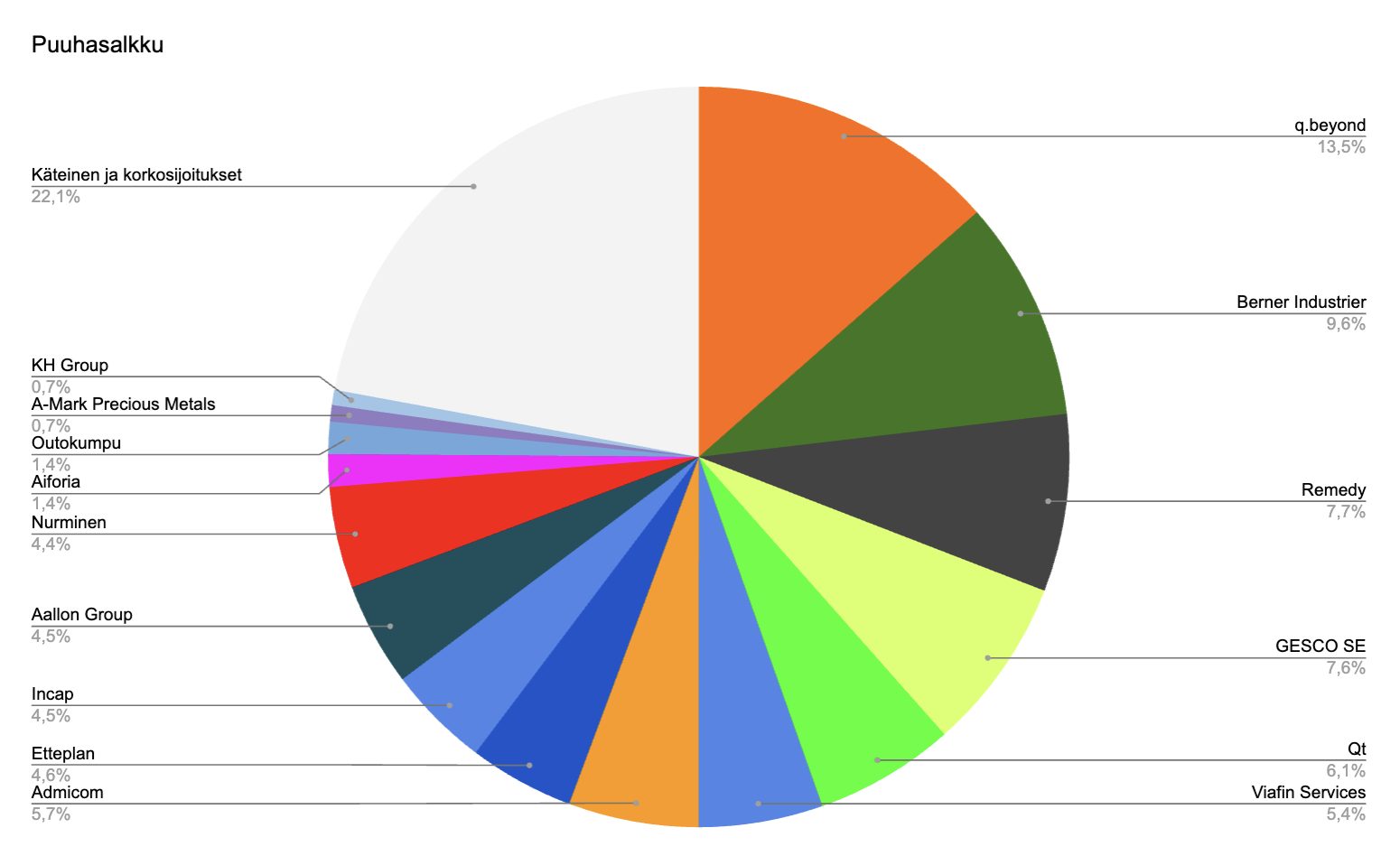
The portfolio’s performance this year has been okay. +7% year-to-date, although this is a relatively short timeframe to look at things. The peak in 2021 was so high that the portfolio hasn’t reached it yet. On the other hand, I am satisfied with the development in the sense that despite catastrophes like Boreo and Kamux, the portfolio has recovered somewhat since 2022, whereas the Helsinki stock exchange has tumbled to new lows. However, the long-term return has been good and speaks to the fact that the processes, thoughts, and deliberations refined over the years before pressing the buy and sell buttons have continuously developed despite constant fumbling. And fumbling will surely continue, it’s part of the game. But one can at least try to curb its amount by avoiding the worst pitfalls.
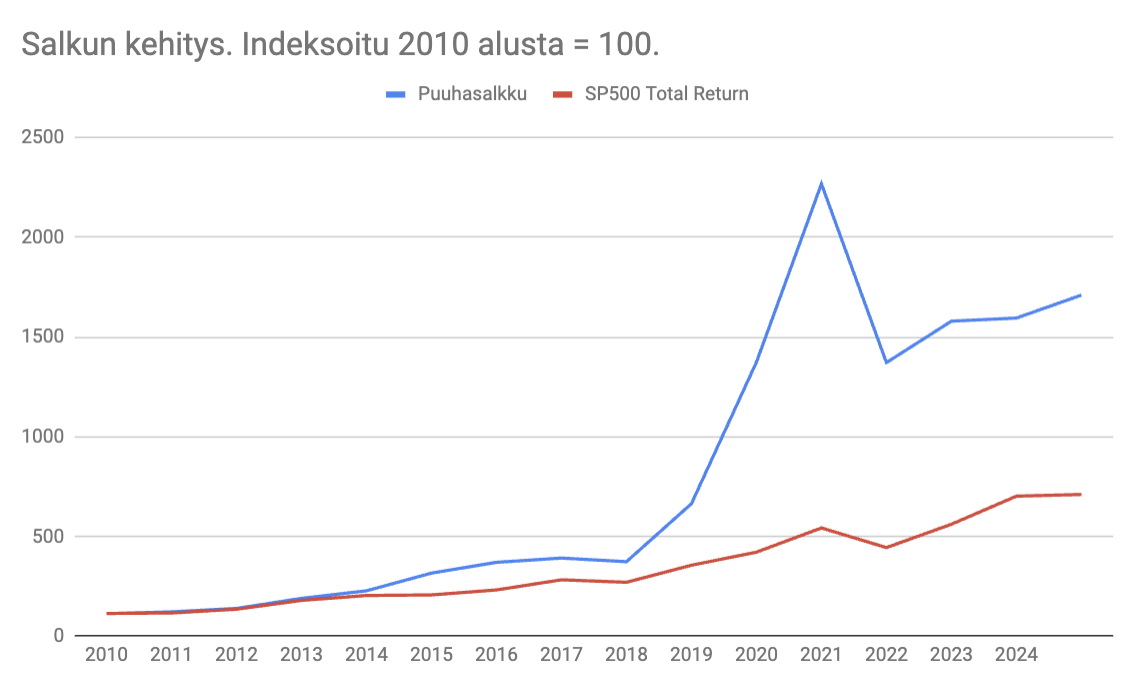
There’s a good amount of cash. Cash is an option to buy stocks now or later. I’ve been enthusiastically sifting through companies all over Europe. That German market, in particular, is like Hesuli squared, and now Nordnet has also opened up French and other markets. I spend a much larger part of my free time on stocks than before, and new ideas are constantly maturing. More than before, after initial research and quick checks on a company, I try to spend time on its comparables. All companies believe they are always leaders in their field, and it’s strangely enlightening to read the same arguments from a company’s comparables as to why they are leaders. This brings more perspectives on the quality and situation of companies. For example, before buying Incap, I went through Note and Kitron (Note is also very interesting), but still concluded that Incap is one of the best in its peer group, plus it’s more affordably priced. Or, regarding q.beyond, I went through a bunch of other German IT service companies, in addition to keeping an eye on the Finnish IT sector and a bit of Sweden. Well, q.beyond isn’t the best of the bunch, but it’s affordably priced if the profitability turnaround succeeds. The company’s robust net cash and its own data center are also an interesting card.
GESCO was also not included in the last review, so it deserves a brief mention. It’s a multi-industry laggard that has been bogged down in restructuring for years, of which there are quite a few in Germany. The company’s largest business is the tool steel wholesaler Doerrenberg, which is quite cold due to the German economy’s hangover. But the German economy is unlikely to shrink forever, especially with a stimulus package being rolled out. In addition, the company’s new management is focused on improving profitability. A change in management, share buybacks, debt repayments, divestments, and a focus on profitability are usually a classically good combination. Time will tell how well this combo works in this case, but when you can get this junk pile at 0.7x book value (the company has managed an average ROCE of about 10% over the last 7 years, and even more in good times), it’s unlikely to go completely wrong. However, one probably doesn’t want to own something like this forever, unless it gets Swedish management and goes down the path of a Swedish serial acquirer. 
And I still ask. Why take the risk of AI disruption if you can own a piece of this. Look at this beauty.
The OST (Investment Savings Account) was there for a long time, but I removed it because now I practically have stocks in three accounts, and it doesn’t represent the holdings that well.
66 Likes
Shouldn’t you just bravely put that portfolio on Shareville too  Apparently it was removed at some point. It’s a bit strange that not even a single analyst is there, except maybe one…They analyze, but they don’t invest themselves
5 Likes
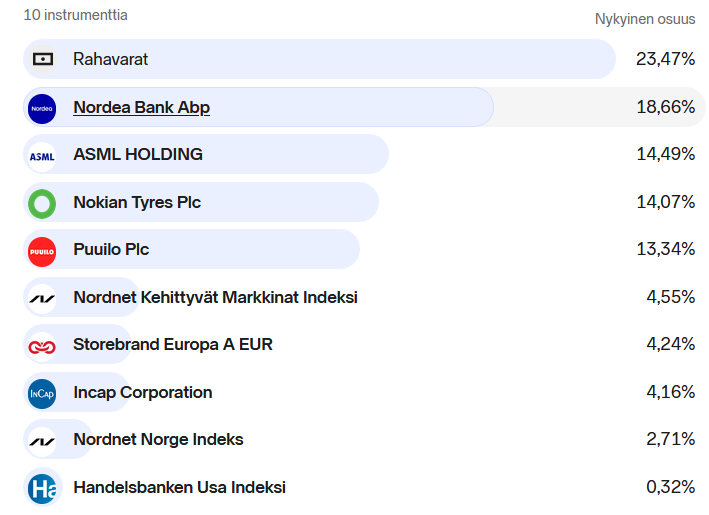
Above is the current portfolio content. In addition to this, the company’s bonus fund, which is the second largest holding.
Nordea - Still the cornerstone of the portfolio.
ASML - A newcomer I grabbed from Nordnet’s offer. A technology leader in an interesting field.
Nokian Renkaat - New factory and strong brand. If a turnaround doesn’t start to show, I’ll sell the shares for something else.
Puuilo - In my opinion, a brilliant concept. However, the valuation is quite tight, so no additions in the near future.
Incap - I definitely intend to add more, but I’ll monitor the current position for a while longer. I hope the management finds use for the massive cash pile.
Funds - On Wednesday, I returned to the US market through a fund. I consider the Oslo stock exchange cheap and, of course, it’s available without fees. I’m very bullish on Europe and emerging markets for diversification. All of these are in monthly savings, which I started rolling again the month before last.
Cash - For once, a situation where not everything is tied up in the market. I’m waiting for buying opportunities and letting the monthly savings roll.
Potential targets - Evolution, which was already in the portfolio. Let’s see the results for the current quarter and then decide. Relais Group has piqued my interest, and I’m keeping an eye on it. There might be a buying opportunity in Novo. I’m particularly interested in the weight loss drug market, but I wouldn’t want (again) a falling knife in the portfolio. Incap addition is probably the most likely next purchase. In addition to these, some domestic engineering company would be of interest.
I like the portfolio holdings. Once we can increase the weight of the funds, I’ll be even more satisfied.
25 Likes
There’s always something at a loss in my portfolio. However, nothing has ever been as much in the red as Neste. Tieto, UPM, and Novo Nordisk are also in the red. Sampo, Kesko, and Faron are in the black. As are the funds, Phoebus, Spiltan Högräntefond, and Selugson’s money market fund. This is what we’re going with.
6 Likes
Another update. Quite a few changes have occurred in the past half-year.
1. ETFs and Funds — 25.29 %
| Fund / ETF | Symbol | Weight |
|---|---|---|
| iShares Core MSCI World ETF | IE00B4L5Y983 | 7.67 % |
| iShares Core MSCI EM IMI ETF | IE00BKM4GZ66 | 6.24 % |
| iShares Core MSCI Europe ETF | IMAE.EURONEXT | 4.66 % |
| iShares Automation & Robotics ETF | IE00BYZK4552 | 4.03 % |
| Svea Index | sve index | 1.98 % |
| Nordea BetaPlus Global Equity | LU0994677119 | 0.71 % |
2. Domestic Stocks — 35.64 %
| Company | Symbol | Weight |
|---|---|---|
| Nordea | NDA FI.HEL | 6.83 % |
| Wärtsilä | WRT1V.HEL | 5.28 % |
| Admicom | ADMCM.HEL | 4.73 % |
| Kempower | KEMPOWR.HEL | 4.48 % |
| Qt Group | QTCOM.HEL | 3.38 % |
| Huhtamäki | HUH1V.HEL | 3.15 % |
| Optomed | OPTOMED.HEL | 3.03 % |
| Neste | NESTE.HEL | 2.83 % |
| Talenom | TNOM.HEL | 1.93 % |
3. Foreign Stocks — 39.07 %
| Company | Symbol | Weight |
|---|---|---|
| British American Tobacco | BATS.LSE | 10.54 % |
| AMD | AMD.NASDAQ | 6.99 % |
| Take-Two Interactive | TTWO.NASDAQ | 5.03 % |
| AstraZeneca | AZN.LSE | 4.85 % |
| Evolution AB | EVO.STO | 4.78 % |
| BAE Systems | BA..LSE | 4.31 % |
| Novo Nordisk | NOVO B.CSE | 2.57 % |
I asked ChatGPT how my previous portfolio differs from the current one:
"1. Structural Changes by Main Category
| Group | Previous Weight (%) | Current Weight (%) | Change |
|---|---|---|---|
| ETFs and Funds | 23.22 % | 25.29 % |  +2.07 % +2.07 % |
| Domestic Stocks | 44.02 % | 35.64 % |  –8.38 % –8.38 % |
| Foreign Stocks | 32.76 % | 39.07 % | +6.31 % |
Summary:
Your portfolio has shifted towards a more international and ETF-heavy direction. The share of Finnish stocks has clearly decreased, and the emphasis on high-quality foreign companies has increased."
I agree with that. I have consciously aimed to reduce the weight of Finnish stocks. There is still an overweight in them, of course.
Then:
" 2. Most Significant Individual Changes
 Sold or Removed Stocks
| Stock | Comment |
|---|---|
| TietoEVRY | Sold – weak performance, sensible decision |
| Valmet | Sold – share price near target, cyclical |
| Nokian Renkaat | Sold – good decision due to difficult outlook |
| Harvia | No longer in portfolio – possibly sold, not visible in current one |
| Palantir | No longer visible – you have likely sold (or significantly reduced) |
It’s nice when ChatGPT praises my investment decisions!
"  New Stocks
| Stock | Comment |
|---|---|
| AstraZeneca | Defensive, high-quality – good ISA choice |
| Evolution AB | Technology-driven growth, excellent replacement for Tietoevry |
| BAE Systems | Defense industry – timely and strategic addition |
| Novo Nordisk | Top quality, low risk – excellent new company |
| Huhtamäki | Stable cash flow and dividends – good ISA investment |
Indeed, quite a few new stocks have been added to the portfolio. AstraZeneca and Novo Nordisk bring diversification to the pharmaceutical markets. AstraZeneca has good drugs and a strong pipeline. For example, the use of dapagliflozin (Forxiga) is constantly increasing, and new indications seem to be emerging all the time. Novo Nordisk is at the forefront of obesity treatment, with Ozempic as the spearhead. The share price has been beaten down quite a bit now, and thus it is also currently at a loss. But there is faith in the future.
I wanted to buy BAE Systems because Europe (hopefully/likely) is also starting to prepare militarily, and Germany is beginning to stimulate its economy, and the EU is also planning joint funding, etc. BAE also has the aerodefence and similar sectors involved, possibly participating in the drone business in the future?
Evolution started to interest me when the share price had been beaten down and the numbers started to look reasonably good. I don’t know the company in great depth, but there’s probably some so-called “safety margin” already? Pyysing also seemed to be buying. Kempower brings more growth to the portfolio.
26 Likes
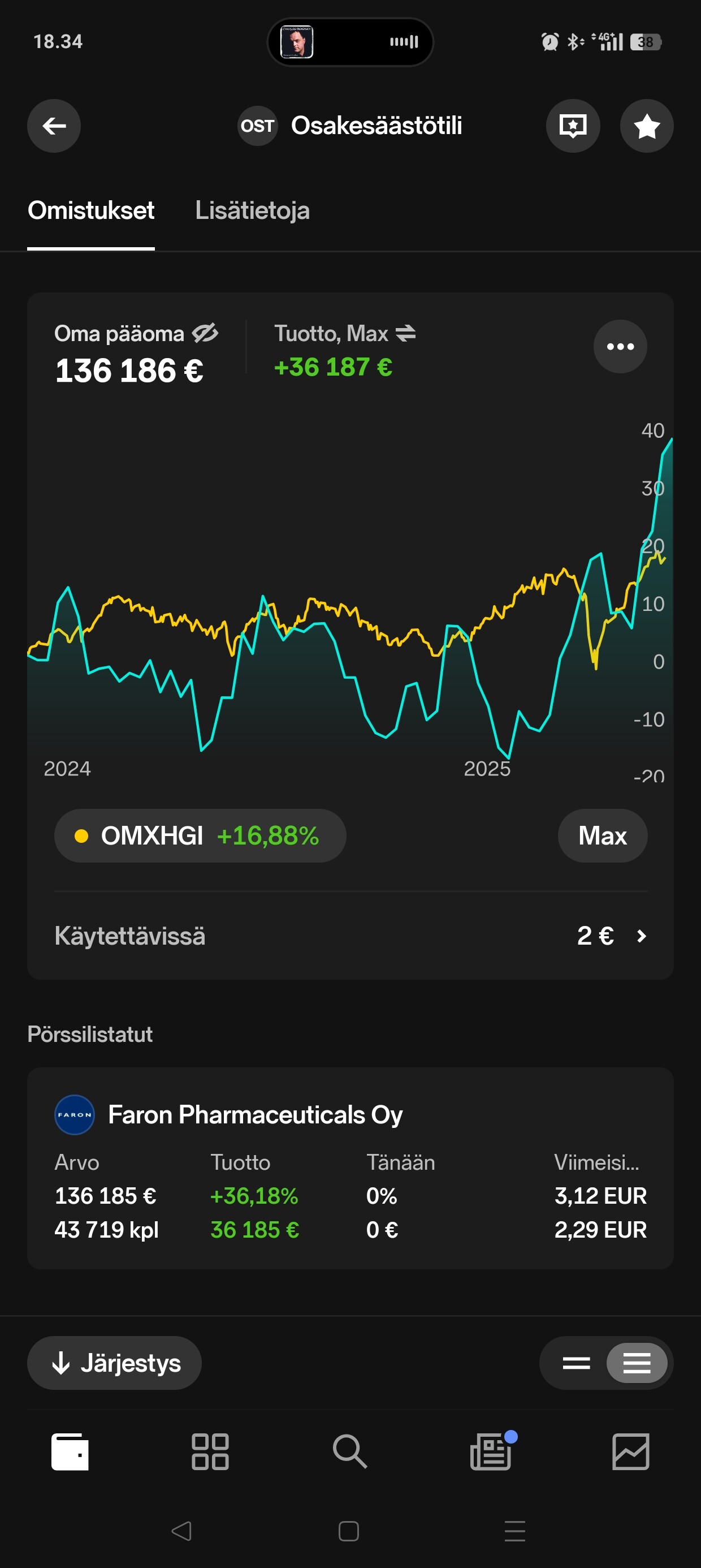
Well, it turned out that I put the rest of my cash into Faron during the previous dip, and now the portfolio is full of it, so with this, we’re going somewhere (to the moon?  ), but let’s see calmly how it goes
53 Likes
So it happened that the curve swung above the target level. At the current level, one could quite carefree live life without the rat race of working life.
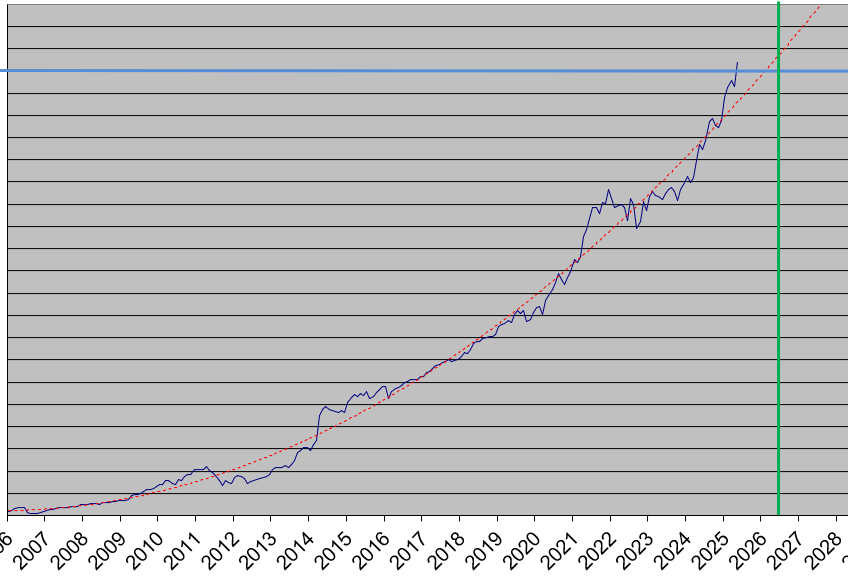
Inspired by exceeding the target, I also tentatively set the date 6.6.2026. It’s not set in stone by any means, but now the target would be known. A year to thoroughly think about my own dreams and aspirations to be realized after my career. Perhaps the goal is to try to slow down even during the last year at work, so as not to get entangled in all work anymore. And work in the future is not ruled out, but a complete detachment for some time is indeed the goal. Perhaps some of my own work projects or then some lighter occupation.
One extra year would bring an emergency buffer and risk provision. In practice, living would be solely on the portfolio’s dividends and interest. A debt-free two-room apartment could also be added as a buffer.
So what changes to the portfolio?! There is no longer a need to actually accumulate wealth, but rather to start protecting it. So the short-term goal is to grow boring and stable dividend machines and purely a “war chest” for bills.
Unnecessary hasty sales should be avoided. After declines, prices tend to rise in due course…
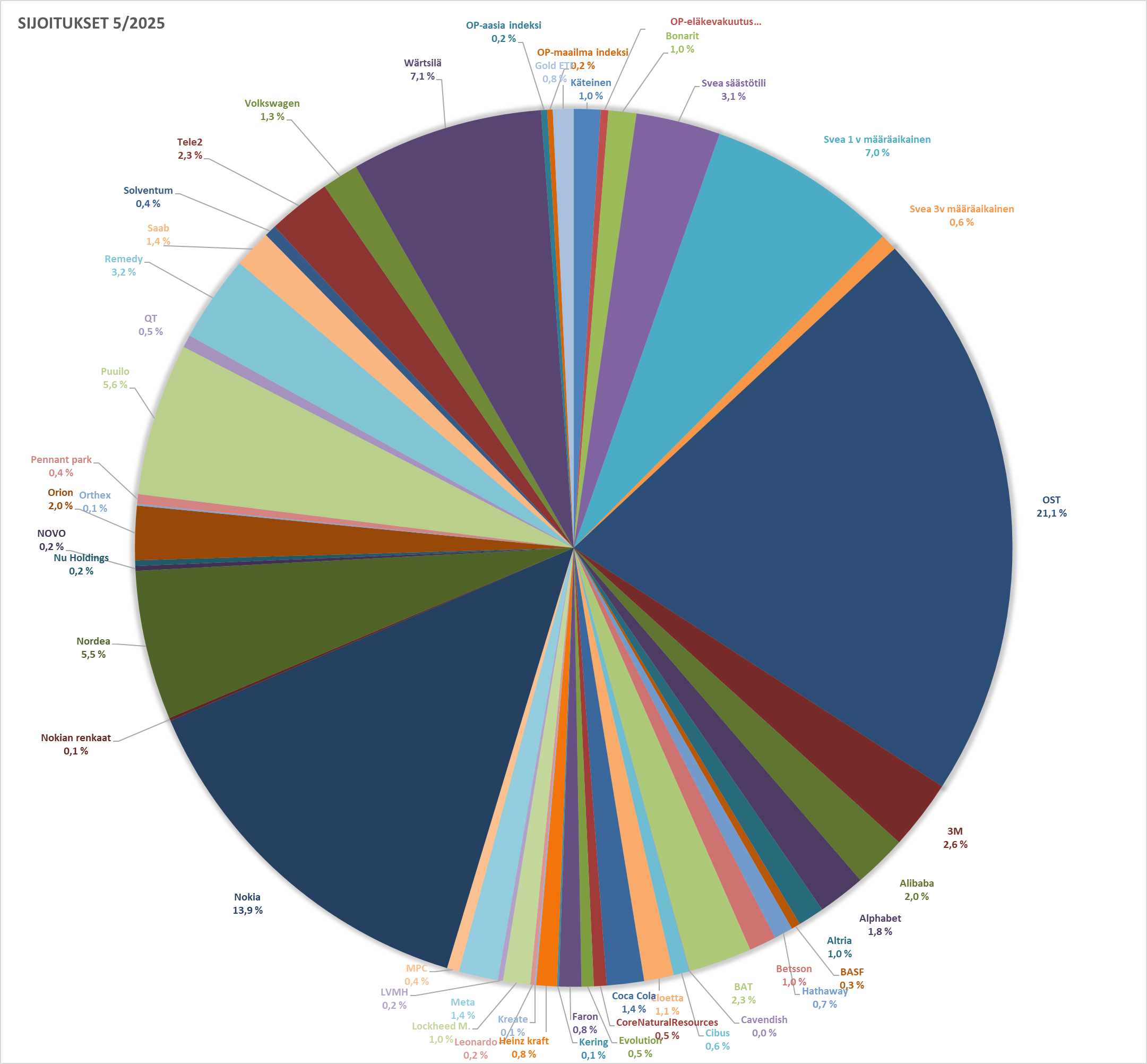
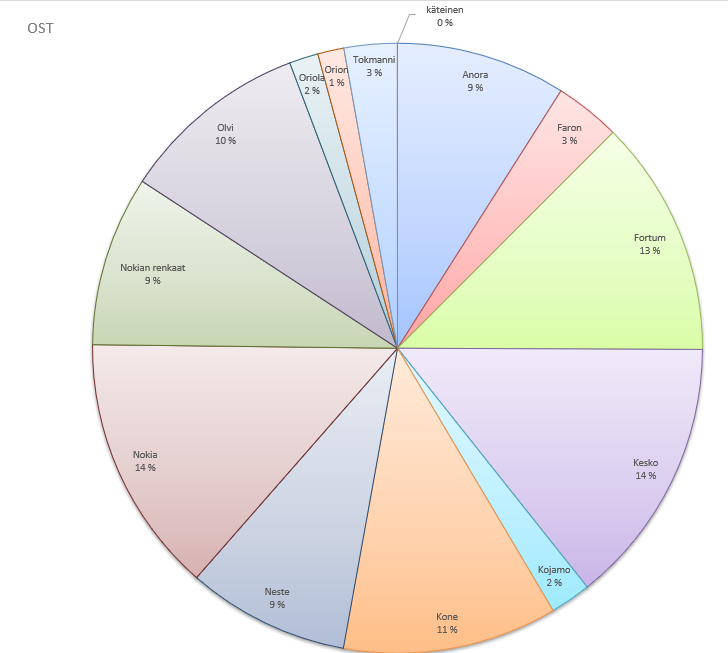
Whew! Quite something, when the goals actually start to be met and one should wonder about the next 20 years 
71 Likes
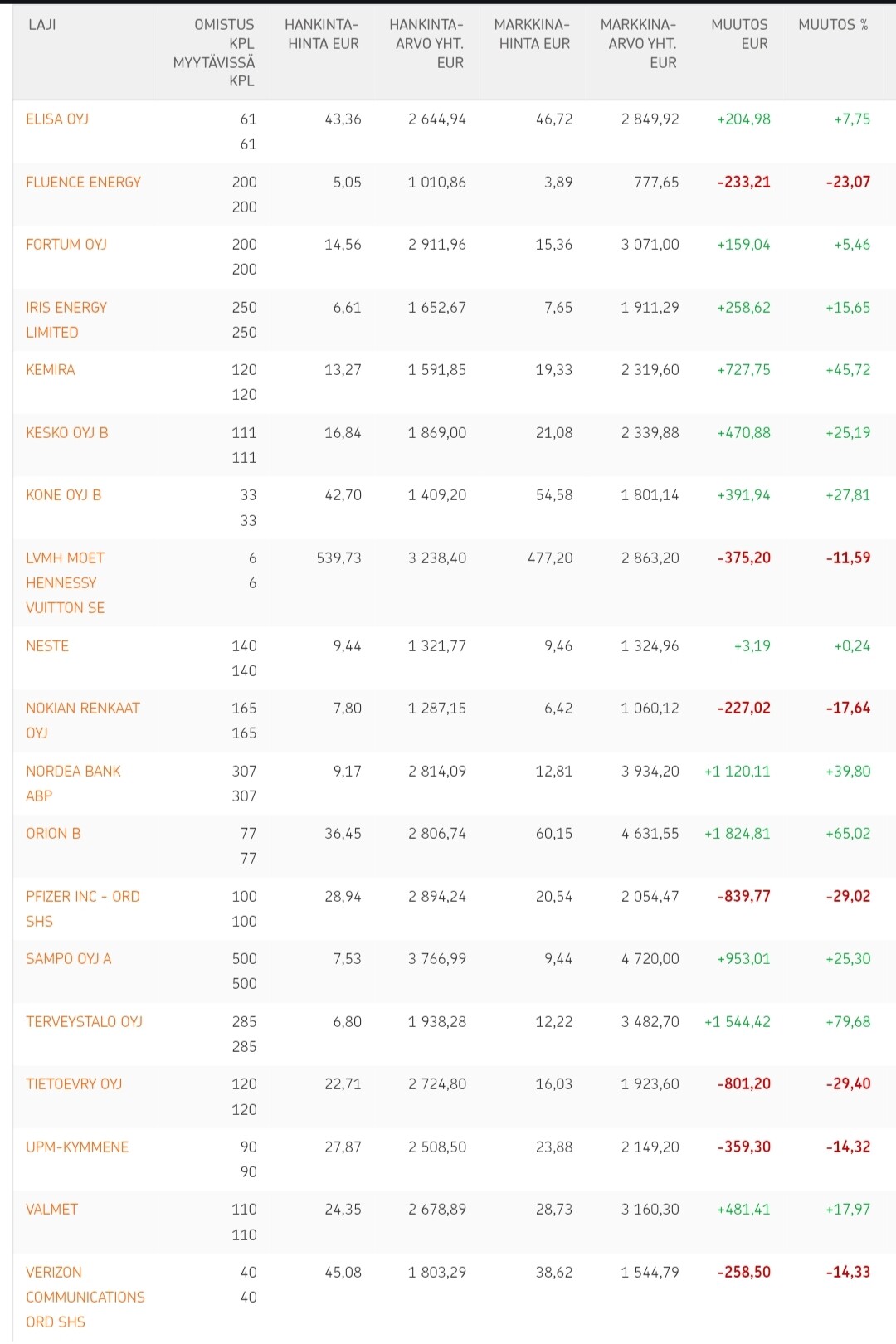
The dividend strategy has become somewhat fragmented, as Iris Energy and Fluence Energy have been added as new holdings since the previous review. And LVMH cannot really be called a dividend stock either.
In addition to these, there is an index portfolio in Nordnet with a market value of 12k, including:
Nordnet Global Index,
Nordnet Sweden Index, and
Nordnet Finland Index.
24 Likes
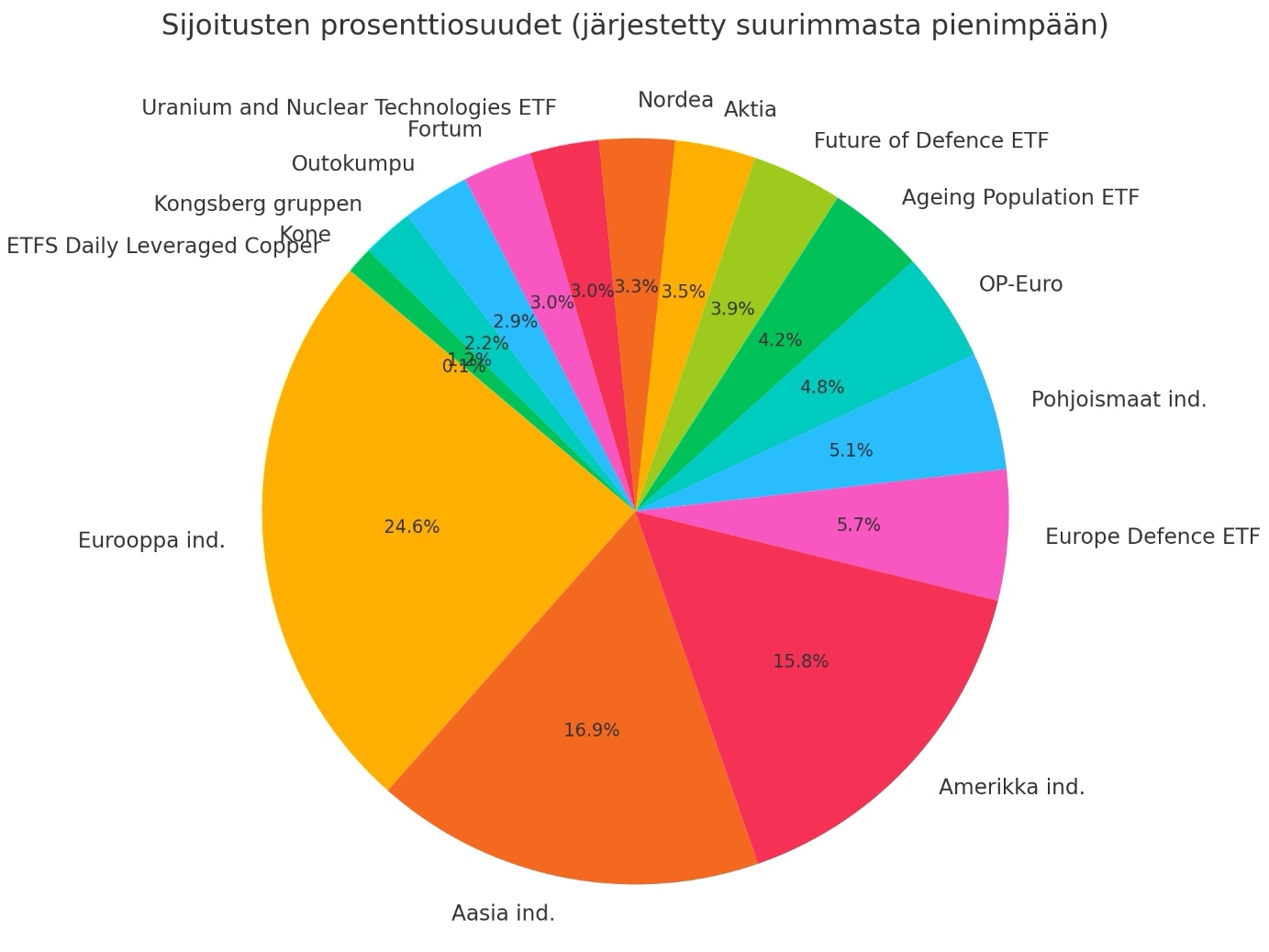
Europe heavily overweight! 49.3% of the portfolio.
15 Likes
Portfolio review time! The latest from January, and again some small changes have occurred. I probably won’t bother with any grand poetry, but a few words per holding. I’ve written something in most of the company threads, so there’s probably no need to explain the business operations.
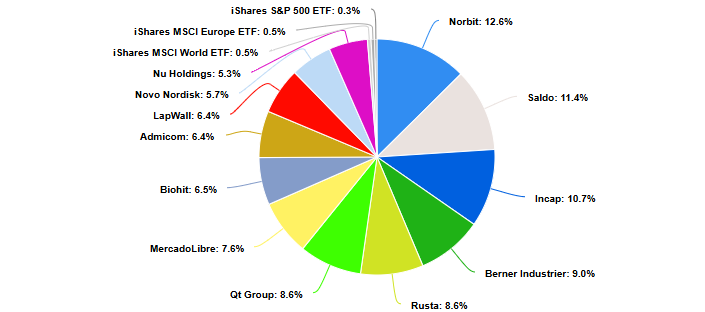
Norbit (12.6%) continues to be the largest holding in the portfolio. I’m head over heels in love with the stock (and its performance). It gives me '21 vibes and reminds me of Harvia, and soon we’ll probably be riding a white horse down a cliff without realizing we should lighten up. The valuation is, in my opinion, very tight due to recent rises, but I’ve also learned that you shouldn’t sell a rising stock (I lightened up around 150NOK and bought back later at a higher price). Let’s enjoy now, cry later. Norbit’s thread probably best explains why I’m involved as an investor.
Saldo (11.4%). Does this need explaining? I’m operating with an unusually large cash position, and yet YTD is hovering around 15-17%. I feel serene about this.
Incap (10.7%) has suffered from a few weaker years due to its largest customer reducing orders. Now, however, the direction may have changed, and orders from the European security sector could be a positive surprise. Incap, which generates good profitability in its sector and (hopefully) will achieve double-digit growth in the coming years, is a quality company with a quite reasonable valuation.
Berner (9.0%) has many thoughts about the company in its thread, but in short, jumping back into the M&A bandwagon was a very pleasant event in April. Although the stock is no longer incredibly cheap, it’s not expensive either (P/E 17x with this year’s forecasts).
With Rusta (8.6%), it happened that after initial enthusiasm, the excitement dried up. I perceive the company as a very defensive and safe holding, which isn’t significantly hit by consumers’ thinning wallets. The departure of the long-term CEO was an unpleasant surprise, but on the other hand, bringing in a new perspective might also be appropriate. The stock has practically been languishing for 18 months. I’ll probably watch an earnings report or two, and then make decisions about the holding.
Qt group (8.6%) valuation has plummeted from its golden age (21’ never forget). The sharp slowdown in growth is not pleasing, but I still believe the company has all the prerequisites for better performance. EV/EBIT is around 20x, which I don’t consider unreasonable. The profitability “hockey stick” should continue to materialize, so there’s potential for returns here.
MercadoLibre (7.6%) is the Amazon of Latin America! Practically a significant player in that region, doing pretty much everything. Valuation is tight, and one shouldn’t expect a boost from multiple expansion. The main thesis is long-term sustained growth and the company’s ability to constantly innovate and develop new businesses around its core. Somehow, companies like this appeal to me greatly, and currently, I’m actually researching a similar player…
Biohit (6.5%) is awaiting new geographical openings for its excellent product portfolio. The valuation is moderate, considering that there will certainly be continued demand for its products in cancer screening. TOP100 owners have been steadily adding recently. I could have more of this in my portfolio.
Admicom (6.4%) is probably one of the biggest sufferers due to the market situation. The product is presumably still in good shape and needed. When the market situation brightens and bankruptcies decrease, Admicom could get back on a stronger growth path. International growth should gradually start to materialize, as relying on a single market has been somewhat sluggish recently.
LapWall (6.4%) is also one of the sufferers of the market situation. When new construction isn’t happening, elements don’t move. The company has performed surprisingly well during the recent difficult times, and when the sun eventually rises, its market position is quite excellent. I really like the CEO and his communication style.
Novo Nordisk (5.7%) is the most recently built holding in the portfolio. I bought the first position when the bottom seemed to have been reached, and have since added twice. The company produces exactly what will be needed in the future: help for people’s overweight issues. I hope that the company’s obesity drugs wouldn’t sell, but that people would invest in their own health and watch what’s on their plate. Although obesity is not a choice, what one puts in their mouth is (I’m betting my money that a pill is easier than broccoli).
Nu Holdings (5.3%) provides banking services to those who don’t have them yet. And in LatAm countries, there are still many of them. Great track record, growth prospects, and a well-managed company. I would probably own more if some of its services didn’t overlap a bit with MercadoLibre.
ETF holdings (1.3%) diversifying across S&P500, global, and European indices. Gradually understanding my own mortality in stock picking, and as capital accumulates, some form of capital “protection” into slightly safer assets. Still a significant emphasis on stocks, but gradually over the years, a shift will occur. 
So, here’s a review for now. I won’t write much about the business operations, as quality threads have been created for practically all my companies, where one can learn about the firm. I quite like the composition of my portfolio, and the high cash position has suited my mind quite nicely! Later, I’ll try to jot down a few words about the portfolio’s returns.
E.
53 Likes
Time for the year’s first portfolio review. So far, the year can be considered eventful. In the spring, I was quite confident in the portfolio’s contents, as the companies were mostly of high quality and the outlook was favorable.
How the situation changed when it turned out that the old-new US president is more vulgar and fascist than ever. The first wake-up call came after the Munich conference, following Vance’s fiery speech about Europe’s ruined values.
Probably one of those rare moments when feelings of dread were actually useful from an investing standpoint, as it was easy to relate to a European policymaker when the US Vice President states that the greatest threat is not outside the borders, but inside. There is a grain of truth in that too, of course, but comparing slow decline vs. an existential threat to one another—completely different things.
I started scanning European defense companies at a fast pace. Since the war in Ukraine has been going on for some time, it was difficult to find so-called “laggards”. The easiest move would have been to buy the largest company, Rheinmetall, because big money uses it as a vehicle to express a trade, and valuation doesn’t matter as much. However, I wanted more margin of safety, so I opted for a more labor-intensive approach.
I eventually ended up buying Exosens, Theon, and tripling my Alzchem position. At best, I had the company at 30% of the portfolio. A little later, I also bought Ceotronics stock, which I see lagging behind the sector. Mainly due to its small size and lack of investor relations. I expect the situation to correct itself during Q4–Q1 when the German army and other European armies begin making purchases in earnest.

The playing field in Europe continued to change as Germany’s Merz pushed through the debt brake and fiscal stimulus in a controversial manner. At that time, I owned a bunch of options and illiquid German industrial companies with the idea that the package simply had to be passed. As someone previously far removed from politics, it was really interesting to follow the different perspectives on the matter.
Particularly interesting, though subjective, was discussing the matter with a German couple working in Finland. They mostly saw yet another politician who doesn’t keep his promises and irresponsibly takes on debt. I saw an intelligent national leader who understands economic policy and strives to fix Germany’s structural problems across party lines.
The peace didn’t last long before Trump decided to announce his tariffs. I started closing out my options pretty quickly after smelling a rat.
I have always been really bad at making the most of dips, and a dent was left in the portfolio due to the use of hedges. This year too, I am lagging behind the more passive backtest portfolio by about 15%, which speaks in favor of my strength being on the long side of stock ownership rather than using derivatives, at least to any notable extent.
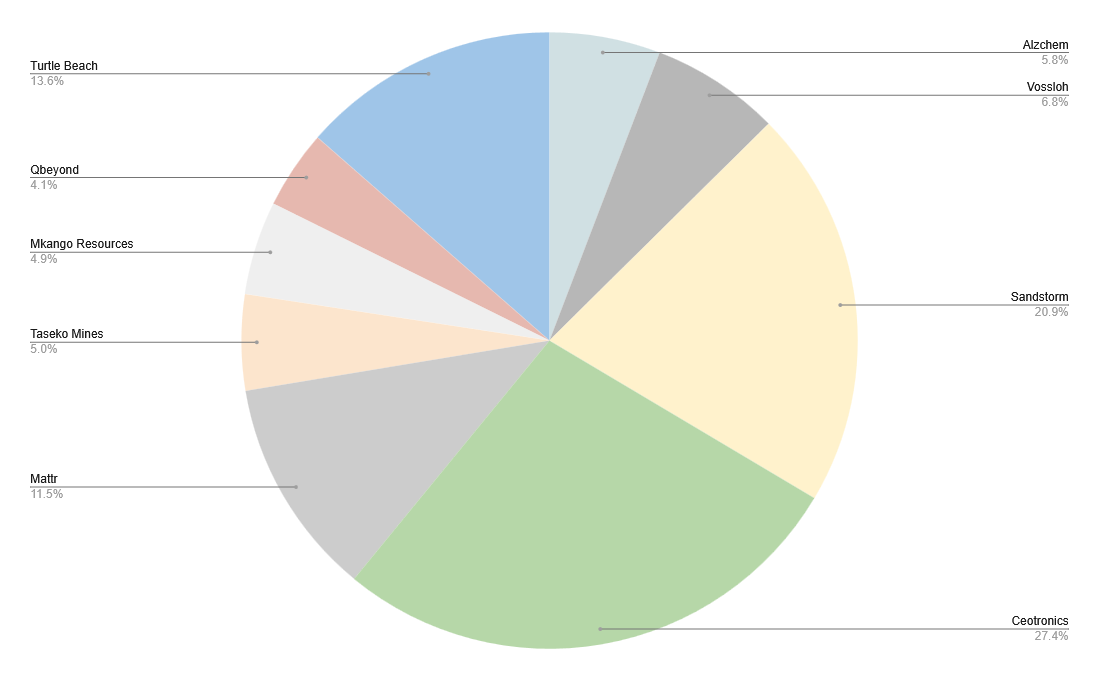
A little about the current contents of the portfolio. To some extent, Trump is a gift to the investor. Major changes to the status quo also create new opportunities. The portfolio is easy to divide into different baskets.
European Defense and Infrastructure
Alzchem, Ceotronics, Vossloh, and Qbeyond will directly benefit from European fiscal stimulus. Consequently, I consider these ideas to be relatively low-risk. Among others, I dare to hold Ceotronics in a large weight because I know the orders will come. Mainly, their scale and timing are the biggest question marks. I am particularly excited about Vossloh from a risk/reward perspective, but it doesn’t have the same scalability as Ceotronics.
Metals
Mkango, Taseko, and Sandstorm. The West clearly seems to have awakened to its dependence on China regarding critical metals and magnets. I chose Mkango because I see production as undeniably the most profitable and the valuation as attractive. Time will tell if I actually bought one of the biggest winners in the sector or a speculative bomb.
Sandstorm has been perhaps one of my most frustrating investments this year, as the stock was trading really poorly even before the tariff shenanigans, and there were issues with production. However, the gold rally has helped with this problem as well, while my perspective on gold has changed. I plan to keep the stock’s weight unchanged as I see attitudes toward the dollar having shifted during the spring.
Trump is continuing from a different angle, but in the same direction as his predecessor by weaponizing the dollar. Nor are there any signs of cutting deficits. Quite the contrary—just more of it. Various fund managers have also started complaining in recent months about the unsustainability of the debt mass. At the same time, the debt market has started to push back in the face of clear economic policy errors (tariffs). I don’t know when the bond market will actually start fighting back or if the answer is the devaluation of the dollar. In any case, I think gold is a good hedge against that scenario. In the short term, I am worried about gold’s momentum. It rose a pathetic 2% due to the attack on Iran while oil was up 15%. However, the structural factors I mentioned remain in the background.
No more on Taseko. I opened up the thesis enough in the thread.
Other
Next year something will happen that will make the upheavals of previous years look small. Grand theft auto 6 is being released. Gaming peripheral manufacturers faced quite a hangover after corona when everyone upgraded their setups. However, it has already been about five years, and it would be time to upgrade the hardware. The lifespan of the devices alone is gradually coming to an end. For example, I just bought a new mouse myself, even though I try to use devices until they no longer work properly.
Controllers, headsets, etc., are a cyclical industry not just because of fluctuations in consumers’ purchasing power, but because purchasing decisions follow the release of new consoles and major games. Therefore, the sector might face a really strong turnaround with the approach of the new Nintendo console, but also the release of GTA 6.Turtle Beach is a good investment because the management has proven its capital allocation skills. Among other things, they made an affordable acquisition about a year ago and have been buying back their own shares. The company currently has a share buyback program underway that covers 30% of the company’s market value. That’s a great move, especially if the cycle is turning.
In the short term, consumer behavior causes some headaches, as does the trade war. The company’s management handled this exemplary well by stocking up on inventory before the tariffs hit and shifting production almost entirely from China to Vietnam. However, questions still remain regarding how the tariff negotiations with Vietnam will go and how much of the production is actually local versus how much genuinely comes from China.
Oil and Mattr
In the Rookie’s interview, I talked about a potential attack on Iran. It actually happened with surprising force, and I must admit that I messed up my preparation for this case big time. Looking back, I see that I should have done more background work, which would have made it easy to pick the low-hanging fruit. I should have found this company:
Now I am in a somewhat uncomfortable position because I should start betting on less probable scenarios. If a regime change happens in Iran, it will certainly cause internal unrest and oil production will drop. As a result, the price of oil will naturally rise.
The question is whether it’s even worth relying on that, since OPEC seems to have spare capacity out the wazoo. I’ve heard the same story for the past four years about how OPEC doesn’t actually have the capacity and not enough has been invested in the industry. Yet, oil prices have remained extremely low relative to inflation all these years.
Another even less likely case would be the closure of the Strait of Hormuz. That would mean the situation had escalated.
After trading back and forth for a while and burning a bit of capital, I decided to bet on the latter case. Why? Because both scenarios are binary, and I think using options is the best approach. In the production drop scenario, to get a significant return, I would need to buy options with a weight of a good 2% of the portfolio. I might wake up in the morning to find that Trump has started negotiating and the value of the option has halved. However, because the latter scenario is less likely, the odds are also high.
I get the same nominal return by risking only 0.2% of the portfolio. When one scenario is 10:100 and the other is 1:100, it doesn’t matter as much which one you choose.
Mattr might get a little extra help from this, as a third of the company’s business is tied to the level of oil production in North America. That segment has likely bottomed out, as oil will maintain a slight risk premium going forward, and the company is expanding its product offering next year, which should support the segment.
In relation to this, the company also provided an optimistic outlook for next year at The 15th Annual East Coast IDEAS Conference a week ago. Supposedly, tariffs will only have a limited impact on this year’s earnings, and customers, depending on the segment, are optimistic. The company believes it will reach close to its targets for margins and revenue by 2026. That would mean next year’s valuation would be a P/FCF of 4-6. Insanely cheap if the company executes.
Humanoid Robots
I listened to a podcast a while ago that presented a realistic case for humanoid robots.
Quietly, the development of robots has progressed surprisingly far. I hear a slight echo of the 2023 AI theme here. Surprisingly, the largest cost component of robots is joints, etc., and their manufacturers are in the automotive value chain. Therefore, an industry that has been under pressure for the past few years may face a structural change.
As mentioned in the report, there were already signs of a turnaround in the industry anyway. Valuations for all companies are elevated, as is typical for cyclicals. After screening through the stocks, the cheapest ones were Infineon, Onsemi, and Allient. I am interested in Allient particularly because the management sounded trustworthy on the call and the stock is affordable.
So far this year, the portfolio has a YTD return of +28%. I would like to reach a good 40% this year. We’ll see what the end result is.
57 Likes
