The last portfolio company has also published its quarterly report, and it’s time to take a look at the portfolio again  . This transition period between Puuilo’s and Admicom’s reports is very subtle, but a good moment to reflect on the previous quarter.
Portfolio building has continued; I think I wrote in the last quarterly report how my interest, as a sum of many things, has shifted from domestic companies towards international ones. I seem to be an unwilling contrarian, as the Helsinki Stock Exchange has been strong at the beginning of the year, and other markets… well, they haven’t developed as strongly  . When I started selling a significant portion of my Finnish investments last year, I took a conscious risk that I would sell cheap companies and buy expensive ones. This felt foolish, but I’ve noticed that sometimes that slightly uncomfortable feeling yields good results in the long run. This is, of course, entirely subjective, but for example, buying falling knives has previously given me a good feeling because I get something cheaper than before. On the other hand, buying Lifco at 200 SEK felt really bad because the price seemed expensive. If I had the same opportunity again, I would buy with both hands. Perhaps that’s why I try to resist this good feeling that buying falling knives gives me.
Falling knives are, of course, a tricky subject, because everything depends on your investment horizon; if your trust in the company remains and you can sit on your hands through the rollercoaster, you might make good deals in the long run. But in the short term, you’ll likely only face pain and discomfort. I’m not sure if I can endure that feeling. A falling knife is often also a signal that the market doesn’t trust the company’s future. I’ve learned enough humility from past mistakes to know that the market is often right. If you go contrarian and buy a falling knife, you need to have a strong understanding of what the market might be misunderstanding about the company. Buying on the premise that “the market is stupid” leads to poor results in my experience. Therefore, I’ve started avoiding purchases that feel intuitively good. On the other hand, I’ve focused on those that initially feel a bit unpleasant because the price might be a bit tight. “You pay peanuts, you get monkeys” has often been on my mind. Let’s see where this leads.
Reversal to the mean is indeed a known phenomenon in the market, and it seems to be happening now, Helsinki Stock Exchange vs. NASDAQ. However, I wonder what this means in the long run. Companies with strong competitive advantages are still rare on our domestic stock exchange, and many of them are unfortunately in the US. The fact that capital is flowing back to Europe doesn’t change this reality; rather, rotation changes valuations.
Last year, when I wanted to make changes to my portfolio, the underlying idea was to raise the quality of the portfolio companies, and unfortunately, I couldn’t find 25 companies in Finland that would meet my criteria. Therefore, I had to turn my attention to international markets. Researching foreign companies has been eye-opening because international stock exchanges offer companies with truly amazing business models. In my opinion, one shouldn’t buy these blindly either, but I think it says something that certain companies actively work to create an image of fierce competition in their own market so as not to fall under regulatory scrutiny for too strong a competitive advantage. At the same time, mediocre companies try their best to look as good as possible in the eyes of investors.
Portfolio
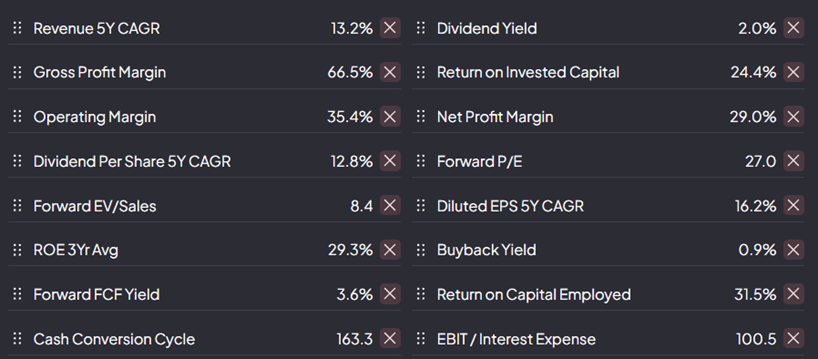
If my portfolio were a single company, its revenue would have grown by 13.2% CAGR over the last five years. For the past year: gross margin 66.5%, EBIT 35.4%, ROIC 24.4%. EPS has grown by 16.2% CAGR over the previous five years. I am satisfied with these figures. Looking back, my companies generally have a competitive advantage that has generated strong returns on capital. Of course, for me to benefit from this, future investments must perform equally well, and competitive advantages must remain strong. Otherwise, I will witness the quality → trash effect, which does significant damage to a portfolio.
Valuation is a bit tight, NTM P/E 27 and NTM FCF 3.6%, but for several companies, staring at the P/E is not particularly meaningful; for example, Dynavox’s EPS has tripled in four years.

The portfolio contains the following companies, from largest to smallest holding:
Investor B, Admicom, Marimekko, Nordea, Revenio, Puuilo, MSCI, Mastercard, Alphabet, Harvia, Chemometec, Visa, Medistim, Dynavox, Copart, Fortnox, Lifco, Vaisala, Berkshire Hathaway, Idexx, Medpace, Moody´s and Shopify.
A total of 23 companies; there would still be room for two more, and six companies are on the watchlist.
Significant Finnish positions still remain in the portfolio because we have a selected group of companies that interest me here in Finland. There are also a few exceptions in the portfolio that don’t quite fit the strategy I’ve outlined. Nordea is a great company, but it’s difficult to find a competitive advantage in the banking sector. However, I appreciate the dividend paid by Nordea, and the company has done excellent work in recent years. Investor Ab is another company whose competitive advantage may not be the strongest, but rather stems from its ability to allocate capital. However, I will highlight the following image from Investor’s 2024 annual report.

The company’s stock has generated 17.3% p.a. over 20 years. I can already state that if I were a rational investor, I would give up stock picking and just buy Investor. I will hardly ever beat that track record. This is why the company is still my largest position.
As for the other companies, I believe that in the long run, they will be able to grow into their higher valuations and create value for me. I don’t believe I am an exceptionally skilled stock picker, which is why there are so many companies in the portfolio. Some companies will not succeed as expected, I have probably paid too much for some, and in some cases, authorities might intervene or break up the company. Therefore, I think it’s good to keep a sufficiently large number of companies in the portfolio.

International diversification has improved from the old 100% Finland situation. I still believe that my best competitive advantage as an investor is in Nordic small-cap companies, which is why their weight in the portfolio is significant. On the other hand, I am fascinated by companies with strong competitive advantages, such as Copart. Thus, I have come to the conclusion that these styles and my interests should be combined.
Finally, I want to highlight a few bright spots in the portfolio. Namely, Marimekko, familiar to many, and the less familiar Norwegian Medistim.
Regarding Marimekko, I have been waiting for a turnaround in the Home category, as it has a significant impact on the company’s revenue. Now, in my own papers, it appears that this product line grew year-on-year for the first time in three years, after a small corona hangover.

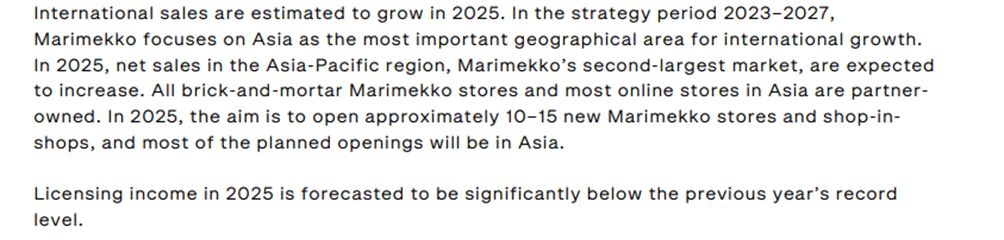
The company also continues to invest in the right direction. Last year, 2 new stores were opened net in Asia. The goal for next year is to open 10-15 new stores, a large part of which will be in Asia, so it feels like a significant addition.
 Medistim is a Norwegian med-tech company. The company has a strong position in a niche market. The company manufactures blood flow measurement devices and vascular imaging devices for cardiac and vascular surgeries. The company has approximately 37% market share. Competitors have 8%. 55% of surgeries are still performed by manually measuring blood flow, i.e., by feel. The company primarily has two types of revenue: devices and recurring sales of sensors. Recurring sales accounted for approximately 73% in 2024. Depending on the type, the device sensors can be used approximately 50 or 100 times, after which they must be replaced. Recurring business certainly sounds great, but a high proportion can also indicate that not enough devices are being sold. Of course, each device sold increases potential sensor sales. The company has been very profitable and has grown steadily, but in recent years, profitability has declined from its peak years. The company has invested in new products and expanded its organization to support direct sales. This has resulted in increased costs, but not yet in profits. However, the market has shown small signs of recovery for higher-margin products, and the company’s newest device version is ready for sale. Certain efficiency measures have also been implemented. This was pleasing to note in the last quarter. Am I now sure about a turnaround? Absolutely not; this could just be one slightly better quarter after many declining ones. In any case, positive signals have been received as EBIT% improved in Q4-24 vs Q4-23. It is therefore interesting to continue owning the company, and we will see if profitability continues to improve next quarter.
As we can see, the company has continued to grow, and the gross margin consistently hovers near 80%. However, costs have grown faster than revenue, which has unfortunately led to a decline in operating profit margin in recent years. At the FY level, profitability is still on a strong downward trend.

I could have chatted on longer, but perhaps it’s good to end the portfolio review here  . The intention is to continue hunting for companies in 2025 as well. I strongly hope that the opening of the IPO window will bring more interesting companies to the domestic stock exchange. However, market turbulence provides an opportunity to buy exceptionally interesting companies internationally. Happy spring to all!