Payment Solution Companies as Investment Targets: Edenred, Corpay(ex:Fleetcor), Pluxee etc.

The company named Fleetcor came across my stockscreener earlier and piqued my interest. And for good reason. After that, I familiarized myself with Edenred, a peer probably more familiar to many of us. I was even more astonished. Did I find a goldmine? I’ve been poring over the financial reports of these two, and it strongly appears that the companies operate in a boring industry but with sexy profitability. Here’s a bit of Fleetcor in numbers:
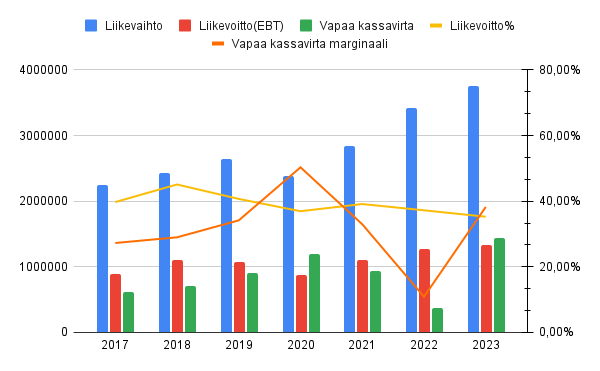
In the years 2017-2023:

  • CAGR growth = 8.9%
  • Operating profit margin on average = 43%
  • Free Cash Flow to Equity (FCFE) margin on average = 32%

Not bad.

This business model heavily utilizes financial leverage, and the Altman Z-Score yields an average result. It is certainly not in the “danger zone,” but on the other hand, it last received a completely clean bill of health in 2018. The Beneish M-Score gives a clean bill of health for every year in the previous chart, so there’s no reason to suspect creative accounting on that front.

Valuation is not cheap by traditional metrics, but then again, the company’s performance hasn’t given any reason for such pricing either. At first glance, based on cash flow, the market prices the stock for growth roughly in line with inflation forecasts, with profitability as shown in the chart above. According to the company’s own estimates, there’s still a huge amount of TAM (Total Addressable Market) to grow into, so that doesn’t limit growth.

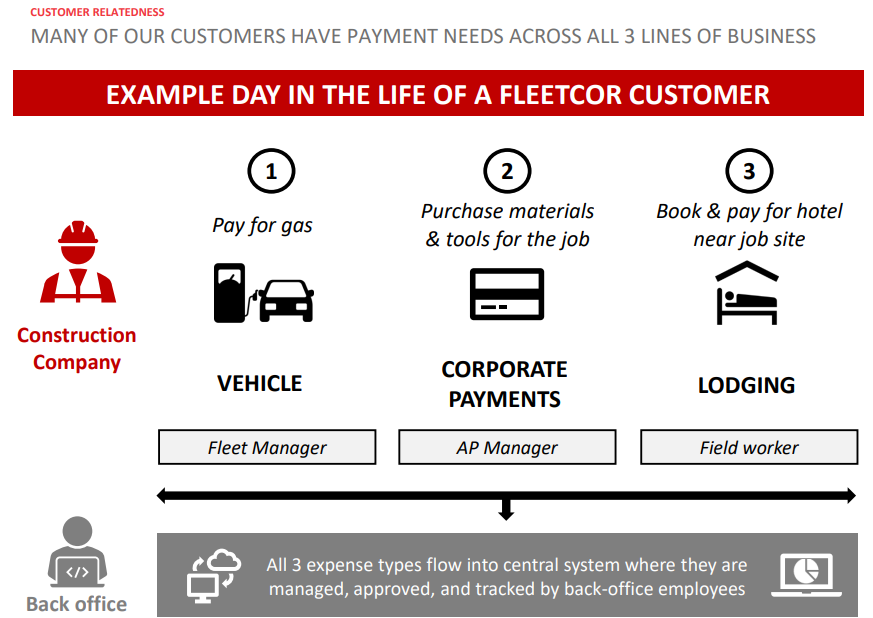
These companies offer various payment solutions to businesses. Fleetcor’s primary product throughout its history has been fuel cards, and in recent years, it has expanded to offer a more comprehensive product portfolio, including its own software for expense management. Fleetcor also went shopping in Finland when, about a year and a half ago, they acquired Plugsurfing, an EV charging service, from Fortum. Here’s a bit from the company’s own presentation about what they sell to their customers:
56% of last year’s revenue came from the USA. Other major markets, with approximately a 15% share, were Brazil and the UK. Trustpilot reviews lambast the company, but then again, the company boasts a 92% customer retention rate. Due to the limited number of Trustpilot reviews, perhaps that 92% is more indicative, although the company did go to court in recent years over some billing ambiguities, so there might be a grain of truth in the Trustpilot reviews as well.

Edenred was previously known for its Delicard corporate gift card product, but over the last decade, they have expanded in Finland to become a major player in various employee benefit implementation solutions. To my understanding, the company also has similar services globally to Fleetcor. I have only superficially reviewed their financial reports, but based on that, the figures are very similar to Fleetcor’s.

This is a brief introduction to the thread. Hopefully, it will spark discussion.

EDIT: I changed the chart’s operating profit to reflect EBT, as I believe it gives a better picture of the company’s profitability than EBIT.

24 Likes

Fleetcor indeed has great margins in its business, but revenue growth consumes a strangely large amount of capital. I checked that the company’s revenue has grown 8.5-fold over 13 years, while the balance sheet has grown 9.4-fold. The ratio between revenue and balance sheet size is 0.25, which can be considered very capital-intensive. The ratio has also remained more or less the same over time, so it’s not a temporary issue. As a result, the company hasn’t really been able to return capital to shareholders. No dividends are paid, and share buybacks reduce the share count slowly.

The company’s return on assets (ROA) is, however, 6.5%, which can be considered reasonably good quality, and it too has remained fairly stable over time. However, it shows that the company is not quite as high-quality as the margins alone would suggest.

2 Likes

Well, it depends on how you look at it. Over the last 7 fiscal years, the company has bought back a net of 4.5 billion in its own shares (over 77% of net income) and the number of shares has dropped by 20%. Sure, you can dig into an even longer history, but I don’t know how much added value that provides.

I wouldn’t say the company hasn’t been able to return capital, but rather the opposite, and because the business is very asset-light in the traditional sense, cash flows are also flowing freely.

The business model is not capital-intensive in the traditional sense where tangible assets on the balance sheet would grow. PPE has grown only by 160 million, while at the same time revenue has grown by 1.5 billion. Working capital is consistently negative and doesn’t consume much capital. That 1.5 billion in revenue growth has occurred during fiscal years where working capital excluding cash and debt has dropped another 300 million further into the negative. Considering cash and debt, 1.5 billion in revenue growth has required 200 million in working capital growth. Negative working capital, of course, always requires special scrutiny.

Fleetcor utilizes the securitization of accounts receivable, which results in receivables turning into cash faster than the company’s own expenses fall due. This is certainly partly responsible for the negative working capital. Of course, the margin takes a small hit with it, because who on earth would buy 1.3 billion in receivables at face value, but on the other hand, the credit risks of the receivables, packaged into a neat bundle, are simultaneously sold to investors. In practice, Fleetcor gets financing cheaper this way than, for example, from banks or the bond markets.

Fleetcor’s balance sheet has been bloated over the last 7 years by the growth of goodwill and debt. Those two lines account for 70% of the balance sheet growth. In addition, a quarter of the balance sheet growth is explained by the growth of cash reserves and the securitization of receivables. Goodwill has grown through acquisitions, and debt has been taken on because, for some reason, they wanted to buy back a net of 4.5 billion of their own shares at the same time. Looking back with hindsight, capital could perhaps have been better allocated.

In addition to that working capital and receivables maneuvering, I’ve been scratching my head over the definition of the company’s cyclicality. The business is very dependent on customer activity, so the top line, logically, is sensitive to the general economic situation. On the other hand, in the company’s history on the stock market, there is one year where the top line shrunk, and even in that year, profitability remained at a very good level.

EDIT: corrected an erroneous figure for the number of shares.

3 Likes

Where did you get the information that the share count has decreased by 80%? Perhaps it’s a reverse split. The latest figure from the company’s Q4 report was 71 million shares outstanding, and according to the Stockanalysis website, in the peak year for shares in 2016, there were 95 million shares outstanding. Goodwill and restricted cash are indeed the largest changes on the balance sheet compared to a year ago. It seems the company receives money from customers and remains liable for it, which in itself inflates the size of the balance sheet (cf. insurance company float). This is not a cause for concern.

1 Like

My apologies. There was a typo in my Excel. So it has dropped 20% from about 93.5 million in 2017 to about 74 million at the end of last year. I used the diluted average weighted shares from the company’s 10-K and earnings reports, as that is what interests me personally as an investor.

At least the amounts allocated for share buybacks were correct. And the shares issued during the same period have been deducted from those buyback funds, so the funds used for buybacks are net.

1 Like

What happened to these today?

Screenshot_2025-06-26-10-04-43-49_4ddc8d43e74adc86fab2deaad29d5519

edit

https://media.edenred.com/meal-voucher-reform-in-france/?lang=en

1 Like

Pluxee’s decent Q report, stock up 9%

Pluxee 4.7.2025:

UBS maintains its ‘neutral’ rating on Pluxee shares, with a target price trimmed from €23 to €22, following the Q3 results of the ‘essentially online’ employee benefits solutions group, which were in line with expectations.

The broker notes that Pluxee has reiterated its double-digit revenue growth and margin expansion forecasts, although the Q4 outlook reflects some macroeconomic concerns.

If I looked correctly, Eden’s H1/2025:

  • revenue in line with forecast (1.45bn vs. 1.46bn forecast)
  • EBITDA exceeded forecasts (654m vs. 633m forecast)

Guidance for the year unchanged.

4 Likes
8 Likes
5 Likes

Pluxee’s stock price has fallen quite a lot recently, but I haven’t found any related news. Has there been some regulatory change, or is it just fluctuation?

Edit: apparently Edenred is also down, so probably an industry-wide change.

2 Likes

I couldn’t directly find news related to these, but I assume these are in the background:

Competition authority in Turkey has launched an investigation:

https://www.boursier.com/actions/actualites/news/edenred-et-pluxee-dans-le-viseur-du-regulateur-turc-966083.html

In France:

2 Likes

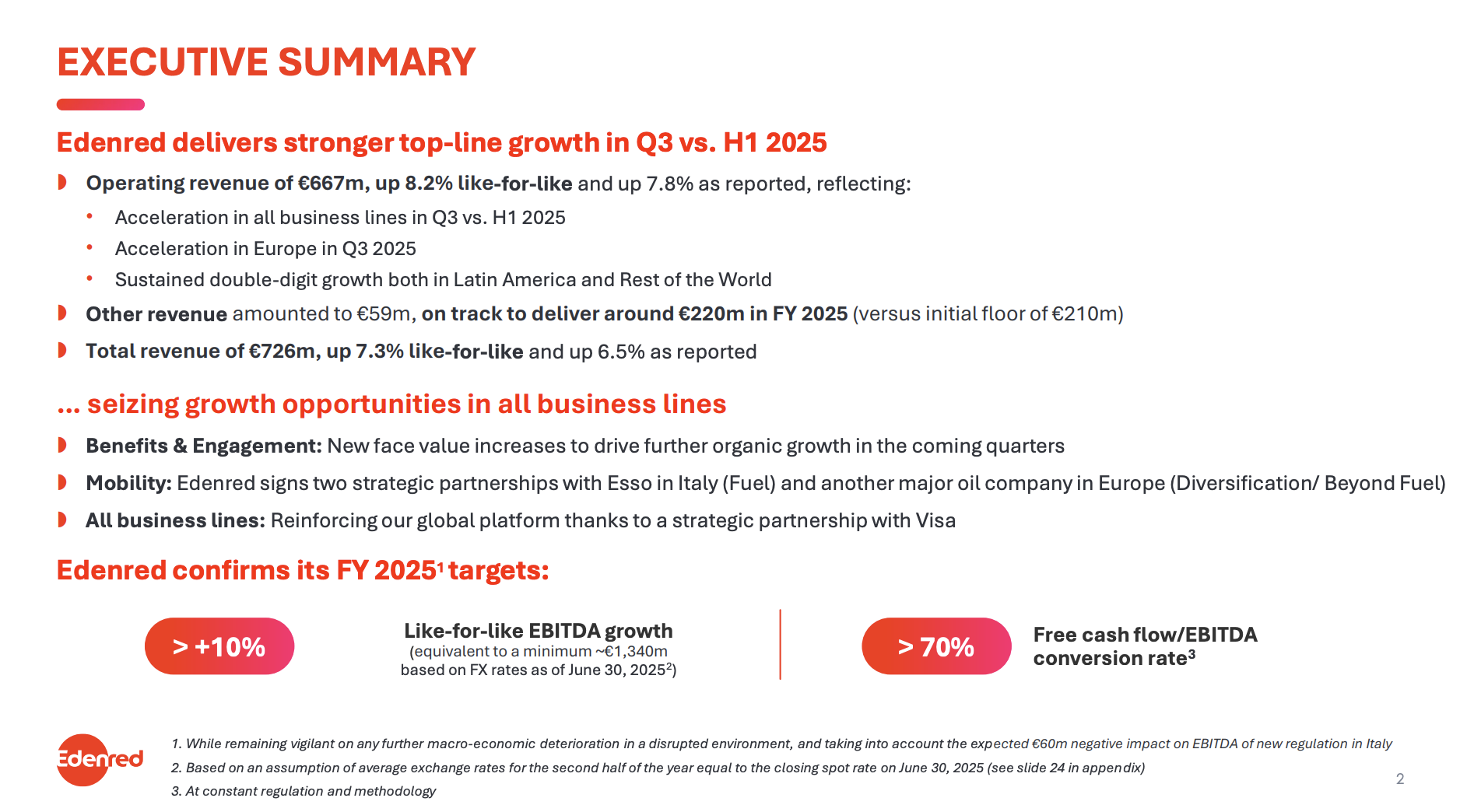
Edenred published its third-quarter review today. Total revenue (excluding float income) grew by 6.5% and “operating revenue” was up by 7.8%. The stock is also rising for the first time in a long while after several years of decline.

The value of lunch vouchers is growing in several countries, which brings Edenred additional revenue.

6 Likes

In honor of Epiphany, here is a video on Edenred. In the video, I go through, among other things, the regulatory changes in Italy and Brazil that crashed the stock price and are causing a dent in Edenred’s results.

14 Likes

Iikka has made an excellent tweet thread about Edenred. :slight_smile:

https://x.com/IikkaNumminen/status/2009884486826107125
image


For those on X, I recommend the first link, and if you don’t have X, then this one instead:
https://twitter-thread.com/t/2009884486826107125

2 Likes

Don’t these baguette munchers withhold 30% of dividends? Not really feeling like investing in a dividend machine like that if the total tax on dividends ends up being 30% + 10.5% (the Finnish taxman’s share on top of the 15%) = 40.5%. Sure, if you can be bothered to do the paperwork, you can probably claim that 15% back from the French tax authorities, although with small amounts it’s just not worth it.

1 Like