Since I am not familiar with Springvest at all, it would be interesting to see some data/sources on this. Where does the information about the 33% fee come from? If that is true, it certainly sounds very steep.
The steepness of the fee depends on the valuation of the offering from the entrepreneurs’ perspective.
I just took a quick look at the latest offering prospectus/investment memorandum (NewIcon, page 26 [edit: page 19 of the investment memorandum, page 26 of the PDF]). I double-checked, and at least the following costs are disclosed there: arrangement fee: €485,000, subscription fee 3-4% = €150,000-200,000, value of options €947,554. It is possible that some fee was missed or not disclosed in the prospectus. The company receives €4,520,000 in its account from the offering, meaning that depending on the perspective, the costs are a maximum of 36% on top of that.
One could, of course, also calculate it such that investors pay €6,152,554, of which the company receives €4.52m = 73.5%, so calculated that way, the costs would be under 30%.
From the entrepreneur’s perspective, an (overly) high valuation is not always a positive thing, especially for a startup (unless the entrepreneur sells their own shares at the same time). Specifically, securing follow-on funding (from sources other than Springvest) can become quite impossible, which has been the fate of almost all Springvest clients so far… On the other hand, if the company is certain that this funding round is the last one, then the highest possible valuation is naturally to the company’s advantage.
6 Likes
What do you think about NewIcon and its open share issue?
NewIcon seems to be unfortunately loss-making and funding has been sought multiple times (e.g. 2017, 2019, 2023), but is a turnaround finally on the horizon, or will things continue as they have so far?
Share issue 2019: Springvest
Share issue 2023: Springvest
2 Likes
I’ve been following for a few years now, and things seem to be improving all the time, with sales picking up at an accelerating pace. I am confident in the current situation and the management.
Earnings are also heading in the right direction, but the continuation of this positive development will require those big deals to materialize and successes elsewhere as well. The industry is growing rapidly, however, and automation is certain to increase.
Based on this thread, I must come across as quite negative since I’m always here shooting down these crowdfunding companies 
I haven’t followed the company, but looking quickly through the numbers, I don’t understand how one can reach such a conclusion.
In the latest materials, the entire history has been neatly cut out and started from 2021, so they can once again start drawing a nice-looking hockey stick.
The reality is that as early as 2018, the company had revenue of over €7M, which is much more than the predicted(?) nearly €6M for 2022. Though even during those peak years of 2018-2019, they were posting losses of over two million a year even then. So they’ve been stagnating for five years now, making big losses, and that’s why they need more investor money every couple of years as it just keeps burning. The only thing indicating a better future is the growth curve drawn by management; there seem to be very few grounds for why “just now” would be the moment it takes off when it hasn’t really taken off in the past 10 years. Of course, they have pockets full of excuses ranging from COVID to the war in Ukraine, and these would be a bit more credible if the company had been growing strongly before them, but that’s not true either. They are clearly counting on investors having short memories, and to me, this looks like another “Wello” situation where they think they have the world’s best technology/product, but it doesn’t seem to sell, or at least not at a price that would yield a reasonable return.
And Eka can’t come here and say, “Seppo, you just don’t understand these fast-growing scalable software companies” . This is not fast-growing, not scalable, and not primarily a software company. In a business like this, you should be able to achieve some reasonable result—at least breakeven or close to it—with a revenue of €7M. Then they come and explain that “but we are investing so much in R&D.” Well, those investments aren’t showing up as growth. The fact that the industry is growing doesn’t help much, and the existence of a billion-dollar global market doesn’t help if you can’t tap into it.
“Fool me once…”
34 Likes
My post was poorly reasoned, and @SijoitusSeppo was right to point it out.
My view is based on the company’s investor relations communication and information received at annual general meetings (AGMs).
A high percentage of the customer leads previously mentioned by the company have led to deals, and as an optimist, I still view the currently communicated major accounts as quite strong. This is, of course, a strong gut feeling. We have been involved since 2016. It is true that the company uses COVID-19 to justify the dip, but the company communicated quite early on that they couldn’t meet customers and that deal-making had stalled.
In my opinion, the company is not a software company but rather a high-tech company. The equipment they manufacture is highly advanced in terms of automation and, of course, also contains a lot of software.
A company must believe that the product they sell is the (world’s) best for the customer’s needs; if the company didn’t believe this, it would be a “red flag,” and if an investor doesn’t believe in this potential, it’s best not to invest. I agree about the pricing, and it could obviously be better, even though investments have been made in new product development. Deals have been made at an accelerating pace since the 2020 dip, and the currently communicated accounts support the continuity of growth. Of course, these involve uncertainties, and as with everything, no deal is 100% certain until it’s finalized, so the management and the company still have plenty to prove. Everyone, of course, forms their own view, but this is how it looks through the eyes of this owner. Over these seven years, there have certainly been feelings of both disappointment and success.
Some general thoughts as an early-stage investor and a follower of the discussion.
Often, companies are lumped together too simplistically based on their need for capital. It’s a completely different thing to develop software, equipment, let alone primary production like recirculating aquaculture systems (RAS) for fish. Software development can be achieved with relatively modest equipment investments and can reach sales quickly; building equipment requires significantly more capital for facilities and production tools, and reaching sales takes longer; and finally, the recirculating aquaculture example requires massive initial capital and takes years before production is scaled up. The situation flips as things progress: a software developer must constantly increase development inputs, as must an equipment manufacturer, but the equipment manufacturer doesn’t necessarily need to invest rapidly in fixed assets; a recirculating aquaculture plant operates with stable costs after ramp-up, but growth can only be achieved by putting a lot of money into expansion. In between these, there are numerous different versions. In every case, you have to think about how the capital journey will unfold in that company’s future and how many more share issues you expect the company will still need. Some communicate an estimate of the number of share issues right from the start. It’s a bit of an oversimplification to say the numbers are bad so it’s hopeless; it’s worth digging a bit deeper, but criticality shouldn’t be forgotten, and you should challenge your own thoughts, for example, by writing here on the forum.
1 Like
Of course, a company has to believe in its own technology/actions; that’s not what I meant :). However, it’s a completely different matter whether an investor should believe that story when the facts (=the numbers) tell a completely different story over the long term.
My point in that software company comment was that this kind of customized equipment manufacturing scales very poorly. Sure, there might be some economies of scale in design, but even those are quite limited because solutions are heavily customized for each client. Then there’s all the manufacturing and on-site installation, which practically doesn’t scale at all. So, if you can’t get this anywhere near profitable with €7M in revenue, the evidence is pretty poor that it would be any kind of gold mine even if revenue doubled or tripled. On top of that, there is no evidence whatsoever of such growth. For goodness’ sake, the company was founded back in 2007; you’d think there would have been enough time by now to prove that growth, even if designing and building equipment takes a bit longer, etc. So, in my opinion, this isn’t some “early-stage investment” that is just developing technology, but a long-established, mature company (the market leader in Finland) that isn’t growing, is chronically loss-making, and isn’t viable without constant additional funding from investors.
And no matter how much they ride the health tech and innovative solutions wave, it looks like pretty basic bulk automation to me; there might be some specific approvals/certifications required in this field, but technically these don’t seem like anything extraordinary. The business model is also clearly poor and seems to be based largely on new equipment sales/installations alone, since almost half of the revenue can suddenly vanish in a single year (2019->2020), meaning there probably isn’t much recurring business there.
Here are the historical figures from Finder, as I couldn’t manage to find them in the marketing materials.
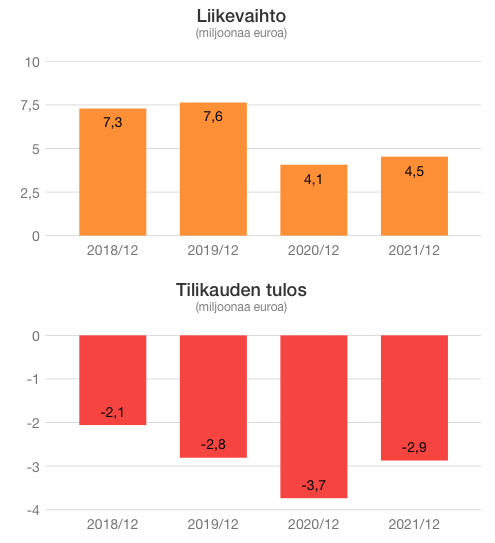
So there has indeed been a bit of a recovery from those depths since 2020, but I’ll emphasize that in 2022 we are still significantly below 2019 levels, and the growth from 2018->2019 (=before COVID during a peak cycle) was a modest +4%.
Maybe with such a superficial look I’m missing some very essential “this time is different” point about the company’s situation, but to me at least, this seems like quite a “hope and pray” case.
14 Likes
Well, here’s a somewhat interesting case on the Invesdor platform again, amidst all the coffee companies and office hotels:
https://www.invesdor.fi/kierrokset/6691a223-f4d8-40f0-b521-a72ee22b49fd#/
They make plastic from wood-based raw materials, with softwood pulp as their main raw material. Their business model is to own and develop the technology used to produce this material; the company doesn’t manufacture the material or the final products itself, but this happens through industrial partners.
The main product at the moment seems to be a packaging bag aimed at the food-to-go market:
They’ve managed to get a couple of real “big names” on the board:
https://woodly.com/press_releases/woodly-prepares-to-scale-its-technology-globally-strengthens-its-board-with-two-business-professionals/
Among the owners are a couple of high-caliber players:
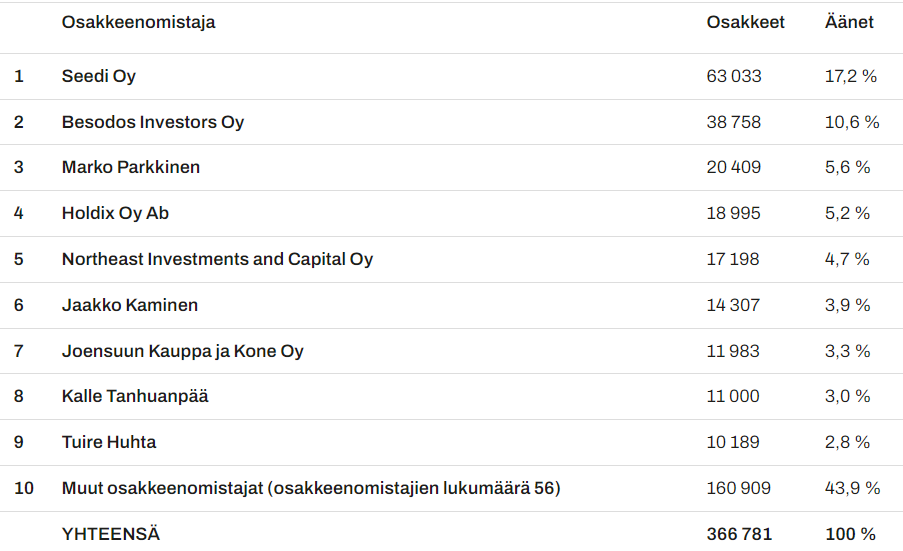
I’m posting this here to spark some discussion before I dive deeper myself and make a decision on whether to invest. I’m especially interested in bearish views. @SijoitusSeppo do your magic.
10 Likes
Without looking into the company further, I asked a couple of acquaintances from the forest industry’s R&D side, and it was a total rejection. Apparently, the plastic is cellulose acetate, which is not a new invention at all. At least for now, the product is not suitable for coating paperboard, for example. Additionally, the product is only partially bio-based and does not biodegrade. The bio-content is ~40%, meaning over half of the product is fossil-based. There are also challenges in recycling.
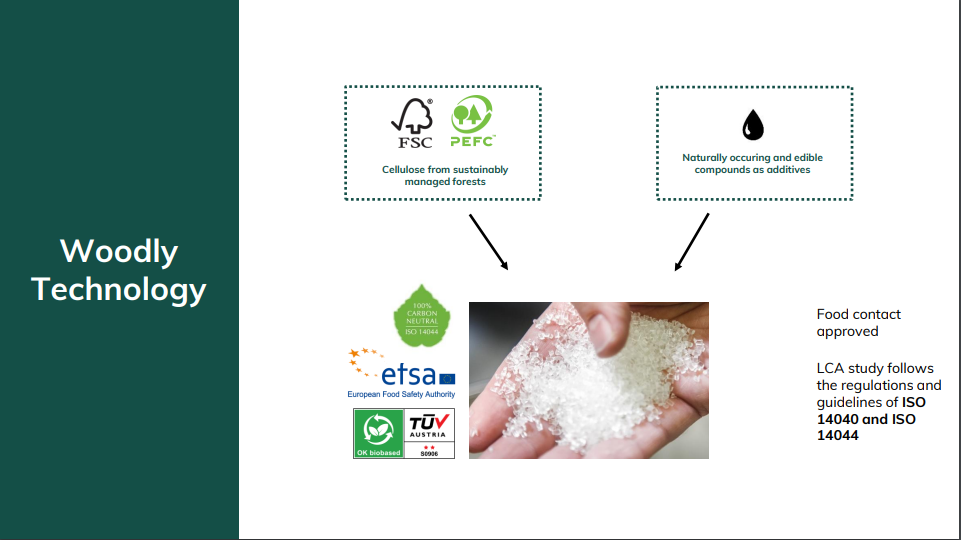
At least the bio-content of 40-60% can be inferred from the two TÜV stars in the image above.
So, the points mentioned above are not my own view, but things heard from “gas station talk” and industry conferences, and should be taken with a heavy pinch of salt.
12 Likes
I have to disappoint you a bit, as I lack the competence to assess the potential of this “completely new kind of wood-based and carbon-neutral plastic” in any capacity. So, I won’t comment on whether something new and revolutionary has been invented here, but I will just say that generally, one should take a company’s own hype about how it has completely new and revolutionary technology with a fair amount of skepticism.
A few very miscellaneous observations after a quick browse, however:
The first time I almost snorted my drink through my nose was when the introduction already said
Our goal is to achieve a 15% global market share of plastics
Not even of a certain product segment or plastic type, but apparently of all plastics used in the world in all its different forms and applications. Statista seems to say that by the end of the decade, the global plastic market will be 810 billion; we only need a measly 120 billion for Woodly, so we’re not dealing with any small goals here.
The company apparently has one product so far (Woodly® W100 series granulate) and one (Finnish) customer (Amerplast), and the product is used—to put it a bit bluntly—for one application (as a wrap for fresh products like bread). And sales haven’t exactly taken off with this product either:
Current customers filled their stocks in late 2022, which is why sales in 2023 have so far developed at the same pace as the previous year.
So it’s quite optimistic to forecast almost 70% growth for this year when the start of the year has seen zero growth.
The previous €2M funding round was apparently in 2019:
Back then it was:
The goal is to get the new types of packaging onto store shelves as early as this year.
This was delayed by 3 years, which provides some perspective for future product launches.
It looks like they are raising a maximum of €2M now. A loss of -€1.7M is forecast for this year and the same for next year. There was about €1M in cash at the end of 2022. So another share issue is coming by next year at the latest, even in the best-case scenario.
The company was founded back in 2011, so when product development has taken ~10 years, it’s no wonder that even though there are money-men like Ollila on the board, they’re no longer interested in pouring more into this machine; instead, someone else should fund this fun now.
I always get the feeling with these “revolutionary innovations” that if, for example, this really was a completely revolutionary thing, wouldn’t an industrial player in the field like Stora Enso or Huhtamäki etc. easily lay down a few measly millions and buy the whole technology for themselves, or at least finance it by buying a large stake in the company. The fact that when no one who actually understands the subject seems to grasp what a great invention this is, they then ask for money via crowdfunding from people who have no competence to evaluate it. @Kyllitati69 presented expert comments on the technology quite well there, and they weren’t very flattering.
This money pit doesn’t pass Seppo’s sieve either. 
40 Likes
I’ve been reading through Woodly’s materials and they are indeed painting some pretty wild visions for the future A few thoughts below:
- The concept is quite interesting, but it inevitably raises the question: why are they seeking funding this way when there are top-tier players in the industry in Finland who would also have the appetite for investment if the technology has potential?
- As @SijoitusSeppo mentioned above, we already have Huhtamäki on the stock exchange, a top-tier firm in this field.
- So why would I put money into this instead of Huhtamäki, which already has a solid track record (and which could buy this technology in the future if it’s truly promising, etc.)?
Overall, the vibe I get from this is that they are trying to hang on and scrape together a bit of cash from wherever they can just to last long enough to sell this to someone else. If it succeeds, you might make a bit of money, but it’s mainly the big owners getting a chance to cash out.
2 Likes
Hello, we are organizing an investor meeting for everyone interested on May 8th at Valo Hotel & Work in Helsinki. The Finnish-language segment will be held both on-site and online simultaneously. The event provides an opportunity to receive more information about Woodly as an investment and to hear about our future plans. Welcome! You can register here: LinkedIn
10 Likes
For me as well, by far the biggest red flag is why it’s necessary to go after the wallets of the general public when the board and top 10 owners are full of wealthy individuals who wouldn’t need to reach very deep to pull together a measly 2 million.
The exit strategy will also get more complicated down the road when the shareholder base consists of a stubborn group of households. It’s a shame I didn’t have time to join and ask about this. Would it be according to protocol to ask @Jaakko_Kaminen directly: why crowdfunding instead of a directed issue?
The second biggest red flag is the aforementioned cash runway. My own calculations made the same observation: more money will still be needed here. It’s fine for growth investments, but I’m no longer interested in financing working capital.
By the way, does anyone remember at what valuation Kakkonen, Puttonen, and the other big-money partners came in?
I asked the new Bing to dig up the basic key figures for plastic raw material manufacturers, which look like this:
| Company | Revenue (2022) | EBIT (2022) | EBIT% |
|---|---|---|---|
| Nidhi Enterprises | $6.7 million | $0.8 million | 11.9% |
| Kamal Polyplast | $8.5 million | $1.2 million | 14.1% |
| Flame Retardant Plastic Granule Market | $1.5 billion | $0.3 billion | 20% |
| PlasticKar | $20 million | $2 million | 10% |
| Ahd Thermoplastics Industries | N/A | N/A | N/A |
| Shanghai Info New Material Technology | N/A | N/A | N/A |
| Median | $14.25 million | $1.6 million | 13% |
| Average | $379.05 million | $76.4 million | 14% |
In light of these peer figures, this doesn’t look completely impossible if that kind of growth is achieved. Let’s imagine, for example, that in a few years sales are over 10 million and 10 percent can be taken as distributable in “cash cow” mode. With the dilution happening now, that would mean a 10x PE and about 1x EV/Revenue.
Of course, the major risk remains that sales of over ten million might never be reached (or that drastic dilution occurs before those numbers are hit).
Anyway, I think there’s a good story here, the drivers are in place, and I especially liked the CEO’s demeanor. I think achieving a 10% market share in Finland within a year of the first product launch is a promising performance.
As for Huhtamäki, in my opinion, a raw material producer like this doesn’t fit Huhtamäki’s portfolio at all. Instead, Huhtamäki could perhaps be a potential buyer for Woodly’s plastic, since about a fifth of Huhtamäki’s raw materials are still reportedly plastic. This would, however, fit very well into the portfolio of a wood processor. For example, UPM seems to be a direct competitor with its BioVerno product — and it seems to be just as difficult to break through in a big way in that field, even with the muscle of “Nalle” and Pesonen in the background.
1 Like
Hi @Roope_K and thanks for the question/comment. We are building Woodly into a brand recognized by consumers, so crowdfunding is a relevant way for us to raise funding as it also serves as a marketing campaign. The company’s major shareholders are also participating in this round.
2 Likes
What relevant data supports the assumption that crowdfunding pricing provides better visibility into the consumer landscape than conventional brand advertising (Google, Meta, TikTok, etc.)?
8 Likes
Isn’t this of interest?
6 Likes
On the other hand, is there any data suggesting that conventional brand advertising is better? I would say that both methods have diminishing marginal utility, so my guess is that the company also engages in more conventional brand advertising.
Crowdfunding provides better visibility in the consumer market than, for example, VC funding. Building a consumer brand is long-term work that requires utilizing many different marketing methods. At the moment, our most important single marketing tool is the Woodly logo on all packaging.
I’ve recently started looking into investing in unlisted companies myself. I should mention that I don’t use services like Indesdor and Springvest; instead, I receive several company presentations every month directly via email. These aren’t public rounds but are instead aimed at professional investors, and the minimum subscription is typically a five-figure sum. Due diligence has already been carried out by a larger investor, and only the top 5% of companies are presented to co-investors.
If interest is piqued, the companies usually organize a Teams meeting where they provide more detail about the company, and potential investors can ask the management questions. The rounds are typically filled within a few weeks. There is a wide variety of companies on offer, from early-stage startups to “boring” million-euro industrial companies. What they have in common is that they are seeking funding for growth. Compared to private equity funds, the benefit of this model is that there is, in principle, no fixed term for the investment, so the company doesn’t have to be sold off in a bad market.
On the downside, the investments are highly illiquid; typically, selling shares is prohibited in the shareholder agreement. This is reflected in the valuations; an industrial company growing profitably at tens of percent per year might have a P/E ratio of 6, or a profitable gaming company a 3 
I’ve put a bit of money into a few of them now, but for the sake of diversification, I need to get over a dozen of these into my portfolio. The amounts invested are still only a few percent relative to my own balance sheet; my finances won’t collapse even if they all went bankrupt. But this is certainly a much more interesting game than investing in listed companies.
52 Likes