Atte has released a new company report on Kreate following the positive profit warning.
We are raising Kreate’s target price to EUR 25.0 (previously EUR 20.0) following yesterday’s positive profit warning. Our recommendation remains at Accumulate. During the quarter, the company has announced projects worth over EUR 200 million, which also significantly support volume levels for the coming years. We also believe relative profitability will improve in the coming years as revenue reaches a new scale. In our view, the valuation still appears reasonable, considering our clearly upgraded earnings forecasts and the expectation of significant earnings growth.
Atte is hesitant, not because of today’s “Torstai-Kalle,” but because Kreate is reporting its Q2 results on Tuesday, July 14th
We expect the company’s revenue and earnings to have grown strongly compared to the comparison period. The growth is driven by the consolidation of KFS Finland, the SRV Infra acquisition, and the company’s strong order backlog. In our report, we will pay particular attention to the development of the order backlog, which we expect to have risen to a record level, as well as the progress of the Swedish operations and comments on market developments. The company raised its full-year guidance for the second time in June, and naturally, we do not expect any changes to this.
As Alokas noted above, Kreate will report its Q2 results next Tuesday. I will be interviewing the company’s CEO regarding the results, so if you have any questions, please post them in the thread and I will do my best to ask them.
Hi @Atte_Jortikka, if possible, it would be good to ask the CEO about the potential bonuses and sanctions for the alliance projects. In other words, how are they structured and what kind of impact do they have on the company’s earnings in the best/worst-case scenarios?
April–June in brief
Order backlog was 885.8 (281.0) million euros, up 215.2%
Revenue increased from the comparison period and was 185.4 (73.5) million euros
The change in revenue from the previous year was 152.3% (8.1%)
EBITDA was 12.4 (4.0) million euros, or 6.7% (5.4%) of revenue
EBITA was 9.3 (2.2) million euros, or 5.0% (3.0%) of revenue
Earnings per share was 0.64 (0.14) euros
Operating free cash flow was 3.8 (9.3) million euros
Interest-bearing net debt was 52.9 (19.0) million euros
Number of personnel at the end of the period was 997 (605)
Combined accident frequency rate was 3.4
KFS Finland Oy has been reported as a subsidiary starting from April 1, 2026
The analyst’s Excel really can’t keep up with the company. At first glance, a strong report in every respect, but let’s chew through it in more detail today.
I am neither Atte nor the CEO, but I’ll answer nonetheless
These can only be commented on at a general level because alliance contracts are very project-specific (sometimes quite complex setups) and are not usually public. In general, cooperative project delivery models, such as alliances, do not use traditional bonuses and sanctions; instead, the contractor’s entire billing is based on realized construction costs and various fees.
Contractor fees typically consist of a fixed portion and several incentive components. The fixed portion (including overheads, staff costs, and margin) is what the contractor provides in their bid in addition to the target price (sometimes the final target price is not determined until the development phase). The incentive component is based on a contract-specific incentive system with various targets defined by the client. These targets almost always concern the target price, schedule, quality, safety, and environment, though there can be others as well.
For example, if the target price or schedule is beaten, the contractor receives an additional fee based on a percentage defined in the contract (on top of the fixed fee).
If, on the other hand, the target price is exceeded, the excess costs are shared between the client and the contractor at an agreed-upon percentage, thereby reducing the contractor’s fixed fee. And so on.
A specific calculation basis for the fee/sanction is defined for each target.
Of course, a contract can also have so-called direct sanctions or grounds for termination in cases of gross negligence, such as gray economy activities or work safety violations, but enforcing these is rare in general and, at the listed company level, should certainly never be an issue.
Cooperative models (including construction management contracts) are often favored by large contractors (read: construction companies listed on the stock exchange), and they lobby heavily for these, especially to clients subject to the Public Procurement Act. In competitive bidding for cooperative projects, quality (usually company and personnel references) is given more weight, meaning the selection is not as brutally based on the lowest price as it is in fixed-price turnkey contracts. In addition, these almost always include a development phase, during which the contractor can invoice the client for the salaries of the staff participating in the project’s design phase (as part of the fixed fee or as a separate development phase fee). Clients also have a very high threshold for changing contractors after the development phase, meaning the contractor’s foot is already firmly in the door.
Overall, it can be said that the contractor’s financial risk is much lower in an alliance project than in a fixed-price contract. On the other hand, the margin potential is capped.
This is, of course, a purely general-level answer. I know nothing about the specific contracts Kreate has entered into.
Atte interviewed a satisfied CEO Timo Vikström regarding Q2
Topics:
(00:00) Introduction
(00:11) Strong quarter
(00:55) Predictability of projects
(02:40) Guidance range
(04:23) Integration costs and growth investments
(04:59) Relative profitability
(06:02) Kreate Rock
(07:20) Growing the order backlog
(08:30) Strong outlook for bridge construction
(09:21) Risk-return profile of alliance projects
(11:39) Is there still an appetite for M&A?
And here is a joy-filled company report on Kreate, Ate-style.
Kreate’s Q2 revenue grew by a whopping 152% from the comparison period to €185 million, clearly exceeding our forecast of €155 million (+111%). In Sweden, revenue developed roughly in line with our expectations (Q2 '26: €15.6 million vs. €16.2 million forecast), so the revenue beat came entirely from Finland. The growth was driven by the same themes highlighted in connection with the guidance upgrade in June, although the growth materialized even more strongly than expected in Q2.
Although revenue growth exceeded our expectations, the most positive takeaway from the report was, in our view, the clear improvement in profitability compared to the reference period, as the strong growth now channeled through to the bottom line more clearly than before. Kreate’s Q2 EBITA settled at €9.3 million, leaving our forecast of €5.4 million far behind. The relative profitability (EBITA margin of 5.0%) also clearly exceeded our expectation of 3.5%. The only weakness in the report was the operational free cash flow, which remained clearly below the comparison period (€3.8 million vs. €9.3 million). However, the decline is explained by the normalization of working capital from the exceptionally strong levels seen at the turn of the year.
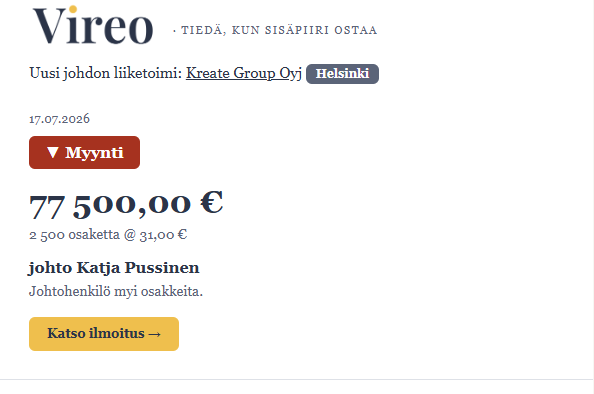
Indeed, and the stock is tanking -5% because of it. Isn’t the generally accepted rule of thumb that there can be countless reasons for insider selling (related to the seller in question) that have absolutely nothing to do with the company or its operations? Conversely, when insiders buy, it is far more often a statement on the company’s prospects.
Well, look at that. And the plot thickens, as yet another insider has sold a hefty batch of shares. That certainly gives one food for thought: has some piece of information germinated such decisions for them—or has the stock’s valuation taken off so sharply that they no longer have the patience to wait for even better numbers on the board?
I still don’t find these sales alarming. In the first case, the seller has some kind of selling program where, whenever the window opens, they sell a portion of their holdings, which likely came from the company’s dividend program. Indeed, they sold half their stake in the spring at an even lower price.
Second, the HR director is selling a tenth of their holdings.
Of course, if more of these start to appear where a majority of the holdings are being offloaded, I would be concerned.
The stock has climbed tremendously over the past year, and naturally, that makes one consider selling some of it if a large portion of one’s wealth starts to be tied up in a single stock. However, I still see some potential for the stock price to rise further. The guidance was very conservative, and we could very well see a third positive profit warning this year later in the autumn.
The sell-offs are completely understandable; the P/B is around 5.5 and the P/E based on realized earnings is 30+. I would sell too if I had any shares to sell.
Edit @Blackparta Realized full-year EPS is €0.72. Forward and rolling figures are separate.
Well, that’s not accurate. Over the last 4 quarters, the net profit has been 2.7 + 2.3 + 0.8 + 5.7 = €11.5M. The current market capitalization is €258.76M → P/E 22.5.
Then, if you also estimate the earnings for the next two quarters, it’s quite safe to say that growth will continue, which would push the full-year P/E even lower if the price remains the same, though at that point we are admittedly moving into future speculation.
Without making any judgment on anyone’s assets or investment background: these are actually quite small quantities and amounts. Once you take the taxes out of that, you’ve just barely got enough to buy a new car and some beer. The company has performed very well, and there are still plenty of good projects to come. I hope they end up benefiting Kreate.