If Trump wins the election and raises tariffs as promised, then accelerating inflation is a given.
3 Likes
It would have been good to post this in some stock-related thread, but I couldn’t really find a suitable one. In this memo, Howard Marks examines allocation and risk across different asset classes. Nothing new or groundbreaking emerged, but it makes you think about your own portfolio and its allocation in a healthy way.
Finns are traditionally a nation of lottery players, whose more enlightened individuals prefer investing over playing the lottery. However, investing is mainly perceived as stock investing, perhaps specifically because we are a lottery nation—the prospect of getting rich quick is tempting.
Of course, there are many types of investors and savers among us. Most operate with quite modest capital, while a select few manage multi-million portfolios. It is understandable that those operating with small capital want to take greater risks than the wealthier ones, who also want to protect their own capital. Age also plays a role: when you’re young, you’re ready to take higher risks than when you’re on the verge of retirement or already retired.
Regardless, I think the lessons in this memo are suitable for everyone. Risk is a factor that many novice investors overlook. Risk-taking, on the other hand, can be difficult for older generations. For these issues, you can find, if not outright answers, at least material to support your own thinking.
Enjoy reading/listening.
5 Likes
Thanks, Kryptoniitti, for the great work in increasing our understanding of fixed-income investments! An interesting question, which was also hinted at at the end of the article, is the development of spreads for high-yield bonds. Spreads have come down since last year, and it is possible that they will rise if there are surprises during the transition toward a low-interest-rate environment. For this reason, I personally have mainly invested in Investment Grade, but if turmoil occurs, it’s good to have a plan ready for how to invest in high-yield-type bonds.
2 Likes
I asked earlier about the differences between Evli Likvidi B and the Money Market Fund (Rahamarkkinarahasto). I have investments in ETFs, so my diversification in the stock market is broad. Is there one large (big and proper) and relatively safe ETF, for example, that invests in bonds or government bonds? It would be even better if it were available for monthly saving through Nordnet. I’m in my fifties, so I feel like maybe not all my money should be tied up in equity ETFs.
Help and advice needed.
SPDR® Bloomberg Global Aggregate Bond is at least one option. However, I can’t say for sure about monthly savings plans. And other houses likely have similar ones if you don’t want to maintain the allocation between different types and maturities of bonds yourself.
1 Like
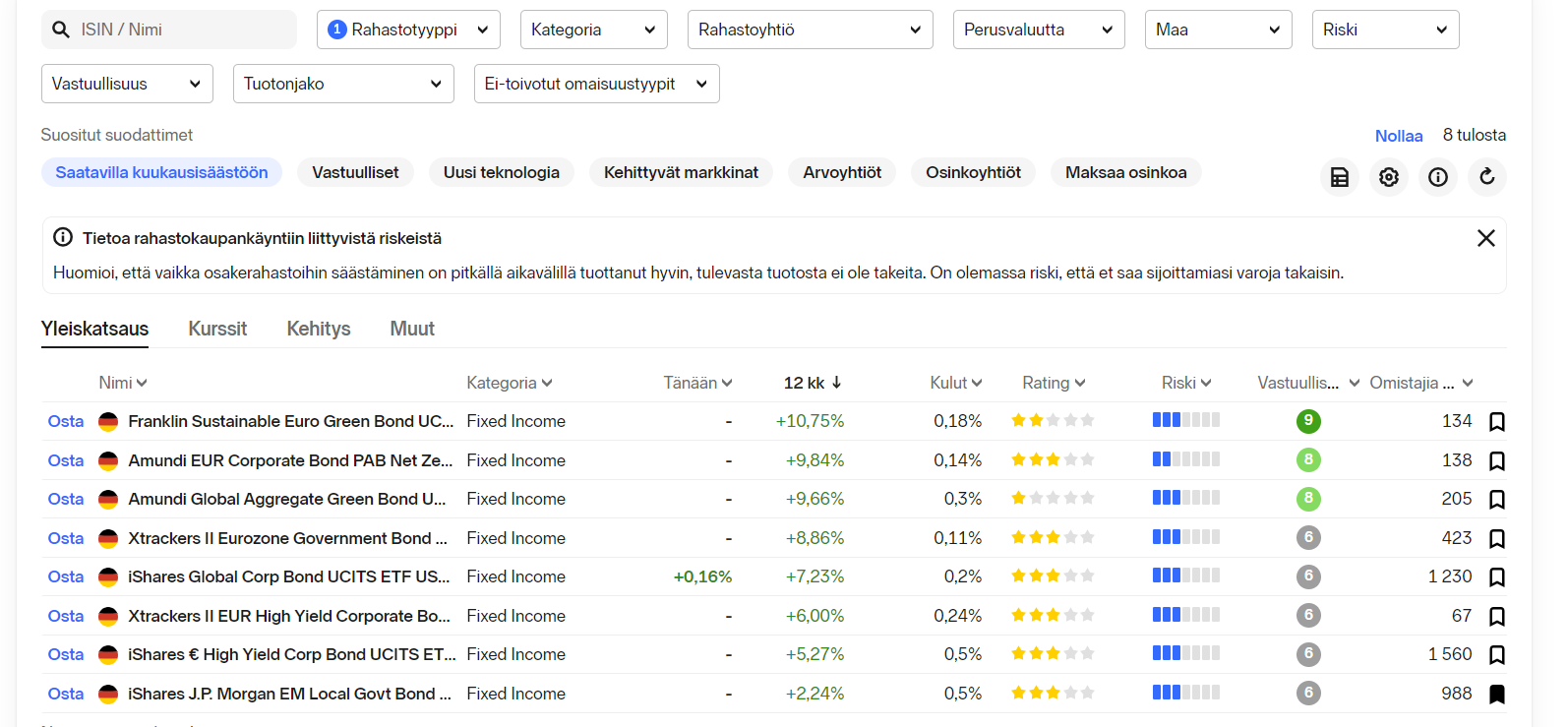
Nordnet’s monthly savings selection for bond ETFs is quite limited.
iShares Global Corp Bond UCITS ETF USD (Dist) (IS0X) invests globally in corporate bonds. I have chosen that bond investment myself. It pays “dividends” twice a year.
In addition, there are funds investing in Eurozone government bonds and corporate bonds. Personally, I have an issue with x-trackers and Amundi regarding the lack of clarity in their prospectuses about what I have actually invested in. For example, with the former, when I try to find out what kind of bonds it contains, I get an error when downloading the list. Regarding Franklin, I don’t like green bonds. I think there is a high possibility that there will be over-investment in “green.” For instance, there are plans to use hydrogen in cars and also in steel manufacturing. This increases the demand for hydrogen and electricity and could make electricity or hydrogen, or both, expensive and still unprofitable. Conversely, expectations of high electricity demand could lead to over-investment in power generation capacity and suppress prices, especially on windy and sunny days. Well, loans for those production types can be bad business.
In bonds, government bonds are generally considered the safest, and sovereign defaults are quite rare. Then come investment grade corporate bonds, which is where iShares Global Corporate belongs. After that, High Yield bonds, which are risky corporate bonds. However, it is worth noting that not all companies have a credit rating, and for example, Stora Enso among domestic companies has fairly consistently been at a high yield rating.
I still think there is quite a lot of risk in the Eurozone. Risks include the highly indebted PIGS countries. These are large and can again cause major problems for the entire European banking sector, and finding consensus can be difficult, as we have seen with the example of supporting Ukraine. Then, for example, Germany is in a surprisingly difficult situation thanks to increased energy prices and the transformation of the automotive industry. Another risk is Russia’s actions. If the war expands, it could be that the debt situation changes. So, in my opinion, Europe’s risk profile is currently quite high. Higher than, for example, a company operating globally.
Edit: Nordnet monthly savable ETFs can be selected from the menu by choosing “available for monthly savings” and fund type “bond.”
9 Likes
Thanks Warren_Fyffet for the response. I’m still curious as to why many fixed-income investors say that government bonds are the safest to invest in, yet this IS0X consists of about 97% corporate bonds. Why don’t you invest in US government bonds, for example? Sorry for the stupid questions, but I have a strong desire to learn to understand fixed-income investing.
Corporate bond yields move more in both directions than government bonds; corporate bond yields are typically higher than government bonds (as is the risk, of course). Consequently, they offer higher returns when interest rates fall, while the decline in value is greater when interest rates rise.
I see the problem with corporate bonds being that they carry similar risks to stocks, especially the riskier corporate bonds.
The reason why government bonds are often a great addition to a portfolio is that they have a low (sometimes even negative) correlation with stocks. That is, when stocks fall, government bonds rise, and so on.
However, this isn’t necessarily the case with corporate bonds. They can decline even if, for example, government bonds are rising, if corporate risks are elevated (e.g., during a recession).
Of course, if we are talking about high-credit-rating bonds, they are indeed very similar to government bonds.
EDIT:
For example, if you were considering investing 50% in stocks and 50% in high-yield corporate bonds, you would likely achieve a better or similar outcome in terms of risk and return by increasing your stock allocation—say to 70%—and putting 30% into low-risk government bonds.
4 Likes
Regarding corporate bonds, it’s worth adding that with those index-trackers, within each credit rating, you hold the most debt from the companies that are the most heavily indebted. I would say that in fixed income, if anywhere, a good active manager can improve the risk/reward ratio by more than the cost of their fee. Especially in the High Yield space, hardly anyone wants concentrations in companies with massive amounts of debt; instead, they want a good distribution and insight into companies whose High Yield status stems from something other than over-indebtedness.
2 Likes
There are no stupid questions; in fact, that is a very good question. It was partially answered above, but I will answer fully from my own perspective. First of all, I have government bonds in my portfolio. I don’t remember where I read it, but it was said somewhere that you should hold bonds from the strongest nations. For me, it has become clear that in a crisis, it is worth holding the types of bonds and stocks that are feared the least; they are the easiest to sell and maintain the best valuation. I personally consider US Treasuries to be the strongest government bonds. There are other strong ones too, but as an example, it’s worth Googling which countries have defaulted over time. There are a few countries that have never defaulted. Curiously, those same ones tend to default multiple times.
In any case, with investments, you have to look toward the future. The fact that a country has never defaulted doesn’t mean it couldn’t happen. And conversely, a default won’t necessarily occur even if the situation is worrying; in fact, there is a very high probability that states and companies will pay back their loans. It’s about the level of risk and the return you get: the risk-reward ratio.
Summary of risks:
- Credit risk
- ETF investments are quite broadly diversified, so the risk is fairly low; for example, credit losses exceeding 5% are rare (requires defaults on investments that exceed 5% of the total).
- Interest rate risk
- If interest rates rise, the value of your investment falls because new bonds with higher interest rates become more attractive.
- Currency risk
- If your bond is in a different currency than the one you use to buy or calculate your returns, the bond’s value can decrease if the currency weakens (and, of course, the opposite happens if it strengthens).
- Usually, for this reason, bonds in the same currency you use are recommended.
- This is exactly the point regarding the currency of the strongest country.
- I’ll give a very extreme example: in a wartime situation, whose government bond would you rather hold, Ukraine’s or the USA’s?
- I want to add that regarding the USA, there were fears that the US would default on its debt when Trump was last president and the debt ceiling was reached.
Now, regarding these investments. I personally hold US government bonds for the following reasons:
- The FED rate is higher than the ECB’s, and quite significantly so.
- The US default history is better than that of European countries.
- I believe the USA is the strongest country at the moment, and I think that holds true if the war expands.
- The US economy is strong, which leads me to estimate that interest rate cuts will be slower/less likely. This leads to the currency remaining strong.
I hold corporate bonds for the following reasons:
- Companies pay a higher interest rate, and thus the risk/reward ratio is better.
- I am talking about Investment Grade bonds in this context.
- The companies are usually quite large and stable, with operations in several countries.
- The interest yield is better, and through interest, money moves to new targets faster—better compounding.
- A globally diversified corporate bond portfolio is fairly currency-neutral.
- Interest comes from multiple currencies and business is conducted in multiple currencies; currency changes create benefits and drawbacks fairly evenly.
I avoid the Eurozone because:
- The risk of a Russian attack or accidental impact on these countries is high, and pro-Russian governments are possible.
- This could lead to a situation where obligations are not met.
- PIGS countries have a challenging debt situation.
- The Eurozone has a weak default history.
I have previously held emerging market bonds, and they were a rather poor investment. This is because, for example, they held quite a lot of Russian debt. Additionally, Argentina has been a rather difficult case. Still, as a whole, they probably didn’t go into the red. But as an example, I sold my Russia fund as soon as Russia invaded Ukraine. I should have done the same for the emerging markets fund. Fixed income investments, which are supposed to provide steady returns, shouldn’t be messed with in places where there is chaos and high risk (unless you know exactly what you are doing). Bonds are a weaker investment than stocks, and if you want good returns, you should think about how that money will eventually be transitioned mainly into stocks.
18 Likes
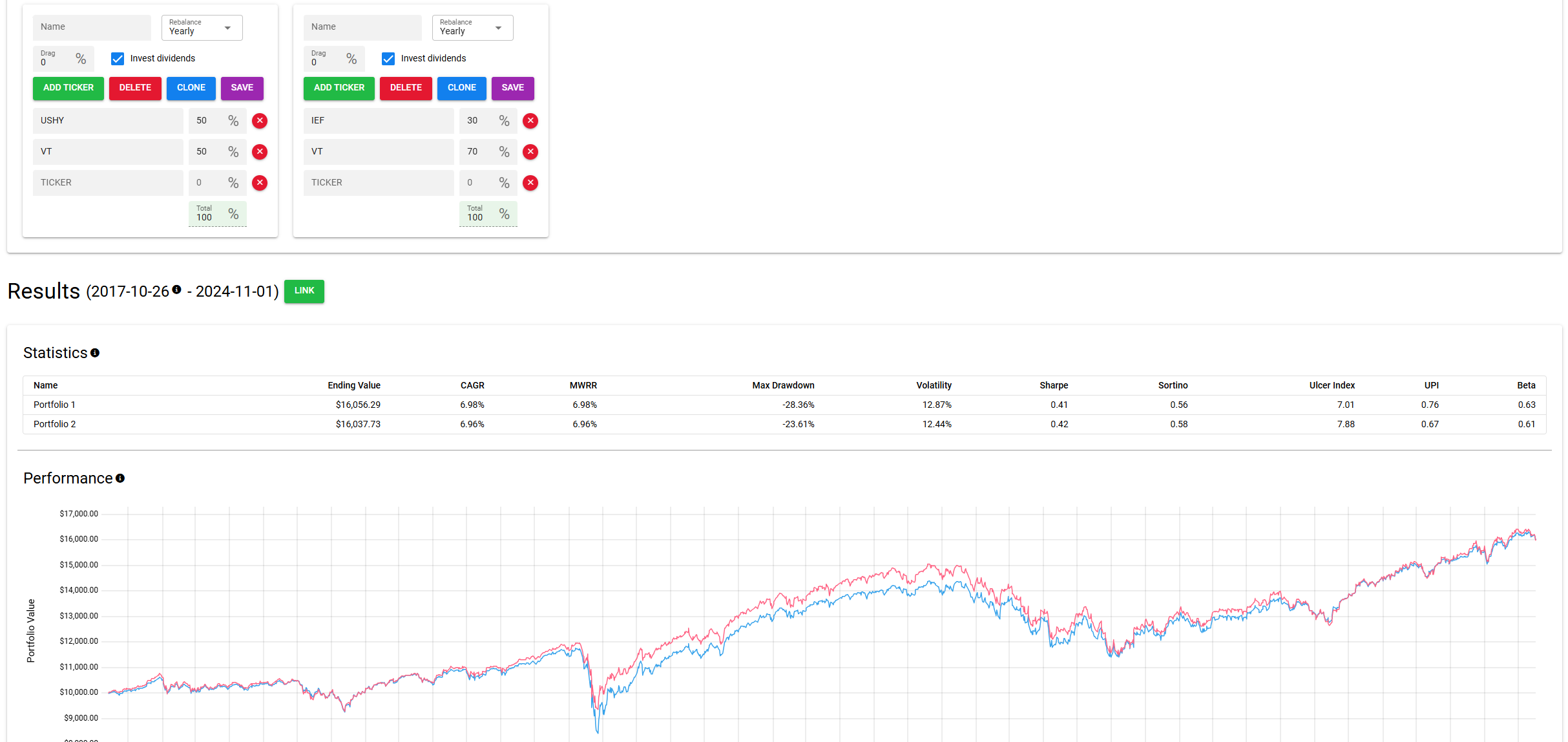
I checked those randomly chosen allocations just for fun. 50% stocks 50% high yield (portfolio 1) and 70% stocks, 30% 7-10y government bonds (portfolio 2).
Nearly identical outcome, a slightly better Sharpe ratio in the one with more stocks + government bonds.
So in practice, government bonds are a much better diversifier for stocks.
Backtester: https://testfol.io/
7 Likes
This thread has mentioned IS04 (20+ yr bonds) as well as VDTE (mainly under 10 yr bonds).
As a beginner fixed-income investor, I’m wondering which direction to look.
How do you see the differences/risks/etc. between these maturities? Is the longest one the lowest risk, or something else?
Additionally, it would be interesting to hear about alternatives similar to IS04 (long bonds) that do not pay dividends and are potentially currency-hedged.
The longest ones essentially carry the most risk. They move the most if interest rates rise or fall.
Of course, this can even be a desired feature if you have a view on interest rates falling or are seeking diversification for stocks.
Thanks for the answers. I would still like to get comments from all of you on which “tickers” would be the safe government bonds worth investing in right now? I’m looking for a low-risk option, which is why I would prefer government bonds over corporate bonds.
1 Like
For me/my family, fixed-income investing feels quite difficult overall, and I read somewhere that it might be sensible to outsource it. What do you think about that?
And what would you suggest as a partner/service provider if I were to consider outsourcing fixed-income investing? Who provides the service at a fair price? I had a quick look at Evli, but I don’t know what a reasonable price to pay for a fixed-income investment service would be.
Comments are welcome.
Think about how much risk you want to take and examine bond fund prospectuses. You’ll find durations and yield to maturity there. As a rule, long-term bonds are riskier than short-term ones. Then, for example, choose one with the lowest costs. Nordnet is full of bond funds to sift through.
2 Likes
Accunia. CLOs are yielding particularly well. Of course, you need at least 100 grand.
1 Like
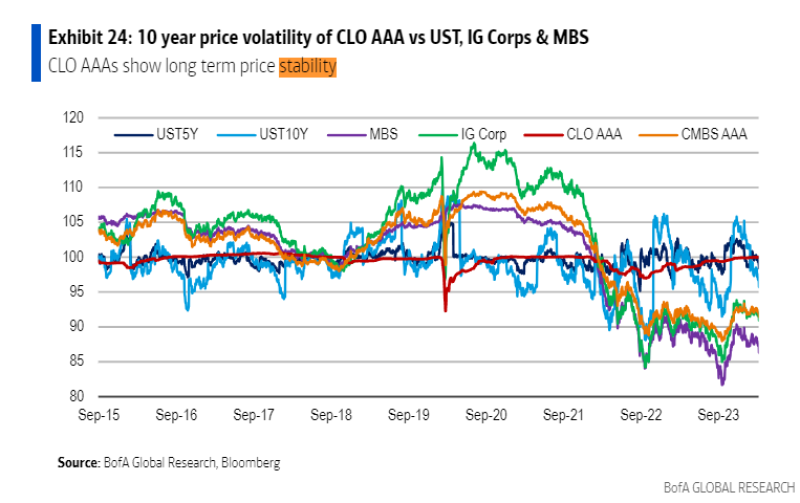
Here is a link to a short CLO overview, according to which the bogeyman created by the financial crisis still haunts investors.
If knowledge of the principles of the interest rate markets is weak, and fixed income investing and bond funds feel like difficult things to understand and grasp, I might not be the first to suggest the CLO market as an alternative… 
Regarding the question, is it meant here that, for example, a bond fund would be “outsourcing,” or what does outsourcing mean? If you don’t outsource, does that mean you buy individual bonds etc. yourself?