I have 200K to put aside for a new apartment that will be completed in a year and a half. The options are a savings account with a maximum rate of 4.5% or fixed-income investments. I’m leaning toward the latter because I understand one could get a significantly better yield than on a savings account, but I can’t evaluate for myself what kind of fixed-income investment would be best for this timeframe, which will likely coincide with general interest rate cuts. Short or long duration, corporate or government bonds, or what—any comments on the matter?
Short-term / money market are probably the lowest risk. Long-term rates always involve interest rate risk. Though you don’t necessarily get significantly better returns from those than from the best deposit offers in the end. 
4.5% is really high, where could one get that kind of interest?
2 Likes
The answer depends entirely on what kind of risk you are prepared to take. For example, many low-risk short-term bond funds fell by 10–15% during the financial crisis, by several percent during the COVID spring, and so on. So, if you don’t want to practically take the risk of secondary market pricing, the only options are a bank account or the Seligson Money Market Fund (Rahamarkkinarahasto).
If risk isn’t a concern, I would personally invest in a fund with a duration of 2–3 years and high yield for that timeframe. In this case, a potential decrease in interest rates would pay off nicely, and on the other hand, if interest rates stay flat or even rise, the high running yield of the debt instruments provides a suitable buffer against negative interest rate effects. For example, LähiTapiola Europe High Yield meets these criteria.
I wouldn’t go for a government bond fund with a 6–7 year duration and low running yield, because then you are essentially only betting on a decrease in interest rate levels.
3 Likes
Money market funds do share the same risks as short-term bond funds. They often contain bank-issued paper, for example, which still carries credit risk. That risk is very small in the Seligson fund, for instance, and you do get a little compensation for it.
For the average person, a deposit is likely one of the easiest completely risk-free options due to deposit insurance.
High yield spreads are currently quite low, so the compensation for credit risk is relatively small. ICE BofA US High Yield Index Option-Adjusted Spread (BAMLH0A0HYM2) | FRED | St. Louis Fed
1 Like
True, credit risk exists in the Seligson Money Market Fund as well, but in practice, there is no risk related to secondary market pricing (or it is minimal compared to short-term bond funds).
The realization of credit risk is a different matter than the actual pricing of the security. A short-term bond fund can hold Company X’s ten-year floating-rate bond, whose secondary market price can drop by tens of percent due to company-specific bad news or a general widening of spreads, even if the credit risk is not realized. Such securities cannot be held in a money market fund.
2 Likes
I finally ended up buying the iShares $ Treasury Bond 20+yr (IS04) ETF (iShares factsheet). I put 10,000 euros into it. YTM is 4.5% and duration is 16.7. I might buy a bit more if it drops significantly from here. There’s no rush to sell this; now I’m just waiting for interest rates to fall, whether that takes a year or more. In the meantime, I can enjoy a dividend yield of roughly 4.5%, plus hopefully some capital appreciation as a bonus when rates decline.
The idea was to buy a slightly longer duration than what I currently have in my portfolio (Evli Likvidi B with a duration of 0.35 and Vanguard Eur Corporate bond with a duration of 4.5). When I went through the funds and ETFs on Nordnet, all other options—such as Treasury Bond 7-10yr, USD corporate bonds, etc.—either had too low trading volume, Nordnet wouldn’t allow the purchase, or there were other issues, so I didn’t think there was a better instrument available on Nordnet for this than IS04. The only downside to IS04 is that dividends are distributed, meaning it is not an accumulating (growth) share class. Additionally, there is naturally a currency risk, but I am prepared to take that against the euro, as it could just as easily provide extra returns.
My fixed income portfolio is pretty much set now. In addition to this 10k€ in Treasury bonds, I have approx. 108k€ in Evli Likvidi B and 44k€ in Vanguard Eur Corporate bond. So, a total of approx. 162k€ in fixed income, which is about 20% of the total portfolio value, with the remaining 80% in stocks. On top of this, I have a cash reserve of 20k€ in Bank Norwegian with a 3.75% yield. If interest rates start to fall at some point, I will first start trimming Evli Likvidi B once its expected return drops sufficiently.
11 Likes
I have been investing in CLOs for some time now. A CLO investor can choose the “tranche” that suits their own risk level. Risk and return, of course, go hand in hand. Last year, the best return, 43%, came from the riskiest option, i.e., Equity. Personally, I have mostly invested in Mezzanine, where the expected return is over 10% and last year’s return was exactly that 28.1%. I have also invested some in the Equity class. Initially, I invested directly in different CLOs, but nowadays you can also invest in funds, which provides better diversification and, above all, better liquidity. It is worth noting that a CLO investor is not safe from market disruptions, so you need to have a strong stomach for it. In the long run, returns on par with the stock market will then pay off.
1 Like
I assume that a CLO is not a familiar structure to most forum members. Therefore, an introduction to the topic is likely necessary.
https://www.investopedia.com/terms/c/clo.asp
2 Likes
Wasn’t this investment product formerly a CDO, where loan = debt? No wonder the name was changed, considering what kind of sketchy setups they were. Especially US mortgages (which were also given to the broke, since house prices can’t do anything but go up  ), had received stellar ratings from rating agencies and were shoved into CDOs in the portfolios of banks and large institutions both abroad and domestically. They were rotten to the core. How well can one actually inspect the contents of a CLO?
6 Likes
You mentioned: “In the meantime, one can enjoy a dividend yield of roughly 4.5%”. Since I’m not really familiar with those fixed-income products, I’ll ask: Does an investor then receive this “dividend” of about 4.5% annually into their account from, for example, this IS04? The fund’s value itself seems to just be falling, but if that 4.5% lands in the account, then it’s fine. And I suppose the fund’s value will start to rise when policy rates begin to fall?
I have been wondering how falling interest rates will affect short-term bond funds? And then, for example, Money Market Funds, which are also referred to as “cash.”
With long-term bonds, falling interest rates increase the valuation of existing bonds. I’m not that familiar with those short-term ones. If the yield is, say, 4%, how long will it stay at that level?
And don’t short-term bond funds have to load up on more new bonds, which will then have lower interest rates? So would the yield level stay the same as long as there are old bonds in the fund, if they are held until maturity?
I’ve also been planning to buy a high yield fund again; shouldn’t they provide pretty good returns once interest rates drop? How much “base yield” can one expect from high yield? On top of that, there’s a bonus from the increase in bond values, which are traded more because of their longer duration.
Here are some example bonds from a high yield fund I own a small amount of.
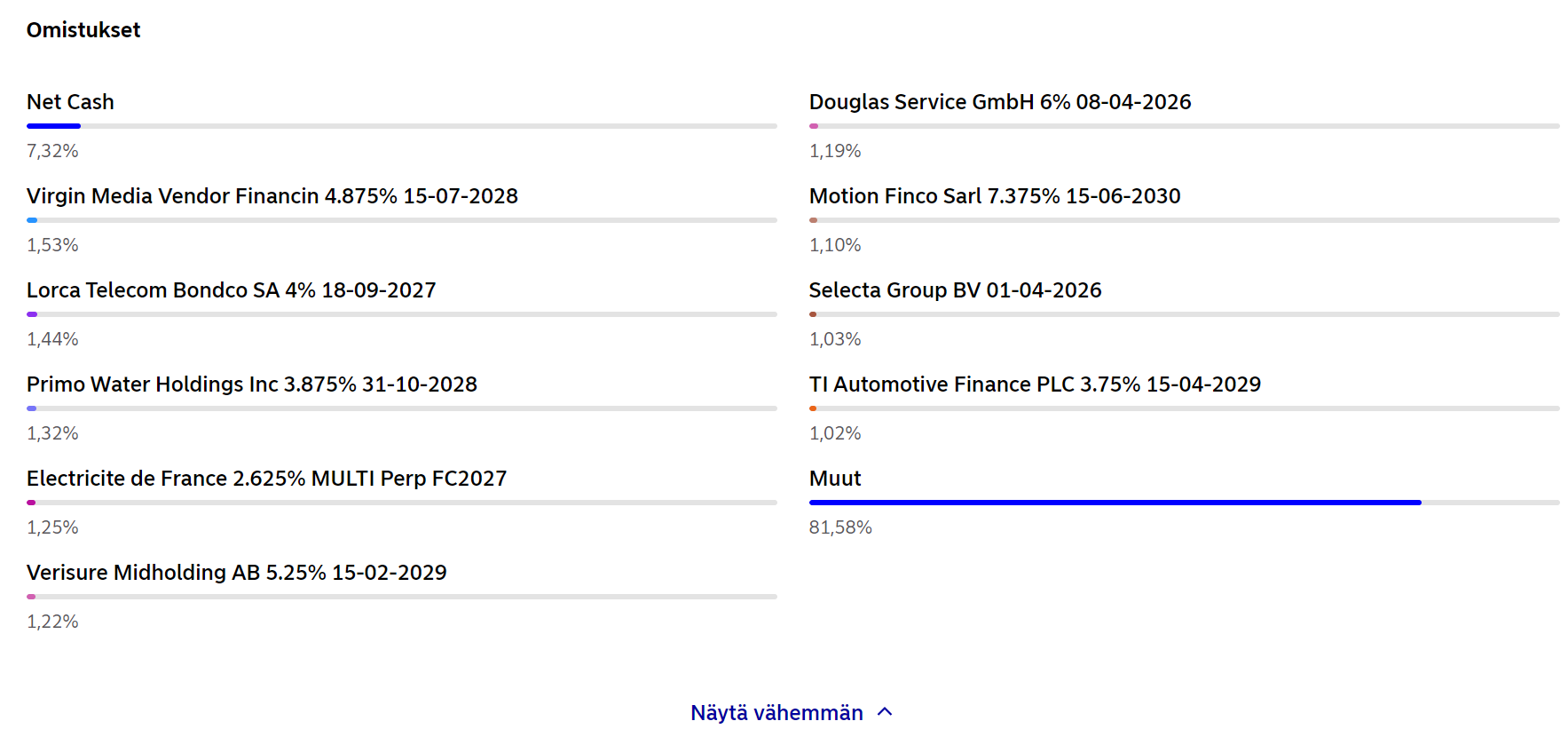
I’m pretty clueless about the bond markets, so feel free to explain it in very simple terms.
1 Like
It might be worth thinking of an ultra-short-term bond fund or a money market fund in much the same way as a deposit. The value hardly decreases, but the interest yield you receive on your money drops because, as you said, maturing funds have to be reinvested at a lower interest rate level.
2 Likes
The reason I’m asking about short-term rates is that I’ve invested in many companies that are now making record profits because of favorable interest rates. Their net interest income rose from zero to record highs. The portfolios mainly consist of short-term interest instruments.
For example, Nordnet’s investment portfolio as a company. 40% are <1y loans and 78% <3y. Could that “cash” refer to Money market funds or a deposit account? I wonder if “Fixed” refers to interest-rate hedged?
https://www.sijoitustieto.fi/system/files/sites/default/files/image_145.png
https://nordnetab.com/wp-content/uploads/2023/03/Nordnet-liquidity-briefing-2023-03-16.pdf
However, I’ve been wondering how long a portfolio like that will keep making good returns. I assume interest rates will drop to around the 3% range initially. And do short-term rates benefit from falling interest rates, given that they mature faster and new ones must be bought over time?
And here is another company, Wise PLC, which earns interest income specifically from MMFs. I read that MMFs are very short-term debt investments or something along those lines.

1 Like
Fixed likely refers to a fixed-rate bond and FRN to a floating-rate note.
Ultimately, a short bond behaves exactly the same way as a long one when interest rates fall. Its value rises/falls by approximately the interest rate change x duration. The duration is just much shorter. If the duration in a short-term portfolio is, for instance, 0.2, its value increases by about 0.2% when interest rates fall by 1%, which is very little. This is because a short portfolio is repriced very quickly to the changed interest rate level.
That change in value would only be recognized for an AFS (Available For Sale) portfolio, for which changes in fair value are recorded. For an HTM (Held To Maturity) portfolio, even that 0.2% increase would not be recorded, only the income received from interest.
In practice, falling interest rates decrease the returns of a short-term portfolio over, say, a one-year time frame, even though there might be a small initial rise (as the duration is not zero, after all).
Of course, if we are talking about, for example, a bank that also finances itself with short-term funding, the net impact of interest rates on the net interest margin can be zero. (What is lost in yields is gained in decreased expenses.)
4 Likes
I’ve been researching different options for adding bond funds to my portfolio. How does it work if a company becomes insolvent or goes bankrupt—is the value of the bond automatically written down to zero? For example, in a High Yield fund or an ETF.
BTW, I just noticed that Evli has published a 7-part video series on fixed income investing on YouTube.
11 Likes
How can you invest in Mandatum’s Nordic High Yield? Do you need to be a wealth management customer, or can you access it if you open a Trader account? Apparently, it is not sold anywhere else but through Mandatum.
At least through Trader, it’s possible for a book-entry account.
1 Like
I am a wealth management customer myself. At least based on the start of the year, the fund in question is no better than others, with a YTD return of 1.65% whereas Ålandsbanken’s fund has returned 2.61%. You can buy Ålandsbanken’s fund directly from Nordnet if you don’t want to become their customer.
4 Likes
LähiTapiola Nordic Corporate Bond (Pohjoinen Yrityskorko), YTD +2.58% and was selected by Morningstar as the best fund investing in European corporate bonds. In a class of its own regarding its Sharpe ratio.
6 Likes