Kamux - Hunting for profitability improvement (Part 2)

Behind a paywall unfortunately, but if the headline holds true in practice, there are grim times ahead for Kamux and other used car dealers. The new reality will likely become clear over the next 12 months. This matter has already been noted above in the thread, but I’m raising it again as the impact could be very significant.

Who will buy high-margin Kamux Plus in the future if customers assume that faults will be repaired for free anyway? And since used cars will continue to have defects, even previously easy-going customers will start complaining twice as much and disputing sales. It won’t be a treat to be an employee at Kamux or a CFO trying to protect the company’s cash flow when repair bills start piling up on the desk more than before. Costs will increase, that is almost certain. Whether they come up with ways to reduce the cost burden now or later remains to be seen.

5 Likes

The point here, however, is that while the rules are changing, they remain the same for everyone. The clearer the rules are, the easier it is to operate according to them. In practice, this means that car dealerships will know their responsibilities more precisely and can better price their risks accordingly. For cars with few defects, pricing won’t change. For riskier cars, trade-in values will decrease and target margins will be increased. All of this is paid for once by the dealership through the value of their inventory, and from then on, by the consumer.

Consumers can, of course, shift toward doing more peer-to-peer business, avoiding paying the dealership for the liability coverage. Even today, market prices are very close or even identical regardless of whether the seller is a private individual or a business. Up until now, businesses have had liabilities while consumers have not. This will likely continue to be the case even as dealerships take on more responsibility. So, the question is whether it will be more attractive to buy from a dealership or a private individual in the future.

I would add that the car trade will not end or fall into distress due to any single change. Think about the industry and all the possible changes that have occurred, say, over the last 50 years. All possible variables in legislation, taxation, power sources, etc., affect the value of the current inventory at that moment. This means that if the cash flow is dry, a single variable can lead a specific dealership to bankruptcy. If there is cash in the bank, the inventory is cycled through under the new rules and business continues. The industry has had a difficult or very difficult time since the start of COVID because so many changes have occurred in such a short period. However, the industry has not disappeared and will not end. What affects the industry most is the total volume of car transactions per year. With an empty till, a shrinking market, and a shift in power sources or legislation on top of that, you’re finished. In the same situation with a large cash reserve, you just roll over the inventory and get back to work.

7 Likes

It seems like a real socialist has taken the helm at the Consumer Disputes Board.

They think they are some sort of legislators, or at the very least, they are making extremely strong interpretations of the law. In my opinion, their justifications wouldn’t hold much water in a court of law.

I wonder why the automotive industry hasn’t mounted a stronger resistance.

I wrote about this in a certain media outlet:

The Consumer Disputes Board (Kril) has, in recent automotive cases, started applying a new line in its decisions regarding the seller’s obligation to bring a product into conformity with the contract without the customer contributing to the costs. This is based on aforementioned EU Court of Justice rulings where a more recent judgment concerned the repair of a used tent purchased via distance selling (which did not meet the agreed specifications at the time of delivery), the rescission of the sale, or the replacement of the product, and an older one concerned mail order.

Could an expert explain how such a case can be used as a basis for, say, these Kril decisions where no form of distance selling was involved?

Is it possible to take a single point out of a specific judgment and apply it to any case whatsoever?

Decisions used in the justifications of the judgments:

JUDGMENT OF THE COURT OF JUSTICE In Case C‑52/18, paragraph 34

34 As regards, first, the condition that the goods must be brought into conformity ‘free of charge’, which means that the seller cannot make any financial claim in connection with the performance of that obligation — whether that obligation is performed by repair or by replacement of the non-conforming goods — and which is intended to protect consumers from the risk of financial burdens which, in the absence of such protection, might discourage them from asserting their rights

(see, to that effect, judgment of 17 April 2008, Quelle, C‑404/06, EU:C:2008:231, paragraph 34),

it must be stated that that condition cannot depend on the place where the goods purchased under a distance contract must be made available to the seller for the purpose of being brought into conformity.

Corresponding case C-404/06, paragraph 34

https://eur-lex.europa.eu/legal-content/FI/TXT/HTML/?uri=CELEX:62006CC0404

“34 The seller’s obligation to bring the goods into conformity free of charge, whether by repair or replacement of the goods, is intended to protect consumers from the risk of financial burdens which, as the Advocate General observed in point 49 of his Opinion, might discourage them from asserting their rights in the absence of such protection. This guarantee of the lack of charge, intended by the Community legislature, means that the seller cannot make any financial claim in connection with the performance of its obligation to bring into conformity the goods to which the contract relates.”

#kuluttajariitalautakunta #krl

3 Likes

Yeah, maybe the auto industry is active on this behind the scenes, but less so in public.
The tax mess in the auto sector needs to be swept under the rug first…

It certainly can’t be the case that a used car gets a “forever” warranty at the dealership’s expense, to put it bluntly.

Fortunately, the Consumer Disputes Board doesn’t get to legislate in Finland…
Perhaps court rulings will again be sought to determine where the line for liability/compensation is drawn..

Car dealerships have thick skin; they don’t flinch at the little things.
I’ve had a couple of cases myself when a VW timing chain stretched and an Audi was guzzling oil; it was “colorful” in both instances, and both had under 100k km on the clock…

1 Like

Here are Rauli’s and Thomas’s comments on April’s car sales :slight_smile:

Used car sales developed positively in Finland in April, but after an encouraging March, new car sales turned back into a decline. The number of used cars sold through dealerships developed in line with the market in April.

4 Likes

Here are Rauli’s pre-match thoughts as Kamux reports its Q1 results on Tuesday :slight_smile:

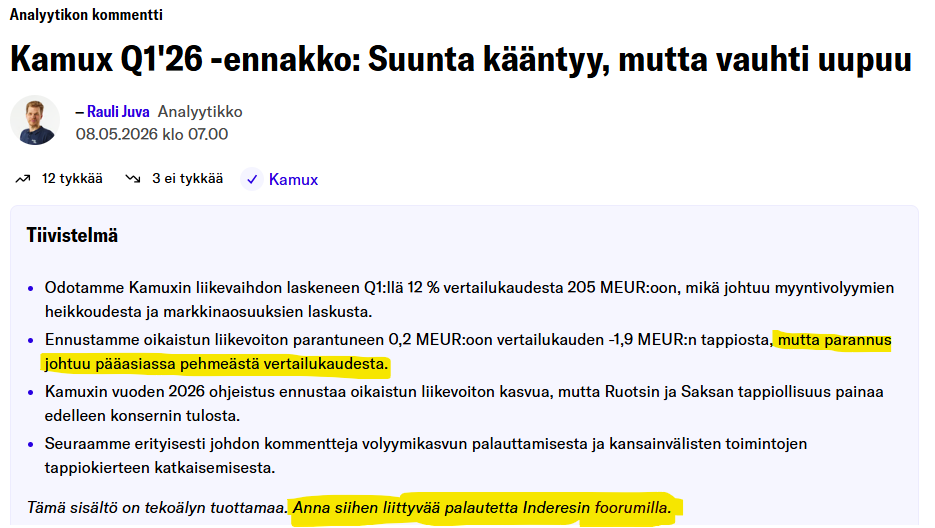
We expect Kamux’s revenue to have decreased significantly from the comparison period, driven by lower volumes, but we expect the adjusted operating profit to turn slightly positive. We expect the company to reiterate its guidance predicting earnings growth, even though Kamux’s position still appears challenging.

2 Likes

If Kamux performs as Rauli has analyzed, with Q1/26 operating profit at +€0.2M compared to -€1.9M in Q1/25, does that improvement really just stem from a “softer comparison period”?
Doesn’t the earnings improvement actually result from entirely different reasons and fundamentals?

I hope that the bottom for Kamux & the car trade has been seen and things are looking up; there are signs of this.

3 Likes

This isn’t on the AI, but on my writing. This is specifically meant to say that in our view, Kamux’s fundamentals haven’t significantly improved compared to, for example, the end of last year, but the comparison period is so poor that an improvement is still expected. On the other hand, it’s meant to convey that similar earnings growth isn’t expected from other quarters this year. And perhaps thirdly, that the performance is still weak in absolute terms, even if an improvement occurs.

By the way, I’ll be at Oriola’s and Fiskars’ CMDs all day tomorrow, so the analysis of Kamux’s results will be left for later in the evening on my part. Therefore, there won’t be a live stream or forum comments tomorrow, but the report will be out on Wednesday as usual.

18 Likes

Operating profit still in the red. This is certainly no top-tier performance.

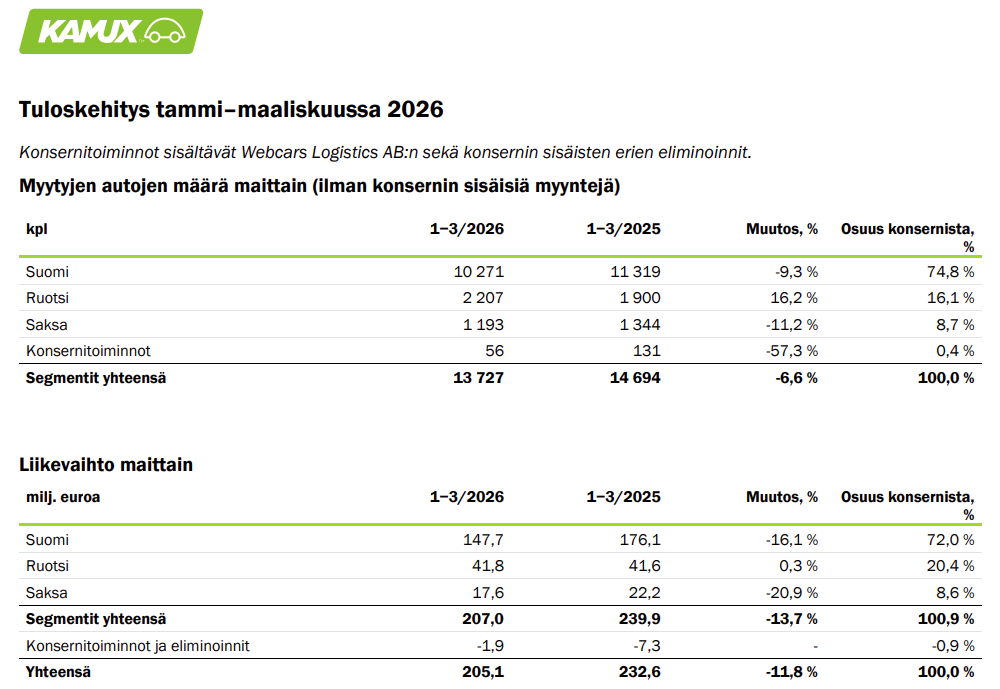
January–March 2026

  • Revenue decreased by 11.8% to EUR 205.1 million (232.6)

  • Gross profit was EUR 19.0 million (18.1), or 9.3% (7.8) of revenue

  • Adjusted operating profit was EUR -1.0 million (-1.9), or -0.5% (-0.8) of revenue

  • Operating profit was EUR -1.0 million (-2.6), or -0.5% (-1.1) of revenue

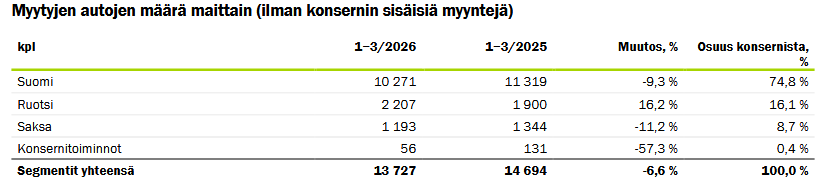
  • Number of cars sold decreased by 6.6% to 13,727 cars (14,694)

  • Basic and diluted earnings per share were EUR -0.03 (-0.10)

14 Likes

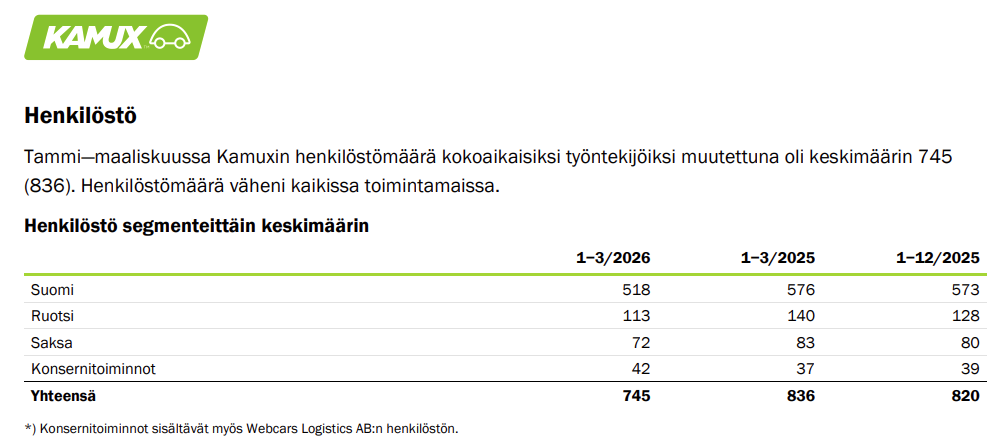
Are Germany and Sweden being scaled back already? The number of employees is at least in a sharp decline.

2 Likes

I would have been ready to bet that the demand for used electric vehicles would have temporarily pushed the quarterly figures well into the black, but perhaps the company will state that the “sales mix was slightly off.” Once again. Towards the one-euro mark we go, then.

Well, the demand for electric vehicles only really picked up in Q2, so perhaps Kamux will brighten up then as well.

9 Likes

Kamux estimates that the used car market declined in the first quarter of 2026 compared to the prior-year period in all of its operating countries. In Finland, however, the number of used cars sold by car dealerships grew by 1.1% compared to the corresponding period in 2025.

So, in Finland, dealership sales volumes for used cars grew by 1.1%. However, the number of cars sold by Kamux in Finland fell by 9.3%. From this, one can likely conclude that competitors are taking Kamux’s market share in a big way.

34 Likes

The problem here is that if the sales mix was wrong in Q1—meaning there were no EVs in stock—how would that mix improve in Q2 when everyone is competing for the same units? It might even happen that they fight tooth and nail to fill their inventory with EVs, and then Hormuz opens up, gas costs 1.5e/liter, and EV prices collapse.

6 Likes

The figures certainly look bad, and the explanations behind them remain the same. Has anyone compared the figures of different car dealerships (volumes, gross margin, EBITDA, share of services in revenue, etc.) somewhere? One would need to see if there are even prerequisites for improvement here.

For the first time, watching an earnings call is causing second-hand embarrassment… The CEO is reading from a teleprompter/notes and is struggling badly. Kalliokoski is likely a good operational manager for a car dealership, but the boots of a listed company’s CEO are too large, as the job includes public speaking in English (have Kamux’s earnings calls been conducted in English before?). I bet the actual expertise isn’t as shaky as the presentation style. Oh dear…

8 Likes

Kamux’s performance is weak. Admittedly, the markets are challenging right now. Sales volumes for new cars in Finland are at record lows, which means no used cars are being added to the circulating population from the domestic market. Uncertainty regarding the choice of powertrain is slowing down consumers’ purchasing decisions.

And there is weakness in the neighboring country’s market as well. Stores closing and bankruptcies too.

7 Likes

Kamux’s poor figures are not driven by the market situation, but rather by the company’s weak performance. This has been visible for years already. In Finland, Kamux is losing market share to its competitors.

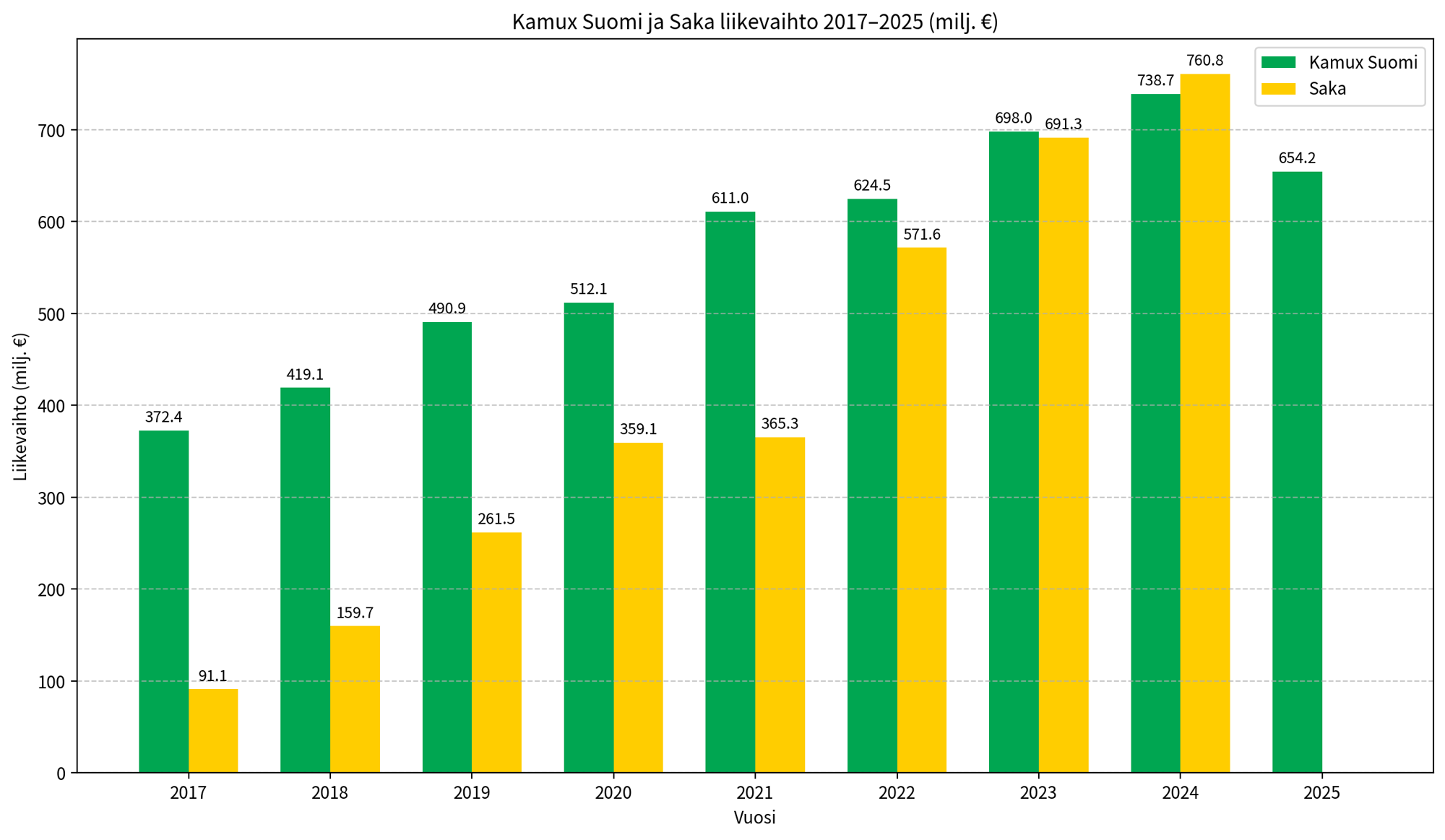
At the same time, Saka is publishing completely different figures.

From the Q1 release: "Saka forged record-breaking figures in the first quarter (Q1) of the year. The company’s revenue grew significantly, rising to 194.9 million euros. Simultaneously, the company’s profitability improved substantially compared to the reference period, strengthening our position as the superior market leader in the industry in Finland.

Saka’s start to the year shows that there is demand for an automotive retail innovator, even though the general economic situation has been a topic of concern for consumers. Our company sold a total of 10,690 cars during January–March."

Edit: here is an image to help visualize the development over the recent years:

19 Likes

Well, in Finland, there isn’t a huge difference in units between Kamux vs SAKA, though there certainly is in trade-ins.
But Kamux definitely needs more brisk sales going forward and must continue to keep costs under control.
Kamux’s Q1 is a disappointment, that much is clear. Heavy headcount in Germany…

5 Likes

Inevitably, the question comes to mind: what exactly is so difficult about this? Of course, addressing challenges and inventory optimization takes time, but this has been going on for a long while now.

2 Likes

Kamux has had 50% or more diesel cars in stock throughout the entire Q2. This is easy to verify even now through the inventory search on their website. At the same time, demand for used electric vehicles has doubled in Finland. From this, one can draw conclusions about how this second quarter is progressing.

9 Likes

There are all sorts of buyers in the car market, and not everyone is looking to buy an electric vehicle. Good diesels without electrification are the crown jewels for a certain crowd, and their prices have risen. Let’s see how Q2 goes; there are at least signs of the market picking up. In Germany, Kamux is forced to hold change negotiations (YT) and let 10-15 people go, mainly from the back office. And perhaps the best move in Germany would be to just board up the windows.

3 Likes