K-auto is Kesko’s and Käyttöauto is its own company, meaning they are different things.
4 Likes
Well, it seems that in Seinäjoki, Käyttöauto and J. Rinta-Jouppi are still the biggest. Käyttöauto is about a couple of hundred meters from K-auto.
You replied to this message:
K-auto operates in the same building as Kamux, while Käyttöauto is almost next door.
The property used by K-Auto and Kamux was built on land owned by Käyttöauto/Viitala, but it may have changed ownership in recent months.
3 Likes
Perhaps that was a lighthearted/confusing comment, meaning that in Finland, competitors can also buy each other’s shares. I think that’s a good thing. Additionally, this was meant to be somewhat of a conversation starter.
Back when Käyttöauto became one of Kamux’s owners (during 2021), I thought that Kamux must truly be valuable and have something very special, for such a decades-long successful and highly respected company in the same industry to be willing to pay quite a high price for its shares.
Kamux Corporation: Share buyback program completed
Kamux Corporation | Stock Exchange Release | 16 April 2026 at 19:00:00 EEST
Kamux has completed the share buyback program announced on 11 November 2025 and 25 February 2026. Between 18 November 2025 and 16 April 2026, Kamux repurchased a total of 1,665,209 of its own shares in public trading on Nasdaq Helsinki Ltd at an average price of EUR 1.9598. The total purchase price of the shares was EUR 3,263,467.16. The share repurchases were based on the authorization given to the Board of Directors by the 2025 Annual General Meeting. The shares are intended to be used as part of the payment of rewards for the Group’s key personnel performance-based share plan 2025–2029 and the Green Lions matching share plan, for the Board of Directors’ share-based compensation, and to develop the company’s capital structure by reducing equity.
So does reducing equity mean that some of the shares will be shredded, or that they will be generously handed out to operational management…?
4 Likes
Saka just released a glowing Q1 press release: revenue reached 195 MEUR and 10,690 cars were sold. With these figures, Saka claims to be the “superior” and “undisputed” market leader in Finland.
Our forecasts for Kamux Finland’s Q1 are 151 MEUR and 10,350 units. Based on Saka’s comments, there isn’t really much room for a positive surprise on the volume side.
16 Likes
Does SAKA have some kind of visibility into other car dealerships’ sales volumes that you and I don’t have?
2 Likes
In the total market for used passenger cars, the volume of trades decreased by 0.8 percent in January–March compared to the same period in 2025. In contrast, the number of used passenger cars sold through car dealerships grew by 1.1 percent in January–March 2026.
Source: New passenger car sales picked up slightly in March - Autotoday
If the market share of one large player grows, then it shrinks for others when the total market has not really expanded.
7 Likes
Yeah, there are statistics used in the industry from which you can see at least the volumes. There was more talk about this a while back, e.g., in this post.
4 Likes
Consumer authorities are putting more pressure on the used car trade.
The Consumer Disputes Board has adopted a stricter interpretation in new decisions, according to which the car dealership is fully responsible for repairing defects found in a car. Typically, in dispute cases, the burden has been shared, meaning the car dealership has only partially compensated for repair costs. Below are links to the Consumer Disputes Board’s press release and the (naturally critical) response from the automotive industry.
Stricter responsibilities and the resulting costs should, of course, flow into car prices, so this should not be a problem for Kamux in the long run. Instead, the new stricter interpretation may make it more difficult to sell Kamux Plus (and competitors’ similar) extended warranty services, which consumer authorities have already paid attention to anyway.
16 Likes
The justifications for Krili’s decisions are indeed weak and severely lacking, based on the ECJ’s rulings on the matter, where the more recent ruling concerned the repair, cancellation, or exchange of a used tent purchased through distance selling,
and the older one concerned mail order.
How do the aforementioned cases apply as a basis for Krili’s decisions, for example, where there was no distance selling whatsoever?
Can a single point be extracted from a single judgment and applied to any case anywhere?
Decisions used in the justifications for the judgments:
JUDGMENT OF THE COURT OF JUSTICE OF THE EUROPEAN UNION In Case C-52/18, paragraph 34
34 As regards, in the first place, the condition relating to the bringing of the goods into conformity “free of charge”,
which means that the seller cannot make any financial demands when implementing that condition – regardless of whether
this is done by repairing or replacing the defective goods – and which aims to protect the consumer from the risk of costs
which, in the absence of such protection, might dissuade the consumer from asserting his rights
(see, to that effect, judgment of 17 April 2008, Quelle, C‑404/06, EU:C:2008:231, paragraph 34),
it must be noted that this condition cannot depend on the place
where the consumer must make the goods purchased by distance selling available to the seller for the purpose of bringing them into conformity.
Corresponding case C-404/06, paragraph 34
https://eur-lex.europa.eu/legal-content/FI/TXT/HTML/?uri=CELEX:62006CC0404
"34 The seller’s obligation to bring the goods into conformity free of charge
– regardless of whether this is done by repairing or replacing the defective
goods – aims to protect the consumer, as the Advocate General stressed in point 49 of his Opinion, from the risk of costs
which, in the absence of such protection, might dissuade the consumer from asserting his rights.
This guarantee of freedom from charge, in accordance with the will of the Community legislature, means that
the seller cannot make any financial demands when fulfilling his obligation to bring the goods subject to the contract into conformity."
4 Likes
This leads to certain brands/models no longer being accepted as trade-ins or purchased, or the trade-in value being low because the risk of post-sale expenses is so high. It requires professional expertise to select the right products; otherwise, defects are left unrepaired, relying on the customer getting tired of the runaround and not taking the matter to court. This applies to all dealerships, but primarily to those specializing in used cars. Prices don’t flex upwards but downwards—if a price difference cannot be justified, for example, between Finland and Germany, consumers will vote with their feet and have a car brought in from elsewhere.
4 Likes
@Rauli_Juva, how much was Kamux’s Q4/2025 revenue in Finland and what was your estimate for Kamux Finland’s Q1/2026 revenue?
Actual figures can be found in Kamux’s interim report, for example.
Future quarterly revenues are available in the premium report.
2 Likes
Rauli’s company report from 26.2.2026 included this. 
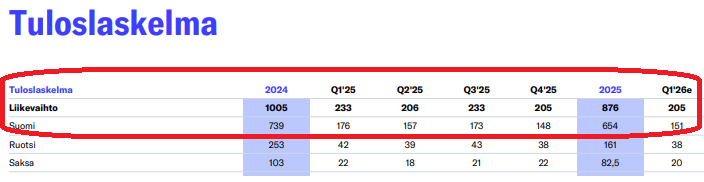
If he provides an updated estimate on this, he’ll likely do so around the time the preview comment is published or slightly after (the preview comment isn’t broken down this precisely, of course). The preview comment should appear shortly before 12.5.2026, when the company reports its Q1 results.
4 Likes
The price difference between Finland and Germany is negligible at the moment; only relatively new electric vehicles and hybrids are worth importing, others are not. For other cases, importing is based more on the fact that the selection in Finland is poor and, for example, features have been skimped on; if a customer is willing to pay for those, then importing may make sense…
1 Like
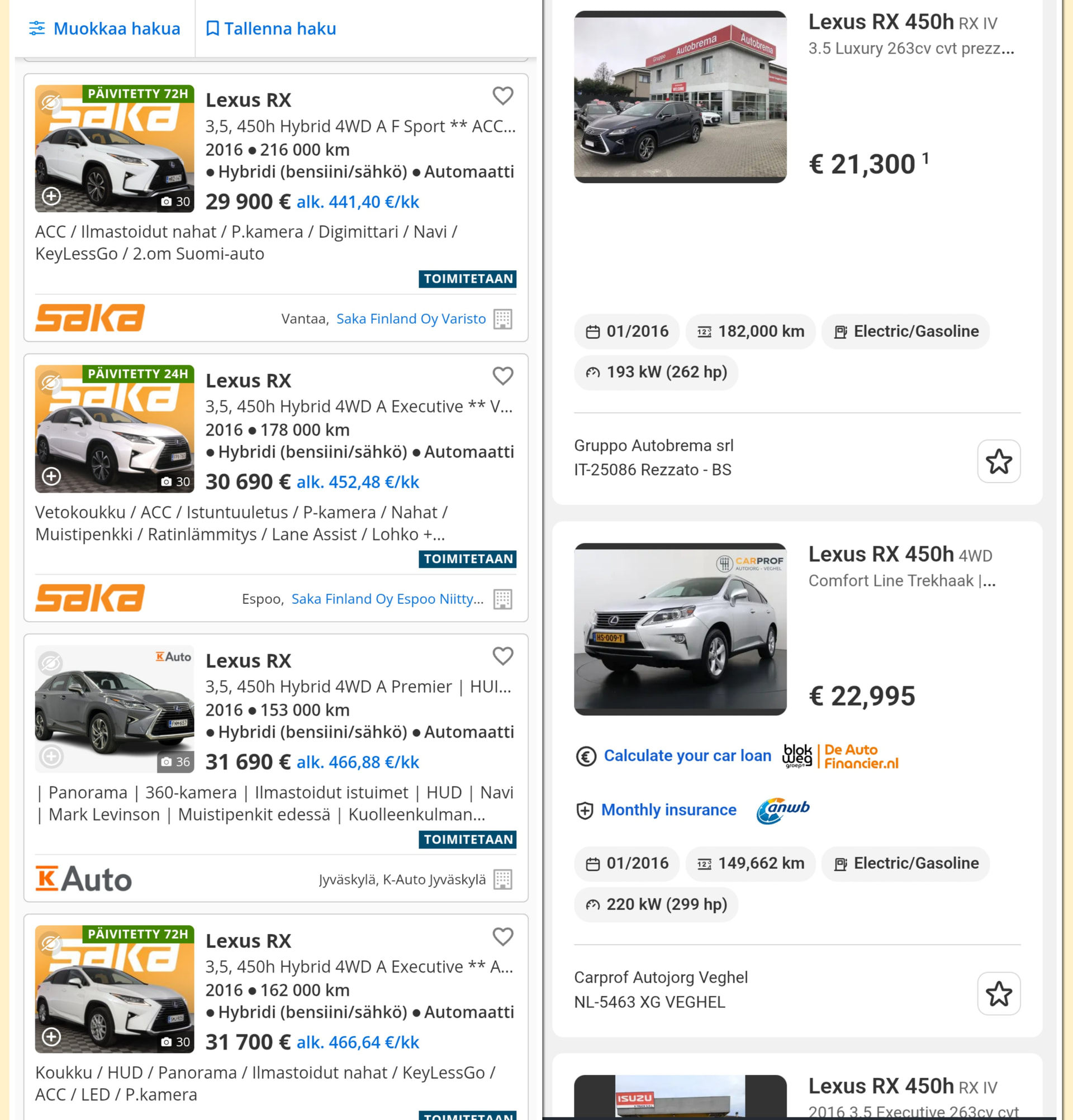
So what exactly counts as a negligible price difference and what counts as “relatively new”? For 10-year-old Lexuses, at least, there seems to be enough of a price difference and selection on the European side that, in my opinion, it still very much justifies importing one 
1 Like
If we were to do a fair comparison and compare cars of the same body style, for instance, and include a second set of tires and wheels, import costs, and taxes in the import price, the margin remains quite thin on those as well. And are you saying those weren’t hybrids 
Italian imports have a lower resale value than, for example, those imported from Germany…
And the Italian car prices are missing VAT.
Maybe those import matters should be left to someone with experience…
17 Likes
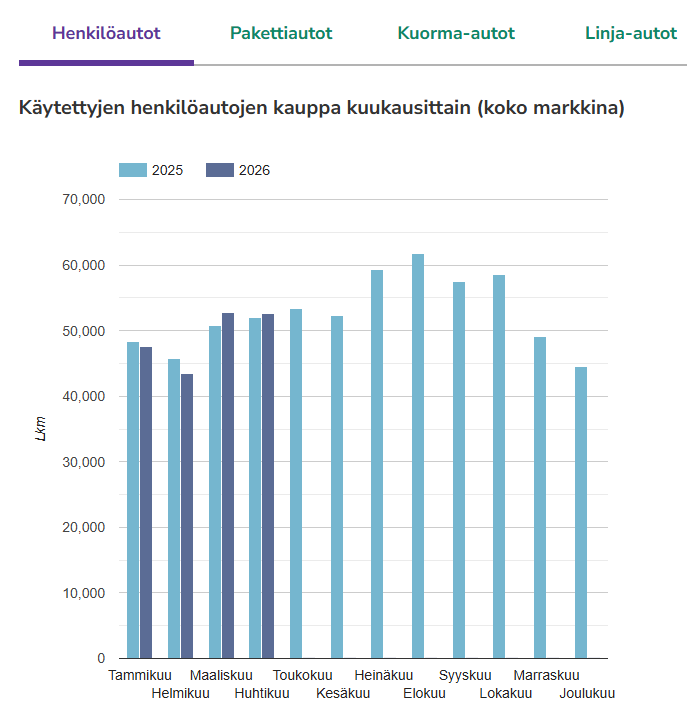
And there’s the old body style as a German comparison, which easily has a €5k difference, and the Italian version as mentioned above.