I own Kahoot shares because I believe megatrends will increase Kahoot’s absolute operating profit. I intend to buy and sell based on how I view the stock’s valuation. I am not taking a stance on whether the stock is cheap or expensive right now.
I haven’t had a proper chance to familiarize myself with the company yet. Now, however, I’m starting to sift through information about the company and its stock to see if it would fit into my portfolio
The thread opener @MoneyWalker would probably be able to tell us more about the company and its valuation/possible comparables first and foremost.
Interesting. Earlier this week, I took a remote first aid course, where Kahoot was used to answer questions which, in a way, ensured that the course participant was engaged. In Kahoot, the answer options were displayed, and the web image showed the question + options.
Kahoot! is pretty much the best-known gamified quiz tool in schools, and probably the majority of our primary school students have played it. The app probably started spreading to wider use in Finnish schools already 4-5 years ago.
I don’t have time to go through the investor material in detail now, so a couple of quick questions for those who have analyzed it:
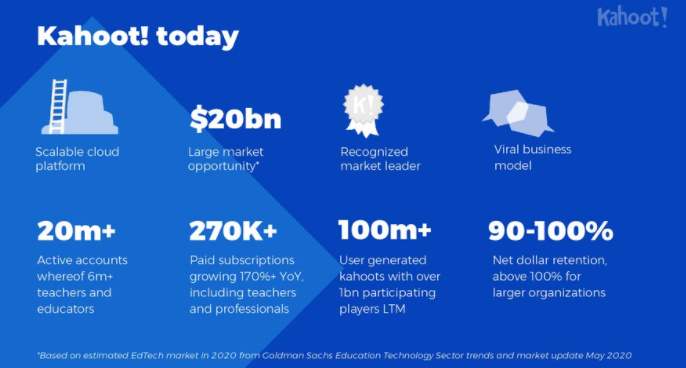
What is the company’s earning logic? To my knowledge, almost no one in Finland pays anything for it, but everyone seems to use the free version. Do revenues come only from premium or also from e.g. ads or similar? How are free users converted to premium users?
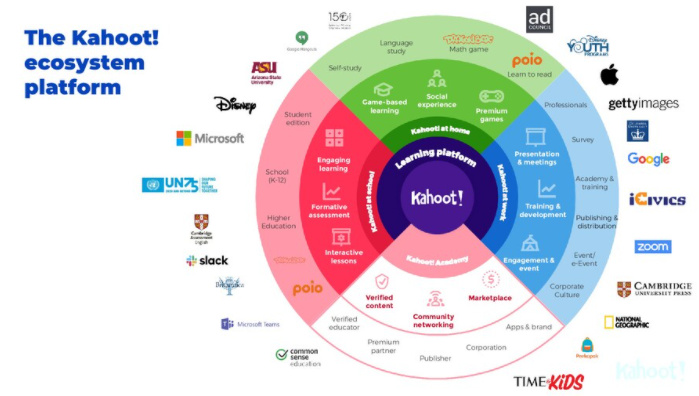
Ecosystem network. It lists a pretty excellent set of different education and work-life applications. Is it the case that Kahoot! is somehow integrated into the aforementioned platforms and/or the gamified quiz tools of the aforementioned platforms are made by Kahoot! company? It would somehow seem odd if, for example, Microsoft or Zoom did not make their own quiz tools on top of their platforms but instead utilized an external operator.
I have only familiarized myself with the free gamified quiz tool. What other services does Kahoot! offer?
With the very marginal information I have about the company, I would guess that the moats of such a quiz tool are not necessarily very deep.
Based on a quick review, it seems that revenues primarily come from premium licenses. There are three market segments: Work (approx. 37% of revenue), School (46%), and Home and Study (17%). Each segment has its own pricing model and features. In short, all segments offer multiple pricing tiers that provide additional features (larger surveys, personalized questions, slide import, organizing Kahoots, etc.).
Teams, at least, is a platform where you can install many kinds of apps. The Kahoot app allows you to launch polls directly from Teams. By the way, Microsoft also owns 5% of Kahoot.
Kahoot’s offerings can be divided into two main components:
live quizzes
“self-paced challenges”
Live quizzes are often used in presentations or in school during lessons. “Self-paced challenges” are used, for example, for completing training at work or as homework assignments for school. Challenges can also be assigned directly to users via Teams.
The whole package includes a lot of small extras (e.g., personalized learning in the most expensive licenses → AI selects questions for users from a pool based on what they find difficult). In any case, the business model is based on the idea that as a free user, you can create individual quizzes, and as a paying customer, you can manage a larger entity. For example, a teacher, as a paying customer, can reuse tasks they created once for later courses.
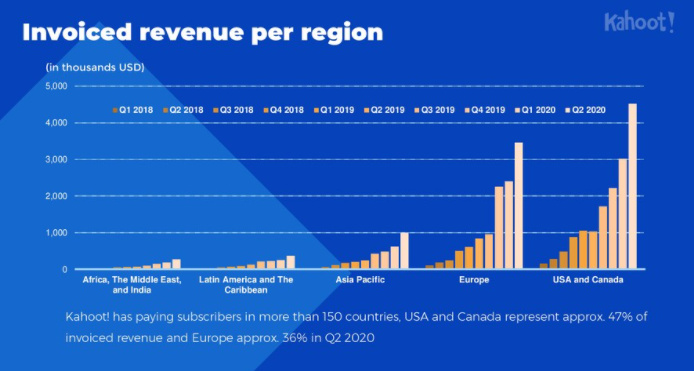
This is interesting indeed! I tried to find some information about competitors from that presentation, but I didn’t get any in-depth information. What makes Kahoot! better than its competitors, I wonder? At least in the corporate and university sectors, it’s widely used in the USA. Does this indicate some competitive advantage?
Being the first in the market when it comes to easy-to-use (and free) interactive learning applications? I don’t know if any noteworthy competitors have emerged yet, but there’s probably no deep moat here.
I bought some of this a couple of times in the spring when it started to look like the lockdown was going to pay off.
Kahoot! two years ago bought a Norwegian-French learning game company called Dragon Box. I have been following that company with great care due to my profession, and in my opinion, they make the best games in the field. The developers clearly have an eye for both learning and gaming. They have also expanded into gamified and narrative learning materials. Development is underway in elementary school, and these materials are already in use in Finland.
Rumor has it that Kahoot! would also be preparing a platform for these learning games.
So I see a lot of potential, and the company is definitely at the forefront of trends.
With one language teacher, I’ve discussed Kahoot many times. Currently, it’s used for fun to fill class time, but she sees potential for more serious use. She uses the free version. If she could be sure that students would use their real names, she could replace some vocabulary tests, and this would make the grading process easier.
An excellent case example. The free version is perfectly adequate as “entertainment,” but for “more serious” use, a paid version is needed. In my opinion, the monetization in this sense has been successful.
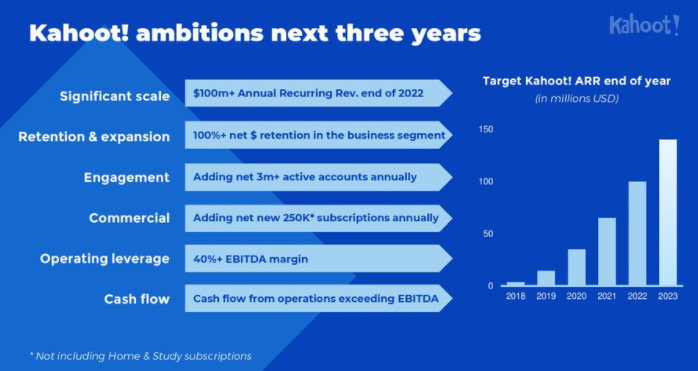
It’s a fast-growing, scalable business that has just turned operationally cash flow positive. There’s potential, and the cash reserves are good. The risks, in my opinion, relate to increased competition - what happens if a bigger player releases a similar application?
If one considers the education sector, one should carefully consider the client’s financing. In Finland, budgets are tight, and buying various applications is quite slow unless it’s a digital learning material or a tech giant’s platform. I don’t know how procurement decisions like these are made and funded in educational institutions in other countries, but it might be worth investigating if the company is of interest.
Of course, schools and educational institutions are just one target group, and in the corporate sector, acquiring such training applications is certainly much more straightforward. And there is surely a lot of hype around edtech globally right now, so in less digitalized countries, these could be big new things for school use as well.