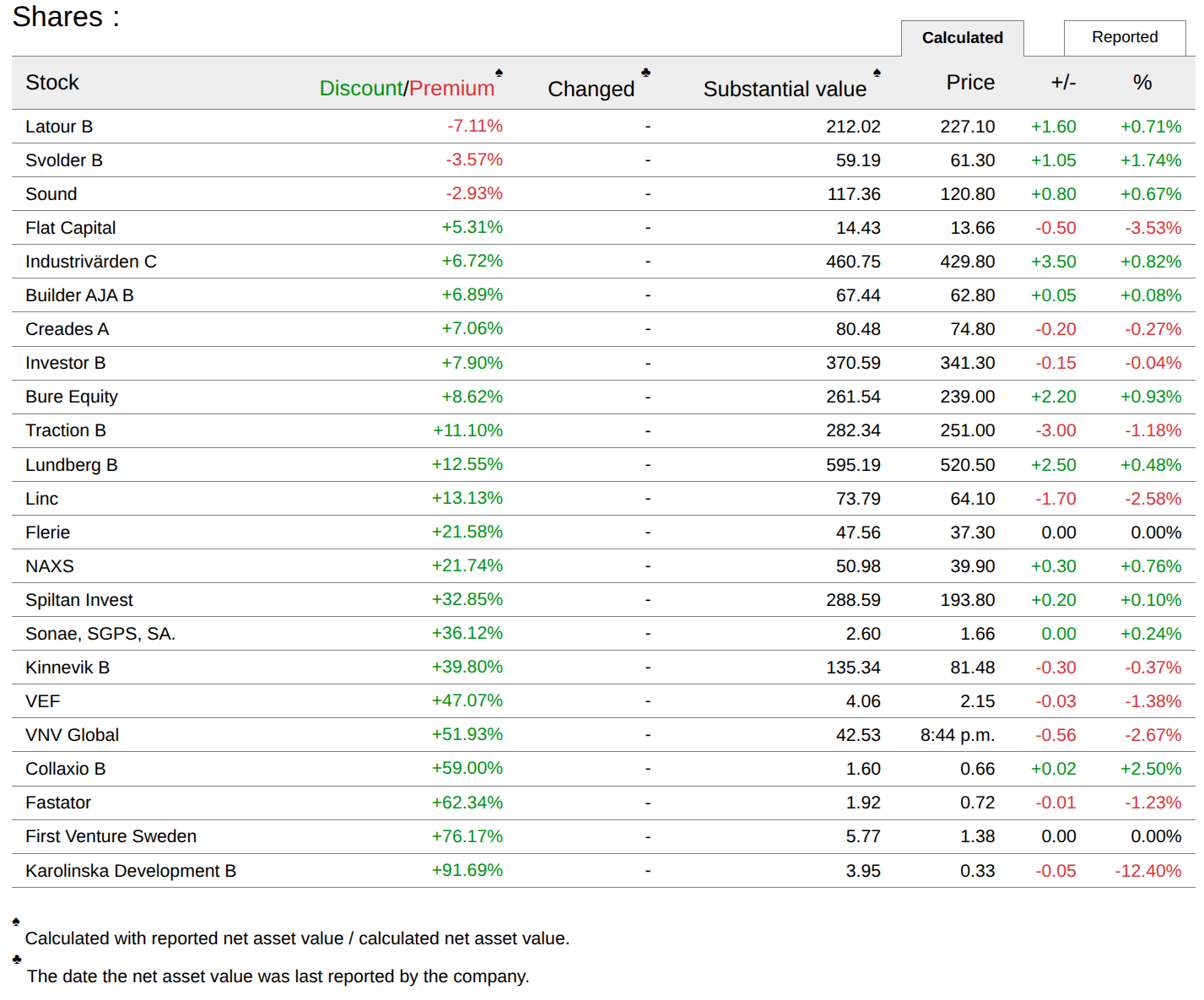
Investor, like other investment companies, is neutrally valued based on its listed holdings. The discount Investor applies to its own price correspondingly raises the valuations of Investor’s portfolio companies. If Investor were not an owner of Atlas Copco, Atlas Copco would be 10% cheaper.
Thus, by buying Investor, that money is either in the front pocket or the back pocket, but the total value in all pockets of the trousers remains the same.
What might be the extent of the Wallenberg effect on that typical valuation range? For better or worse, because personally I’m a bit on the fence about whether such a concentration of voting power should even be on the stock exchange. In this regard, warm greetings also to the Perssons’ summer villa, but then again, of course, also to the Prime Minister’s Office.
If one simplifies the valuation of an investment company and compares the market values of Investor’s holdings to Investor’s market value, then in my opinion, there should be some kind of discount. If, in a hypothetical situation, Investor decided to cease operations and liquidate its holdings, the tax authorities and other costs would likely intervene, meaning Investor’s owner would not receive a sum equivalent to the market value of the holdings.
In addition to the balance sheet, one should also consider Investor’s ability to make good investment decisions, the quality of which hardly anyone here disputes
Good perspectives in the answers I was just looking for, and I was interested in the “forum consensus” on valuation. It should be noted, of course, that this is an Investor thread. Thanks to Ilkka6 for the effort in valuing the portfolio companies. I personally think about valuation such that the valuation of the portfolio companies should at least be adjusted with a NAV (Net Asset Value) discount. In my opinion, it’s “price what you pay” and “value you get” is harder to assess. With a true value investor mentality, one should, of course, assess what is gained if everything is liquidated.
Conversely, Investor has the ability to “preserve” investments. As an example, SAAB came to mind. Investor sold SAAB Automobile from it and left the current part, which has been an excellent investment recently. Another example is the EQT listing. Thirdly, Atlas Copco and Epiroc.
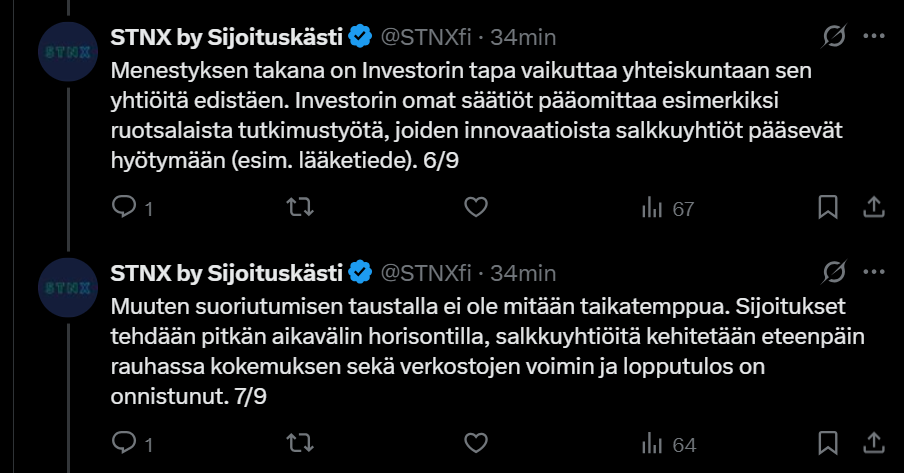
Although for an individual holding company the P/E might currently look a bit high, and based on the NAV discount there have been better buying opportunities, I want to believe, even somewhat naively, in their capital allocation and value creation ability in the long term due to their good track record. My idea is to build this into one of the cornerstones of my portfolio and have it serve the role of a European index or similar with a 15-20% weighting. Currently, it’s at about five percent.
Does anyone have thoughts on the impact of tariffs on holding companies, is this what’s considered a normal level?
ABB is affected by tariffs, but I read somewhere that 70-80% of ABB’s production is regional.
I don’t know Atlas Copco in detail, but I expect it to be more visible in demand, as Canada, Brazil, Australia, and China in rare earth metals are major players in the mining sector.
SAAB and SEB probably don’t supply much to America.
AstraZeneca is in a precarious position, like other pharmaceutical companies.
Nasdaq, to my understanding, is not affected, but there’s a possibility of an unpleasant surprise.
I don’t know Epiroc in detail, but I expect it to be more visible in demand, as Canada, Brazil, Australia, and China in rare earth metals are major players in the mining sector.
I don’t know Sobi.
Ericsson, visible in US demand, but on the other hand, benefits from the uncertain geopolitical situation. China is a no-go in terms of spying, and even if tariffs and prices are higher, one might have to choose it over a Chinese provider.
I would estimate Wärtsilä to be the biggest sufferer, but with the smallest ownership.
I’m quoting this interesting highlight from @Karhu_Hylje from the “Stock Market Direction” thread here as well, as it might interest Investor’s owners. At least ABB, Atlas Copco, Epiroc, and Wärtsilä benefit from the awakening of industry. The share price has finally received a small boost and has climbed back above 300 kronor.
The results will be out in less than two weeks, on Thursday, October 16th, so we’ll stay tuned to see what kind of development has been achieved in Q3.
Investor AB’s key holding ABB is making significant moves in its organizational structure by selling its Robotics division to the Japanese SoftBank Group. With this move, one of ABB’s four business areas will be removed from its organizational structure, with reporting consequently continuing in the future in the form of three business areas.
Previously, ABB announced it was considering separating and listing its robotics business as a standalone company, but due to an offer from Japan, the company decided to sell the business entirely. The transaction price amounted to USD 5.375 billion. The transaction is estimated to be completed in “mid-to-late 2026”, once the relevant bureaucracies and approvals are finalized.
“In today’s environment, it is pleasing to see that our portfolio companies are doing a good job focusing on what they can control, such as cost efficiency, while they continue to invest in future-proofing their businesses, setting themselves up for stronger long-term performance.”
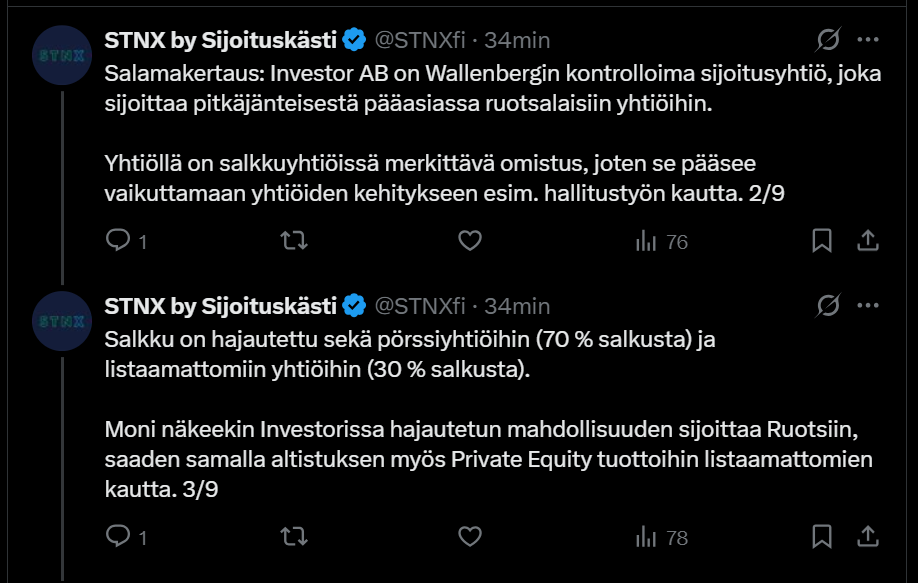
Investor beat the Stockholm stock exchange index during 2025, which was the 15th consecutive time. The achievement is apparently quite unique on a global scale for the period 2011–2025. (I read somewhere that it might even be the only company, at least in that size category, but who knows.)
In my opinion, there is a glaring mispricing going on with Investor AB. If we look at the historical returns (referring to the record mentioned above) and the company’s current shareholdings (ABB, Atlas Copco, SEB… + as the largest owner in the ten-bagger Saab and the brilliantly developed Wärtsilä), the valuation of this stock should be something else entirely than just barely the sum of its parts (or is it even close to that anymore). I am certainly happy to keep loading up on the stock at these prices. What do other forum members and Investor owners think?
Why pay a premium to the sum-of-the-parts if an investor can build a completely identical listed portfolio themselves? Co-investors also reap the same (potential) benefits related to, among other things, corporate governance and strategy work through their own holdings alongside Investor. Naturally, unlisted holdings also have a certain value, but a higher valuation for them would naturally require that these holdings are currently undervalued in the sum-of-the-parts (without taking a stance on whether this is the case or not).
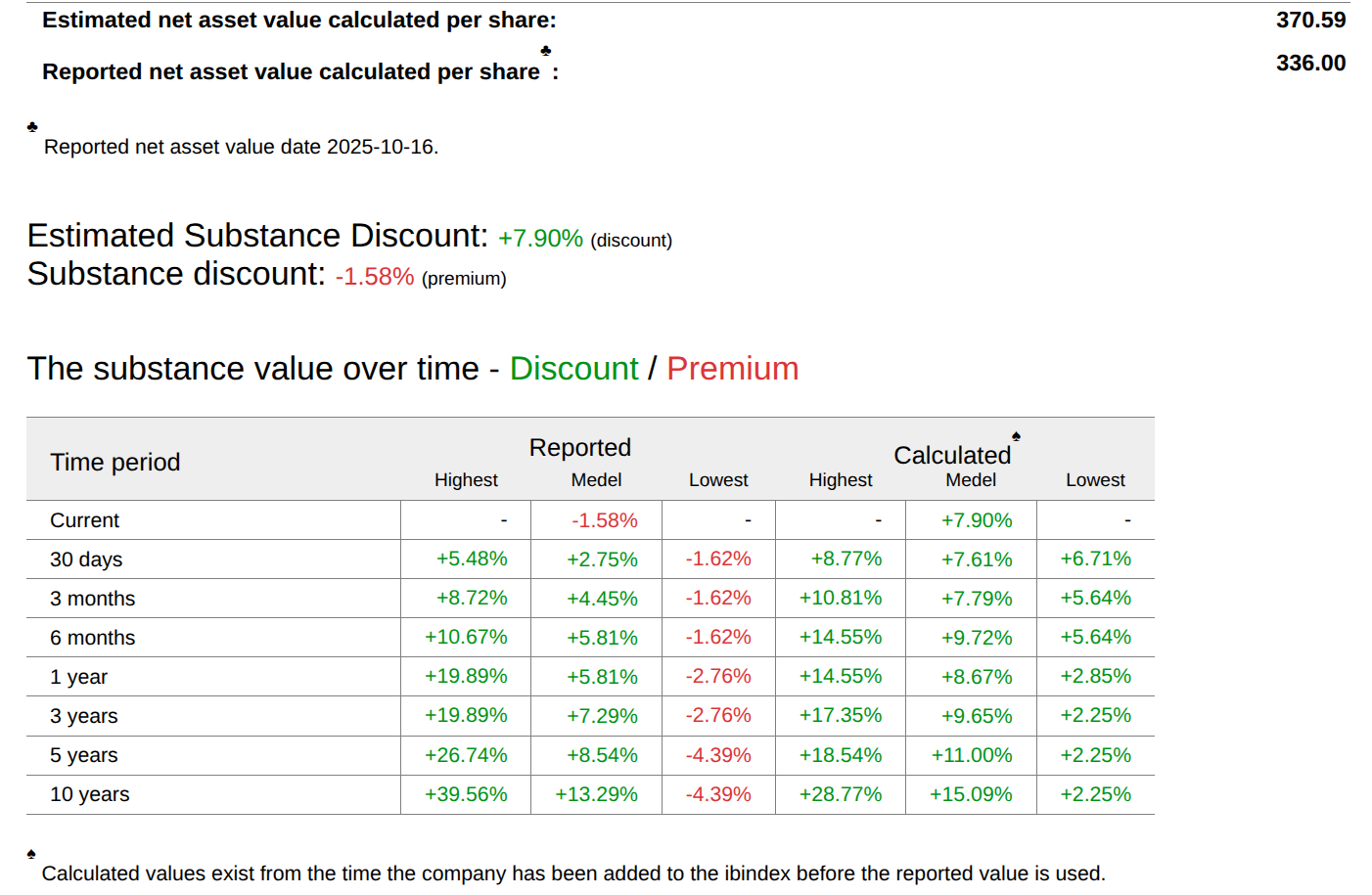
In my opinion, the historical discount to NAV, dividend yield, and technical chicken bones do not indicate the best buying opportunity right now. That being said, over a 25-year run, hardly anyone has likely kicked themselves for buying Investor when it was “expensive”.
Investor is by far the largest holding in my (broadly diversified) portfolio, so that kind of FOMO doesn’t really arise with this one anymore. I’m happy to keep an eye out for buying opportunities, and when the stars align, I’ll buy more. So, it’s a strong hold in my playbook right now.
As already stated above, it is typical that investment companies are not valued at the sum of their parts, but there are companies in the IB index for which the sum of parts is paid. In my opinion, it is impossible for Investor to go bankrupt as it is debt-free. So, from a risk perspective, and considering the history, I agree that the pricing is not really justified. I believe the situation will continue as before and Investor will trade at its typical NAV discount. For such a large company, growth already has its limits, and if it is sought by other means, the risk increases. Secondly, Investor’s price is affected by volatility, which is usually quite high, and therefore the company is classified as “risky”. In any case, the investments include many cyclical companies whose market value can fluctuate significantly. Examples include all the companies you mentioned, with the addition of SAAB and Epiroc.
For me, Investor AB is also one of the longest-held companies in my portfolio. The company’s annual total return over a couple of decades has been around 17%, which is quite excellent. The unlisted part of Investor, Patricia Industries, has made over 100 add-on acquisitions over the last five years, meaning more than one every month. So there is a kind of PE fund inside that you can access with the same discount to net asset value, and it seems that the capital accumulated from dividends can be reinvested within the portfolio with quite high quality. This is why, from a Finnish investor’s perspective, it is quite tax-efficient that the dividend has been kept small but growing. Investor’s connection to private equity firm EQT will likely ensure deal flow for corporate transactions in the future, providing its own synergy alongside the Wallenberg network.
Especially in the current global climate, I like Investor’s basic idea of investing in clear secular trends while, at the same time, the portfolio companies’ revenue is actually globally well-diversified across different industries. I have also been looking for alternatives that provide a counterweight to the growth of passive investing and US-weighting. Little attention has been paid to how large a share of index funds & ETFs (especially in the United States) is owned by the baby boomer generation. I haven’t found any relevant research on the matter, but common sense raises the threat that these indexes will be liquidated as a result of aging and natural attrition, causing liquidity to evaporate. From this perspective, a stock like Investor can be a very good risk-adjusted return alternative for a portfolio.

 At least ABB, Atlas Copco, Epiroc, and Wärtsilä benefit from the awakening of industry. The share price has finally received a small boost and has climbed back above 300 kronor.