Strangles (Streptococcus equi) vaccines already on the market:
https://www.msd-animal-health-hub.co.uk/Products/Equilis-StrepE
Strangles (Streptococcus equi) vaccines already on the market:
https://www.msd-animal-health-hub.co.uk/Products/Equilis-StrepE
As I understand it, these vaccines do not have a DIVA (differentiate infected from vaccinated animals) feature, which means it’s not possible to determine whether an animal has been vaccinated or if the disease is incubating. This is important, for example, in equestrian sports, where animals come and go in the same facilities, change owners, etc. Also, it would be interesting to know the protective efficacy of each vaccine against the disease; it’s probably at the same level.
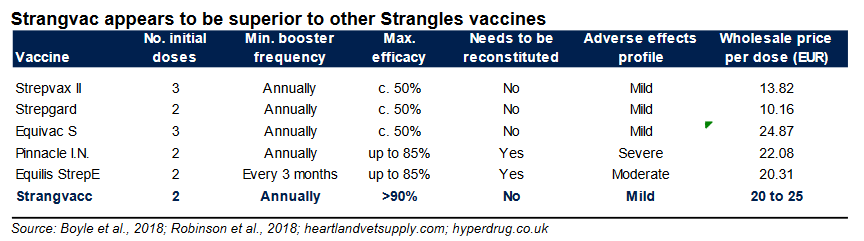
This image was in ABG’s Q3 report about competing vaccines:
So, in addition to having a critical DIVA, it is also more effective, easier to use, and safer. That’s why it’s estimated to cost more.
Thanks Hapakka! Interesting table, the efficacy of Strangvacc is truly excellent. For more effective preparations, Pinnacle has the problem of large side effects in terms of competition, and Equilis has to be repeated four times a year.
I don’t see DIVA as a significant factor in this case. Racehorses must be medicated well in advance of competitions due to withdrawal periods, and all administered medications are recorded in the horse’s medication records.
That’s probably how it is. BTW, what percentage of that 60 million horse population are racehorses?
In Finland, there are just over 70,000 horses, of which about 7,000, or 10%, compete annually in trotting or riding competitions (according to Hippos statistics). I assume there is quite a bit of country-specific variation in this. For example, regarding harness racing, France and Sweden are in a league of their own among European countries when it comes to the number of racehorses and the scope of operations. In the UK/Ireland sector, thoroughbreds are a large group.
Intervacc’s recruitment clearly indicates preparation for the launch of the Strangvac equine vaccine, assuming the European licensing authority gives the green light. This news is a few weeks old, but it’s worth highlighting on this forum.
Emma Hartman has already been appointed as Global Product Manager for Strangvac, and they are looking for a quality manager – I would guess for vaccine production operations.
The wait for drug approval is gradually increasing as we approach the turn of the year.
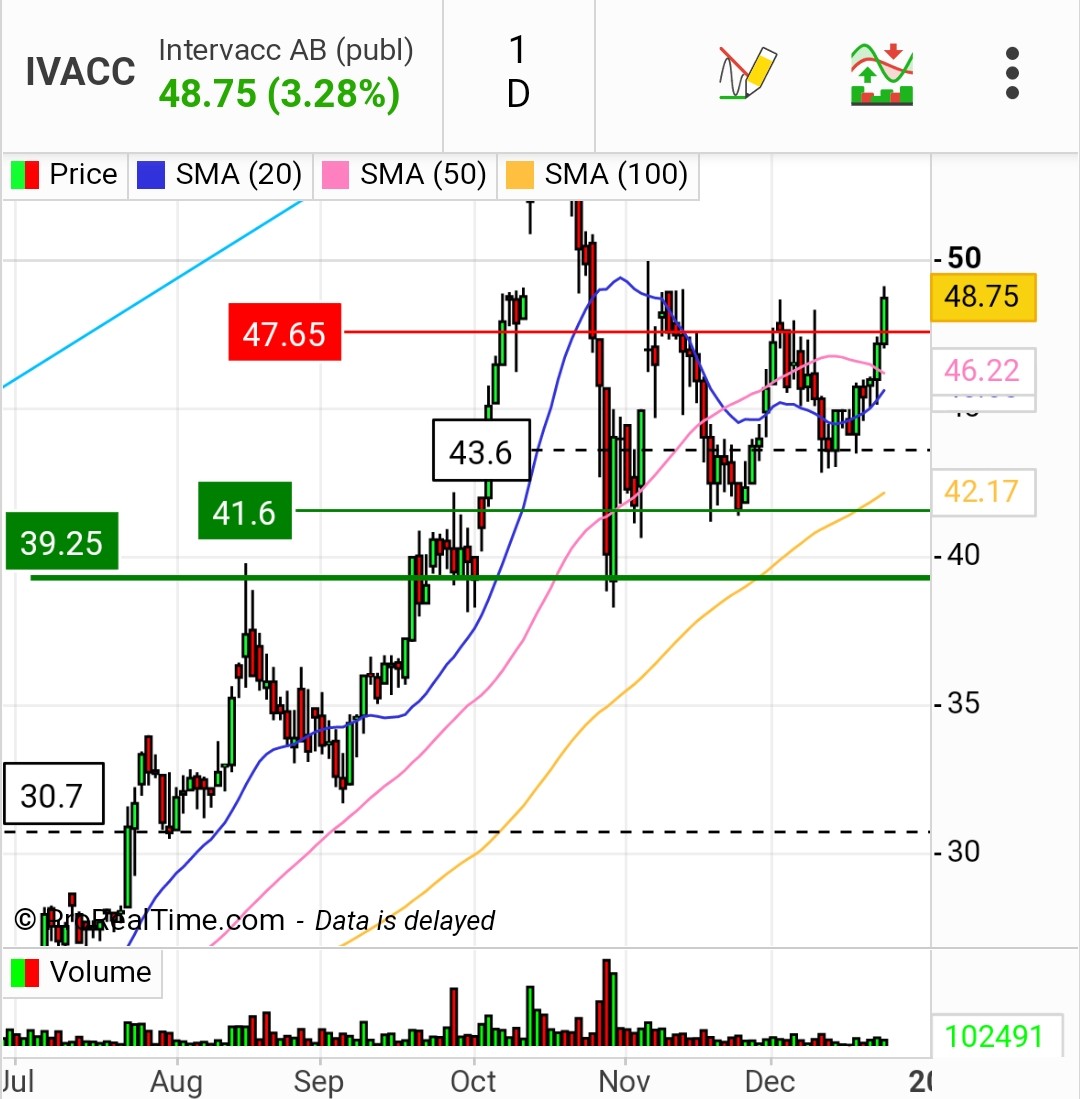
The short-term trend in the stock is turning upwards, with the 20-day moving average aiming to cross above the 50-day moving average.
“The Company estimates that it is on track for a positive opinion from the CVMP during Q2 2021.”
Different investors have different risk profiles; some saw it best to invest years ago, some will only invest once approval has been obtained, some will only invest once revenue is rolling in, etc. At the same time, risk and return always go hand in hand, or rather, are tied to each other.
We are in an interesting phase. In the fall, we can start following the interim reports regarding actual sales.
The product should be competitive, which gives the company a stable base to develop new products in the coming years.
One could envision that this will become the Revenio of animal vaccines if the well-functioning blueprint used in the horse vaccine can be utilized more broadly.
Tomorrow, Thursday, February 18th, the 2020 financial statement will be released. No special surprises are expected. I would assume the financial situation is under control. Of course, we are eagerly awaiting a decision on the sales authorization for the horse vaccine (or, to use a rich Finnish expression: “awaiting it like a horse awaits the heat”) for the spring snows.
Exactly. What interests me most here are the management’s comments on the outlook for the coming year and whether costs have been kept under control. However, new recruitments have been made, and probably also investments related to production and distribution.
Our marketing authorization application for Strangvac was submitted to the European Medicines Agency, EMA, at the end of February 2020. After having received the Day 120 questions from EMA we have strengthened the dossier. We are on track and are planning for a positive opinion from EMA during the second quarter 2021.
We focus on the preparations for the launch of Strangvac, which includes a distribution partner for Europe, outside regions where we distribute ourselves.
We continue renewing the product portfolio within our Nordic distribution operations and launched a new product from Syva s.a. during the autumn.
We strengthen the organization and during the period Ed Torr and Niels Holck, both with extensive experience from the international animal health business, were elected as new members of the Board of Directors. Dr. Andrew Waller, an international leading scientist within the fields of bacterial infections and equine strangles, joined as new Chief Scientific Officer. Emma Hartman was appointed to the role as global product manager with responsibility for launching Strangvac. Emma comes most recently from MSD Animal Health, where she worked as product manager. Astrid Larberg was recruited to the role as quality assurance manager. Astrid joins us from AstraZeneca and is not only a biologist and quality expert but also a trained veterinarian.
Positive results from Strangvac clinical trials were published in the journal Vaccine.
“2020 was a fantastic year for Intervacc and 2021 will be the year when we launch our first proprietary vaccine, Strangvac. This is something we are all looking forward to and I would like to take this opportunity to thank all employees, partners and shareholders.”
The upward trend continues strongly in the stock, having already surged 46% in a month, and up over 8% today. It seems investors are already at the starting line, palms sweaty, awaiting the approval decision for the horse vaccine. So the market is quite hot - this is indicated by today’s 8% rise, which apparently has no other background than the presentation of the vaccine development project in a current affairs program on TV4 in Sweden. Investors should keep a cool head and a clear mind; I wouldn’t make additional purchases unless it’s to take advantage of some irrational dip in the stock price. But those are rarely available.
The hint that it might be possible to manufacture human vaccines as well is probably driving the share price up.
Good news. It was commented on positively in the media today. Dechra is the 8th largest distributor of veterinary products globally, so they have quite considerable muscle and will be able to distribute the vaccine all over Europe. (However, investors and veterinary professionals still have to wait impatiently for regulatory approval of the vaccine).
Now that distribution agreements are being made, EMA approval seems like a mere formality. Let’s hope this is the case and that the approval is granted during Q2 as anticipated by the company.
Drug pricing is an interesting matter, which should become clear in the autumn if EMA approval comes on time. ABG has previously predicted the vaccine price to be 15 euros in its analyses. One could speculate whether a higher vaccine price would be a positive thing; the essential point is what effect pricing has on demand.
It’s not very easy to value Intervaccin right now. The stock has already exceeded Danske’s target price of SEK 80. There have also been opinions in the chain that the stock has been expensive, and ABG’s old analysis has been chewed over regarding the market size and the magnitude of forecasted returns. What about acceptable key figures… many questions.
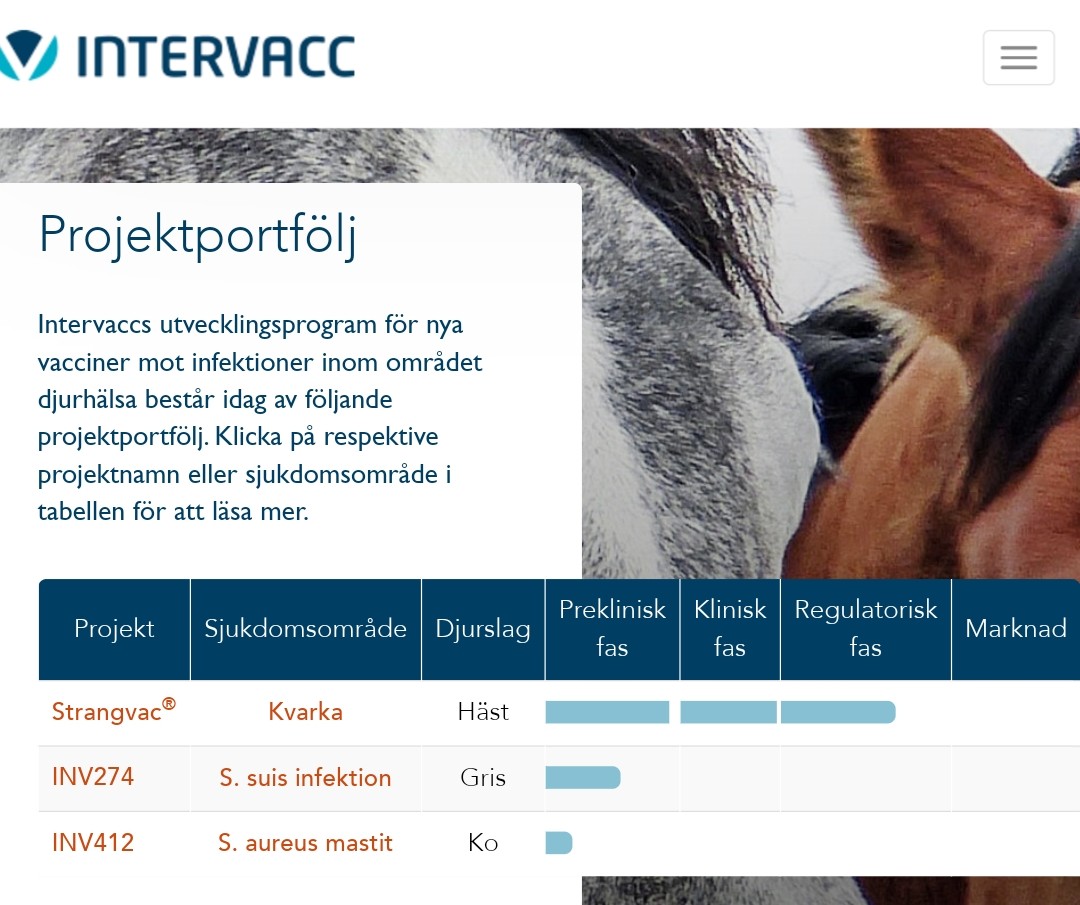
The company’s website shows the status of other vaccine projects, see the image below. Other newer projects are still in phase 1, and the horse vaccine is indeed moving into the sales phase. It would be interesting to know estimates of how long it might take with other vaccines. Something like 3, 5, or 10 years. If the pace remains good and the company could effectively replicate its vaccine technology, the earning potential would be excellent.