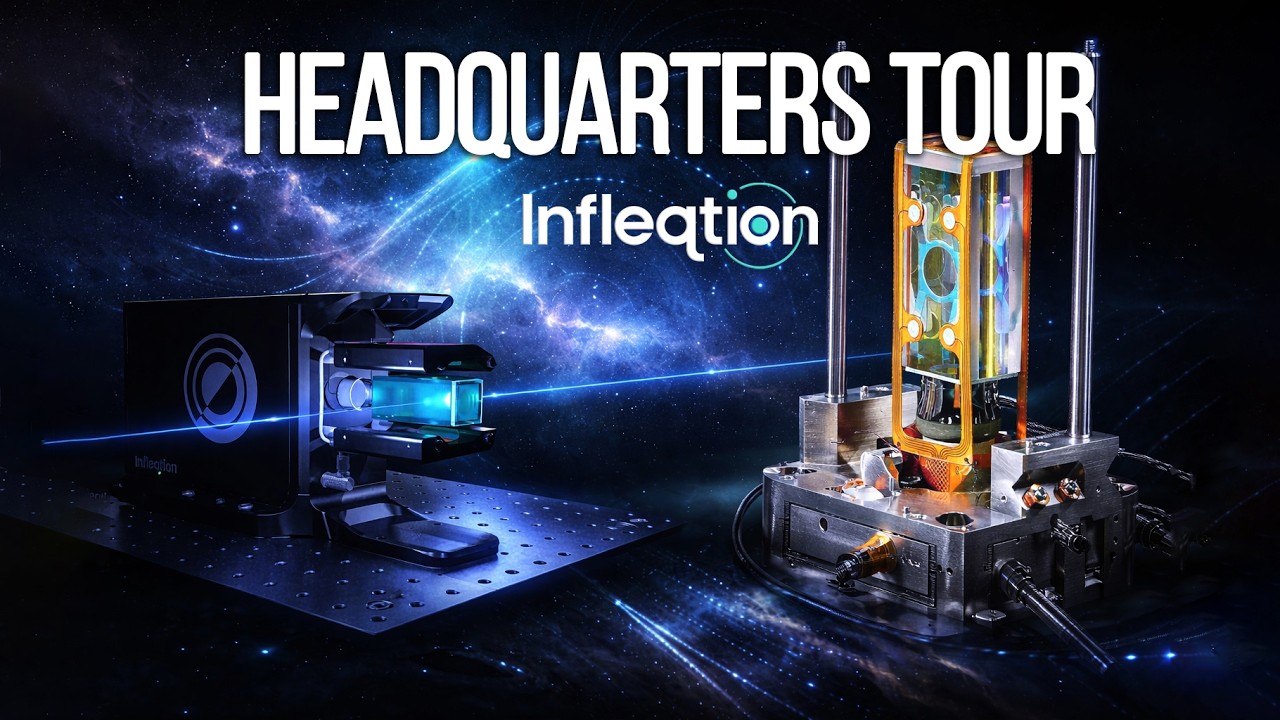
Infleqtion wants to grow into quantum computing through quantum sensors

Quantum technology company Infleqtion plans to go public by merging with the SPAC Churchill Capital Corp X (NASDAQ: CCCX). The merger has already been confirmed, and as a result, the company will list on the Nasdaq under the ticker INFQ. The company was originally founded as ColdQuanta in 2007 in Colorado.

There are a few reasons why I opened a thread for this company. The company has a strong scientific foundation; founder Dana Z. Anderson served as a professor in Colorado and did pioneering work with ultra-cold atoms; he originally served as the founder and CEO of ColdQuanta. The current CEO is the company’s first venture capitalist, Matt Kinsella. During his career, Dana has been part of several Nobel Prize-winning teams, but the prize has never fallen to Dana himself because he has always been an experimental physicist, and the prizes often go to theoretical physics researchers.

In 2024, the company had a revenue of 29 million. The company’s operations are now focused on sensing and observation, where extremely precise timing plays a central role. The company is able to produce solutions that improve the accuracy of an atomic clock by several thousandfold. The company is now able to revolutionize 120-year-old radio frequency technology. This means that submarines no longer need to tow a 1 km long antenna behind them; instead, the antenna is the size of a sugar cube. Frequencies are being pushed into Terahertz. Alternatively, if the 1990s-era GPS system based on 30 satellites were destroyed, the company could provide the positioning and precision timing required by IT equipment through a ground-based solution. The company also has a satellite-based gravity product used to detect underground tunnels and the heavy objects moved within them, such as nuclear weapons. All of the above is based on the use of quantum mechanics—namely entanglement and superposition. Infleqtion’s new solutions are thus on a completely different level of precision and security than what is used in the mainstream today. The company was the first to take quantum technology into space in 2018. The company’s services are needed for tasks requiring extreme precision, particularly in the US missile defense system, as everything there is based on sensing, communication, and a high-precision clock. That is why Infleqtion (under the name ColdQuanta) was selected alongside IonQ for the Golden Dome project to provide its services.

The above represents the current foundation of the company’s business. In other words: sensors, sensing, new radio frequencies, and 1,000x atomic clock accuracy.

Infleqtion builds qubits from nature, i.e., directly from atoms. The processor operates at room temperature.

Below is a picture of the processor. It’s a hand-sized device (mötikkä). It’s similar in structure to IonQ’s processor. Both share the same idea: the device contains a vacuum where atoms are placed and manipulated—or rather slowed down—with a laser. Infleqtion slows the atom with a laser, effectively reaching absolute zero (0 K). After the acquisition of Oxford Ionics, IonQ moved away from lasers and now uses electronic control built into a silicon chip (instead of lasers). It will be very interesting to see the results of different technologies in producing logical qubits. This is one reason for the new thread—it’s interesting to see how logical qubits are achieved through different atom-handling methods (laser vs. electrical control).
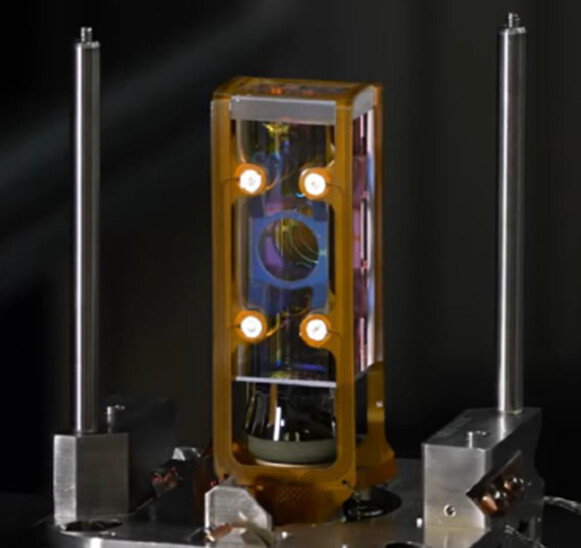
image

Infleqtion plans to move forward with the development of its quantum processor and believes it will achieve 100 logical qubits by 2028. The solution involves building atoms into a lattice structure inside a vacuum, which are then entangled to build a multi-qubit processor.

To summarize, Infleqtion appears to be a company whose main focus is sensing, new radio frequencies, and extremely precise clocks. The company talks about expanding into the computing side. Personally, I suspect IonQ will win in that area, but Infleqtion could be a strong runner-up. Ultimately, both IonQ and Infleqtion will make their “Golden Dome quantum careers” in areas other than computing: for IonQ, the focus will remain on quantum networks and encryption, and for Infleqtion, it will be sensing matters. The companies complement each other nicely. And both have a strong position in space.

I used this video as the basis for my post:

Inside the Quantum Era: Infleqtion CEO Matt Kinsella
image

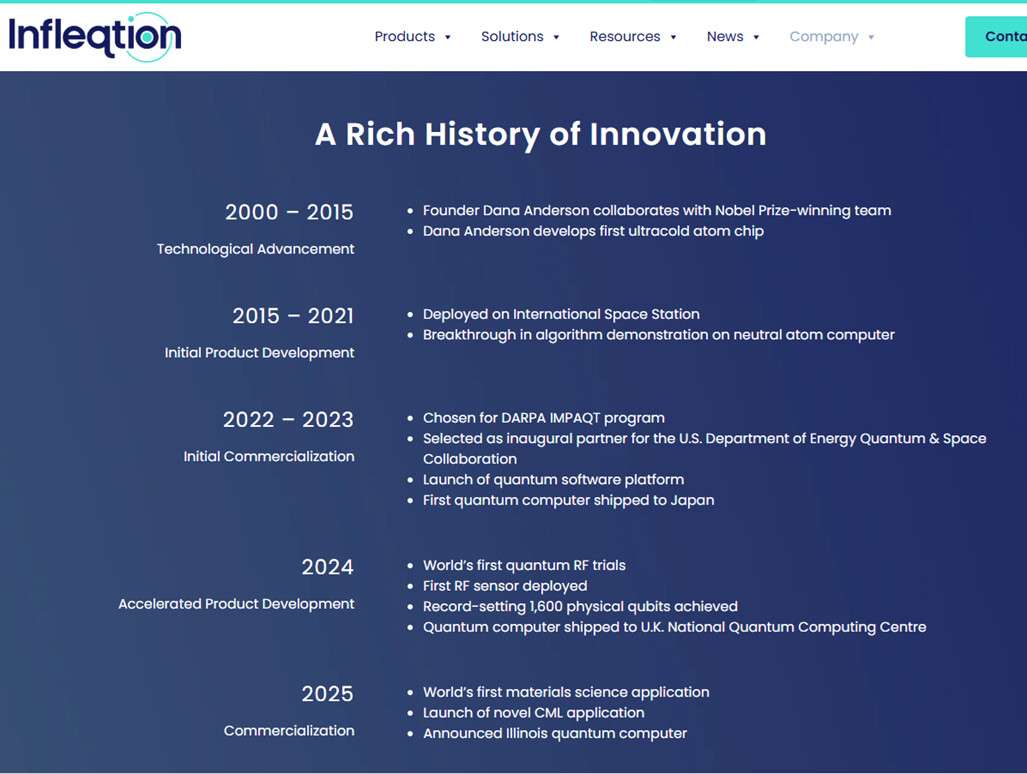
About Infleqtion, Leaders in Quantum Technology

36 Likes

Cantwell, Young, Colleagues Introduce Bipartisan National Quantum Initiative Rea…

So Infleqtion is commenting alongside IonQ in this news story:

“Infleqtion applauds Senators Cantwell and Young for advancing the National Quantum Initiative Reauthorization Act. Reauthorizing the NQI is important for U.S. national security and economic competitiveness and will improve the lives of all Americans. Quantum technologies will strengthen our nation’s critical infrastructure, boost U.S. manufacturing and jobs, and this legislation will help accelerate deployable quantum capabilities into real-world use and accelerate adoption at scale.” - Matt Kinsella, CEO of Infleqtion

I need to look more closely at what the National Quantum Initiative Reauthorization Act means for Infleqtion. But more good than bad, anyway.

5 Likes

Some signs of collaboration between Infleqtion and Dell.
{9DD3E9B8-CCD0-45E4-AEFD-57AAA49EC0E0}

2 Likes

Infleqtion’s public listing via the SPAC company CCCX appears to have been successful with very low redemptions. Trading under the new ticker is set to begin, as I understand it, next Tuesday, Feb 17 (NYSE:INFQ).

The recently announced partnership with NASA also serves to bolster the company’s credibility.

4 Likes

Getting to know the company better once again with another video.

The sensing side here is quite interesting

edit.

this is also relatively recent from February

https://x.com/QuantumBullHQ/status/2022139483806982506?s=20

3 Likes

Infleqtion released its 2025 results and 2026 forecast. Revenue for 2025 was approximately $33 million, with a similar amount in losses. The 2026 guidance is $40 million (and similar losses are expected). The crucial point is the cash reserves after the SPAC/IPO, totaling around half a billion. Market capitalization is approximately $2.5 billion.

Infleqtion Announces 2026 Revenue Guidance of $40 Million :: Infleqtion, Inc. (INFQ)

Immediately after, an announcement about cooperation with NASA:

Infleqtion and NASA Deliver Next-Generation Quantum Capabilities to International Space Station :: Infleqtion, Inc. (INFQ)

It’s possible that these natural atom-spinning quantum companies (IonQ and Infleqtion) could gain an advantage from the space boom compared to synthetic modalities. But we’ll watch and see.

7 Likes

SalkunRakentaja has published an article about Infleqtion. :slight_smile:

The industry’s current size is still modest in relation to the hype. According to McKinsey’s quantum technology report this year, companies in the sector generated a total revenue of just over one billion dollars last year, and this figure could rise to 4.4 billion by 2028.

In the longer term, estimates grow rapidly. McKinsey estimates that the quantum technology market itself will reach 60–100 billion dollars by 2035, of which quantum computing would account for 43–71 billion, and the total value generated across the economy would be 1,300–2,700 billion.

Subheadings:

  1. Clocks and sensors bring in the money before computers
  2. Nvidia connection eases the error correction bottleneck
  3. Market forecasts are large, realized returns are small
4 Likes

Below are some excerpts from Infleqtion’s Q2 earnings call. I have inserted my own comments after the => sign.

John McPeake Analyst

0:43:25

Oh, nice. I know this question, just qualitatively, someone has to ask it, can you give some sense as to quantum versus sensing, either growth or just temperature-wise, where we are these days ?

Matt Kinsella CEO

0: 43:52

We are seeing strength in both right now. If I had to say which one I have been surprised by, I would say I have been surprised by what we are seeing under the surface on some of our quantum computing opportunities that I think will start to be more apparent in revenue over time. We are seeing a lot of strength on both sides. Things are accelerating for both quantum sensing and quantum computing, but relative to maybe my expectations, I think quantum computing is coming in a little hotter than I had expected, which is grea t.

=> Infleqtion is still a sensing company today, with a larger portion of its revenue coming from atomic clocks and sensing services. Matt Kinsella is hinting that growth is beginning to materialize in the computing market.

Pranav Gokhale CTO

0:46:44

Yeah. We are extremely excited about how fast things are moving, thanks to AI tooling. Indeed, the OpenAI hackathon just accelerated the pace tremendously for us in terms of adoption of Codex and GPT-5.6 Sol. To give some specific examples, I referenced this in my remarks just a few minutes ago, but we have discovered a way to do operations between logical qubits more efficiently by a factor of 2 logical qubits using an invention that actually ChatGPT-5.6 Sol came up with. A lot of the bottlenecks that used to exist on just the rate of mathematical reasoning in theory have overnight almost become no longer our bottlenecks. There’s certainly an incredible role for the theorists and mathematicians at Infleqtion who now effectively wield armies of massive compute that churns through theorem proving and conjecture disproving, et cetera, at a f aste r rate.

Pranav Gokhale CTO

0:55:08

And 30 logical qubits, we think, is a huge step forward toward 100 logical qubits, which in turn is the point at which you start to be able to solve important problems in material science and chemistry, perhaps in AI too, that classical computers cannot solve. For the last several decades of quantum computing, very great progress was made, but it was still without logical qubits until just a couple of years ago. If we’re able to hit, and we expect to this year, 30 logical qubits, I think that is a tremendous leap towards the next milestone of 50 logical qubits and then 100 logical qubits, and that is the moment where quantum computing becomes everything we hope it will become.

=> All quantum companies are now benefiting from the rapid development of language models. Language models solve physics theory puzzles in a day that previously took months. In Infleqtion’s own roadmap, they are targeting 30 logical qubits this year, and from there a path to 100 qubits, which is the point for their modality where they can offer a strong quantum computing platform for business applications.

Conclusion:

What was notable in the earnings call was that the company hinted at significant news for the Q3 results release. It’s hard to gauge what those might be now, but good news should be coming. Could it even be M&A? The company has the largest cash pile after IonQ, with half a billion in cash and zero debt. The company is currently burning 60 million a year. So, the company is in a very good financial position.

And, the company is receiving 100 million in federal quantum acceleration funding from the Trump administration. Infleqtion has also been selected as a vendor for the U.S. missile defense system. In my opinion, the stock market has been quite pessimistic regarding Infleqtion. There is a reason for this: the company’s revenue in Q2 was 12.6 million, or, as corrected just today (a stock exchange announcement was released regarding this), 13.5 million. And the full-year forecast was raised from 43 to 45 million. In H1, the company made 23 million, and the forecast implies 22 million for H2. The stock market is punishing Infleqtion because there is no growth within 2026! Another thing the market doesn’t like is the order backlog, which is at about the 20 million level. That’s just how it is. The stock market is short-sighted. However, the company has the potential for success. And share dilution is not knocking on the door.

6 Likes
2 Likes

Quantum computing is so young that concepts are only just forming in the field, and their definitions are still evolving. A good example is the discussion shared earlier by @timontti about what Infleqtion’s logical qubit actually means. Well, it means one thing at Infleqtion, while someone else might evaluate it differently. Definitions are still being sought.