The source is apparently this book by Ray Dalio.
6 Likes


27 Likes
”The economic situation is not as bad as citizens think.”
7 Likes
This was a failure from the start. It must have caused some kind of customer churn for them to give up on it so quickly. A completely senseless reform in this day and age. These specific services should definitely be included in the monthly fee. Just charge more for the monthly fee then, just like they do everywhere else.
7 Likes
I got a few spider plant starts from a friend and put them in the same pot to grow. It looks like they survived. Apparently, the grandparents of these little guys’ parents originate from somewhere in Russia.

I’ve heard a legend elsewhere that the more “runners” a spider plant has produced, the more its grower has had affairs. This friend’s plant, where these starts were plucked from, was indeed quite prolific with its runners. 
I still need to figure out how it’s actually supposed to be grown. I’m giving it evening sun for now.
13 Likes
It looks like it’s here.
Found it on Google based on @Marmoset’s tip.
1 Like
3 Likes
It’s strange that something so obvious is so difficult to understand in Finland—this is not directed at the author, but in general.
If there are 2.5 million wage earners in Finland, then 100,000 open jobs are easily part of the normal turnover: positions open up and stay open for a couple of weeks—some for a month if it’s a very demanding role—and then a suitable applicant is hired and the posting is removed. In my opinion, these job openings are a normal occurrence, but the NCP (National Coalition Party), at the forefront, wants to use them as a justification to bring more people into the country, even though all those jobs are filled normally anyway. Then there are many commission-based jobs where there is no way to make a living, or recruitment agencies gathering applicants into a pool for jobs that don’t even exist. It has often been noted that a job advertisement has better advertising value than a regular ad, meaning positions are posted even if no one is actually needed.
If those are removed from the statistics, hardly any job openings remain. And the few that do remain are nursing vacancies for which there are not enough trained people, but immigrants or those in the unemployment registries of other fields cannot fill those positions.
The National Coalition Party’s (Kokoomus) agenda leads to mass unemployment, but perhaps that is the intention: to keep wages low.
4 Likes
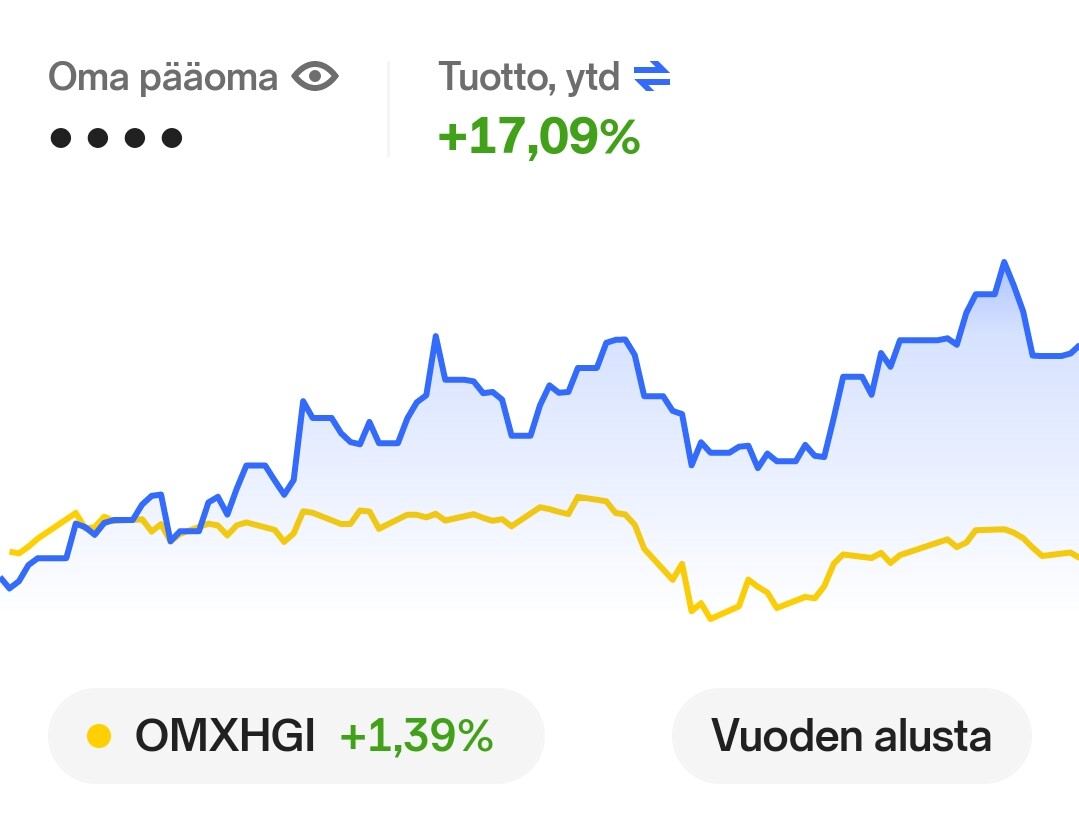
You grit your teeth and keep working. Or you find some other way to scrape by once your portfolio has melted away. Of course, a smart person shaves off enough of their portfolio to have, say, 2 years’ worth of living expenses in cash, so small market fluctuations won’t be a problem.
1 Like
This shouldn’t be confused with risk diversification…
3 Likes
State ownership steering works in Finland
20 Likes
I found the article again.
https://ssrn.com/abstract=2739602
Judging by academic standards, the article is not very heavyweight, but in my view, its argument is quite convincing. For a monthly saver, the long run is at least 26 years (achieving a positive real return seems certain) or even 40 years (earning a risk premium seems certain).
Exactly. Although 2 years is quite short for this purpose.
3 Likes
I’ve placed a bet with a friend that Käärijä’s ranking won’t be in the top 3. The stake is a ticket to any ice hockey match chosen by the winner.
NoHo could be one way to hedge the bet.
15 Likes
Couldn’t a law be introduced for those state representatives on company boards so that the fee goes to the state instead of the civil servant? The civil servant is already paid for being employed by the state. On the board, they represent the state. They’re hardly there on their own merits, are they?
13 Likes
Russia risk continues to materialize. One can only congratulate those companies that managed to end their operations in Russia in time, or never operated there in the first place.
11 Likes
Yeah, and the outrage just keeps mounting regarding these rewards; it’s pretty brazen in these circles. Riitta Uosukainen’s “a worker is worthy of his pay” line, delivered with a straight face, doesn’t really hold water here. Someone scraping by on Kela (social security) or unemployment benefits is hounded relentlessly, and if they make a tiny mistake out of ignorance, they get hit with the heaviest penalties, yet these slickers hand out money to each other and the state even blesses it.
18 Likes
In Fortum’s case, the Russian exposure has long since been valued at zero.
3 Likes
That is not true, at least as far as Fortum’s accounting is concerned. For last year, Fortum recorded only a third of its deposits in Russian banks as credit losses, for example.
Investors’ thoughts are then harder to interpret. I suspect that not all hope is lost in this regard either – not even after Russia’s announcement yesterday.
Fortum’s adventures in Germany and Russia will likely go down in Finnish corporate history as the greatest failure of its kind and as an example of a total breakdown in risk management.
As for @Salvelinus’s comment – it actually provides quite a good contrast to things. With the billions lost in the Fortum mess – that is, if Russia is included as a total loss – the labor market subsidy for all of Finland’s long-term unemployed could have been paid for at least a decade.
18 Likes
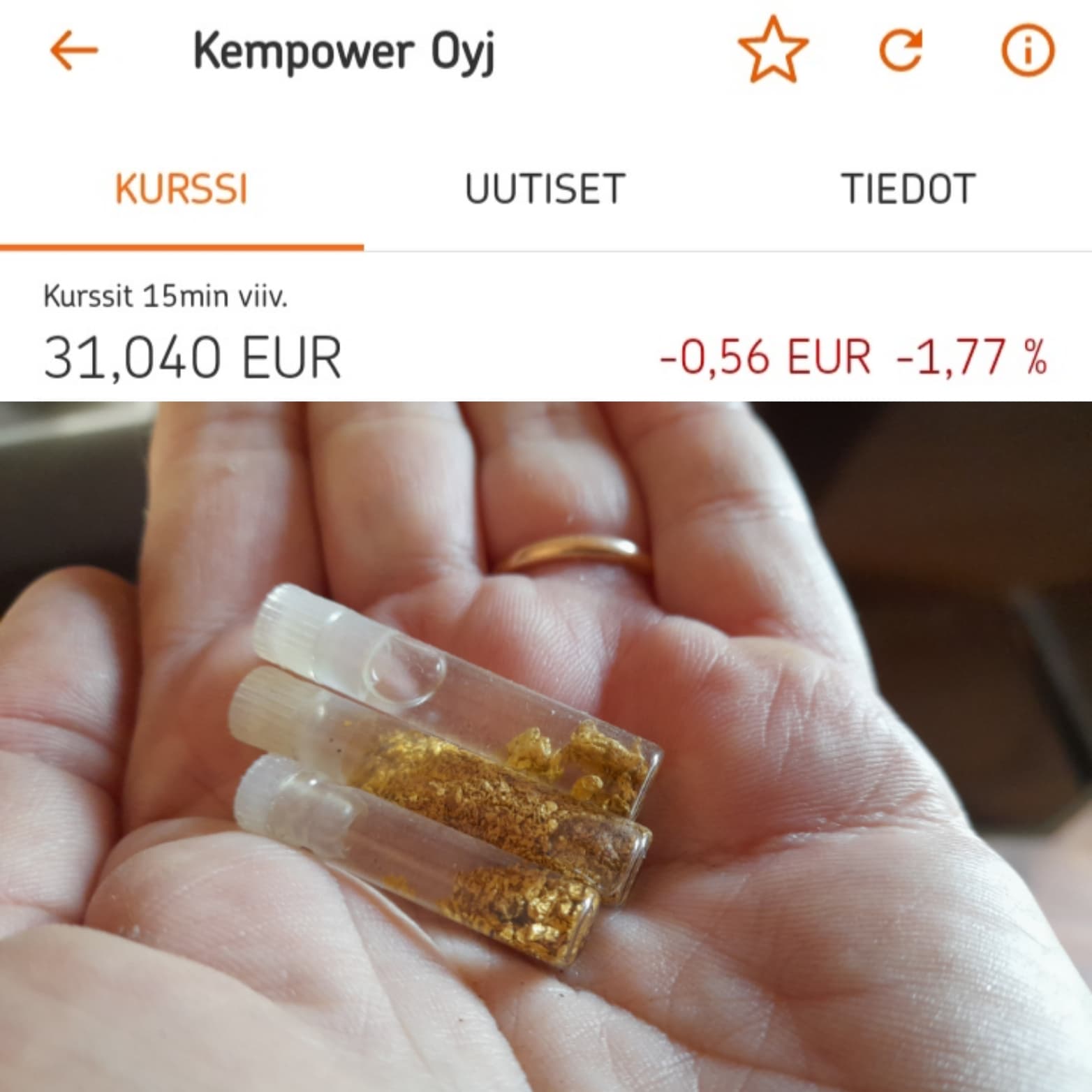
Kemppi in a steep dive  Fortunately, part of my wealth is tied up in gold, and even self-dug gold at that

Once the kids have left the nest, the place is paid off, and nursing work doesn’t interest me even this little anymore, it’s very possible that gold prospecting with a shovel will continue. An extremely interesting hobby.
36 Likes
In a sharp nosedive indeed 
4 Likes