I agree with you that the operations of payday loan companies are immoral, especially when the life management skills of their customers are already challenging to begin with.
The person tried to get on top of the situation through hard work, but did not succeed. The reason mentioned is: “I was terribly ashamed. No one in the world knew that I was so in debt. For a long time, I had explained the purchases I made with payday loans by saying that I had worked so much, Paasiranta said.” So according to this, the person was still making purchases that even those close to them noticed, even though the intention was to pay off old debts. My empathy was slightly dampened by this comment.
But some of those kilos would definitely be shaved off my result if I were lifting in a competition.
The Finnish Powerlifting Federation record in the 74 kg class is 182.5 kg, and it was certainly achieved with clean technique, but even higher results have been achieved without a bench shirt even here in Finland, if I remember correctly.
"Immo, Immo, come and see what @Sijoittaja-alokas is writing; our bench PR is 82.5kg! Thanks to the private gym program Alokas gave us, we’ve already reached sets of 5x75kg at the Kainalniemi Sweat basement gym We’re starting to be in competition shape soon
That Alokas is quite the coaching guru, since he helped even us become muscle men
“Lyly, the reading glasses are there on top of the ET magazine in the hallway”
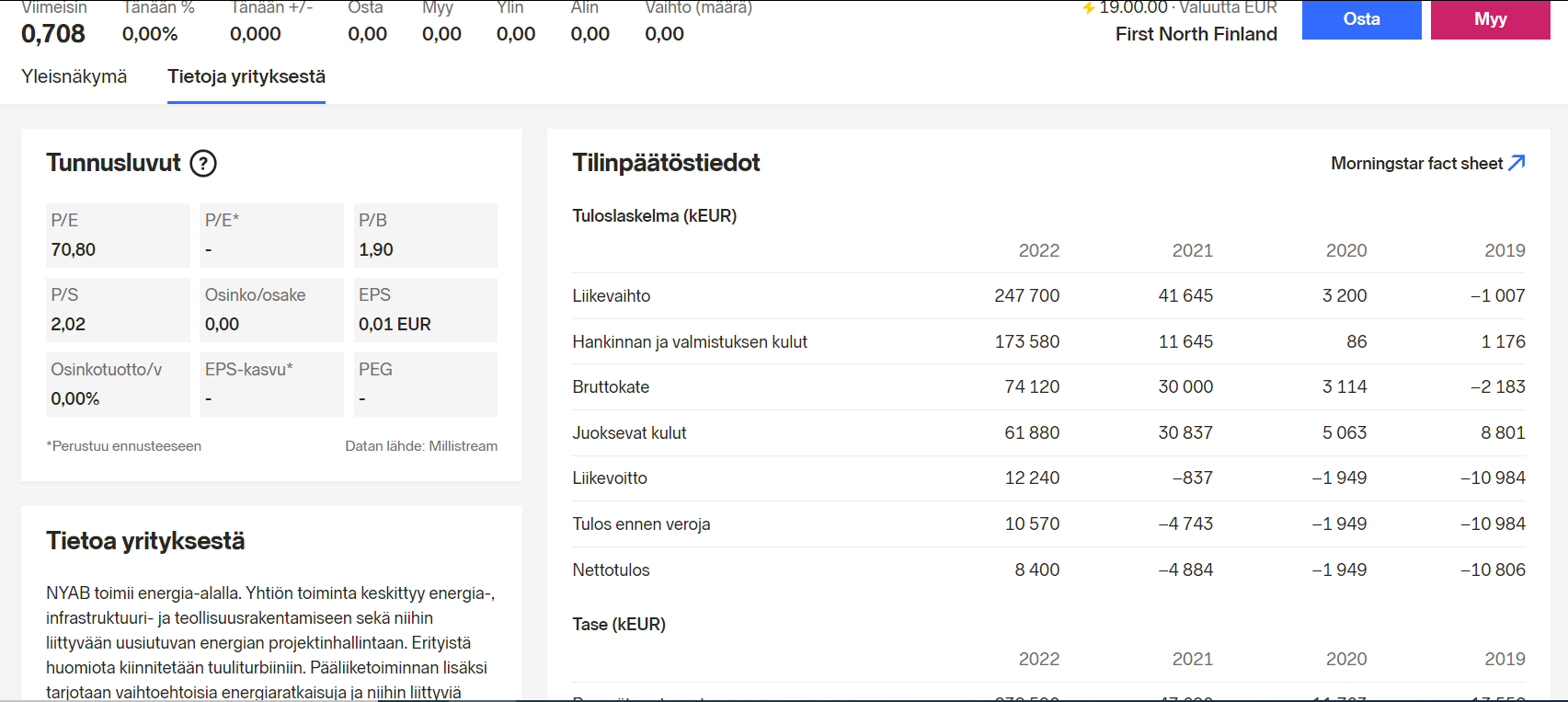
Could someone explain what this NYAB is, and how I’ve never come across it on the Helsinki Stock Exchange before, even though I’ve definitely gone through all the company names at some point. Some company that changed its name within the last 1-2 years?
It would probably be the easiest game in the world to just short Nokia. No matter what happens, how the company is doing, or if the rest of the market is rising, Nokia just keeps dropping. Could this be a free lunch?
Regarding that labor shortage, there are 32,000 jobs available on the TE Office site. That’s quite few. Of course, there are other channels and hidden jobs. There were 258,000 unemployed in February. When you break down those 32,000 jobs, a large portion are positions in the social and healthcare sector, cleaners, and retail sales assistants. Tell me, why is it hard to find workers? Are we just talking about practical nurses and registered nurses?
The main point of the story remained a bit unclear. “We earn €4557/month net, of which €1000/month goes to savings and another €830 for discretionary use.”
So there is 40% of extra cash in the household budget, which is very good, and yet they say things are a bit too tight?
It has always bothered me that in the debate over labor shortages vs. the difficulty of finding work, people point to the number of job vacancies.
If you go and browse through the open jobs, you can often find all sorts of “vacancies,” for example:
“we are ready to hire blueberry pickers, we pay €0.1/h + commission, i.e., half of the sales profits” (all telemarketing jobs fall into this category)
“open application,” meaning there is no actual job, but a recruitment agency is collecting CVs
recruitment agency 1: ‘seeking an electrical designer for an industrial group in Luvia’, recruitment agency 2: ‘seeking an electrical designer for an industrial group in Luvia’, recruitment agency 3: ‘seeking an electrical designer for an industrial group in Luvia’, recruitment agency 4: ‘seeking an electrical designer for an industrial group in Luvia’. In other words, the same job advertisement is in the system multiple times because it has been posted through every possible channel.
Without downplaying the problem of finding labor for some jobs, staring solely at the number of job vacancies seems like little more than intentional misleading.
That’s right. I don’t understand where those jobs are. You rarely see, for example, 50 workers being recruited for industry. I often browse these in the hope of extra income, and I definitely come across all kinds of crap. €11/h, 20 hours a week. It’s no wonder they can’t find workers for these.
Job vacancies should be recorded in statistics based on the hours offered and converted into 40-hour work week equivalents. Preferably, this would be done so that if an employer offers, for example, 10–30 hours per week as agreed, then congratulations—the lower end of that range is what goes into the statistics. Some might think this is very unfair, but no one is forcing them to offer zero-hour contracts.
If I were an employer myself and struggling with labor availability, that would be one of the first things I would check: I can invest as much as I want in the quality, meaningfulness, and even the pay of the work, but if I don’t offer enough hours, those investments go completely to waste. There is no point in expecting a flood of applicants if the employment terms offered are not sufficient for the employee to manage their daily life.
Interesting earnings coming out today in the US: Microsoft and Google. Has the rally just been about waiting for interest rate cuts, or is the situation actually better? Personally, I expect “weak” results, and rates might stay elevated for longer than the market thinks.
I understand the interest in securing one’s assets, especially at the stage when the funds intended for the rest of one’s life have been acquired. However, a -90% drop in stock market prices (not just individual securities) is a catastrophe of such magnitude that to prepare for it, you’d better already have a self-sufficient farm.
In the United States, a bear market of about 90% can be found in the 1930s. At that time, however, we were still quite far from the kind of chaos that would require preparation with a self-sufficient farm. There are more of those 50% bear markets.
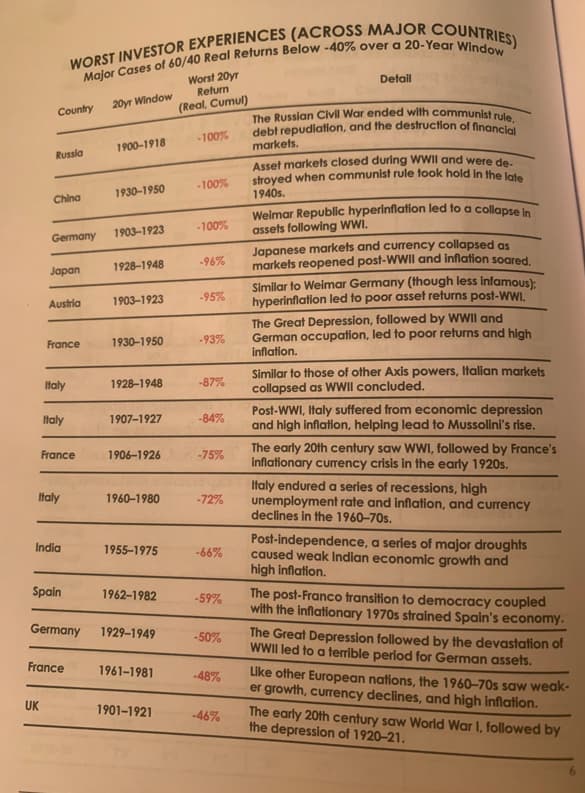
I once saw a list online of historical crises ordered by how much value investors lost. At the top of the list were a few 100% losses (e.g., the Russian Revolution of 1918). I can’t find the list again right now. Even a farm doesn’t help in preparing for such cases, nor does conventional asset allocation. In my own plan, I have sought to protect a small portion of wealth against even this—since the event is very unlikely, not much is invested in it.
The most essential point, however, is that if a bear market hits right at the start of retirement, withdrawals consume capital significantly, and savings might run out too early. (Yes, I know there are various strategies recommended to avoid this.) It is also essential that recovery from a bear market can take a remarkably long time—not every time, but often enough that the risk is real.
Let it also be said that these thoughts are not a reaction to the current market sentiment; rather, I formed these views when stocks were still in their historical bull run.

 We’re starting to be in competition shape soon


 Those are already some nice weights