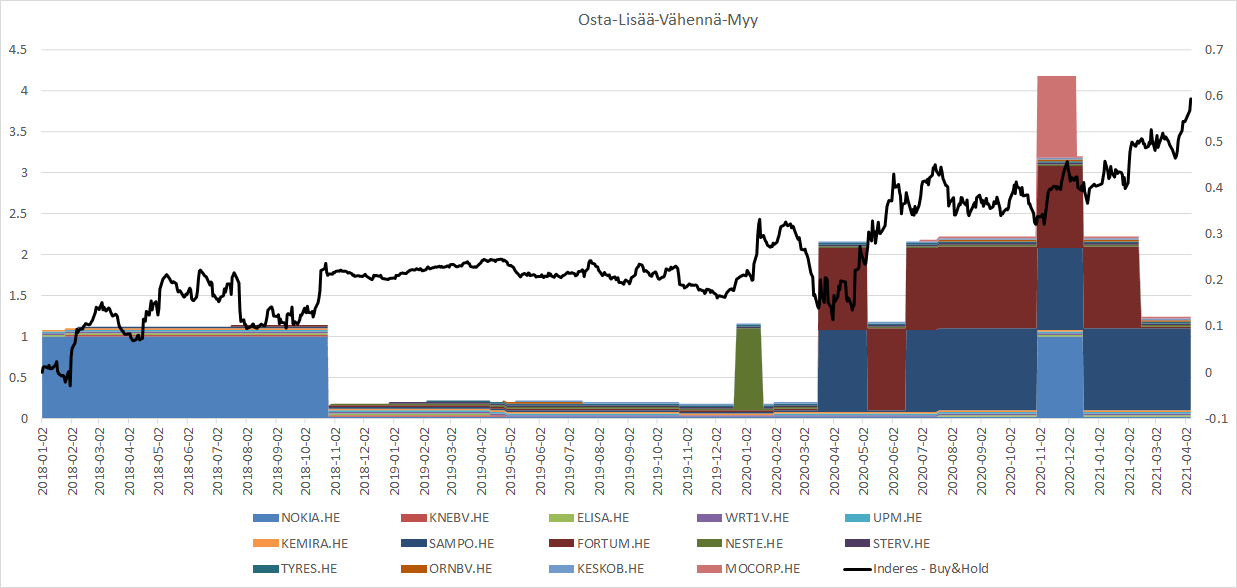
I don’t have a cash option in the code right now, so it always has to be invested somewhere. A “buy-only” solution like this would leave all the money in cash in situations where none of the portfolio companies receive a “buy” recommendation. On average, if we assume that prices are constantly rising a little, one could imagine that a strategy where investments are held in cash would lose to a strategy where investments are evenly diversified across a relatively large number of companies (Add+Reduce covers the majority of companies). This shows that from November 2018 to December 2019, there was a long period where this portfolio did not receive a single “buy” recommendation. The “buy” recommendation is thus shown as a large rectangle.
From this graph, one could also conclude (the black curve is the difference between Inderes and B&H) that at times when there are “buy” recommendations, investing according to Inderes’ recommendations outperforms the Buy&Hold strategy, but if there are no “buy” recommendations, the result is +/-0 or even weaker.
For my own case, i.e., trades made within the insurance basket with those 14 stocks, I would think it might be smarter to invest those interim periods when there are no “buy” recommendations into a good fund.
I have used Adjclose prices, i.e., closing prices adjusted for dividends, splits, etc. Good point, by the way, that recommendations can come, for example, on a Sunday. I missed a dozen trades in the calculation. However, they mostly fell between “Add-Reduce”, and that bug doesn’t seem to have much sexual significance.
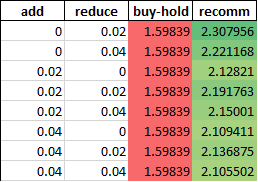
This table now shows trades such that if a recommendation came on a Sunday or even on May Day Eve, the trade occurs at the closing price of the next trading day.
I also included the possibility of excluding “Add” companies and investing only in “Reduce” and “Buy” stocks. With this small data set, this would even yield a better (!) result than investing in “Add” and “Buy” recommendations.
This can probably be calculated from other data, but that’s for later. I would assume that “of course” the closing price is always slightly more expensive. But if you don’t switch to cash, you also get a better price on average when selling at closing prices. Here, with these recommendations, the assumption is that prices move in opposite directions, so one can probably then take the calculation in the direction that it would be advisable to make trades immediately in the morning. I need to think about how to do that calculation when I have more time. In principle, open and close prices are also available for trading days.
Edit. Oh right, and if you are looking for the effect of the Inderes effect, perhaps you should use smaller companies than these large companies so that the effect can be found amidst the noise.


 And then it was just a link to introduce a new guy



