Inderes Coffee Room (Part 2)

That’s precisely what doesn’t matter to me :smiley: You’re completely misunderstanding me now. I’m pondering this at an individual level, trying to understand what makes a consumer make questionable purchasing decisions. Finnish texts on websites? I haven’t visited e-ville’s website in a couple of years, but it used to be a blatant rip-off site for casual shoppers.

I’m a sole proprietor, so margin calculations and similar things are very familiar to me.

Edit. And e-ville is an ingenious business idea! I just don’t like paying for nothing. It’s a matter of principle. Well, this turned into quite a mess.

2 Likes

Aah, okay, this clarifies things, my apologies. I think in the case of e-ville, for example, its popularity (if it exists, I haven’t looked at the numbers) is based on language skills. That is, their customers often don’t have them.
So people are willing to pay for this when they can order stuff in their native language :partying_face:

Also, shipping etc. is a strange thing for many who aren’t quite so pro at these things.

1 Like

That’s probably how it is. E-ville is cheap compared to even Tokmanni stores. Lean cost structure, I would assume.

The word choices “brazen” and “profiteering” were perhaps too strong. But that’s what trading fundamentally is, and there’s nothing wrong with it per se. Fortunately, free and functioning markets correct these brazen profiteering tactics by bringing new competitors to the market to drive down prices. If there’s a good margin to be had somewhere, healthy competition usually arises in these sectors.

2 Likes

Nordealla has had an equity savings account from the beginning, with an equity savings day every month for a different exchange. I also recall there being one for the USA last year. However, the fees are small anyway, so it doesn’t benefit much.

1 Like

Quite some guesses from the analysts. Wow. But the article talks about a couple of upcoming IPOs.

I really can’t quite believe that $400k estimate; the value should be based on something.

Why, isn’t it based on anything now?

I’m not saying it will rise that high, but the rise to the current level has already seemed so impossible that nothing is impossible anymore.

9 Likes

Well, it’s insane to pay 400 thousand for some “non-concrete” coin. It doesn’t fit into my small brain under this tinfoil hat. But as you said, nothing is impossible. The price of everything is determined by what people are willing to pay for it. But let’s just say that buying a house with one bitcoin seems like a very distant idea.

10 Likes

That’s true, but it’s also absurd to pay almost 60 thousand dollars for it, which is the current price. Absurdity has been exceeded and fundamentals have been bypassed; now, liquidity and the human mind are the only limits.

13 Likes

The more investors/money that are brought into it, the more one can expect it to rise.
When the discussion around it quiets down, the value slowly decreases again. If the only driver is the growing number of investors joining, one can only wonder how sustainable it is.
I don’t understand how it could ever really be used as a currency; someone knowledgeable could enlighten me on that. The value of the currency fluctuates enormously, and it’s not really accepted as a payment method anywhere.

For traders, there’s certainly plenty to do there.

1 Like

https://twitter.com/TRiippumatto/status/1380599686583685121?s=19

2 Likes

I’d be interested in making a small investment in Amazon/Google/Facebook, but the shares are so expensive that it’s not possible. Is there, for example, a FAANG-style ETF that would allow me to invest a small amount in these? I know that these companies have a high weighting in, for example, Nasdaq, but I’m only looking at these three companies, so if there’s something where these have the highest possible percentage.

Go back to Nordea, Investor doesn’t work at all. I mean, you haven’t been able to get service there for ages, but this, not being able to do business, is really something else. On the other hand, a “windbreaker investor” (casual investor) doesn’t get service anywhere, so that’s not news. But it’s like IKEA announcing it’s open, and then it’s not, when you want to go carry your sofa home yourself.

2 Likes

So Macron really abolished ENA.

Our domestic ENA alumni include Yli-Viikari and Stubb. Denmark’s former Prime Minister Thorning-Schmidt is also an ENA grad. What do these people have in common? At first, the French-style arrogant lifestyle comes to mind. Thorning-Schmidt is known as “Gucci-Helle” for her luxury clothing, for example. Yli-Viikari’s reputation is no better. Helle and Alexander were also in their states’ decision-making bodies during the refugee crisis and clearly followed the same ENA strategy.

Macron’s political change has been quite striking. I wouldn’t have immediately thought he would start provoking Muslims or abolishing ENA. Has he experienced a political reform, or is he just fishing for yellow vest votes?

The closure of ENA is definitely the right direction, in my opinion. Hopefully, they will also realize they should abolish Bilderberg meetings and similar gatherings. These give conspiracy theorists an unnecessary opportunity to speculate with the wildest ideas.

Decision-making in a democracy must be as transparent as possible, which in turn prevents private individuals from benefiting from states and loopholes in their legislation. Human’s natural opportunistic greed often takes over and leads them to do wrong things. If oversight fails, Aarnos and Yli-Viikaris will inevitably emerge.

5 Likes

A few years ago, I didn’t believe that BTC would ever rise back to the $20k level either. Luckily, I continued researching and following the matter. :wink: The big fish are driving the train now, and I’m quite happy to sit along for the ride and watch the scenery.

5 Likes

This is yet another interesting step from China towards the deep end of communism, a surveillance society, as information from every transaction would be forwarded, making it very easy for Big Brother to monitor consumer behavior, among other things. In recent months, over 100,000 Chinese people have already tested the digital yuan, with positive attitudes. The article is behind a paywall, but Bitcoin-keskus has a related free article. Bitcoinkeskus.com | Paras opas kryptovaluuttojen maailmaan

10 Likes

I continued with Python, exploring different weightings for Buy, Add, Reduce, and Sell recommendations.

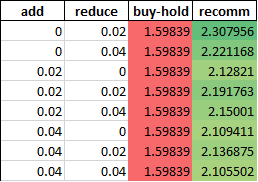
With weightings of Buy=1, Add=0.02, Reduce=0.02, and Sell=0, these 14 companies can form a quite juicy backtest return:
image
Here’s a part of the exploration with intermediate coefficients for Add and Reduce:

Clearly, Inderes’ Buy recommendation has the greatest significance; those should be owned. Add and Reduce don’t differ much from each other, and they should be weighted surprisingly little in the portfolio.

Should I put a few tens (of euros) into such a strategy? What do you think?

P.S. There were a couple of errors in Inderes’ analysis reports regarding the dates in the recommendation history (I assume the year was wrong due to copy-pasting):

Ticker ELISA.HE has suspicious order of dates, line “12.1.2017 Vähennä”, previous date 2017-10-19
Ticker KEMIRA.HE has suspicious order of dates, line “11.2.2018 Vähennä”, previous date 2018-12-05
Ticker KEMIRA.HE has suspicious order of dates, line “29.4.2019 Lisää”, previous date 2020-03-25

18 Likes

Since I don’t master Python, I’m asking instead of testing it myself. How did a portfolio with only “buy” recommendations and other weights at zero perform?

Can you tell me if those dates always correspond to the day when it’s possible to buy? If a target price is updated on Sunday, is the purchase price Friday’s closing price (without the Inderes effect) or Monday’s price? It would also be interesting to know if it’s better to buy immediately at the opening price or only at the closing price.

1 Like

It’s no coincidence, considering the control aspect, that this currency is being urgently implemented in China, whereas in Western countries, central banks are conducting research and are relatively cautious with the initiative.

Although the idea, as I understand it, is to keep the exchange rate stable against the yuan as a “stable coin,” I believe these features can be modified and adjusted. For example, if the Communist Party wants to stimulate consumption, what if the digital currency had a “best before” date?

Perhaps the old, reviled, but actually quite stable FIAT money still has its role..

Addition: Continuing about communism or a complete planned economy.

One of the biggest weaknesses of a planned economy is the lack of information. Paradoxically, a market economy has much more planning, as every firm and consumer plans their own expenses because they naturally have the best information and visibility into their own needs.

Artificial intelligence, data, and for example, this digital currency could partly solve that problem, considering the agenda of the Chinese Communist Party. The country has never officially rejected communism; there has just been a decades-long “NEP” period in between to allow for modernization.. :sweat_smile:

9 Likes

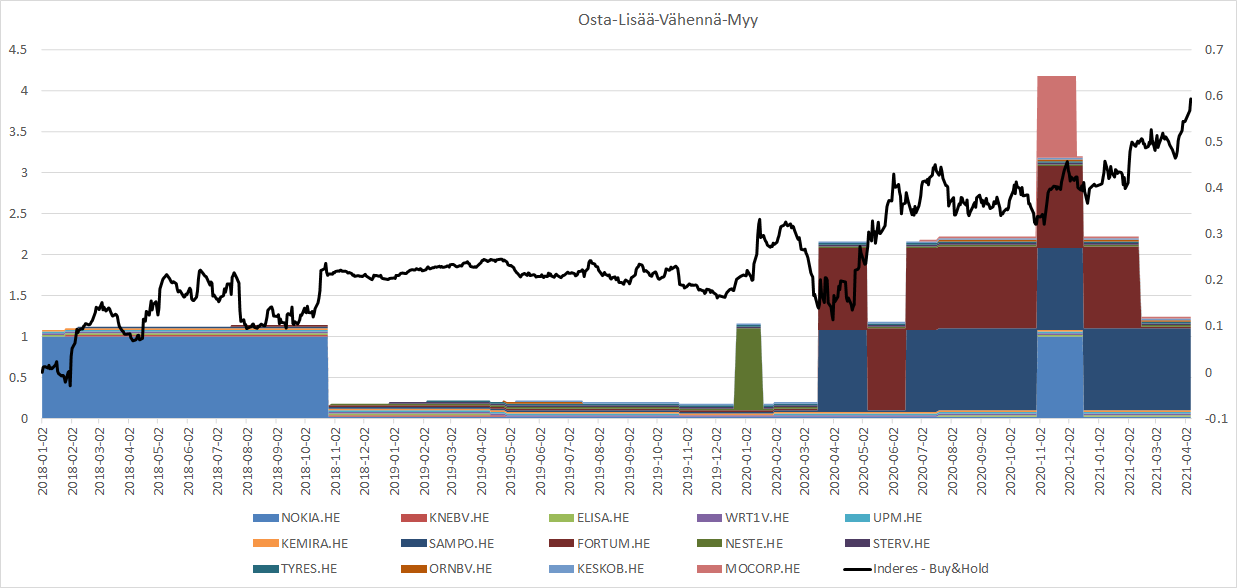
I don’t have a cash option in the code right now, so it always has to be invested somewhere. A “buy-only” solution like this would leave all the money in cash in situations where none of the portfolio companies receive a “buy” recommendation. On average, if we assume that prices are constantly rising a little, one could imagine that a strategy where investments are held in cash would lose to a strategy where investments are evenly diversified across a relatively large number of companies (Add+Reduce covers the majority of companies). This shows that from November 2018 to December 2019, there was a long period where this portfolio did not receive a single “buy” recommendation. The “buy” recommendation is thus shown as a large rectangle.


From this graph, one could also conclude (the black curve is the difference between Inderes and B&H) that at times when there are “buy” recommendations, investing according to Inderes’ recommendations outperforms the Buy&Hold strategy, but if there are no “buy” recommendations, the result is +/-0 or even weaker.
For my own case, i.e., trades made within the insurance basket with those 14 stocks, I would think it might be smarter to invest those interim periods when there are no “buy” recommendations into a good fund.

I have used Adjclose prices, i.e., closing prices adjusted for dividends, splits, etc. Good point, by the way, that recommendations can come, for example, on a Sunday. I missed a dozen trades in the calculation. However, they mostly fell between “Add-Reduce”, and that bug doesn’t seem to have much sexual significance.

This table now shows trades such that if a recommendation came on a Sunday or even on May Day Eve, the trade occurs at the closing price of the next trading day.
I also included the possibility of excluding “Add” companies and investing only in “Reduce” and “Buy” stocks. With this small data set, this would even yield a better (!) result than investing in “Add” and “Buy” recommendations.

This can probably be calculated from other data, but that’s for later. I would assume that “of course” the closing price is always slightly more expensive. But if you don’t switch to cash, you also get a better price on average when selling at closing prices. Here, with these recommendations, the assumption is that prices move in opposite directions, so one can probably then take the calculation in the direction that it would be advisable to make trades immediately in the morning. I need to think about how to do that calculation when I have more time. In principle, open and close prices are also available for trading days.
Edit. Oh right, and if you are looking for the effect of the Inderes effect, perhaps you should use smaller companies than these large companies so that the effect can be found amidst the noise.

9 Likes

A disclaimer regarding this: the B&H (Buy and Hold) strategy with these stocks (59.8%) seems to have outperformed OMXHGI (46.54%) between 2018-2012.

1 Like