That’s exactly the point; the few software companies we have on the stock exchange no longer differ significantly in pricing from the world’s mastodons, which are much larger and have better historical figures.
Even some French mega-ERP empire like Dassault Systèmes is trading at a forward P/E of 19x.
Addition. I suspect Salesforce’s P/E isn’t quite 15x if you look at the GAAP earnings that include stock-based compensation. Many online services show EPS adjusted for them.
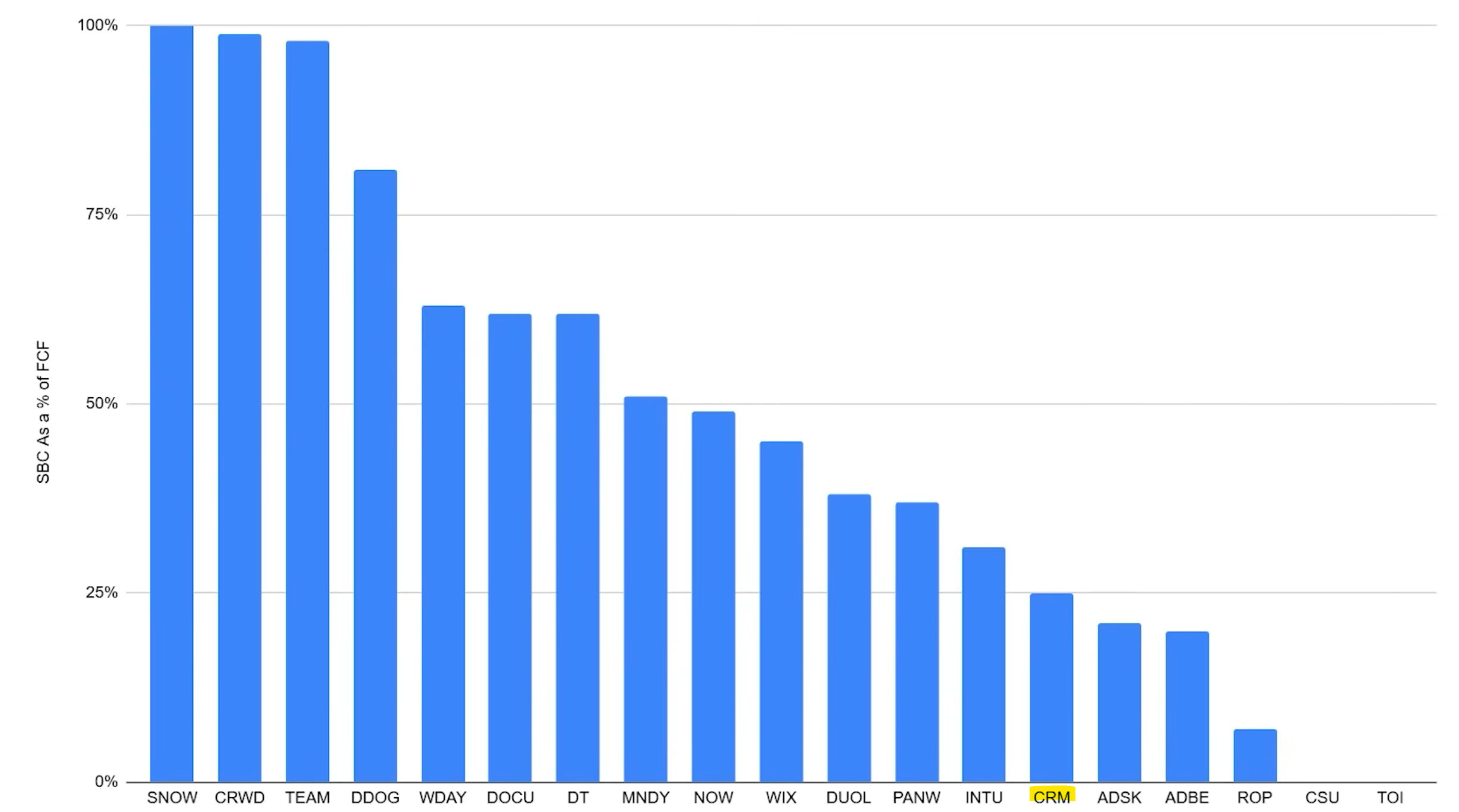
That shows how much SBC (stock-based compensation) accounts for out of the free cash flow for various companies. When looking at these US tech stocks, you shouldn’t trust the P/FCF metric as is; instead, you should practically slash roughly 25-75% off the free cash flow in one go and then reconsider the valuation. Even Salesforce is a giant, and yet 25% of its free cash flow goes toward stock-based compensation, which is a staggering amount.
Good clarification. It looks like it will still stay below 20. We’re in an interesting situation right now, as the big SaaS firms haven’t really shown any weakness in their business; instead, giants like CRM, Adobe, Now, etc., are growing their revenue and there’s no sign of AI disruption. Perhaps if QT were as strong and established a business, the valuation multiples would be in a different league as well.
I am, of course, permanently “Hesuli-traumatized” since 2022, it should be noted.
It will be interesting to see, if the market slump continues, what kind of incentive SBC ultimately remains for employees.
I proudly own one name from that group where SBC is zero. I do have some Adobe in my portfolio as well, but even that stands out favorably from that crowd.
Investing is characterized by generational experiences. I think the bad taste of Hesuli will never leave some people’s mouths.
Smells like populist crap designed to sell books to the masses rather than provide an objective analysis of Sweden’s economic policy decisions.
The problem with books as a source of information is that anyone can write them, and they only convey one person’s opinion. An author can use as much creative license as they want—whether the goal is to influence opinion or boost sales—and they don’t have to strive for objective truth.
To form an objective overall picture of the same topic, you would have to wade through several books to avoid brainwashing yourself into thinking exactly how one author wants. They are therefore pretty lousy sources for forming a political opinion. Even a single peer-reviewed study would be a much more valuable source.
I read that book myself a while back. The author had adopted a bad trait from journalism: seeking drama by repeating the views of various people without being able to form an independent understanding of the subject.
Have you read it? Neither have I. That’s why I don’t even try to assume whether the author’s opinion is right or wrong.
If you have read it, your opinion is acceptable. If not, I don’t even recommend reading it.
I don’t think it offers much if you’ve already decided it’s populist propaganda.
Doesn’t that also apply to books that go against one’s own values?
This is something I’ve been pondering. Why does everything always have to be easier and fancier?
Repair shop yards (take a look when you drive by) are jam-packed, to the point where there’s no room to move. Why? They are diagnosed cases. The owners have received a repair estimate, and that’s where it ended. New technology and the latest engines are so difficult and expensive to repair that the average Joe or Jane simply cannot afford it. I’ve noticed a phenomenon that I don’t understand. Those driving older cars experience being cut off and unnecessary overtakes, apparently because the general mindset is “out of the way, poor person.” Those cutting people off are often just drivers of financed cars who don’t actually own anything. The only way for them to show off is in traffic. But when this financed car breaks down, the jokes are over. You can’t give it up, you don’t have enough money for the repair, and the kids need to be taken to their hobbies. But one has to pretend that everything is going great.
I trust old technology and keep it in good condition through preventive maintenance—a few hundred a year in costs. Add a bit of style to the choice of car, and what’s not to love about cruising along.
I didn’t say that the book is populist propaganda, but that it reeks of populism, just based on the cover alone. The point of my message was to express this suspicion and criticize the use of a single book in forming political opinions.
My message did not aim to bring up my own values, nor are there any references to the idea that books should be treated differently depending on one’s values.
I understand that the Canatu losses are frustrating, but there’s no point in coming here to take out your bad mood on bystanders.
No hard feelings—not about the losses and not about your message either.
I didn’t mean to be aggressive; you formed your own opinion based on the cover of the book, after which I formed mine based on your message. This is a public discussion forum, after all, where someone might form their own opinion on what you’ve written.
After that, one can provide their reasoning if they wish.
One should always be critical, of course. However, you need to know what you are criticizing.
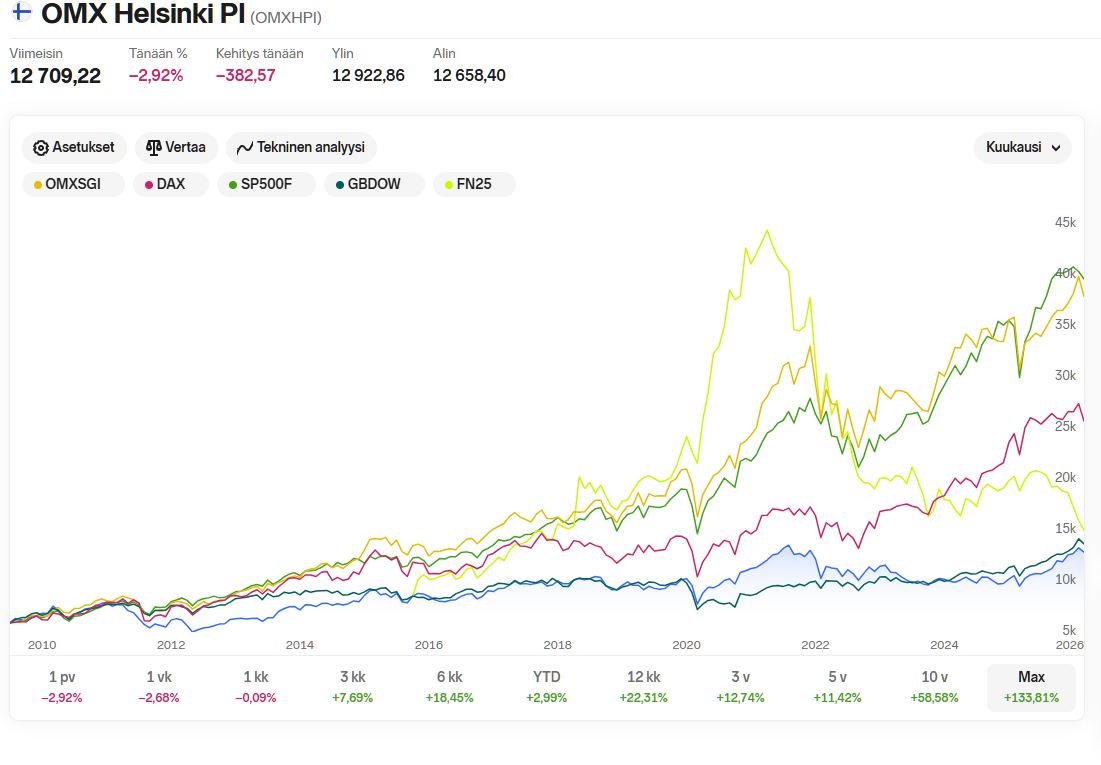
We’ve been rallying long and boldly, and at least in the States, it’s been a bull market for three years. At the very least, a sharp correction is quite welcome. Of course, a bear market could be in the cards as well. Who knows.
First North (FN25) is a different story altogether…
The plan is to start making the first purchases on Friday, and even then, cautiously. I have a gut feeling that the air will be let out for at least two weeks and good buying opportunities should emerge. I usually start topping up too early, and even today it’s quite difficult to sit on my hands. Could patience be a virtue once again? Anyone else having the same thoughts?
Keep on writing, Sami, there are also people here who are very interested in the topic. Maybe you could dial it back a bit so the most sensitive ones don’t get offended.
You’ve been long on Helsinki (Hesuli) First North companies for the last five years and you see posts saying that a sharp correction is finally welcome.
I don’t remember if it was you @Verneri_Pulkkinen who mentioned in some “Vartti” segment whether Finnish small-caps might have the same feeling now as they did back in the early 2010s. How utopian would it be to get you original Inderesians (or at least some of you) @Verneri_Pulkkinen@Sauli_Vilen@Juha_Kinnunen@Mikael_Rautanen on a video or podcast to reflect on how much the current market has in common with back then, when considering it from the perspective of Finnish growth companies (which apparently will never grow again)?

 I think the bad taste of Hesuli will never leave some people’s mouths.