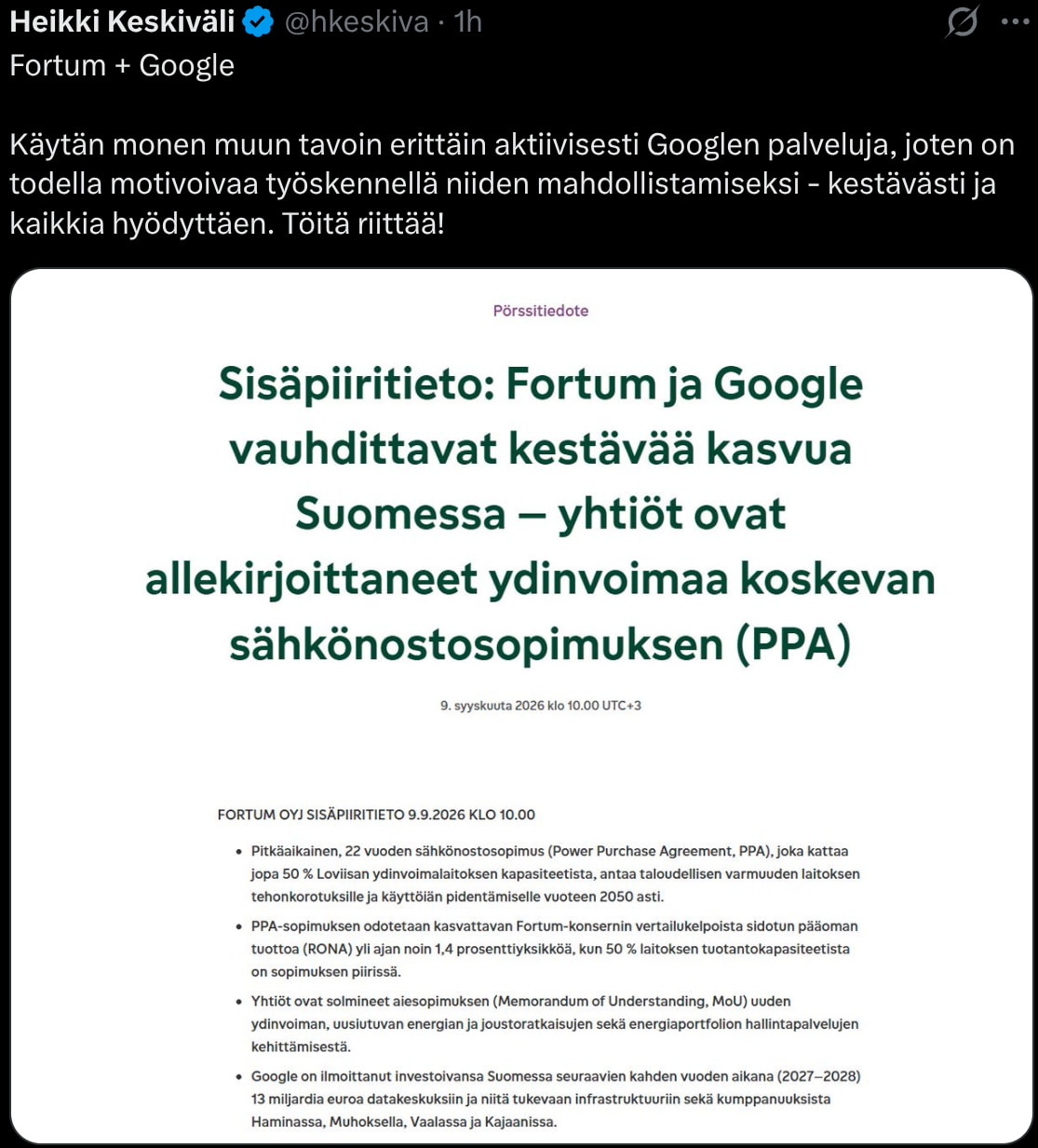
Lol. Google “produces” AI in Finland about as much as it produces YouTube at the Hamina data center. That high-paid developer workforce is definitely somewhere else entirely. Finland is being chosen here purely because of cheap electric power built up over decades using state funding based on security of supply—power that won’t be so cheap for us taxpayers much longer. In fact, it’s pretty much banana republic behavior to sell off your own resources at rock-bottom prices just because “at least someone is investing.” I’m looking forward with interest to the political debate about this leading up to the elections.
35 Likes
Could we take the political discussion and move it to the hazardous waste thread again, please?
11 Likes

Doesn’t this theme of electricity grids, production, and consumption heavily lean towards partial optimization? Fortum optimizes from its own perspective by making a long-term contract. Municipalities optimize on a local level. National policy optimizes particularly for a relatively short time horizon. Etc. An imbalance between supply and demand arises, prices react (e.g., the consumer pays more), and over some timeframe, the market balances out if oversized returns are available (more production). And then further, isn’t this fundamentally a feature of a market economy – what kind of entity would there even be that could have the understanding, vision, and mandate to manage and make choices regarding the electricity grid as a whole from the perspective of the “overall benefit”?
Not that I am particularly convinced by the direction myself, assuming of course that the contracts do not include conditions regarding base/balancing power, price reviews, restrictions on electricity use under certain conditions, etc. As a very poor analogy: if we think of electricity as a necessity commodity, how would one view a contract whereby someone sells a slice of all of Finland’s food production on a 20-year contract to some international actor?
1 Like
Are there also any positives to be found in these investments made with foreign capital, and the short- and long-term jobs for Finland’s development regions? Growth ideas from our own country seem to still be in the more distant future. Distributing money for consumption to the poor and middle class probably isn’t an option.
1 Like
This is certainly not exclusively a bad thing. The destination cities are surely pleased with the increased activity. Only the synthesis made from the observations and analyses is wrong if it refers solely to the size of the investment and the short-term benefits of the investment phase.
Hopefully, this will also spark a discussion about investments in the power grid and electricity generation. The next nuclear power plant should already be in the works. And wind power needs to be increased further. By the way, Google apparently bought the output of a couple of wind farms at the same time.
Of course, this isn’t just about consumer electricity prices, although there is good reason to be concerned about that, too. It is also about the fact that investments like these—and there are dozens underway—take away the grid connection opportunities for small and medium-sized enterprises’ investments, when capacity simply isn’t available or investments cannot be started within a reasonable timeframe. And as we all know, small and medium-sized enterprises are precisely the ones that employ the most and in the most diverse ways relative to their size.
21 Likes
A friend of mine has an electrically heated detached house and is now fiercely cursing the boom in data center construction. It would be interesting to know if opponents of these projects mainly view this through their own lens. This isn’t meant as a criticism in any way… it’s a completely human perspective.
1 Like
Yes, investments in artificial intelligence and data centers will definitely remain net-positive in their impact. Regarding the employment debate, one could state that data centers do not bring a massive amount of new knowledge work to Finland, but it is wrong to claim that the employment impact is zero. The “ecosystem” developing around them will indeed bring new job opportunities to replace jobs in dying industries. For example, some of the jobs in the former forest industry chain can transition into this data center chain.
However, the most essential positive aspect relates to national defense and geopolitics. All Finns are likely aware of the country’s location on the map at the edge of the Western world and having a regrettably familiar actor as a neighbor. The more international, and especially Western, money and infrastructure there is in Finland, the more other countries have a vested interest in keeping Finland in the same club, even though we are far away and separated from central Europe. A hundred years ago, Finland was a remote backwater with which few states, companies, or ordinary citizens had any connection. Finland was easy to leave to fight alone, as the poor country had no real significance to others. When international capital, interests, and engagement are here, Finland’s relevance grows, and the threshold to leave us to fend for ourselves rises.
I will illustrate this a bit with a Donald Duck-style thought experiment. Imagine that a giant vault were built in Finland to store all Western gold. The vault in itself wouldn’t create many jobs or high-value-added economic surplus. However, it would give other countries a concrete reason to keep Finland in the same club, since their gold is stored with us. We would hardly manage to attract all the gold here, but the more, the better. AI investments and all other investments related to the global economy operate on the same logic, as they are simply a more complex version of the gold example. Everything that makes this nation of 5.5 million even slightly more relevant to other nation-states is for the good.
Regarding the price trend of electricity, one could also point out that the volume of electricity production is not constant; it can be increased. In Finland, electricity prices have been so low for a long time that it has not been profitable to make new production investments. If volume demand and price rise, new production also becomes profitable and volumes grow. A higher price is thus a signal that attracts new capacity to the market. Furthermore, highly predictable and sufficiently large demand is precisely what makes new energy investments possible. In other words, overall, the benefits clearly outweigh the transition-phase drawbacks in my view. Finland should attract every possible investment here and then invest more itself. This gets a mighty snowball effect rolling. Go Fortum and go Finland!
53 Likes
And on what assumptions would these “magnificent resources” be put to good use otherwise? At least based on the last decade, it’s most likely they wouldn’t be used at all.
8 Likes
Today I dare say that it would have been a good idea.
9 Likes
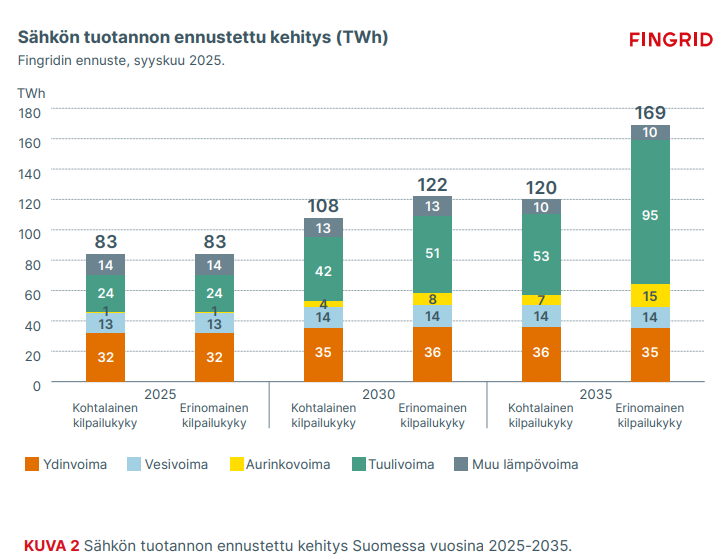
Electricity production is indeed projected to rise:
https://www.fingrid.fi/globalassets/dokumentit/fi/kantaverkko/kantaverkon-kehittaminen/best-estimate-q3-2025/sahkon-tuotannon-ja-kulutuksen-kehitysnakymat-q3-2025-fingrid.pdf I will highlight one point regarding the change in the import-export balance. “In recent years, electricity has mainly been imported from Sweden to Finland and exported from Finland to Estonia. The transmission between Finland and Sweden is becoming more balanced than before. This is influenced not only by increasing electricity production in Finland, but also – even after negative forecast revisions – by significant growth in electricity consumption in northern Sweden. The forecast assumes that the Aurora Line transmission connection will be completed in 2025, and the Aurora Line 2 connection in 2034. Transmission from Finland to Estonia is heavily export-driven. The Baltic region’s electricity production opportunities are good, and if wind and solar power capacity grows there as anticipated, electricity transmission via the EstLink connections between Finland and Estonia will gradually become more balanced as the decade progresses. Electricity consumption is not estimated to grow significantly in the Baltics. Finland is not projected to develop into a net exporter of electrical capacity within the forecast horizon.”
-> if imports decrease, supply drops and prices rise. Therefore, new production must be built here. According to Fortum, producing an equivalent amount of continuously available electricity with nuclear power requires double the electricity price: Fortumin Rauramo: Uusi ydinvoimala vaatisi kaksinkertaista sähkön hintaa | Talous | Yle (from spring '25). So not at the same price level.
A data center will not be a dispatchable consumer (säätökuluttaja), given how much capital will be tied up in its hardware. What new power plants will be erected by the aforementioned two years from now to bridge that gap at this electricity price level? We are talking about the end of 2028. 50% of Loviisa means about 4 TWh/year. In that Fingrid material, the growth is assumed to come from wind power. On an annual basis, roughly speaking, price volatility will increase, however, and the average price will likely rise based on past experience.
3 Likes
Finland is becoming the “European Texas” in the wake of AI giants’ investments:
https://www.cnbc.com/2026/09/09/google-finland-ai-infrastructure-investment.html
10 Likes
AI gave the following breakdown of the potential investment, though I have no way of evaluating how realistic it might be:
| Target | Estimate € | Share | Includes |
|---|---|---|---|
| Data center buildings and MEP | €4.0B | 31% | buildings, electricity, cooling, backup power, fire safety |
| AI servers, GPUs, storage | €4.2B | 32% | TPU/GPU, servers, storage, racks |
| Electrical infrastructure for data centers | €1.4B | 11% | substations, transformers, cabling, grid connections |
| Network + telecom | €0.6B | 5% | fiber, routers, optical infrastructure |
| Cooling / thermal systems | €0.7B | 5% | cooling, heat recovery, pumps, etc. |
| Energy: wind, battery, others | €0.8B | 6% | renewable energy, 94 MW battery, etc. |
| Nuclear power / share related to Loviisa arrangement | €0.4B | 3% | indirect share; PPA itself is not a €13B investment |
| Land, engineering, permits, others | €0.5B | 4% | land areas, engineering, project management |
| Community, nature, and other programs | €0.2B | 2% | forests, wetlands, research, community projects |
| Total | €13.0B | 100% |
Just under a third goes to NVIDIA. Have these centers been mapped out in any database or map that also shows energy consumption? It would allow us to compare whether the plans are grounded in reality or if energy is expected to be drawn from some mystical wall outlet—and through that, NVIDIA’s order book as well.
3 Likes
Since the funds have been honestly valued to the best of their ability, couldn’t the banks just willingly tie up their own capital in them to get the redemptions rolling? They can then free up their capital when customers rush back to subscribe to the funds, which are a good long-term investment.
7 Likes
I also tested a vehicle like this at the end of 2021; it didn’t really pay off even though the price of electricity rose sharply.
2 Likes
In general, I try to invest in companies whose products or services I use myself, as well as to some extent their peers or companies in the supply chain. I pay my electricity bills with power company dividends, phone bills with telecom operator dividends, insurance with insurance company dividends, soft drinks with Coca-Cola dividends, etc. This approach suits me well and helps me avoid investment targets I don’t understand; with the mindset of “if I am not a customer of this or that company, why would anyone else be either.”
4 Likes
You would think it makes making new energy investments easier when current production is sold for 2 decades. Good that some are investing in Finland. This is bound to bring good results.
21 Likes
Even though it would have been a complete game of chance if I had bought Fortum as electricity price protection before today’s big news, it was annoying in the morning to look at the share price and realize what kind of quick gains slipped through my fingers. On the other hand, it annoyed me (significantly less) even now in the afternoon that I didn’t buy at a +10% price increase, since now it’s already up +14%. However, I’m not going to start FOMOing and buying (yet).
1 Like
That is the exact right attitude to have. This is the wrong hobby if you dwell on these things. It’s not the last time you’ll be mulling over an idea and the stock skyrockets for some reason before you can even blink. It has happened to me enough times that I dared to make a joke about it.
12 Likes