Thank you so much, great to hear! We’ll try to keep the bar high. 
24 Likes
Of course, that is also the case.
What I have personally seen in the industry as competitive advantages for service providers, for example, are the following very simple things:
1/ People arrive at work at 7:00 AM (overalls on) and leave at 3:30 PM (overalls on)
2/ People take lunch and coffee breaks according to the collective agreement (TES) (30 min and 15 min)
3/ People are flexible with the breaks mandated by the collective agreement when work stages so require
4/ People prepare for the coming week during the previous week and for the coming workday during the previous day. At the end of the week and day, they check if the target was reached.
5/ People carry out the workday efficiently and productively in an entrepreneurial and self-directed manner. There is no waste of time and/or idle time, at least not through their own failures.
6/ Failures are seen as challenges, and based on them, development measures and long/short-term development paths are built (training and being trained through courses, etc.).
7/ Operations are run by the service provider through an ERP system → work management/planning/scheduling/reporting/billing –> everything at a daily level and up-to-date, including quality systems. For example, daily execution (on an hourly level) and reconciliation of billing at an hourly level are precise and transparent. 50% of the day is saved when all checking and adjustment are minimized.
What I have seen regarding the above from service providers over nearly 20 years from the client’s perspective is that it is by no means simple, even though it sounds very simple. Technology is simple, but people and processes are not. If and when a service provider gets a bingo on those 7 points, I would even go so far as to say that the service provider in question has some sort of a Moat or at least a Ditch dug compared to competitors  Maybe the Chinese and Japanese know how to do that, but Finns don’t, and that naturally starts to create that extra cost for export products as well.
24 Likes
That’s exactly what I think the person was referring to when they said that if you gain an advantage from somewhere, it’s from “experience.”
But apparently, it doesn’t affect customers who always choose the cheapest option. If there are competitive advantages, it should show in the numbers: a better ROIC than competitors!
Note: it remained unclear to me in the end what the business exactly is. Steel is quite a broad concept. It wasn’t Outokumpu, because the CEO wasn’t Outokumpu’s CEO. 
Yep, in many industries, the advantage can already be that your own employees mostly show up to work sober.
But once again, does it show in the numbers? And when moving into the field of listed companies, the competition is already tougher. Just showing up for work isn’t enough in every industry.
Addendum. Great that this post sparked discussion immediately! The theme is very important, and I believe the Finnish investment scene will develop for the better if investors, owners, and analysts knew how to challenge companies better!
18 Likes
Heh, true.
I’m at a company where the development of daily work productivity is monitored in euros, and considering all waste / waiting time / messing around, it has been calculated as a cost of several million euros – or “potential,” as we tend to say… and in this exercise, service providers have been harnessed under very tight scrutiny. Service providers naturally have good bonus/penalty clauses in their contracts regarding this, but it’s still very difficult to even reach average. Then, of course, in this “bulk” service provider portfolio, there are a couple of diamonds who excel in that 7-point bingo and, through that, achieve great results for themselves through less waste and better output. At the same time, the diamond service provider also grows nationwide as their good reputation precedes them, even though they are essentially a “bulk provider.”
4 Likes
I would argue that if production and the work environment in Finland were as efficient as in China, there wouldn’t be a decisive difference in the price of the final product between Finland and China. In high-volume business, the share of labor costs (excluding bloated organizations) and raw material logistics is minimal; I contend that other factors explain the price difference between products. Mainly, inefficiency in production, administration, and sales leads to smaller volumes and drives up the price of the final product. Work is done very much the same way in both Finland and China, with the exception of certain assembly-heavy sectors. Although, even these are increasingly being handled by robots in China.
Well, yeah, we also have taxation in Finland, but that’s another story…
1 Like
I have to weigh in as well. But indeed, if something like that materializes, it would also show up in the numbers. Although it might be impossible to tell from the numbers what exactly was caused by what, ultimately it’s people who do the work, there are differences between people, and they can be incentivized in different directions. If, for example, one of two companies has a really good work atmosphere and all the “invisible little things” are handled well (some were mentioned earlier) while in the other these are handled more or less half-heartedly, I’d argue that in the first one, people produce better results and the best employees stay with the company at a higher rate. As this continues, that company will eventually be able to deliver at a lower cost and win more tenders, at which point, for instance, the ROIC should indeed be better.
In my opinion, in simple industries, looking at the numbers is actually quite a good way to evaluate how well this kind of boring basic execution is working in a company. Because if there is competition and the industry is simple, the differences can’t really come from anywhere else. Whether that is a permanent competitive advantage is another matter, or whether such a competitive advantage is as good as, say, geographical location—hardly.
1 Like
Having spent my career in a project-based firm, I’d say that yes—price is important, but it’s not the most important factor. More critical are quality and, above all, reliability of delivery. These two are primarily driven by functional processes—and once they are in order, price and profitability follow.
5 Likes
And
Incap 
A perfect full house.
Those who know, know.
48 Likes
Next week will be the first ROAST in Sweden. Byggmästaren is a Swedish investment company. There is a lot of money in the country, so there is no shortage of these investment companies. For Finns, the company is made more familiar by its major owners: the 2nd largest shareholder is former Sampo CEO Kari Stadigh, and the 3rd largest is Georg Ehrnroot.
The company’s main owner has the surname Ahlström. I’m not sure, but I suspect they are not related to the Finnish Ahlströms.
8 Likes
AHSLTRÖM - AHLSTRÖM
SL - LS
Different names, so probably not 
Edit:
My second national language (Swedish) is weak enough that I wasn’t at all sure it was a typo, though I did have my suspicions.
2 Likes
Mauri once again uses his quill to put the thoughts of a small-time Helsinki investor into words. As a woodworking professional, I think I’ll make a sign out of this for my office wall.
17 Likes
That’s one way to put it and even perceive it, but for that to actually happen in reality, so many things need to work. If only price mattered, then delivery times, their reliability, product quality, and goodness knows what else should be completely irrelevant, which is not the case. So, in so-called bulk products, price is the deciding factor, provided that other basic things are at least at a satisfactory level.
3 Likes
It is a grand eve, for tomorrow is the workers’ holiday. And those of us who invest in Hesuli (Helsinki exchange) know what thankless work is. Let us not let that dampen the festive spirit, because tomorrow, Friday, is May 1st, 2026, when regardless of the results we can celebrate Wappu, freedom from returns, and enjoy the appropriate beverages—in moderation, of course.
In honor of this, I have written a fitting poem for all forum members.
The sun is shining and the Prisma donut smells sweet,
The busy rush of the daily grind is now complete!
It’s Wappu, a feast, the thrill of being return-free,
The sweetness of sima (mead) and joy for all to see.
Labor has its place, the foundation it did lay,
But only songs and laughter will ring out today.
Now that the savings are melting away,
One can enjoy freedom in every single way.
In the portfolio, Quutti’s (Qt Group) weight just continues to grow,
No more need to buy Nokia, as we all know.
The future looks clear as vodka, hey,
The Wappu breeze blew all yield worries away!
Happy Wappu to everyone! 


20 Likes
Could we also get the comparison period in the charts, even though it’s mentioned in the text. Pleease 
the body text is too similar compared to my previous message
edit. it was there in the later images 
4 Likes
Good idea! I’ll see if I can edit a couple of the graphs into an even more illustrative format! 
Edit: I’ve now updated a couple of the graphs to include comparison points for last year as well!
6 Likes
Hello forum!
My forum activity has been quite passive on my end during the early spring, as my time has been largely occupied by my bachelor’s thesis alongside work. However, the thesis has now been submitted and graduation is approaching!
The above was not the main reason for this message, though; I wanted to share that my fixed-term employment at Inderes ends today. My journey continues with an internship and, in the autumn, master’s studies. Therefore, there won’t be any more comments coming from this profile, but I will be more or less active under a different username!
The forum is a fantastic place, and its value is created by all the forum members and their own thoughts. The forum has been and will continue to be an important place for me to discuss stocks, investing, and everything else surrounding them. Thank you for that! Inderes as a workplace has also been unparalleled, and I see no reason why I wouldn’t return if such an opportunity were to open up in the future.
Happy May Day to the forum!
/Daniel
89 Likes
This leads us to investing and investment strategy. Many investors call themselves growth investors or quality investors. Such pigeonholing easily goes astray, as one usually has to pay at least enough for “quality companies,” and most companies aren’t actually particularly high quality in reality (cf. what has happened to Finnish “quality companies” on the stock market over the last 5 years). Growth investing is also somewhat questionable by definition, as most companies strive to grow wherever it makes economic sense.
My own approach has generally been more cynical and long-term; buying shares in sufficiently high-quality companies when the market doesn’t appreciate them enough and aiming to sell when someone gets too excited and pays way too much.
It’s not easy, but the market usually always offers opportunities in both directions. You DON’T need to hit the peaks and troughs to make a profit.
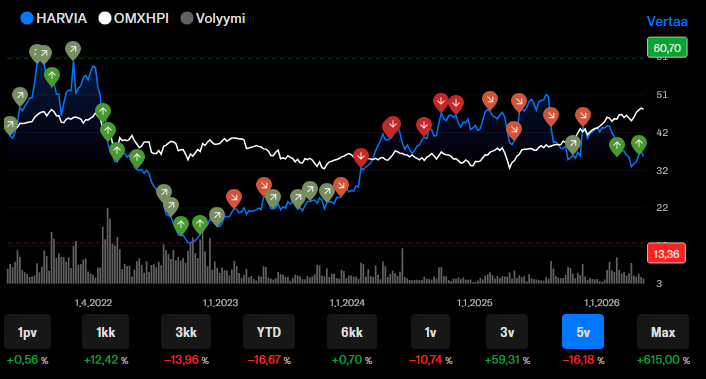
Does anyone else remember a time when stocks on the market could either go up or go down?
Looking at the current K-shaped market year after year, the feeling is:

In one basket, we have US indices, tech giants, European banks, engineering companies, etc. Values rise forever. Every buy has been a success. Every sell has been a mistake.
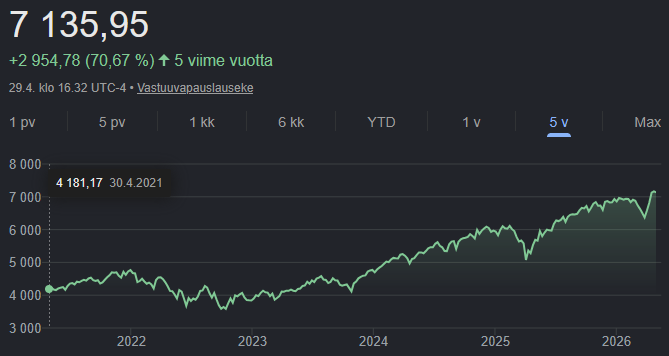
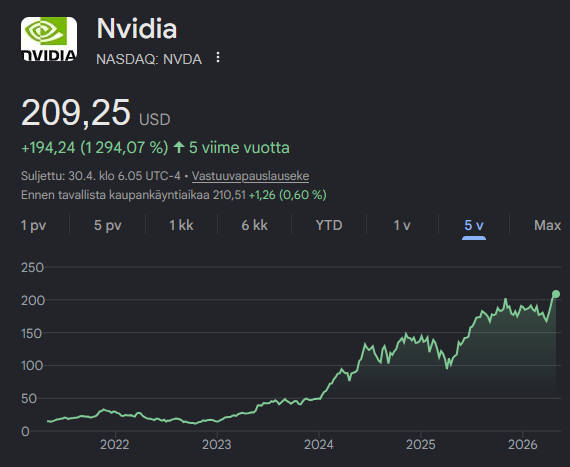
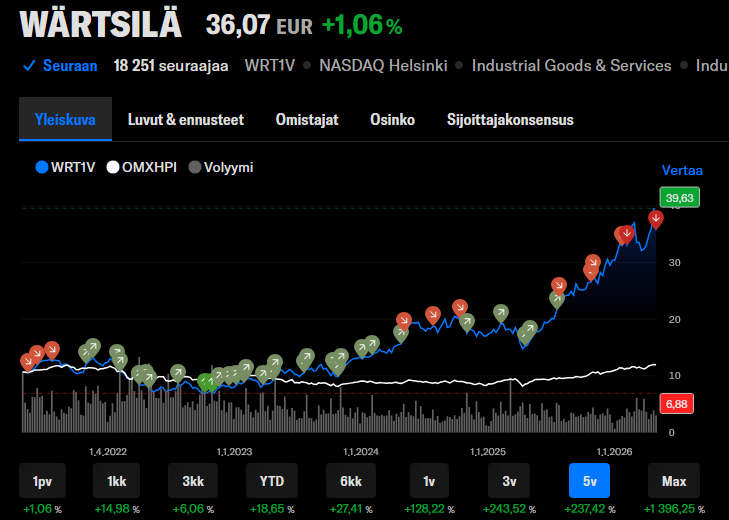
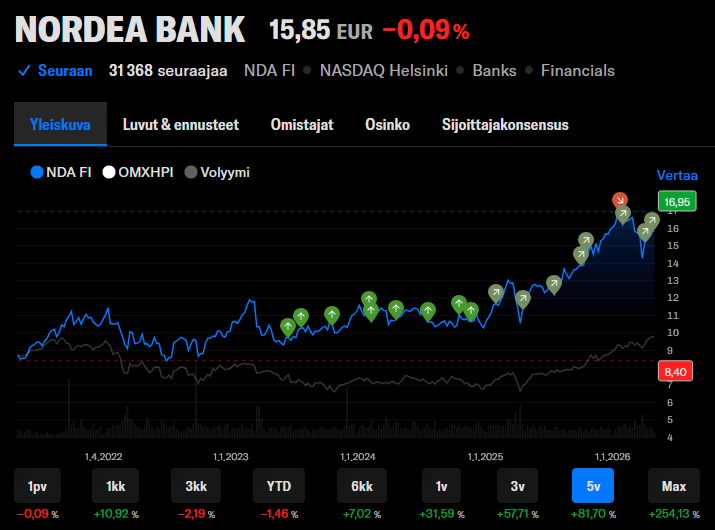
And then we have the lower branch of the K. Small caps, those living under the fear of AI disruption, etc. Prices just keep falling. Every buy is a mistake. Selling at any price has been a success.
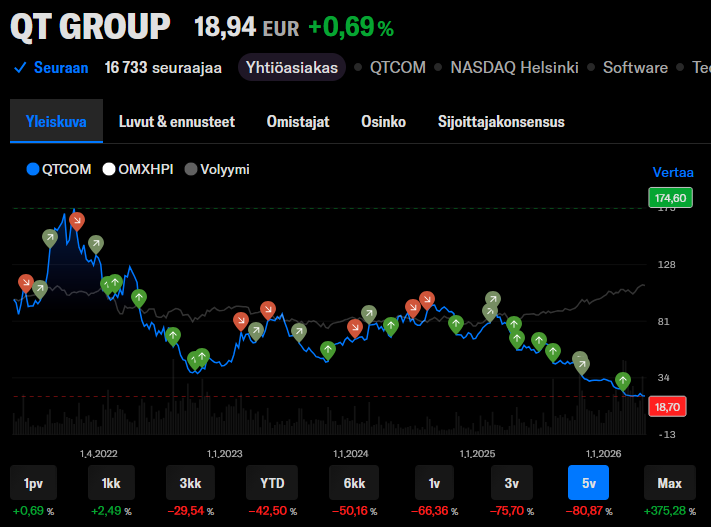
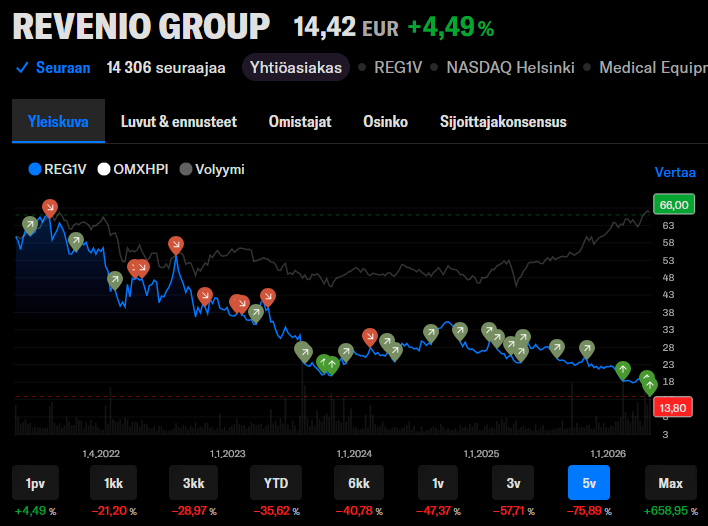
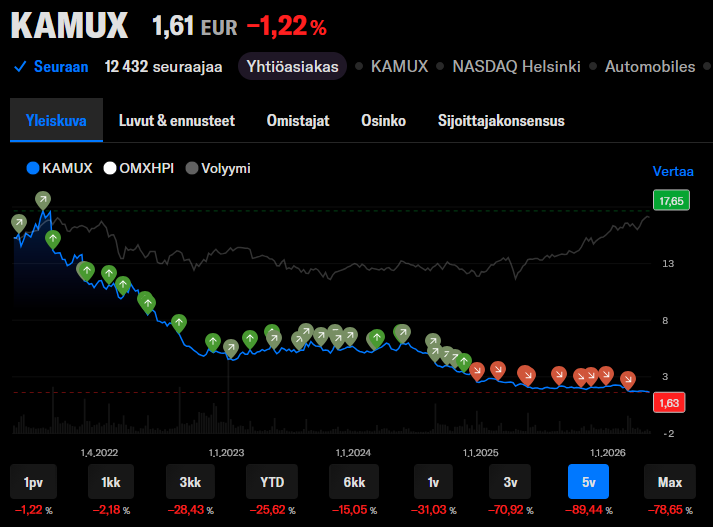
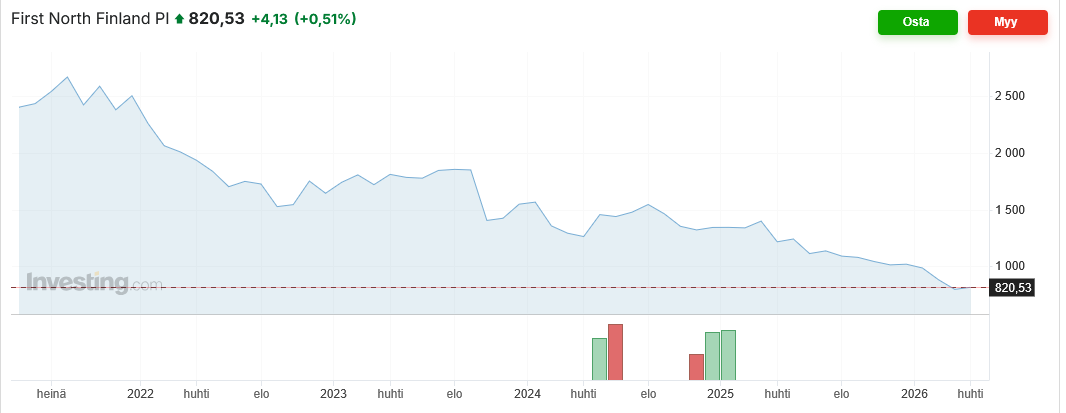
27 Likes
Thanks again for the expert articles and great work!
The door is open.
Soon we’ll be eating the farewell doughnuts. 

12 Likes
Celebrating May Day with a classic 

17 Likes
My own experience, having worked in several companies and specifically operating near the customer interface and management, is that, simplified, this is exactly the case.
Okay, my own industry is not at the heart of any technological disruption. So, we are talking about fairly basic products in a certain way (though some of the products I’ve worked with were certainly pioneering in their own right, and some have even momentarily achieved a significant market position).
And I wouldn’t necessarily blame only the top management for forming a distorted view. Often, R&D, sales, or marketing also actively try to build moats or differentiate themselves from competitors (completely in vain, because customers don’t want to compare different solutions, but essentially similar ones!) to justify larger budgets from management. Additionally, one could consider various internal loops that reinforce these delusions (sales->management->sales->… for example). So, in my opinion, it is a delusion that permeates the entire organization.
However, there are other factors besides just price. The practical functionality of products is a significant factor (reliability), as well as all sorts of services related to the products (maintenance, upkeep, etc.). Sometimes it can even be just the good interaction built up over the years between the seller and the buyer. Even in a B2B environment, you can very quickly observe that price is certainly not the only criterion, though the product’s role in the customer’s value creation affects the matter a great deal. It’s the same as being a consumer: if you buy a single product costing, say, €5, its price doesn’t really matter. If you buy many such products daily, the price matters more.
Ultimately, to simplify, one could ask: why would it be any other way when we know that decision-making biases exist even at the individual level? As described above, sometimes the organization acts as an amplifier, although dampening is also possible (I’m tempted to say rarely, but well-designed operating procedures specifically aim for this).
Then, when you add other interpersonal dynamics between various external parties (suppliers, customers, other partners, etc.), it’s probably not very strange that the perception of reality is, to put it mildly, less than perfect. Someone in ancient Athens probably approached this problem of perceiving reality with their allegory of the cave…
8 Likes