Inderes Coffee Room (Part 11)

This is indeed a great hobby, I mean stock picking. Even someone over sixty learns new things daily, though old things probably start to fade from memory at the same time :slightly_smiling_face:. This hobby doesn’t have to be driven by profits; one can choose, for example, impact investing. However, the average forum member still has several decades to spend on Earth, and many have offspring who might still be alive in the 22nd century.

Of course, profits are an added spice, but everyone is free to choose their risk level and where they want to invest. I, for one, would never invest in the arms industry, under any circumstances. It’s worth remembering that when these state-of-the-art weapons are developed, at some point in history, some dictator or general will want to test how they perform in a real situation. Then, ordinary civilians, like you or me, will suffer alongside soldiers. A credible national defense is, of course, a separate matter.

As @Masse once stated, “This is a hobby you sometimes have to pay for.” No one’s portfolio goes from win to win; there will inevitably be periods of poor returns, even for years. However, let’s keep our eyes on the ball. If small-cap companies are considered good investment targets, then with lowered valuation multiples, they probably still are. Even my portfolio, which has relied more on large dividend-paying companies, has recently seen “gadgets” like Admicom, Deete (Detection Technology), Qt, Remedy, and Revenio :slightly_smiling_face:. Of course, I haven’t forgotten dividend companies either; cash flow must come from somewhere. It’s quite possible that for small-cap companies, light at the end of the tunnel won’t appear until the end of this decade or even the 2030s, as the geopolitical plates are currently in such strong motion that uncertainty will likely continue, and large companies will be favored in the markets.

If the stock-picking game feels too tough, there’s no shame in switching to index investing. One can just as easily research the companies they own through an index if they are interested.

At the same time, I encourage everyone to physically attend a company’s annual general meeting at least once in their life. I admit that as a resident of Helsinki, it’s considerably easier since most companies hold their meetings here, but they can also be found in Oulu, Tampere, Turku, Vaasa, and elsewhere across Finland. A single share owner can participate just as happily as a millionaire owner. Naturally, not everyone can attend a meeting held in the middle of the day due to work obstacles, but for example, NoHo is holding its meeting, known for its real dividends, in Tampere this year at 5:00 PM. A “perfect match” can surely be found by browsing the annual general meeting section on the Inderes homepage. Besides, the trip can be combined with the idea of exploring a new city at the same time; one can easily bring their better half, as long as they remember to mark them as an assistant during registration.

The annual general meeting is an excellent opportunity to meet other shareholders and to discuss with the company’s management. For example, just this past week, there was an opportunity to talk with Hannu Martola, the CEO of DeeTee (Detection Technology). Often, at smaller company meetings, the atmosphere is more immediate; at larger meetings, the sheer number of people can make it difficult to clear a path to, say, Nordea’s Vang-Jensen for a chat :slightly_smiling_face:.

These are my thoughts for this time, without any particular guiding star. Remember to go outside this weekend and recharge your batteries; Monday will probably be another down day on the stock market :slightly_smiling_face:.

47 Likes

I guess I got my wires crossed then :smiley:

2 Likes

Yeah, we got the exact same message in the summer when we sold the Opel we bought for the Norway trip :sweat_smile:

2 Likes

This week it happened: the first proper, prolonged vomiting illness for a child after a diabetes diagnosis. Home remedies for treatment were pretty much used for several nights, after which we had to go to the children’s emergency room. In the emergency room, we went straight past the queue to speak with nurses and two different doctors, an IV was inserted into the hand, and we spent the night on a drip in the ward. Fortunately, their condition improved overnight.

Even though treatment methods for type 1 diabetes have developed tremendously in recent years, it is still, all in all, an extremely frustrating disease for the child and also one that burdens the entire family.

50 Likes

HCP’s interesting Q1 investor letter, takes only a few minutes to read. :slight_smile:

The first quarter of the year has been eventful. Markets are moving on many fronts and investors are fleeing from one asset class to another in the blink of an eye.

3 Likes

Now, in the spring dividend season, it’s good to remember that dividends are nice because you can use them to make your own share purchases according to your own taste.

And thus, you can comfortably position yourself in both the dividend and share repurchase camps :left_arrow: :right_arrow: Or in between, or neither :counterclockwise_arrows_button: :clockwise_vertical_arrows: :palm_tree:
10 Likes

In all honesty, you also have to pay tax on them both when buying and selling if you think of them as a means of buying your own shares. Of course, at best, the share price falls sufficiently, and you can compensate for the dividend tax prior to buying new shares with a capital loss asset. :smiling_face_with_sunglasses:

7 Likes

Who doesn’t own 10 percent of a company/companies (where dividends are tax-free) :thinking: :expressionless_face:

I haven’t yet managed to sell dividends(?):thinking:, but that’s probably due to lack of skill; I’ll have to learn that trick too :+1:

1 Like

Where did you learn that from..

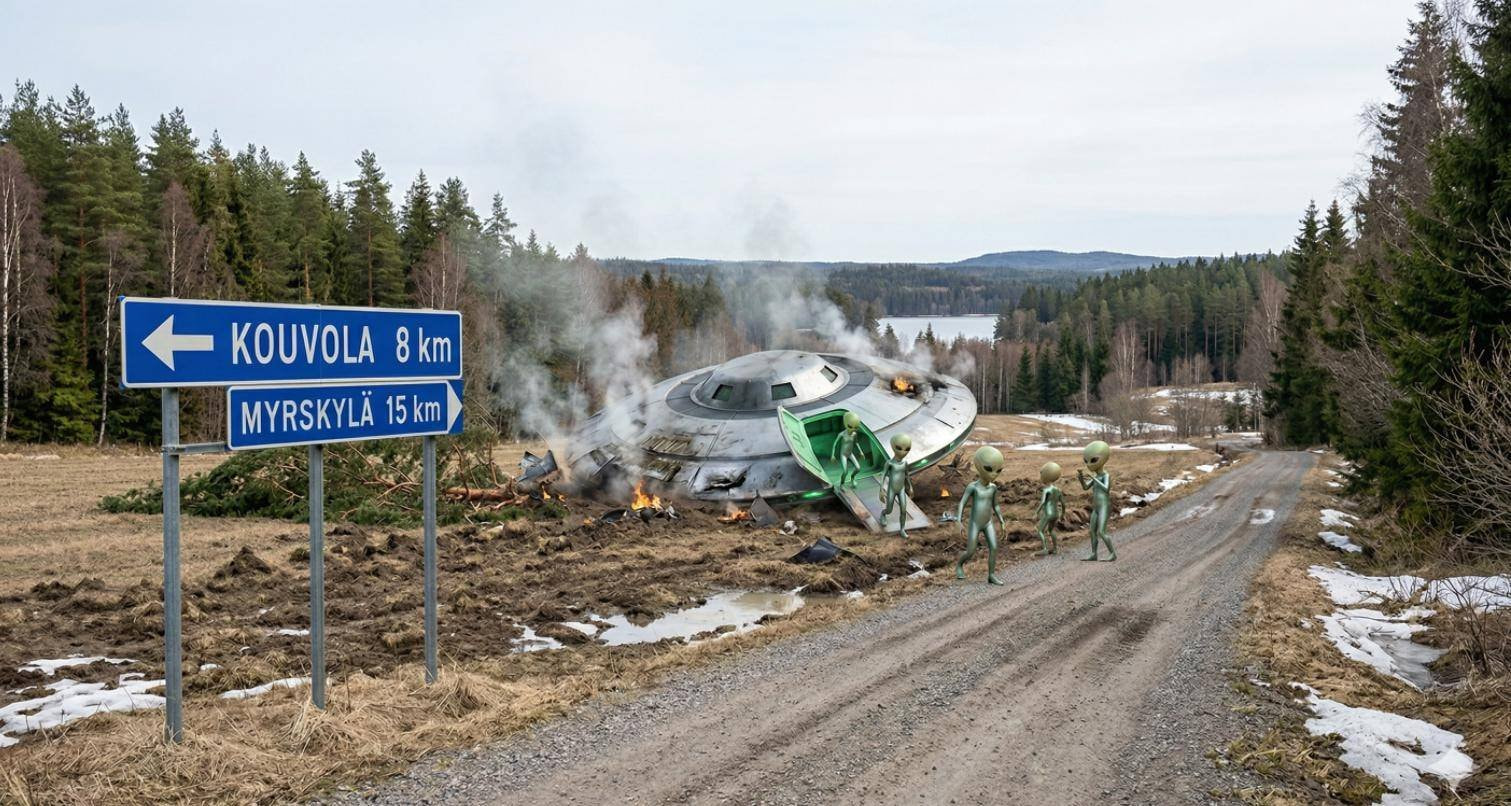
The robot uprising has begun

12 Likes

I appreciate those rebel robots that knock over other people’s improperly parked electric scooters that are in the way :smiling_face_with_three_hearts:

13 Likes

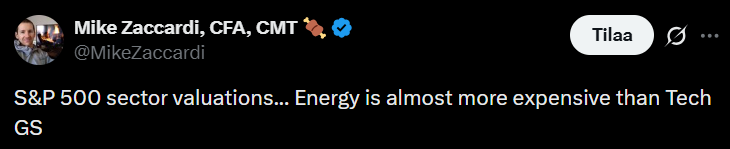
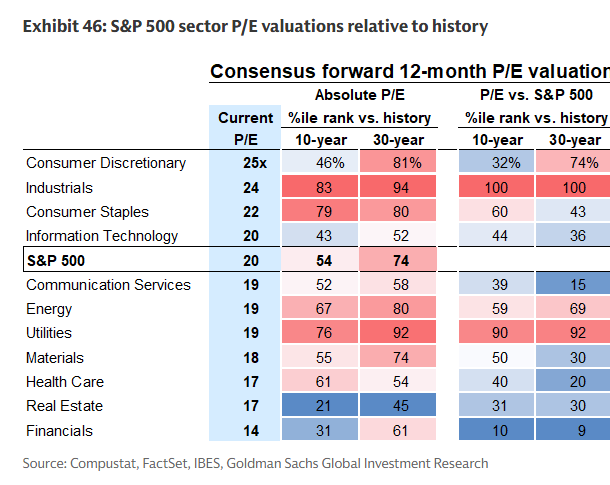
Here’s Mike’s tweet about the valuations of different S&P 500 sectors :slight_smile:

https://x.com/MikeZaccardi/status/2037941790343348406


4 Likes

Where can one see the Euribor rates? I know many places where they show up with a day’s delay, but where can I see them in real-time?

2 Likes

Euribor rates are not finalized until around 12:00–12:30 PM Finnish time, so most free services display the previous day’s closing rates.

This website usually updates the rates as soon as they are confirmed (daily rates after 12 PM).

4 Likes

10 Likes

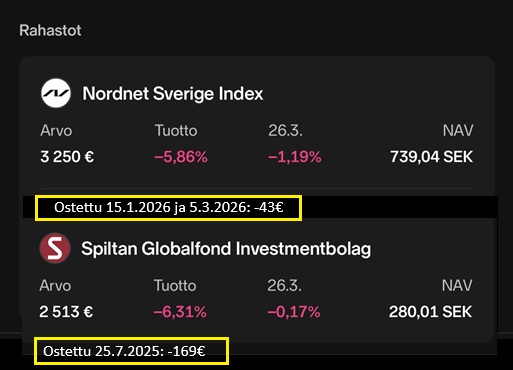
Since the beginning of the year has been miserable for my portfolio, I’ll add fuel to the fire by opening up about my fund history. I’ve always been a stock picker, except for a monthly savings investment-linked pension insurance, which I committed to in the summer of 1996 (Merita Bank). It was sold to me, a fool who hadn’t yet started his investment career, on favorable terms for the bank, meaning it was 50% in fixed-income investments and 50% in stocks (some foolish setup named something like “golden mean” or similar). It took me several years before I noticed its misery and switched it entirely to stocks, and even then, I was ahead of my time at the wrong time: half went to Japan (the fixed-income portion) and the rest stayed in the otherwise very good Nodea Nordic Small Cap fund, but to the point. I thought I’d reduce risk and move some money into funds, but I messed up again when my portfolio was rallying in July, so I put all the money allocated to that fund in at once, instead of using the amount as monthly savings. I had previously taken a 3-month flexible deposit a couple of times, which earned a few bottles of wine after taxes (with a 3-month deposit), but now my new fund career has started poorly as both funds are only making losses (though very moderately in euros). However, before I made my first purchase, the return history enchanted me like sirens, and now I’m left wondering when those bottles of wine will be available. So, a Sunday lighthearted take from the world of fund investments, not to be taken seriously but as an anecdote.

2 Likes

We could arrange a poll on this. Do you support the formation of an EU federal state?

  • Yes.
  • No.
  • Yes, but a Nordic federal state would be better.
  • No, but I support a Nordic federal state.
0 ÀÀnestÀjÀÀ

I asked Gemini for arguments for and against. Read if you wish.

Potential benefits and drawbacks of an EU federal state for Finland

The question of the EU evolving into a federal state is multifaceted, dividing the views of experts and citizens alike. Currently, the European Union’s structure is a unique combination of a confederation (intergovernmental cooperation) and a federation (supranational decision-making). A full-fledged federal state would mean a significant transfer of power from national parliaments to common European institutions, particularly in economic, foreign, and security policy.

In analyses by research institutes such as the Finnish Institute of International Affairs (UPI) and economic research institutes (e.g., ETLA and VATT), certain key themes regularly emerge when assessing the potential impacts of federal development from Finland’s perspective.

Potential benefits of an EU federal state for Finland

  • Security policy backbone: A full federal state would require a unified foreign and defense policy, possibly even a common defense solution. Although Finland is now a NATO member, a stronger, more unified, and more independent European defense capability would increase Finland’s security guarantees as Russia’s neighbor and reduce dependence on shifts in US domestic policy.
  • Economic stability and negotiating power: In a federal state, the Economic and Monetary Union (EMU) would be deeper, likely including a common fiscal policy and a significant federal-level budget. This could protect a small, export-dependent open economy like Finland’s from regional economic shocks. Furthermore, a deeply unified EU is a stronger actor in global trade and technology policy vis-Ă -vis the United States and China.
  • More effective decision-making in crises: The current unanimity requirement in many key issues (such as foreign policy) has often slowed down EU action. In a federal state, decisions would likely shift more widely to qualified majority voting, making the union more agile in solving issues such as pandemics, climate actions, or geopolitical crises.

Potential drawbacks and risks

  • Erosion of national sovereignty: This is the most significant political and legal change. The Parliament’s power to decide on Finland’s national budget, taxation, and social policy would be considerably restricted. Legislative power would increasingly shift to Brussels, fundamentally changing the operating logic of Finnish democracy.
  • Permanent transfer union and financial responsibilities: Economic experts have often raised the risk that joint fiscal policy will lead to a permanent transfer union. In such a case, countries with relatively disciplined economic management, like Finland, might become net contributors, funding less well-managed economies through common debt or taxation.
  • Marginalization in decision-making: Finland is a small country in terms of population and economy, located on the geographical periphery of Europe. In the stricter qualified majority decision-making of a federal state, there is a risk that Finland’s special circumstances – such as long distances, northern agriculture, and the specifics of the forest industry – will be overshadowed by the interests of large Central and Southern European countries.

In political and academic debate, there is no unambiguous answer as to whether the development towards a federal state is a net benefit or drawback for Finland. The conclusion depends essentially on whether the analysis emphasizes geopolitical and macroeconomic stability or national decision-making power and the risk of common financial responsibilities.
[/details][details=“Pros and Cons of a Nordic Federation”]
The idea of a Nordic Federation offers an interesting and often-discussed alternative to broader European integration. For example, Swedish historian and social scientist Gunnar Wetterberg has presented extensive analyses of the potential influence a united Nordics could have.

The formation of such a federation would bring significant synergistic benefits as well as profound structural challenges.

Benefits of a Nordic Federation

  • Unified Value Base and Social Model: The Nordic countries are united by a strong welfare state model, high trust in institutions, similar labor legislation, and a long shared history. This would make the harmonization of internal politics and social security considerably more seamless than in a more fragmented Europe.
  • Economic and Geopolitical Influence: Combined, the Nordic countries would form the world’s 10th-12th largest economy. Together, the region would be a significant global actor in technology, the green transition, and Arctic policy.
  • More Agile Decision-Making: Decision-making between five states (and three autonomous regions) would be structurally faster and more efficient than in the EU with over 27 member states, where finding compromises is often slow.
  • Complementary Security Policy: Now that all Nordic countries are NATO members, the region’s defense is already strongly integrating. As a federation, the Nordics could coordinate Baltic Sea and North Atlantic security with one voice and exceptionally strong regional military capacity.

Disadvantages and Obstacles of a Nordic Federation

  • Conflicting EU Relations: This is the biggest practical obstacle. Finland, Sweden, and Denmark are EU members (Finland being the only Eurozone country), while Norway and Iceland are EEA countries. Establishing a federation would require either all to leave the EU, all to join the EU (which would face strong opposition in Norway and Iceland), or negotiating an entirely new, unprecedented separate agreement with the Union.
  • Disparate Economies and Norway’s Oil Wealth: Although the economies are developed, their foundations differ. Norway’s enormous fossil fuel-based wealth (oil fund) would raise difficult questions about wealth distribution. It is unlikely that Norwegians would be willing to transfer control of their national savings to a pan-Nordic level.
  • Marginality in Great Power Competition: Although the Nordics would be a large economy, it would still be a dwarf in terms of population (approximately 28 million inhabitants) compared to the United States, China, or even a united EU. In trade wars or global crises, a Nordic Federation would still need strong allies to cope.

Nordic Federation vs. EU Federation from Finland’s Perspective

The question of which option would be better for Finland boils down to which characteristics are emphasized most. Below is a summarized comparison of the core differences between these two models:

Characteristic Nordic Federation EU Federation
Internal Unity Very high. Similar political and legal cultures. Low. Significant differences between Northern, Southern, and Eastern Europe.
Economic Risk Small. The need for transfers between states would be limited due to structural similarities. Moderate/High. Risk of a permanent transfer union to support weaker economies.
Global Influence Limited. A regional great power, but globally vulnerable in trade policy. Very high. Ability to challenge the USA and China in trade and regulatory policy (“Brussels effect”).
Decision-Making Power Finland would be one of five decision-makers; high influence per capita. Finland would be one of 27+ members; risk of being overshadowed by larger countries (Germany, France).

In summary: From an analytical perspective, a Nordic Federation would be a significantly smoother and safer option for Finland in terms of internal stability, democratic functionality, and cultural compatibility. However, it would require a solution to Norway’s and Iceland’s EU relations and the distribution of Norway’s wealth, the political feasibility of which is currently highly unlikely. An EU Federation, on the other hand, would offer superior protection in global power politics and trade but would require major compromises regarding national sovereignty and the sharing of economic responsibility.

Edit: Apologies for having to redo the poll. The first one left a little room for interpretation, and I didn’t manage to edit the options in time.

7 Likes

Buffett, by the way, invested really heavily during the latest boom, not in AI companies, but in a sector that was historically blatantly undervalued, which seemed like a terribly old-fashioned place to put his money, according to doubters.

And what sector was that? Well, oil and gas, of course :cowboy_hat_face:

While everyone else was putting their portfolios into EV/S technology stocks, the retired old man managed to find a sector on the market that was completely undervalued and generating huge cash flow, just before a new big upward cycle. He really is a legendary guy, there’s no getting around it.

76 Likes

Yes, Buffett’s insights definitely still have their place in today’s world. Cathie Wood was supposed to be the modern-day Buffett (or proof that Buffett’s insights no longer work), but overall, Cathie’s results have largely risen and fallen with the technology market.

(Nevertheless, I’ve listened to all of Cathie’s monthly videos on YouTube as they’ve come out. Cathie seems to be permanently positive about new tech and especially Tesla. As I’m naturally very ignorant and pessimistic – especially about Tesla – I always learn something from them and get new perspectives for my own internal pondering.)

2 Likes

Stolen from Aku

https://x.com/sulkahattu/status/2038207842608411029?s=20

24 Likes