Inderes Coffee Room (Part 10)

When I started buying Sotkamo at the 0.06 levels, the company’s market cap was just under 20M, so it is certainly considered quite small. There aren’t many smaller than that on the exchange.

What caught my attention was the halt in the share price decline about a year prior and perhaps even a turn toward a slight recovery. Often, for a decline to stop, it is enough that the loss no longer grows or at least doesn’t accelerate. The earnings don’t even need to turn positive yet for the price decline to end.

However, the main argument for following and eventually buying the company was the price development of silver and the story behind it. The company was a tool to take a position in favor of a silver rally.

The company was debt-ridden (and still is) and had been recapitalized several times over the years. This is a very typical development in the mining industry. Before you can really start digging rock, you have to sink money into the ground. Some mining sage has noted: “in the mining business, you can make a billion in a year; the hard part is just knowing which year.” Sotkamo’s journey as a mining company has not been exceptionally poor (or good, if that day ever comes).

When dealing with small-caps or anything new and extraordinary, the most important thing is the ability to tolerate uncertainty. The future cannot be known precisely; it always involves surprises. If you can sense from small clues which direction things are heading over some timeframe, you can succeed. There is no certainty until it’s in the papers.

For many, things stall because they feel they must be able to precisely calculate away all risk factors beforehand before they are ready to get involved. In the stock market, by that stage, you are already behind the curve.

Regarding predicting the future, by the way. If someone gives a forecast that seems too precise and detailed, I advise being extremely skeptical. The future is shrouded in mist for everyone, and that simply has to be accepted.


21 Likes

That concept of agrarian capitalism* evokes so many thoughts. :smiley:

Didn’t the rise of capitalism (and liberalism/market economy) specifically drive the old estate-based agrarian society into the pages of history books? Nowadays, the agricultural sector in many societies survives on subsidies. Subsidies, of course, are not as much in conflict with the ethos of capitalism as one might think at first glance. Few, or rather no, societies have modernized without the public sector’s determined involvement and subsidies for the corporate side in one way or another.

*Not as a description, because based on your portfolio review, you have invested heavily in land rather than in agricultural production by owning farms themselves. :smiley:

4 Likes

From there, you can watch the speakers at the CES 2026 trade show. All the presentations held so far are available as streams. From the “View” view, you can select the desired day. Dozens of hours of presentations, focusing—surprise, surprise—very heavily on AI. Especially for those who happen to be interested in AI..

4 Likes

Based on my long life, I state that history repeats itself in the future. The more hyped something is, the more certainly and steeply it comes down.

So many people I know have woken up from idealistic dreams to reality. The amount of worry is a constant. When a new one arrives, the previous ones are forgotten. Many chuckled when I told them how pleasant it has been to live in a time of peace. They would have rather shut down the military, nuclear and coal power, some even hydroelectric power, mines, aviation, oil refining, the meat industry, and the forest industry. What would have been left for peace is bean soup, coffee, some forestry and agriculture, electric light, the internet, pet breeding, false eyelashes, and gyms…

It is certain, then, that this era will be described by some future term, like the Eocene, Cambrian, Jurassic, Triassic… maybe the Hallucene?

7 Likes

History does not repeat itself, it rhymes.

Many things are only visible in hindsight.

Let’s recap Veikko Huovinen’s types of wisdom:

”In a way, there is too much wisdom in the world, Konsta mused on his skerry. – We haven’t the strength to use it all; instead, it makes our stubborn heads swell until they’re black and blue… The types of wisdom are: farsightedness, of which I have a great deal. What is it? It’s when things are considered in advance and an event is imagined so vividly that once it happens, the paths are clear. Few are gifted with this kind. Those who have it should count themselves lucky! But there are two major flaws in this kind: a thing might simply not happen, or it might happen differently. He who remembers to take even these possibilities into account will find the world a light place to wander…

Then there is theoretical wisdom, found in newspapers and everywhere else. In it, the matter is imagined as a single-barreled shotgun with a broken lock, where the charge might backfire into the shooter’s eyes… Theoretical wisdom is the nephew of farsightedness, but the lens is more impaired…

Practical wisdom is when an old, mangy fox trots along the bog, stepping into its own tracks. But there may be a fox trap on the path… But if one also has a good sense of smell, one will surely manage—except for the hare, who gladly falls into a snare if it’s cleverly set, but not if it’s a bungler’s work.

The best and sweetest type of all is hindsight, for in that field, the most is accomplished. In it, the event is of a past era, but it is imagined as if it were yet to come, and together people figure out how it would have been best to behave. In this type, man is at his wisest… The hindsight-wise person’s eye is in a neat place: it looks backward…”

I don’t claim to master all types, but they serve as my guiding principles.

30 Likes

A new checklist item for when you are researching listed companies. Has the CEO’s spouse or parents been convicted of financial crimes, or where did they live as children? :smiley:

… top-level corporate executives are significantly more likely to commit financial crimes if their parents have previously been accused and convicted of financial crimes…

This is particularly likely when the parents’ financial crimes have been serious and led to a prison sentence.

The spouse’s actions also reflect on the executive’s behavior. Executives who have committed financial crimes are more likely than others to have a spouse who has also committed financial crimes. The probability of committing financial crimes increases the longer the relationship has lasted.

The probability of financial crimes also increases for executives who lived in areas during their youth where financial crime is more common than average.

I should add that study to this speech the next time I give it.

22 Likes

To the market square!

43 Likes

Well, try to figure out from this whether a CEO coming from somewhere like Westend or Malmi is financially dangerous or not.

Confused Gif - IceGif

9 Likes

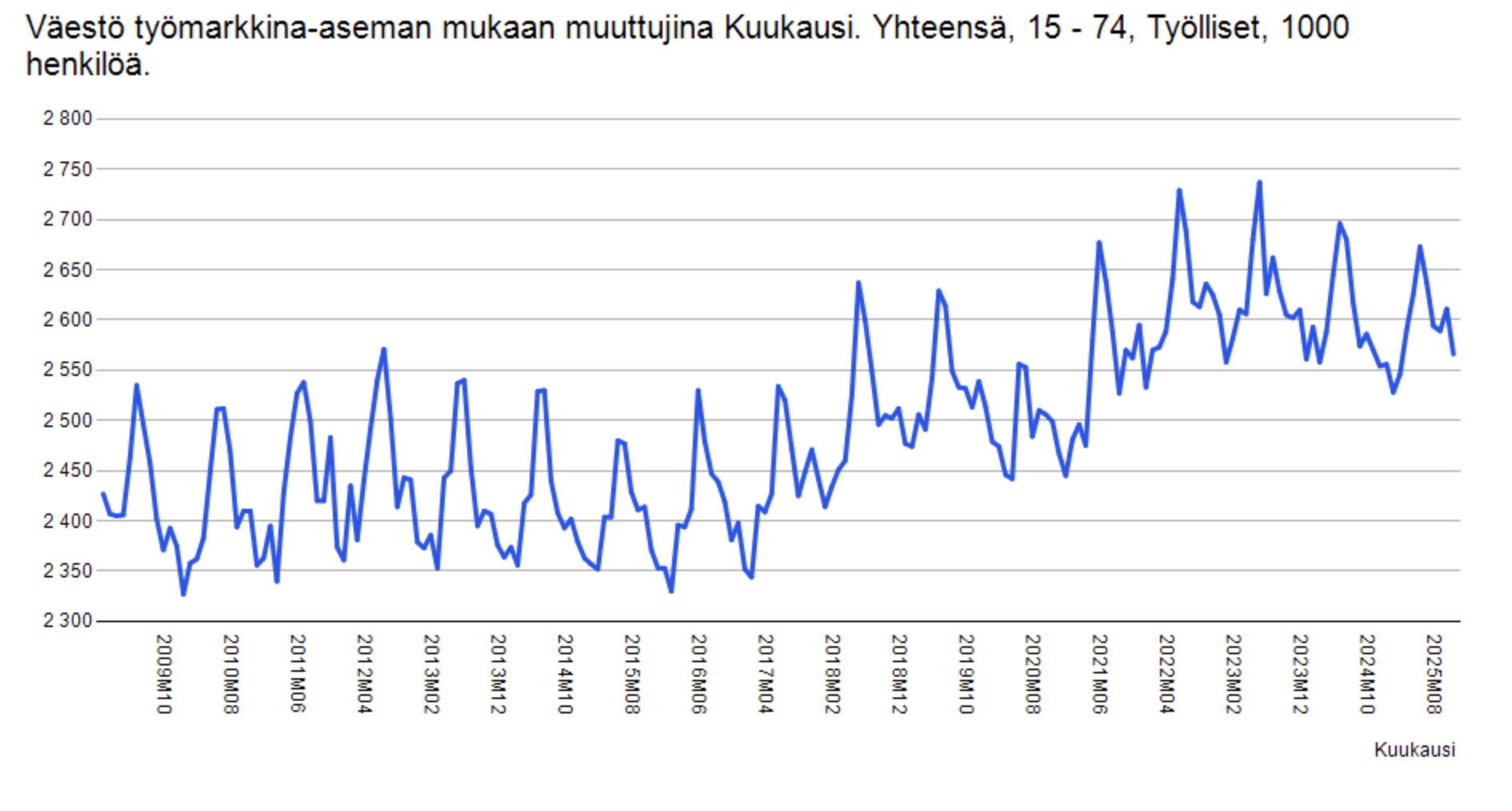
Small consolation is that the number of employed people is still relatively high. This statistic fluctuates wildly, but there are about 2.6 million employed people aged 15–74, whereas the figure hovered between 2.3 and 2.5 million in the early 2010s.

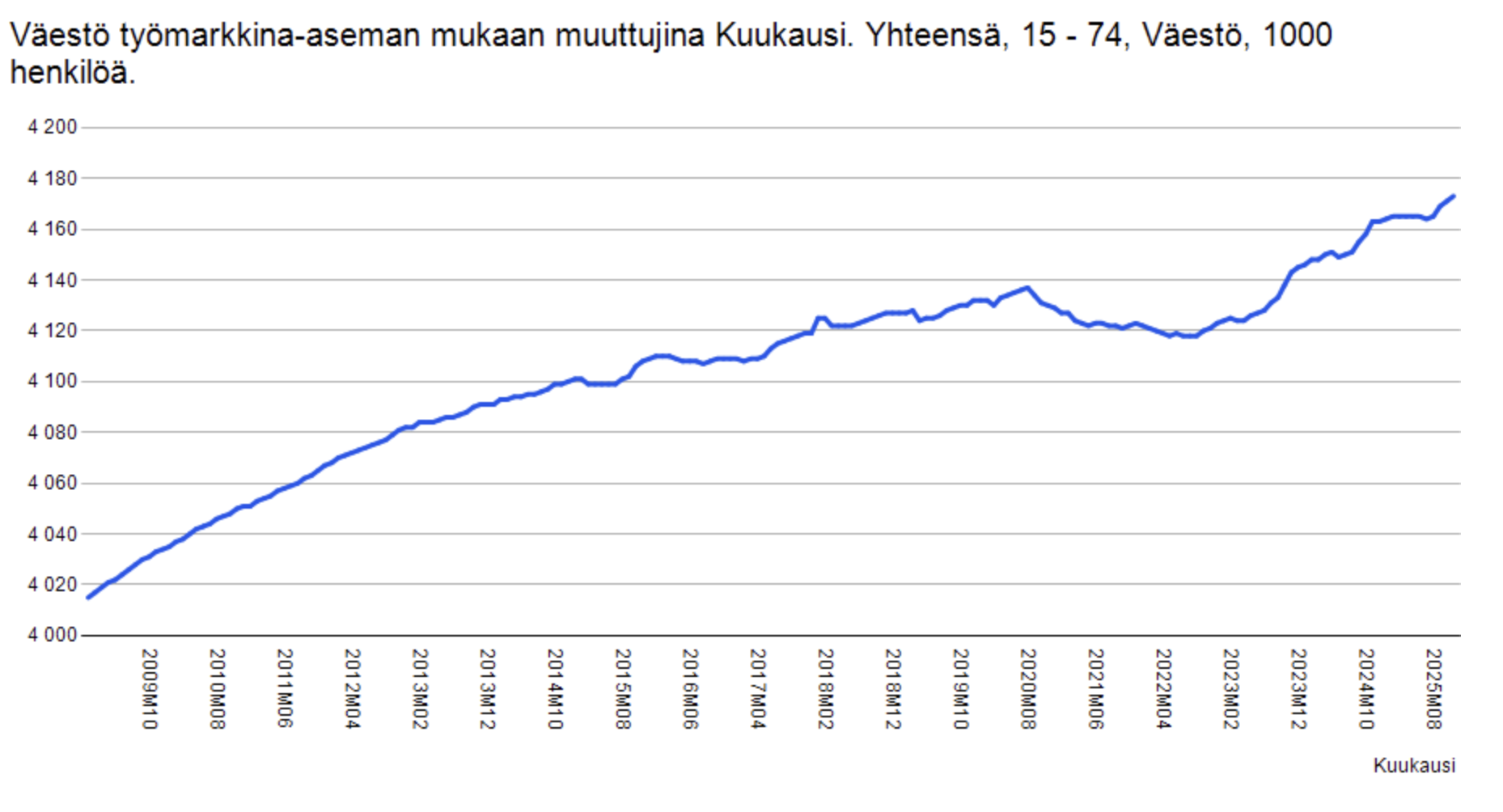
The rising unemployment rate may therefore be explained by a growing number of people looking for work and thus becoming unemployed job seekers. The 15–74 population has also grown in recent years, which suggests that the primary problem is not a decrease in jobs, but rather that enough new ones have not been created.

The population expansion in recent years is partly explained by the arrival of Ukrainians in the country. Without them, the working-age population shrank throughout the 2010s, if we limit the scope to 15–64-year-olds. But even this more inclusive curve looking at the 15–74 age group turned downward after 2020, only to rise again after the war in Ukraine began.

23 Likes

In your opinion, would one Revenio for four Optomeds be an acceptable exchange ratio, or what could it be?

In my view, such a theoretical arrangement would be most natural to implement as a share swap, although Revenio might have the firepower for a cash deal as well, depending on the price.

2 Likes

Finnkino has really managed to totally botch its service with the new website. A couple of examples:

  • Canceling reservations. I often reserve movie tickets for a weekend screening several days in advance to ensure good seats. Often, however, I end up not going, in which case I have politely canceled the reservation and freed up the seats. This way, they go back on sale immediately. On Finnkino’s new website, reservations cannot be canceled at all, meaning they are only released back for sale 25 minutes before the screening starts. I don’t know how common my habit is, but probably the best tickets for Finnkino screenings are now obtained by booking them 20 minutes before the show.
  • Buying tickets. If you reserve tickets on Finnkino’s website, you can no longer buy them later through the same channel. Previously, purchasing reservations was possible afterwards using money, cultural benefits, or serial tickets via the website. It has been like this for at least twenty years. Finnkino’s ingenious method now is to make the customer queue for tickets at the cinema before the screening starts to get them redeemed. This means they are also increasing their own costs as queues grow and they need more staff at the counters to handle reservation pickups. And the tickets must be redeemed more than 25 minutes before the screening starts, otherwise they go back on sale. So you have to arrive at the cinema more than 30 minutes before the show starts if you have reserved tickets. It makes no sense.

The new pages were launched several months ago already and such absurdities can still be found there. I just don’t understand.

21 Likes

I didn’t think about the historical context of the term in detail. I used it because I don’t manage my forests or cultivate my fields myself. Nowadays, I am involved in these only from an investor’s perspective—that is, as an agrarian capitalist :-). And the majority of my portfolio is still in them, even though the share decreases year by year. For tax reasons, I did actually operate as a part-time farmer for a while, but that was a long time ago. And like most others in Finland, the forests and fields were received as gifts or inheritance from previous generations.

The agricultural sector indeed survives on subsidies in Finland and almost every EU country. Even so, it’s not a gold mine; the return for both the landlord and the farmer is poor. I doubt many farmers even calculate the return on invested capital. And that’s a good thing, because for reasons of security of supply, it is desirable that some people still farm in Finland.

The price level of fields in Finland is too high compared to the return from self-cultivation or the rental income one gets from leasing it. That’s why I am personally divesting from my agricultural lands in the coming years, intending to sell them to an active farmer.

In forestry, even primary production operates more on market terms, although there are subsidies there too. But the subsidies aren’t as significant as in agriculture, which would mostly end immediately in Finland if there were no subsidies. I see the future of forest ownership as good in Finland, despite the pressure for conservation. So far, conservation has provided a decent compensation, and every protected hectare reduces the supply of raw timber, thus increasing the price of wood.

10 Likes

I won’t take a stand on the share exchange ratio, but Revenio is looking for acquisitions and this would indeed fit their portfolio. Perhaps they have negotiated before, but the price was too high in Revenio’s opinion back then? They don’t seem to be finding an OCT to buy, so for retinopathy screening, this Opto could be a good addition.

5 Likes

Huh…

Springvest has been rising for a couple of days; naturally, I was kicking myself, thinking I’d gone and sold them in December.

Or did I?

I thought I’d put those shares up for sale—maybe at an unnecessarily high price so they didn’t sell, or maybe I was just thinking hard at the time about using that money for something else but for some reason didn’t actually sell.

Well, they’re still there in the portfolio and the start of the year has been a climb; while they were at 7.xx in December, they’re now approaching ten.

The sun shines even on a pile of brushwood sometimes :innocent:

Apparently, having a forgetful mind pays off sometimes.

6 Likes

If most people acted with movie reservations in a way that they then canceled most of them before the screenings if they just didn’t feel like going, it would be terrible for business. (Personally, I have Kant’s categorical imperative as one of my life guidelines: Kant formulated the categorical imperative in several ways: e.g., Act only according to that maxim whereby you can, at the same time, will that it should become a universal law.)

Other problems caused by those making reservations included, for example, restaurants where people made bookings that they then didn’t cancel, even though the restaurant has to arrange a certain amount of staff based on the bookings. Fortunately, this was solved with a booking fee (effectively a deposit), which is returned upon arrival at the reserved restaurant.

Free or nearly free municipal daycare created a problem where many municipalities incurred six-figure annual costs simply because guardians did not report their children’s known absences to the daycare facility in time. The municipality also has to schedule a certain amount of staff for work based on the expected number of children.

On a general level, I should state that I would be in favor of dynamic pricing in many matters. Briefly, the idea is that the earlier one commits and pays for, for example, a train ticket, a concert, you name it, the more affordably one would get it, and the price would increase as the date approaches. In my view, this would be a win-win for both the consumer and the company. (Of course, there would always be exceptional situations and sectors where this could not be applied.)

Have a good rest of your Thursday, everyone! :slight_smile:

36 Likes

We must be able to form a clear set of criteria on which to base stock purchases. After all, airplanes don’t take off before they have systematically gone through a pre-flight checklist. But jokes aside, it’s probably true that rigid criteria alone aren’t enough, as there must be an exception within the criteria to find anything to buy at all.

How much trading volume did the example’s Sotkamo have back then? If you dig through Nordnet now, there aren’t many options that have a small market cap and trading volume at the same time. Or well, I suppose nobody asked about volume; we’re not shorting right now, but waiting for the stock’s price increase to activate at some point. So, volume doesn’t matter at the time of purchase, nor does the lack of it.

There was enough volume that I was able to fill my pockets with shares without driving up the price.

And when I start selling, I’ll be able to do so without much impact.

By profession, I am fluent in reading income statements and balance sheets. My family heritage includes Lapland shamans and who knows what kind of rainmakers. With these tools, I’ve shuffled my way through my stock market career.

The words I heard as a child still haunt the back of my mind:

“How on earth can you make money just by passing paper from one hand to another?”

18 Likes

I heard the same thing myself as a child, when a relative living in Sweden talked to their Finnish country cousins about stock market investing in the early 1990s. “Supposedly, not everyone could do that, or society would collapse”

That’s why I started looking into the matter myself once I reached adulthood.

17 Likes

Could you elaborate a bit, I don’t quite understand your comment in this context? Do you think Finnkino’s new setup is better now, when reservations cannot be cancelled at all and ticket redemptions must be done at the counter? I understand that in a restaurant, a deposit is charged for a reservation or a fee might be charged for unused reservations, but such reservations can also be cancelled well in advance to avoid this.

However, there is no penalty from Finnkino for an unused reservation, meaning those tickets just hang there as reserved until they are released for sale 25 minutes before the screening. They are just shooting themselves in the foot, as many people might check, for example, 2 hours before the screening and see that no good seats are available and decide not to go to the movies. And shortly before the screening, several good seats are then released for sale at once, but there are likely few takers anymore. And to top it all off, there are queues at the counter before screenings, as customers are physically forced to wait in line if they want to redeem those reserved tickets.

4 Likes

1.. 2.. 3.. … 9… 10… hhhhhh…

The reform is very good. One can commit and plan ahead enough to just go and buy that seat… or then just graciously let that other person, who is on time and actually going to the movie, buy that excellent seat.

By abusing one’s rights, all we get is more collective punishment, like 3,872,562,873 speed bumps on the way to work even if you’ve never had a speeding ticket in your life, and so on.

A little less me-me-me and a little more we-we-we, and we’ll save Ukraines, Greenlands, and some sort of world peace too.

Peace out!

17 Likes