,

23 Likes
OP Gold appears to be available for Owner Plus members at the price of Classic, €3.95/month.
Are you still getting by with summer tires?
Even as far as Germany, it is below freezing.. Right now in Germany, there is a warning for slippery road surfaces. You absolutely must have friction/grip under you on Central European roads now.
1 Like
To clarify. A loan of less than 400k. I was already afraid that this too would be downgraded, just like Nordnet’s PB (Private Banking) was downgraded.
2 Likes
So it seems, and for me as well through the Omistaja Plus (Owner Plus) membership. I figured it must be the same for residents of the same city  .
.
1 Like
I once started a 10,000 push-up yearly challenge. I messed up my shoulder within a few months, and it bothered me for the rest of the year even though I stopped the challenge then and there. In itself, the challenge isn’t impossible, as it averages out to less than 30 push-ups a day. My problem was at least that I got way ahead of schedule. I was doing at least 50 reps/day. Additionally, I should have included other exercises alongside it. It was too one-sided even though I did other exercise on the side. However, that was the only daily strength exercise at the time.
3 Likes
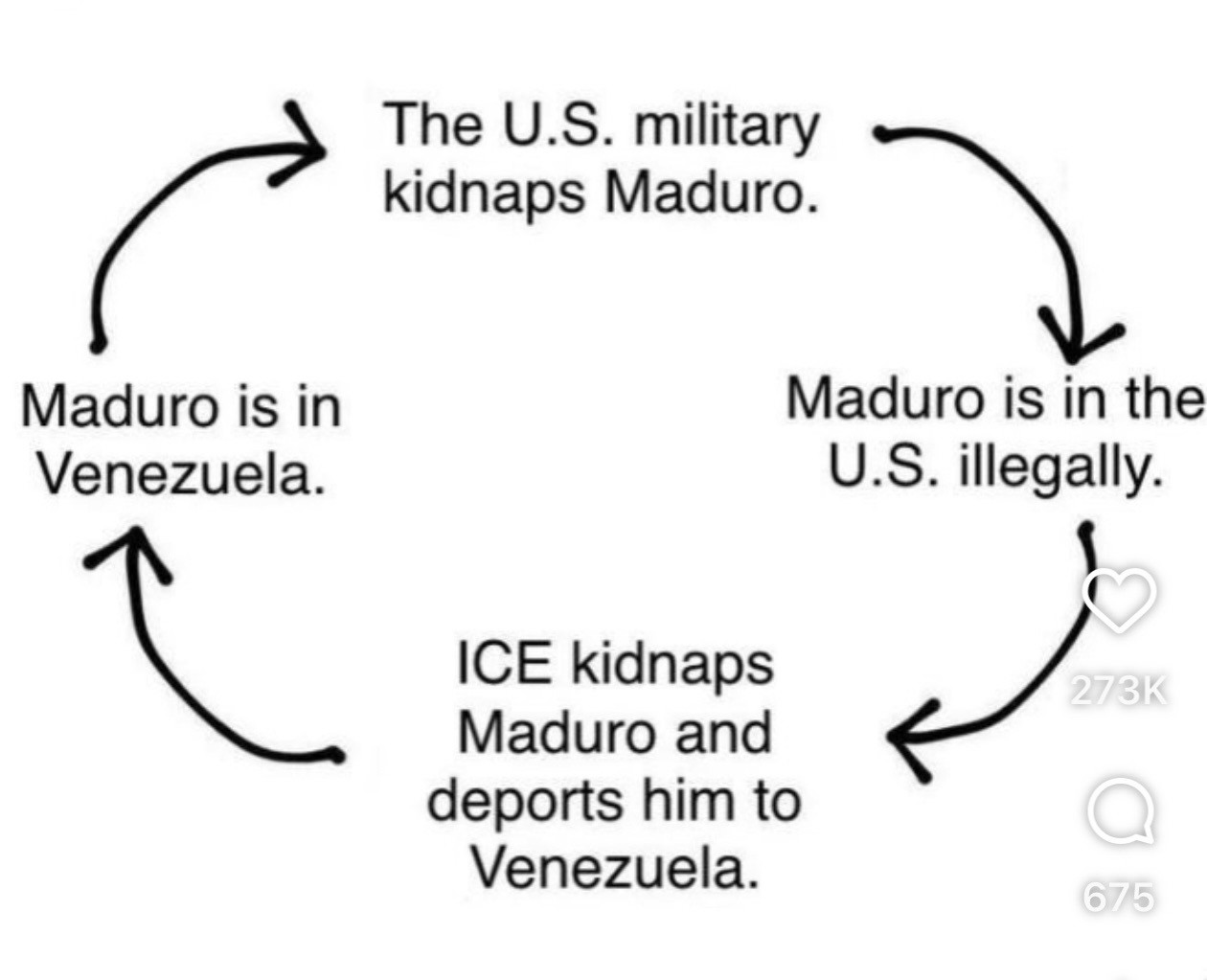
I have heard from a reliable source that, in addition to his other strokes of genius, Trump has created a perpetual motion machine. 
48 Likes
I recently waded through Antti Salminen and Tere Vadén’s philosophical work Elo ja Anergia (Life and Anergy). The work contains reflections on how fossil capitalism has also profoundly changed the human internal experience. I feel that the greatest contribution of the work was not so much in its factual content, but in how it managed to get stagnant thoughts moving from their rutted paths. Philosophy has the ability to reduce mental constipation, whereas accumulating information is prone to increasing it.
The reason that motivated me to open my word processor today was a thought I had when I woke up this morning: storage economy (varastotalous). This felt like an apt concept to describe our economic system. A contrast to this could be the flow economy (virtaustalous), which reflects the mobile subsistence economy of hunter-gatherers. Agriculture, on the other hand, is an intermediate form between these two economies. These concepts are based on Salminen and Vadén’s writing, but are not terms they used directly.
In a storage economy, activity revolves around the storage of resources. Using Salminen and Vadén’s metaphor, one can imagine, for example, a mobile species of rodent living on the surface that suddenly finds immeasurable amounts of fermented plant parts in underground cavities. This discovery changes the direction of the species’ evolution. In the human case, the foundation of the storage economy is fossil fuels, which produce over 80% of the world’s energy. In reality, the dependence on fossil fuels is even greater than this, as the construction and maintenance of renewable energy also consumes fossil fuels.
The storage economy has its place in nature; after all, squirrels gather more extensive winter stores than they will ultimately need. In modern society, however, storage thinking is extreme and pervasive. Some examples:
-
Consumerism: fill your storage with stuff
-
KonMari philosophy: clean your storage
-
The popular “Who Wants to Be a Millionaire” show: win a storage
-
Productivism: grow the community’s stores and thus be a good person
-
FIREing: store now and use your stores later
-
The stock market: buy and sell “stocks” (varasto). The origin of the word stock lies in the word for a store or supply.
On this forum, we occasionally contemplate whether a “storage” worth a million or perhaps one and a half would be enough to secure life for the coming decades. In contrast, for hunter-gatherers living in a subsistence economy, such thinking has been entirely alien. There may even have been a conscious refusal to accumulate stores, and among the indigenous peoples of America, for instance, potlatch ceremonies are known, where people compete by destroying valuable property. Such behavior likely includes an understanding, transmitted through tradition and intuition, of what the excessive accumulation of stores does to the psyche, the community, and nature.
I too, of course, have a lifelong connection to the storage economy, while my connection to the flow economy is considerably thinner. I feel I get a grasp of this more primitive valuation of things after spending days in a tent outdoors, and to some extent even after a few hours of hiking. Today, however, writing got the better of me this morning compared to heading out into the fresh air. I have felt this in my own skin, but it is not yet too late.
Happy Sunday to my fellow stowers!
35 Likes

94 Likes
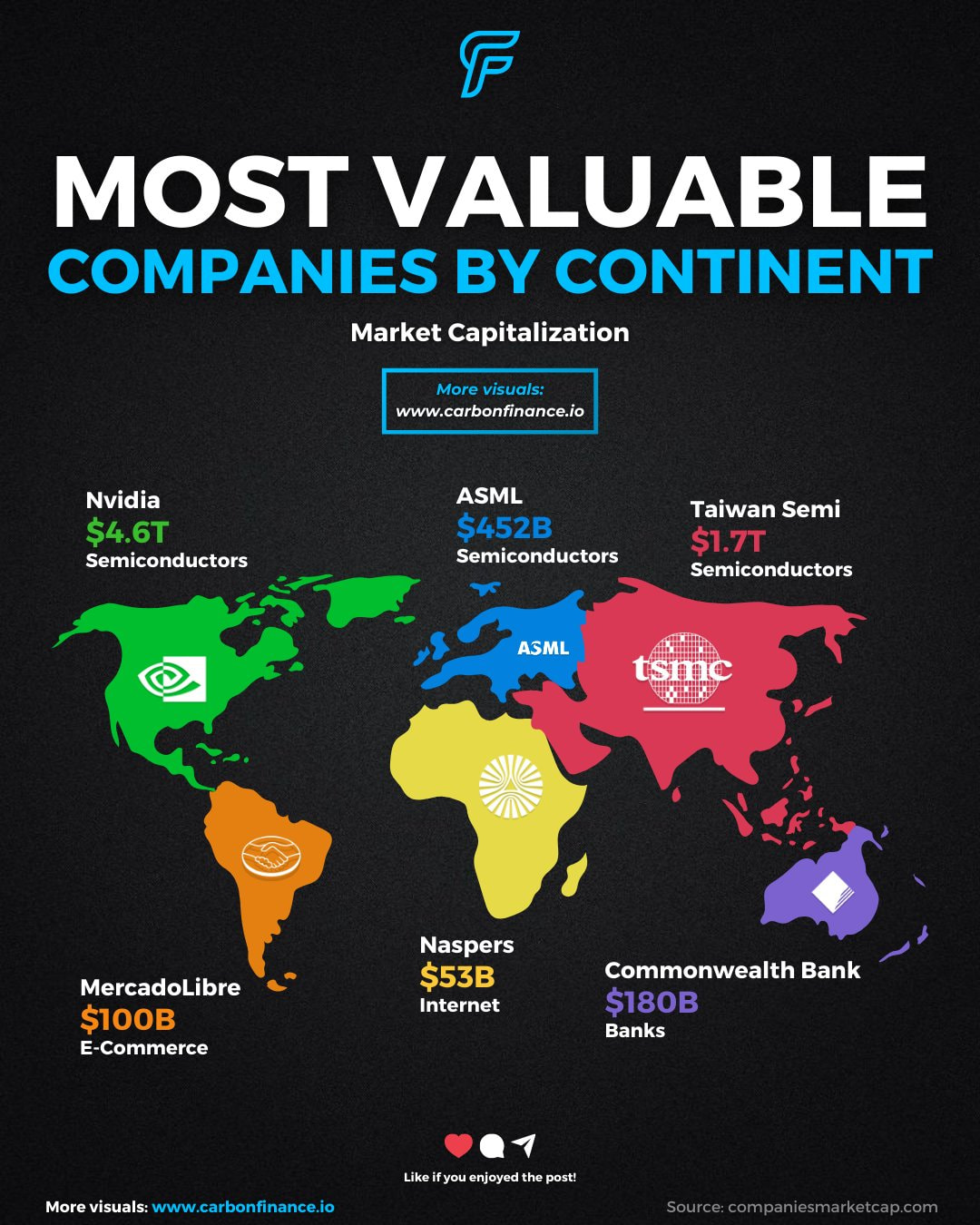
Here are the biggest firms across different geographical regions 
https://x.com/carbonfinancex/status/2007880513693073773

9 Likes
What do you think about that systematic trading? I mean this: https://www.youtube.com/watch?v=kh90TV7wAGM Sampsa Tikkala’s/Jeppez’s shorting style where you make a million a year with an initial capital of 12k? I want to do that too.  How could I get started with this? There’s no need to code a bot or algorithms right away, but I’m seriously interested in knowing how this is done in practice. With which broker…?
2 Likes
Maybe it’s time to take a little break from following investment matters.
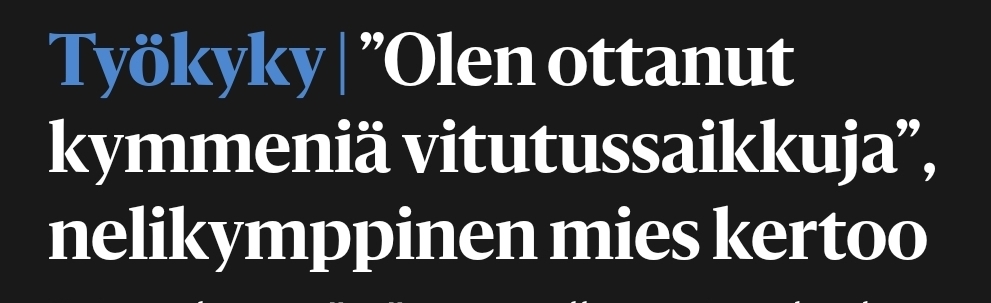
I read this headline three times as “pissed-off portfolio” instead of “sick leave”. For a moment, I identified with this imaginary small-cap investor.
88 Likes
Here is Hannu Angervuo’s article on how the different sectors in Helsinki fared on the stock exchange last year.
The Helsinki Stock Exchange is known as a cyclical exchange. This is due to the heavy weight of large industrial companies in the indices. The weight of service, trade, and transport companies listed on the Helsinki Stock Exchange remains lower than in many other countries.
2 Likes
I haven’t particularly studied Sampsa Tikkala’s style, but as I understand it, Tikkala started by trading quite manually and only last year (?) shifted toward a more systematic approach. When trading in the US, the broker used is typically Interactive Brokers.
Shorting small caps is then very risky business. Tikkala lost his first 10k of initial capital before finding better success on his second attempt. Tikkala has generally had a high risk tolerance, and there have been large dips in his return curve despite his clear skill. If you attempt the same with little experience, you should expect to pay a high price for the lesson. And when shorting, you can lose more than everything.
There are probably better places to try trading than shorting US small caps.
17 Likes
Thanks for the always interesting review!
If I may challenge you, why does the gentleman have so many micropositions? Has Verneri started fearing the market and created some sort of closet index for himself so that big hits don’t hurt as much? I ran out of fingers, but 13 holdings under 5%? Is the man out hunting with a shotgun these days?  Admittedly, that Berner weighting is quite manly!!
Of course, you surely have enough capital that even those mini-positions are real money, but it feels very small and insignificant.

(Welcome back from Christmas break, Verphu!  )
)
Ps. During the holidays, I’ve had time to watch series again and I can only admire your performance in Sons of Anarchy! 

30 Likes
Of course you can, that’s why I write these publicly. I’ll take a larger position once I have enough confidence in it and the potential for losses is truly limited.
A sort of dream portfolio would probably consist of 2-3 really large positions in excellent companies at a cheap price, and then a pile of 10-20 interesting small slices that could be grown larger as the company develops in the right direction and the price is right.
Additionally, Inderes’ trading rules for Finnish companies are somewhat restrictive. It would be tragicomical if a significant part of the portfolio was locked up, while I find some new Amazon where I should throw in more chips.
Thanks! <3
Addition. If you have low confidence and a large position, you might end up like this man, who is a few years older than me:
23 Likes
Hi there. @Sijoittaja-alokas, I’d like to tentatively ask whether there are plans to bring back that one-hour rule to the USA thread; in my opinion, things have already gone the way they always do.

E:
yay thanks

34 Likes
That podcast definitely sent my bullshit detector into overdrive. This was already discussed in some thread earlier, but a quant coder working for a small performance fee, fetching data from a provider’s API and maintaining a trading algorithm, sounds so absurd that it’s very hard to take seriously.
10 Likes
If I found the right person, at least the capital income matches the amount mentioned in the podcast.
12 Likes
Wasn’t he supposed to make over a million in returns? Half a million in deductions sounds like a lot, if the gap between taxable income and returns is explained by deductions, but then again I don’t trade with such sums myself, so I’m not very familiar with the taxation. A trader is unlikely to have many unrealized gains. Well anyway, tax records don’t yet reveal whether he made his income by trading or where he got his capital gains from. I have nothing against Sampsa, nor any evidence that he’s a bullshitter, but indeed that podcast visit didn’t convince me. Quite the contrary.