It probably depends on the industry and what kind of work is being done. For us, tacit knowledge is transferred between employees via Teams screen sharing, even when we are in the office. In practice, in-person work is visible during coffee breaks, when we can catch up face-to-face. Even the company’s management is in favor of remote work, not just the employees.
11 Likes
It’s probably not worth generalizing in the direction that the employer would know better either, if there’s no metric for profitability development on the remote work vs. office work axis. On average, it’s probably the same whether one reads the Inderes discussion forum during work hours at the office or at home.
My own experience is that certain meetings and encounters are more productive and inevitably involve more face-to-face interaction. In my expert work, the basic grind doesn’t change at all with remote work, except that at the office, I might chat about this and that, for example, about the day’s hot sports topics with a colleague on the other side of the cubicle. When at the office, perhaps 1/10 of the encounters where I need to guide or share information with my colleagues happen face-to-face. Most of those encounters happen on Teams, even if we are physically present in the same building.
Probably those who consider remote work an extra day off don’t use their work time very efficiently even in office work; instead, their time at the office is spent on personal matters and chatting with colleagues. Of course, for some, the social contact with other people provided by office work can be important for well-being if their social life outside of work is not otherwise active enough.
12 Likes
Perhaps “knows better” is the wrong description, but the employer has the right to direct work, and final decisions then come through this.
Remote work is not a problem for experienced workers, but it is certainly a real problem for young people and recent graduates. Surely some still employ them, and it is in the employers’ interest to make things work one way or another. Of course, people here view the matter only through their own self-interest, but that should be allowed for them.
7 Likes
This seems like zero-sum thinking. However, remote work has many clear benefits for the employer, such as cost savings, a wider recruitment area, better employee satisfaction, easier scalability, and often fewer sick leaves. Of course, face-to-face work has its own strengths, and especially for new employees or those at the beginning of their careers, challenges may arise if they cannot physically join the work environment. Completely agree with this.
Nevertheless, I find it problematic to automatically view remote work as negative for the employer. In many sectors, remote work is practically the only effective way to expand into international markets and get a foot in the door in new regions.
17 Likes
Theory: Investors coldly and rationally calculate the present value of future cash flows
Practice: Investors haphazardly chase headlines 
5 Likes
 Raharadio’s latest episode is now available!
”HYY, known as one of the world’s richest student unions, was forced to sell its real estate assets, but what went wrong? Can consumer demand recover before housing prices start to rise, and are two share classes in listed companies a good or bad thing?”
Topics:
00:00 Start
00:33 Student Union’s real estate deals
12:29 Wealth effect as a bottleneck for private consumption
27:14 Share classes of listed companies
14 Likes
Perhaps Finland could offer breaks for baby-making efforts? Politicians have been talking about this for years. Antti Rinne at least. Has this practice already been implemented in the Parliament? Apparently, there are very few breaks there, as everyone is incredibly busy, at least if you believe the media. I do understand that Members of Parliament must be role models for citizens, so for once, they have performed their duties exemplarily. 
This model could suit all companies, especially Framery, as they even have a suitable product for breaks. At the same time, the company could position itself as a promoter of a socially important cause. I only see benefits here, and during this pre-Christmas party season, there might be a real need for these in offices across the country. It would also make it easier to get remote workers to the office, as those grumpy ones are otherwise hard to get there. Feel free to share the idea within your own circles. 
4 Likes
This remote work discussion has already been had so many times on this forum that for a moment I considered whether to address it, but this is such a brazen and false generalization that I have to address it.
For 5 years, I have been part of a global team where I have 2 European colleagues, 1 on the other side of Finland and 1 Swiss. The rest are from Australia, India, and the United States. When physical knowledge transfer is not possible, that knowledge must be transferred remotely. Tacit knowledge (too) transfers excellently in independent knowledge work via Teams and remote connections, provided that:
- The transfer of knowledge and training is managed correctly.
- Employees have the right attitude towards knowledge transfer and teaching others.
Problems arise if there are issues in management, or if employees try to protect their own position by withholding information and expertise from others. I, for my part, have adopted the attitude that I admit if I don’t know something, ask a colleague to train me when it suits them, actively take notes during the training specifically on this tacit knowledge, and otherwise try to absorb as much expertise from others as possible. This way, I can effectively learn new things and do them independently, without constantly having to bother others with the same questions. On the other hand, I also actively share that expertise with others. This way, I can perform almost any relevant work tasks, but I strive to ensure that I am not the only one who knows how to do it, meaning I don’t become a bottleneck for tasks because no one else knows how to do them. I have found this to be very efficient and beneficial for both myself and the company. There has been no problem with transferring tacit knowledge.
And before someone gets to say it, it is true that remote work does not suit all jobs. For independent expert work, it is excellently suited. In my experience, those who most resist remote work are individuals who lack any real substantive expertise (hand-wavers), and whose work contribution consists of externalizing their own incompetence as a problem for others, and who do not want to learn to do anything themselves or take responsibility. It is difficult when nothing gets done because one cannot physically transfer one’s own incompetence as a problem for others, as there is no obligation to answer Teams calls, but physically in the office, these people cannot be escaped. I am happy to train and share expertise, but if it is not accepted and no effort is made to learn to do anything, but the same things are constantly asked again and again, then that incompetence is their problem, not mine, and I will not let others make it my problem.
These same hand-wavers also do not seem to understand that individuals with substantive expertise, as well as busy and concentration-demanding jobs, do not always have the time and resources to answer random Teams calls without any warning. Answering such a random call breaks concentration quite effectively, and getting it back takes its own time, which reduces work efficiency to such an extent that nowadays I turn off Teams if I really want to concentrate on an urgent work task, which is practically daily. This way, others cannot escalate their own problems or incompetence to the top of my work tasks, but I help when it suits me. Conversely, if I need help, I ask for it, but always when it suits the assisting party. One would think this hospitality would be common and in line with good manners, but unfortunately, based on my own experiences, it is not.
And this has not been a problem even though I keep Teams constantly closed and focus on my own work, because as should be the case in every well-managed organization, we have systems in place to monitor the amount of work done and work input. Mostly, I have received praise from my supervisor for efficiency. If such systems for monitoring work input do not exist, it is easy to abuse them, but it is everyone’s own choice to misuse the benefits they receive. And just as easily one can slack off at the office (or whatever the physical workplace is), as in remote work.
Let’s take a simple example. I have a 2-hour, urgent and concentration-demanding work task. I have 2 different scenarios for this:
- I work remotely and close email and Teams, and focus on completing that work task in two hours. After that, I open Teams and email and can fully concentrate on other matters.
- I work in the office, and during those two hours, I am physically disturbed four times in the form of various questions or issues. Each disturbance takes away my concentration from my work task, and it takes 10 minutes to get it back. So, completing the same work task took 2h40min + time spent on interruptions. That is, completing the same work task took ~30% more time.
Which of these scenarios is a more efficient solution for the company? It is true that an employee does not always know what is a better solution for the company, but the company does not always seem to know what is a better solution for work efficiency either.
33 Likes
Innovativeness is difficult to measure and prove, but it is certainly significantly less in remote work. In the company where I worked, the teamwork and mutual interaction of the product development staff were what produced all new innovations and solutions. A new, industry-changing invention can determine the success and future of an entire SME (small and medium-sized enterprise), which might not be discovered in remote work. Similarly, the transfer of knowledge and expertise between, for example, a junior product developer and a senior, probably doesn’t work very well remotely. There are also many other, but harder to identify and measure, aspects, such as peer support and problem-solving. Someone working alone can easily spend days looking for a solution to a difficult problem, but if there’s another person nearby, they can interact and find a solution together in a few minutes.
Innovation activity is just so difficult to measure, and the differences in results are enormous; efficiency can be 50 times greater in a well-functioning work community versus a poorly functioning one. The same applies to software development.
5 Likes
During night shift week, the rhythm is a bit different from “normal” people… I apologize for the extra heart palpitations I caused  . My mother taught me that it’s better to always be on time than even a little late, and even now, as a middle-aged, overweight man-presumed, I try to follow this
4 Likes
Exactly. For example, surely some invest in all four of these companies just because of the way Markku from Poland framed the question. Which of these four is 10X? If one is 10X, then it doesn’t matter if three out of four went to zero. It’s just a shame that the outcome could be that everything goes to zero, but the so-called “headline investor” can’t think of that.

Upside spoiler alert:
NBIS 10-20X, CRWV 4-8X, CIFR 2-4X, IREN 1.5-3X.
What could possibly go wrong when there’s so much upside?
7 Likes
In 1989 or 1990, just before the big recession, either the Ministry of Social Affairs and Health (STM) or some official predecessor of the current THL raised the discussion of whether Finland should, when necessary, switch to a two-hour lunch break, so that adults would have the opportunity for one-on-one quality time when the children are at school. And after a demanding workday, there’s hardly any energy left for quality time anyway.
Does anyone else remember this funny harbinger of the recession? Juurikki asks about the same thing every 5-10 years, but no one else remembers. Will I soon have to actually waste time investigating the matter myself, even though I have a researcher’s education, even if you wouldn’t believe it.
5 Likes
If only the message could reach Timo Soini this way…
Timo Soini very strongly recommended Lasse Lehtonen for his current position in his blog. How did that recommendation go, Timppa, in your own opinion?
And in answer to your question, retrospectively, one cannot be thankful for this recommendation.
” Greetings to the National Coalition Party’s ivory tower
The National Coalition Party suffers from the disease of omnipotence.
Here are greetings to the party’s ivory tower.
The ‘party of competence’ has a capable applicant for the leadership of Kela.
Lasse Lehtonen, Doctor of Medicine and Law. HUS Director of Diagnostics and Professor of Health Law.
He is competent, despite being a member of the National Coalition Party.
Nominate him. The Finns Party must support him, because a competent and qualified candidate cannot be left unchosen just because they happen to belong to the National Coalition Party.
You don’t need to thank me for this solution. The homeland is common. “
5 Likes
This message, too, doesn’t bring the desired added value to a large portion of readers, so I’m replying here:
In my view, that is a very theoretical risk based on the definition of the conversion price according to the loan terms:
As the Company has exercised its Share Settlement Option, the subscription price for the Shares subscribed for by the bondholder is EUR 1.8656 per Share, corresponding to 90 per cent of the lowest of (i) the volume weighted average price (“VWAP”) of a Share on the relevant payment date, and (ii) the lowest of the VWAPs of a Share on each of the five consecutive dealing days ending on (and including) the dealing day immediately preceding the relevant payment date.
In my opinion, the biggest risk is that some acquisition or similar occurs while the short is open and Faron then pays the amortization in cash. HCM is not entirely naked even then, because it can always, if it wishes, convert the entire remaining principal or a part of it at the maximum price.
One way to measure the economy’s innovation capability is the number of patents:
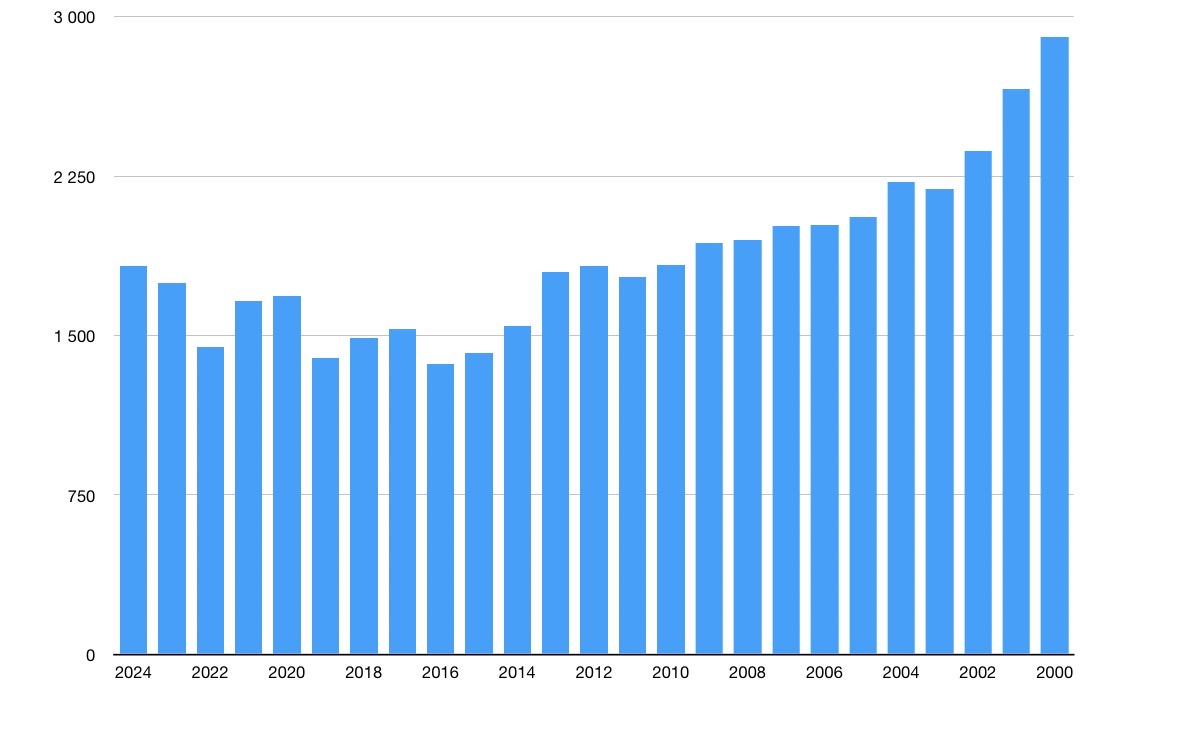
In patent applications submitted to the Finnish Patent and Registration Office (PRH), there is nothing to suggest that Finland’s innovation capability has recently weakened. Nokia appears as a driver of patents in the 2000s. I myself am of the opinion that innovation activity is probably most effective face-to-face, but ultimately, innovation happens in few jobs. For example, at the Social Insurance Institution of Finland (Kela), no one has innovated nor will they innovate; instead, they process applications for benefits. But I somewhat doubt if it’s 50 times more effective, at least not when measured by patents.
5 Likes
Remotely, they can’t even get the graph steps right. Well, someone probably did these efficiently at home.
8 Likes
Here’s a new model portfolio review. 
Juha, Atte and Rauli go through the model portfolio’s movements.
Recorded 3.12.2025.

Topics:
00:00 Introduction
00:31 Tietoevry
04:59 Vaisala
10:10 DT
15:40 InCap
18:20 General thoughts
9 Likes
Suvi Minkkinen!

20 Likes
Iceye  has raised €150M in new funding at a €2.4 billion valuation:
27 Likes
London has an incredibly good and ingenious system!
Restaurants are required to offer tap water free of charge. What’s the logic? It’s that restaurants very commonly shift part of the food price to the prices of drinks. When comparing prices, people only look at the price of the food and make their restaurant choice based on that. Drink prices are often not even visible or they are hidden somewhere. However, when eating, it’s practically mandatory to order something to drink, and that can be up to ⅓ of the meal’s price. By offering free water, drink prices cannot be raised too high, and price competition must genuinely be based on the price of the food.
16 Likes