Same experiences from working life, I won’t dispute these. HR is only interested in the threat of legal action and financial consequences; anything else is just empty words.
3 Likes
@Aloittelija5 answered well that it doesn’t concern expert work.
In manufacturing, safety is usually not even the greatly slowing factor for throughput, even though this is often offered as the first reason. Paint takes its time to dry, assembly of parts takes its time. If you cut corners in these, it will show in quality. You can try to cut corners in scaffolding work/protections, and unfortunately some do, and there are companies where this still has even the silent approval of management. This represents completely immoral behavior at every level for anyone who does this and agrees to it; at the latest when something happens, the company will be on the “no thanks” list. Smarter companies plan the implementation from the start so that there are no interruptions and material flows are under control from the start without completely unnecessary risks.
It applies. There is no ambiguity about this. The supervisor might not know that it applies, but the law is clear.
4 Likes
Heads up, danger approaches.
For the next 5 months, we will have to adapt to a schedule that is an hour different. That is, if one hasn’t already exposed themselves to this ‘danger’ through work trips or holidays, etc.
Hopefully, the brighter evenings during the 7 months of daylight saving time will bring some health benefits.
6 Likes
I am aware of this, and yes, the law applies to all sectors and employers. However, in one company, employees had to take reported data to the union for the matter to be addressed under the law. This is also what I’m trying to say: in few expert fields do employers themselves care about their employees’ well-being. It is usually the employees themselves who raise a fuss, if they do. Generally, they don’t, because everyone has a mortgage and other small everyday problems. You really have to unite within the company if you intend to put the HR team in a tight spot. In my opinion, HR is completely useless in these matters, because the HR director is usually on the management team and also earns 100-300k a year. They won’t start a dispute against the CEO, unless it goes so far that some external force compels them to.
3 Likes
In my work, I deal daily with people suffering from overweight, physical inactivity, and weight management problems. The first thing we try to correct with everyone is a regular meal rhythm. 4-6 meals. Approximately 95% of an effective framework is breakfast, lunch, dinner, evening snack ± snacks according to daily schedules. In a 12-month follow-up, this measure alone usually leads to a significant reduction in snacking and emotional eating, an increase in alertness, and weight loss. If regular exercise is added to the equation on a weekly basis, the results are even better.
A regular meal rhythm, so to speak, “grounds” confused food signaling and gives a sense of control to a person who has felt lost their whole life. In these situations, an extra snack is a minor evil.
There is a huge number of people among us who do not feel full at all, or who, on the other hand, do not feel hungry. Often, the background includes erroneous habits learned since childhood, mental health challenges, busy years, multimorbidity, etc., which are not outwardly visible. No one wants to be tired, overweight, and mentally broken just for fun. This is a lifestyle DISEASE, and moralizing rarely helps in its treatment.
14 Likes
In expert roles, in addition to expertise in the field, interaction skills are the most important. This does not take a stand on whether you are an introvert, extrovert, or just an average Joe.
You need to be able to articulate and communicate your points with justification. Then, permanent situations where expectations are completely unrealistic will not arise. Exceptional situations will constantly occur and will not decrease in the future, but if you can tell the right people – it could be your supervisor, it could be someone else who understands the matter – that you can do seven out of these ten things, and which three you will leave undone, then you avoid the biggest overruns regarding your well-being. It’s just work, after all.
Expertise is, of course, also about being able to make most of these prioritization decisions yourself, and if there’s grumbling, the justifications are correct and understandable. The boss doesn’t want or have the energy to constantly make decisions; you are the expert.
Perhaps I oversimplified things here, but these are my own experiences and views. Tasks and situations are, of course, different.
4 Likes
In theory, yes. But on a practical level, this creates an endless loop where the next person is always blamed, and solving the problem would require genuine dialogue between the parties so that the employer gets an efficient employee and the employee commits to their work.
A few examples:
Workload was not communicated –> it was communicated, but not reported verbally separately, so there’s nothing to verify the matter.
Workload is too much –> counter-argument, work was inefficient. How do you measure this in expert work, where a task is very rarely exactly the same, and there are hundreds of influencing factors?
Workload is too much –> new people are hired —> what was overlooked regarding resources is that onboarding new employees takes time, meaning that initially 1+1 is even less than 1.
The employee burns out and goes on sick leave, the ball is thrown in the other direction for a change. You eat whatever, sleep 5 hours a night, and consume alcohol, is the cause the employer’s actions or the employee’s actions?
6 Likes
Then we are actually almost entirely on the same page and agree on the state of working life.
Appealing to safety is not a silver bullet that would solve all problems, but it is practically the only thing an employee facing pressure and inappropriate deadlines in expert work can appeal to. An employee has a duty to perform assigned work tasks, unless there is some impediment. In practice, an impediment requires that the overall work tasks are illegal – either because the individual acts are illegal, or because the overall situation endangers the employee’s (mental) health.
In these exhausting expert work organizations, HR often buys, for example, a 1-hour webinar once a quarter from well-being at work experts, which employees can watch if they wish. Everyone who has worked in these companies knows that the content of the webinars is useless because they do not address the factors causing exhaustion, such as unclear responsibilities, incompetent management, or how to cope under a supervisor with an antisocial personality disorder. The reason these webinars are bought is not so that employees can feel better, but so that when employees eventually go on long sick leaves due to work-related reasons, the company can show that they have invested in well-being at work and that this employee never raised concerns about occupational safety regarding mental health.
5 Likes
Haha  This was spot on, by the way. Exactly, my experience with HR is precisely like this: even if there are 30 people working there, it only shows up in your daily life as them measuring employee satisfaction once a year (e.g., Great Place to Work) and putting a generic well-being training online. And that’s the core issue. Has anyone in HR ever realized that they are right in the middle of the question of how to open up and understand poor results? By simply going into the operational organization and finding out among the people how they do their work and how they, as the doers, experience it.
Anyone in a leadership position should realize that you won’t achieve anything by ordering people to be more efficient, faster, or productive. But if you go and see how the work is done yourself, you can discover many locks and obstacles that are not visible to the top of a multi-layered hierarchy. Compare, for example, how a production manager speaks versus how the managers working in production speak. You might quickly notice that you are getting completely filtered information, where you could actually ask why I am not being told the truth here in this company, even though I am the biggest boss  Fear is often present there, that no one dares to contradict the CEO.
7 Likes
Here is Henri Huovinen’s latest tweet regarding US tech stocks 
https://x.com/HenriHuovinen2/status/1982008032084066447
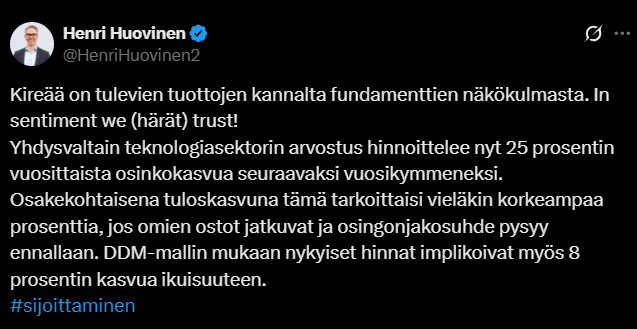

Here is also the reply to the tweet and Henri’s reply to it:
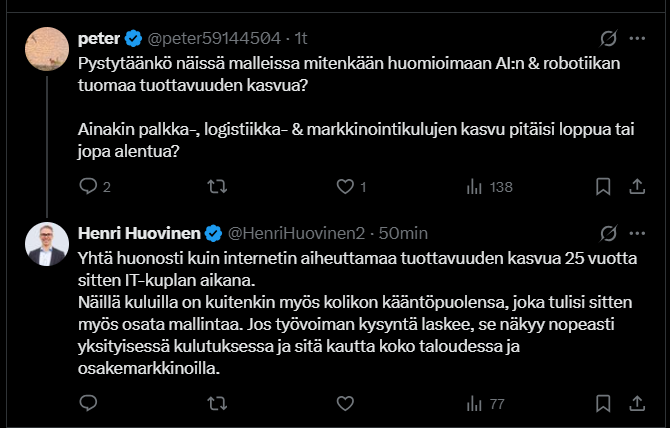
4 Likes
A very welcome change. This whole thing is comparable to a children’s casino. You pay an amount x, which varies from euros to several tens –> a cosmetic item randomly opens from a “case” which is often only a fraction of the box’s price. Usually, these are only worth cents, and rarer skins (with a red background or gold-plated items) can pay for themselves or even yield a profit, but the “condition” of these items (how clearly and accurately the textures appear) varies greatly, so there’s no certainty, even if you were to obtain such an item from this form of gambling, that it would be worth anything.
Unfortunate news for those who have “invested” in these over time and increased the value of their skin collections, but a very welcome change for children and young people. I emphasize that this is entirely gambling.
3 Likes
Is the excessive rush in working life, when caricatured, tied to the amount of salary? I myself have understood that this is what it’s about, however you put it. So if the salary is better than average, then the pace is also more intense. Bosses want a return on their money.
1 Like
I’ve sat through many HR-organized supervisor trainings. This year, among other things, coaching leadership and diversity training.
As you wrote, they are so generic that the benefit is likely marginal. Beautiful words about tailoring tasks, the benefits of diversity, and well-being at work. To top it off, of course, the supervisor is responsible for everything, but their hands are quite tied at the lowest levels.
Regarding the case I wrote about earlier, I haven’t really figured out what the person’s motives are. I don’t really understand how someone imagines they can get, for example, pay raises by intentionally causing difficulties for their supervisor.
4 Likes
Hannu Angervuo has written about earnings growth, the “Magnificent Seven,” market uncertainty, AI hype, the rally in utility stocks, and of course, investor risks.
Subheadings:
- Earnings Performance Matters
- Utility Stocks’ Valuation Multiples Have Risen Exceptionally
3 Likes
It might seem a bit like the company has also been brewing some coffee 
21 Likes
Small changes in the Top10, it’s also interesting whether Mikki and Omppu will cross the 4 trillion mark?
https://x.com/StockMKTNewz/status/1982072069165871119

5 Likes
Is the Intellego thread comparable to good streaming – entertainment with popcorn. I recommend visiting Faron’s thread. I’m already on my second box of popcorn. There are twists like in a Bond movie. I own both stocks and eagerly await whose view will ultimately be rewarded.
25 Likes
The tweet below indicates that monetary policy globally is turning looser again.
Central banks are cutting interest rates almost at the pace of the financial crisis, and financial markets are already talking about a global stimulus wave.
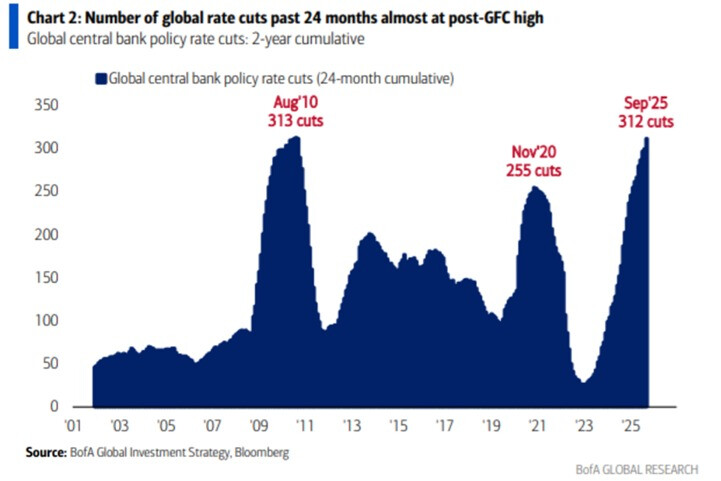
9 Likes
Is it okay to disapprove of the clickbait style? The Texas company is called OxyChem; even in the link, it was hidden behind another click, but luckily, a traditional Google search brought up some more factual articles on the subject 
6 Likes