One really has to admire @Sijoittaja-alokas’s activity. Turns off the lights, and is among the first to be there. Does the man sleep at all, or is it just a bot after all 
27 Likes
Thanks!
My former colleague said that I’m an early bird and a night owl. 
There’s so much interesting stuff in the world and in life that there’s no time for sleeping; of course, even when waking up at night, I have to read some news. 
30 Likes
The problem with these is that usually, for reasons x or y, nothing is done about it anyway.
In this situation, the diligent employee works long hours indefinitely, until they burn out or become a less diligent employee. Either way, the problem is preferably kept at the individual level, and eventually, the individual changes jobs. A couple of times this is blamed on a bad employee; at some point, management wakes up to the problem, if they wake up at all. In some companies, this has become the norm: the performing white-collar tier changes every couple of years, and the tier that keeps costs low on paper rises within the organization.
@Pohjolan_Eka referred to prioritization, which every employee must, of course, be able to do. The problem is simply that if, despite feedback, there is no reaction from above when looking at the overall workload, the whole situation won’t change.
You mentioned earlier that credibility would be lost if one states that something cannot be done on schedule. I see this the other way around. If you don’t immediately express that resources are needed for this and justify what and why, then that information will never go up. I don’t believe that almost anyone inherently wants to do their job poorly.
5 Likes
This EU is truly a great parody organization. Ethanol would be banned from hands citing health risks, but you could still drink as much as your soul desires 
 .
.
What might be on the agenda next? Oh right, probably Chinese-style digital surveillance and censorship of citizens in the British style, where, as I understand it, almost everyone, except for the leadership of the prime minister’s party and a few vocal minority activists, hates the entire law reform.
18 Likes
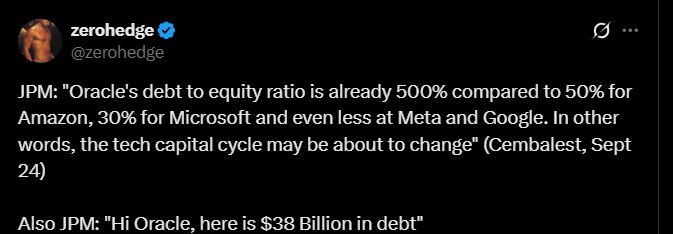
Here’s an interesting comparison of companies’ debt situations, with Oracle highlighted.
https://x.com/zerohedge/status/1981812034489458875

4 Likes
At the beginning of my forum career, I assumed Alokas was a community account for Inderes staff or a very good bot. I still haven’t fully made up my mind, but I’m slowly leaning towards humanity. Works hard.
35 Likes
A relatively convenient way for such perpetual whiners is to ask, based on what they’ve presented, how this situation will be resolved, with its justifications and costs. What comes as an answer is either workable or not, or something in between.
1 Like
Now pay attention. I was talking about delays, meaning failing to meet agreed and promised schedules. Rescheduling and canceling tasks due to re-prioritization is not a delay, but good time management. Delays must be avoided because they erode credibility and, in their uncontrollability, can cause a chain reaction throughout the entire organization.
Compare:
“It was agreed that the work would be completed on 10.10, but there was so much to do that it wasn’t finished until 30.10.”
“A top-priority task came from management for the swimming track, so we are moving this less important task to be done on 30.10.”
The first is an uncontrollable event that, as it were, just happens to the boss. In the second, a decision is made and responsibility is taken for it.
2 Likes
Cleverly constructed bot. I have asked him/it this here without getting an answer. No one can manage to be busy all the time, late into the night, almost every night. Simply can’t. Furthermore, no one here takes turns lamenting or boasting about their portfolio. As a human, it wouldn’t even cross my mind. Supercar videos etc. a bit strange glorification. I’ll probably get banned for this message, but it’s all the same to me. Then there will be time for other things.
2 Likes
Perhaps it’s a test piece of some humanoid robot.
9 Likes
The scale at which this robot helps people around it does not suggest a test unit. Rather, it seems like an AI breakthrough, whose thoughtfulness makes real people pale in comparison (pun intended) and whose diligence and humanity Musk, as a living human, can only dream of in his ketamine haze.
22 Likes

11 Likes
What is a safe investment?
A trotter.
….
18 Likes
This was fun. AI models were put to compete in crypto trading. Chinese models are crushing it and Gemini 2.5pro and GPT-5 have already almost destroyed their capital 
9 Likes
I believe we agree on the core issue itself; the environments in which these are implemented are likely just different. I’ll elaborate a bit on the perspective from which I approach this.
Promises/decisions about projects to undertake are made by the salesperson/top management. These are then tied to the client’s own schedules, and some of these may also be publicly announced schedules. In most cases, the executing level has no possibility to change these; delaying the schedule automatically leads to work for which no one will pay anything anymore. Or, late fees are paid, and the company’s credibility is lost. By micromanaging oneself, one can clear out internal routine tasks and push non-scheduled work further away, but beyond a certain point, one cannot do more for schedules from that role. Another way is to extend the day, which everyone sometimes has to do, but if you do this always, and don’t clearly communicate it, it becomes a new norm to which future schedules are dimensioned. The third option is to try to achieve an 80% result with 20% effort, which is often not a good solution either. Sometimes it is.
Prioritization is one tool, if it’s genuinely used. The most comical situation is when the list is full of top priorities, and management just comments, “all of these just need to get done.”
The example can also be extended to, say, manufacturing. Deals are made, and a schedule is agreed upon for the project. Design is delayed, material ordering is delayed, assembly is delayed – almost without exception, the painter at the end of the chain works around the clock, and the responsibility for the deadline falls on them, even though the problem is at the other end of the chain and there’s no possibility to influence the whole. If we consider this from a design perspective, perhaps something else had to be prioritized there, but within one’s own company, this is more about shifting the problem to the next person than solving the whole. It’s surprisingly often that even if the problem is brought to the attention of superiors, no one is interested. The person responsible for design has no opportunities and often no interest in influencing the matter, and top management isn’t interested as long as the numbers look relatively good. Then, when the numbers no longer look good, the reputation has already preceded the numbers, and the blame is sought from the sales end, asking why new deals aren’t being made. This cycle repeats surprisingly often in Finland from one company to another. Then, when you deal with, for example, Norwegians, the situation is completely different. Days are definitely not extended as a starting point; instead, management coldly says it’s not possible, and it will be ready at time x.
12 Likes
This is rather unfortunate information, assuming that the majority of the company’s owners are its employees. 
61 Likes
I have been in my field for 25 years now. Promoted from an expert to my current role, where I can say that I have a fairly broad view and understanding of how different industries and corporations operate. I can say that I have not been in a single workplace where I personally would have felt that my immediate supervisor was genuinely interested in how much time employees have and how much of it is used for work. That is, genuinely examining whether we are under- or over-utilized. Fundamentally, all new work is piled on top of existing tasks, and discussions are along the lines of “This (too) is really important.” For subordinates and their subordinates, it really just comes down to survival and, in daily life, a triage-type ‘does it die or does it survive’ task sorting.
This is an interesting point, as I argue that the current working life is extremely detrimental to us. Especially in expert roles, and perhaps elsewhere, top management lives completely detached from the operational reality. There is no connection between the bigger picture and the work and the doers IN A WAY that management would examine it with the question “are our human resources being used for the right things?” This could be very easily examined using project management and reporting data. But, in reality, these are middle management issues, and top management just keeps pressing the gas pedal. This is why it is extremely important for middle management to be good leaders of both tasks and people, because if they too detach from reality, radical increases in turnover, health problems related to coping at work, and a direct decrease in productivity will begin.
I could tell many stories about top management teams, where guys who, for example, don’t have children, earn, say, 600k a year and live mostly for their work, wonder why there are complaints about poor leadership again. The HR director then agrees that it’s probably “this organizational change of ours” that is causing turbulence again. This explanation has been used for 10 years, but no one has ever ‘landed’ from the finest meeting room in the building to talk with employees about why they aren’t giving better results in the annual survey 
20 Likes
The problem with these is that, usually for reasons x or y, nothing is done about it anyway.
There, a conscientious employee works long days indefinitely, using flexitime, until they burn out or become a not-so-conscientious employee.
This was my point: instead of completely unfounded and misguided “conscientiousness,” the employee must report that they are unable to perform all assigned tasks safely and that they will leave some tasks undone.
The word “safely” is key. If the employee merely reports that there’s a bit too much work, management can always manipulate, deceive, threaten, or make promises, aiming to continue the current state. Appealing to safety (in writing) means that management cannot pressure them to continue without being guilty of knowingly endangering occupational safety. If such endangerment leads to a collapse in work capacity, the employer is responsible for everything. If the employee just quietly continues and does not appeal to safety, they are responsible themselves.
3 Likes
I understand that this may apply to a field where safety is something concrete, such as a firefighter or a police officer, but in expert jobs, the concept of safety is completely non-existent.
6 Likes
This is not a sector-specific characteristic, but the Occupational Safety and Health Act. It applies to all sectors, excluding the activities of the Defence Forces and the Border Guard.
2 Likes