This too is a skill. Self-serving without incurring sanctions. Much like France’s and Germany’s corporate subsidies supposedly wouldn’t be entirely against the principles of free trade, goods, and movement. The strict state aid system that was in use is already a thing of the past.
6 Likes
Fortunately, I got the matter sorted out by visiting the tax office and avoiding filing a tax return for 2025. At the tax office, it became clear that I wouldn’t have been able to fix the issue through the paid phone service. The request for clarification had been generated automatically by the tax authority’s system. It was positive that I didn’t have to wait long at the office.
2 Likes
Apparently a smart man after all 
3 Likes
After last night’s teasing, I have to comment that @Atte_Riikola had predicted the numbers well and anticipated Mr. Market’s mood regarding Admicom, as the negative news didn’t cause much of an initial reaction this morning 

35 Likes
I have to take a coffee break. Challenges with motivation.
I’m wondering if there’s any point in continuously monitoring the portfolio. Sometimes you sell at the wrong time, and sometimes you succeed brilliantly. Should I trust websites that give stock tips? Well, a few months ago I bought Cleanspark, about which I knew nothing, based on a tip, and it’s +57%! As an investor, the question immediately arises: why didn’t I go all-in based on the “tip”? Typical investor’s hindsight.
I looked at the portfolio structure, and for an entrepreneur who is about to retire, it is still very high-risk. Half of the portfolio, through various detours, is in the crypto and AI markets.
What if they are bubbles? What do I explain to the other shareholder of the company who trusts my “skills” as an investor? What the h….ll. You used hundreds of thousands of company money to buy a basket of tulips. Goodbye supplementary pensions.
Should I sell everything now that I’m over 200k in profit and let a private banker handle it? However, over 15 years, I have clearly beaten my wife’s private banker. Albeit with irrational leverage and risk that a bank wouldn’t take.
At the point when investments bring in over half of the company’s net profit, the pressure to succeed has grown. When a beloved hobby turns into a part-time job, it’s not necessarily as fun.
23 Likes
Just a bit more on Helsinki’s tram deal: Skoda Transtech was, alongside Stadler, the other remaining bidder.
Skoda Transtech’s bid was rejected.
Skoda Transtech’s bid did not meet all 1600 requirements, including techno-economic, environmental, and passenger experience aspects.
Without knowing at all why Skoda Transtech was rejected, in my opinion,
- It seems that the selection criteria include a wide variety of things
- Over-complexity increases the risk that the selection is guided by the selector’s taste
- Even leading to a situation where only one option remains to be chosen…
In itself, Skoda Transtech trams operate in many cities in this country.
So, the selection process itself, no matter how transparent it is to bidders, affects whether there’s even anything left to choose from.
Of course, transparency and the opportunity to compete fairly are precisely the right approach to public procurement.
I suspect we will hear more about this case.
Of the two bids received, Stadler’s bid was the only one compliant with the tender request, meaning it met the procurement requirements. Three bidders were selected for tender negotiations, and Stadler and Skoda Transtech submitted the final bids.
The tram type now selected is cost-effective in terms of life cycle costs and represents already in-use and tested technology. The mandatory requirements of the procurement ensure that the tram is suitable for Helsinki’s demanding conditions and new tram lines.
The bid meets all approximately 1,600 requirements of the tender request regarding the features and performance of the new trams. In addition to techno-economic requirements, the requirements related to, among other things, environmental impacts and passenger experience.
“We are convinced that the tram type now selected is the best possible for Helsinki’s demanding conditions,” states Eetu Kinnunen, Chairman of the Board of Kaupunkiliikenne.
5 Likes
Such a mistake is quite baffling from someone involved in business (assuming it’s a genuine post and not some AI scam). But then again, politicians don’t always seem to know how much milk costs in the store and so on, so perhaps he has focused more on operational management than crunching numbers 
I wish Kalle all the best! He has achieved a lot, and I think it’s sensible to move on to other sports. We’ll wait and see.
20 Likes
Do you even need a private banker for that, when you can just put it into a low-cost ETF/index fund yourself 
13 Likes
Luckily that Stubb and Orpo are in the US just today. Tomorrow and for a while after that, the negotiation atmosphere could be a bit more challenging…
5 Likes
Now, the Vartti has given investors a dangerous tool, because comparing a single stock to a larger group of other stocks leads to the most cognitive biases, at least in my experience. A base rate cannot really be calculated for a single stock from the entire stock market, because the comparison group may not have anything in common with the single stock other than that they are companies and are publicly listed.
A good base rate would require that the data of the comparison group consists of companies that are as similar as possible, with the same business model, in the same size class, and in the same geographical area, in a similar economic situation. The further away from the ideal one gets, the less one can draw far-reaching conclusions from the historical data of the comparison group.
Even sector-level data cannot necessarily be used directly, although it is frustratingly common to see it used, because, for example, in the banking sector, it has traditionally been impossible to grow rapidly without taking too much risk, but if a bank is located in a developing country and targets a historically underserved segment, then long-term double-digit growth can be a fair and sustainable base rate, and no Nordeas would then serve as comparables.
I would also argue that many of the truly top-tier companies are such that no historical equivalents can be found in stock market data, in which case the only truly effective starting point remains evaluating the company from internal perspectives. If a company does nothing differently from all previous companies, then there probably isn’t much competitive advantage available either
9 Likes
Public sector tendering is a unique art form. Often, the goal is precisely for the tendering criteria to eliminate as many bidders as possible. However, as in the case of these trams, the public sector aims to buy good quality goods and targets a long service life. Nevertheless, the procurement law is structured such that the price of the acquisition always carries the most weight. This leads to a situation where some company always offers goods significantly cheaper than others, which are not actually suitable for the intended use. If the other criteria are too loose, these unsuitable but cheap offers must be accepted, or else the Market Court will intervene. Therefore, public procurements are often made nowadays with the starting point that the procuring organization first selects the product it knows to be good, then crafts the tender in such a way that it excludes as many other products as possible, and then crosses its fingers hoping that no company will insist on selling cheaply something that is not wanted or needed at all.
12 Likes
That’s not how it works, even though often both public buyers and supplier bidders lack sufficient understanding of the Public Procurement Act and its operations to utilize all the opportunities the law provides. You can always be challenged in the Market Court, no matter what documents you prepare, so there’s no need to fear it if the tendering process has otherwise been properly carried out. Unprofessional companies and those engaging in dumping can be directly excluded from the tendering process:
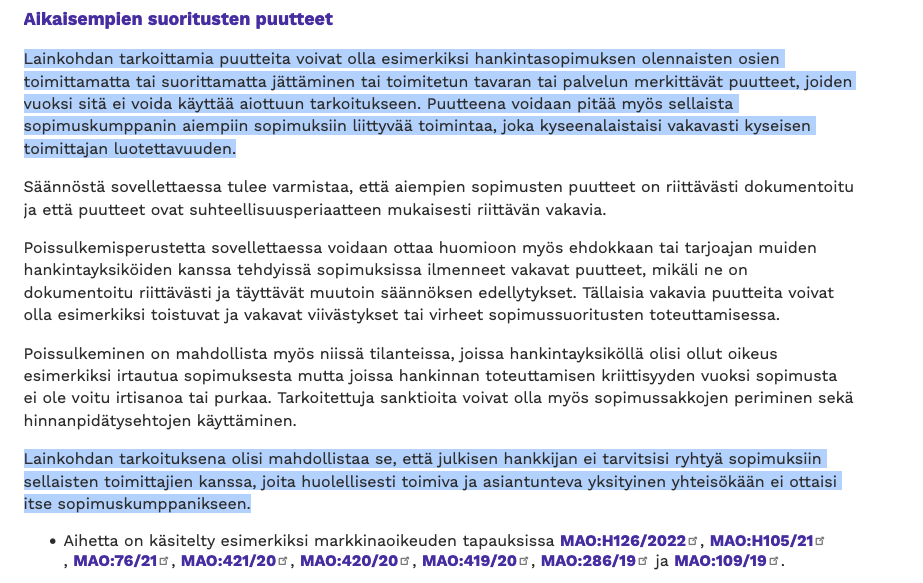
So, if a public sector operator is smart (often they are not, so they need to be enlightened), reference requirements from several sites are included in the tender. Then, an inquiry is sent to these reference sites asking if there have been significant problems with the supplier in the last 3 years, and documents regarding these problems are requested. After that, the supplier is given a deadline to submit a response. Once the response is received, the supplier is informed that they are excluded from the tender, citing Section 81 of the Public Procurement Act.
The supplier can complain and appeal and go to the Market Court if they wish, but in practice, they will almost always lose the case. During the Market Court’s proceedings, a temporary agreement can be made with another company, which will then be replaced by the main agreement or terminated depending on the Market Court’s decision, allowing the procurement to proceed at full speed while awaiting the final decision.
Source: I have a 100% win rate in public procurement cases that went to the Market Court during my career
This is seen a lot in the public sector because it’s not their own money, and they want an ‘easy and nice’ supplier, regardless of the price. So far, no one seems to have come up with a patented solution for this, other than perhaps reducing or removing quality criteria from tenders and leaving only broad enough mandatory requirements to ensure genuine competition and market-based offers
7 Likes
Greetings from Helsinki! 
Dovre announced in its half-year review on August 20, 2025, that Suvic’s Swedish subsidiary’s wind farm projects had caused total losses of EUR 23.7 million, of which EUR 18.7 million was recognized for 2024.
Based on the updated estimate, the company will have to record additional losses totaling EUR 4.0 million from them, bringing the total estimated losses for the Swedish project portfolio to EUR 27.7 million, of which EUR 18.7 million has been recorded for 2024, and EUR 9.0 million will be recorded for 2025.
5 Likes
The biggest problem for the rich is having too much money. Few of us know that Ballmer owns the NBA team LA Clippers. Ballmer has been in the news in recent weeks as it has emerged that he has found a new way to utilize his wealth.
Strong recommendation for viewing/listening, confusing but at the same time entertaining investigative journalism about the activities of the elite in the US.

What happens when you combine Aspiration, a growth company promising a green footprint, which raised money with a $2 billion valuation and was on its way to the stock market via a SPAC, NBA superstar Kawhi Leonard, the NBA salary cap, and one of the world’s richest people, Steve Ballmer, who owns the LA Clippers?
The result is a Hollywood thriller with no shortage of plot twists. Robert Downey Jr. is among the supporting cast.
4 Likes
Kalle Rovanperä F1 World Champion 2028?  Well, at least an F1 test could be a reality if he does well in F2. The marketing value would be so high.
1 Like
Rovanperä has already tested F1. Red Bull, if I remember correctly.
2 Likes
Yeah, I meant that you can test a current F1 car. Kalle probably drove at least a 10-year-old car.
5 Likes
Who still remembers the customs chaos in the spring when the Dow Jones dropped almost 4,000% in two days? The source is on the internet, so it must be true.

EDIT: I don’t know if this is a machine translation or not. “Points” translates terribly into “percent”. And at the end, it also mentions “Translation: Päivi <what’s the surname> - Iyuno”
While not the point of your message, I must say that it’s horrifying how much machine translations cause misunderstandings and find their way as facts into, for example, political discourse. Here’s a good example of how such things could arise.
For the uninitiated, let me clarify that here “4000 points” has turned into percentages in the translation. In reality, the drop was, uh, “only” over 9%.
7 Likes