The start went quite badly, which is probably expected when one is not a professional sprinter. If they were even semi-professional, they would surely have won the race.
1 Like
I took a small “break” from investing this summer. Of course, I loosely followed my holdings (roughly every 1-1.5 months), but I didn’t need to take any actions. I only own “boring” securities; with them, there are rarely any particularly exciting moments (and that’s a good thing).
Now it’s time to start following things a bit more closely again, and a couple of new companies are on my radar, so there might still be purchases ahead during the winter to improve diversification. Or funds, if the companies don’t prove interesting enough. Or both, I’m quite flexible regarding these.
Do you usually take breaks from monitoring your investments, and for how long?
5 Likes
Try to decentralize this then 
LapWall Plc launches a new roof element solution developed for data center construction - Inderes
Soon even Fodelia will just be making some DC soup
18 Likes
Absolutely! =) I always try to keep my summer holidays investment-free, meaning about a month away from the market… Or at least several weeks!
It clarifies thinking.
5 Likes

That would be tough :D… but seriously - Chambers’s record was probably 6.42 and in that video he ran 6.64. Kevin was about a second behind. Maybe Kevin could have shaved off a tenth or two with proper training. 
Markus Pöyhönen has run 6.58 and Lotta Kemppinen 7.16.
2 Likes
In many sports, strength and speed support each other excellently, and the shorter the distance, the better “muscle bundles” perform, especially if there’s any background in a sport requiring explosive power. For example, shot put champion Ryan Crouser, weighing over 140kg, has reportedly run 40m well under 5 seconds.
Similarly, I remember reading, whether it was from a muscle doctor or an athletics coach’s text, that most elite-level shot putters and discus throwers perform well against sprinters for the first 30-50 meters. But that performance collapses after that, and for example, at 100m, the difference would already be significant. Unfortunately, I couldn’t find the original source with a quick Google search.
This also works the other way around, that fast people are often surprisingly strong. Muscle Doctor Hulmi once wrote that, for example, triple jumper Heli Koivula, who would have easily met beauty pageant criteria with her lightness, did clean and jerk sets of 4-5 repetitions with 90-100 kg weights as supplementary strength training.
4 Likes
Yep!
Finnish heptathlete Saga Vanninen has done three repetitions of 105 kilograms in the clean and jerk. Mika Halvari also had a relatively fast 100-meter time, but I couldn’t find it with Google now. I know what you’re talking about, as I’ve heard and read about similar things. 
Right off the bat, I’ll say that I’m not super fast right now, but I’ve received praise for my speed from a couple of people who play ball sports. I squat about 2.6 times my own weight and I think I accelerate well when I need to sprint. Although I immediately suspect that when I go to the sports field to time myself, I’ll be disappointed  (as my mental images don’t match reality), but I should go and test it sometime.
11 Likes
Today is a good day to tell in the bought/sold thread how one had just previously bought Herantis. 

18 Likes
Who knew that in medieval Italy, usurers… ahem… moneylenders always had a wooden seat, i.e., a bench, i.e., a banco, at their place of business. The term for conducting business at that establishment became established. Instead of a man needing a quick loan telling his wife, “I’m going to borrow money,” he would simply use the euphemism “I’m going to that bench.”
This and other curiosities from the financial world based on the Italian language can be listened to in two episodes of the Kielen Päällä program, which was already released in July:
17 Likes
I, on the other hand, told how I sold it… I’ve been going against the wind my whole life in my little bubble 
8 Likes
The previous message in the thread was from October 2023. It’s been quiet…
10 Likes
I can’t help but wonder how the currently Roman legion-sized communication departments at UPM, Stora Enso, and Metsä Board view the prevailing investor discussion about these companies.
16 Likes
Inderes once again rides a buy recommendation into a profit warning

[quote=“Johannes_Sippola, post:1210, topic:239”]
And there it is, the profit warning came.
ARR growth with new guidance 6-10%
20 Likes
Earnings season starting🤠 The next expected negative profit warning still from Qt, and then the top two of the model portfolio are under pressure again. Of course, that negative profit warning can always be priced in, but at least for Admicom, I’m guessing a small downward market reaction tomorrow😅
10 Likes
The recommendation is to add more, and go check out the forecasts, as they fall within the updated guidance ranges 
40 Likes
Well, so it was  I was wondering why I was able to add today without buying.
Seriously, that wasn’t such a bad negative surprise if we stay there.
9 Likes
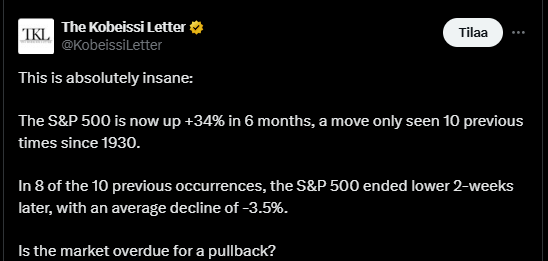
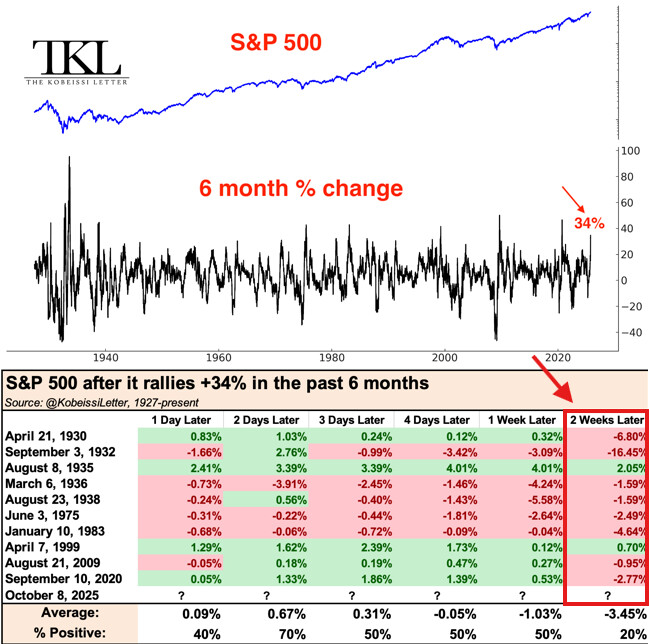
Kobeissi is a bit of a breaking news account, but this tweet has a couple of interesting observations, albeit presented “excitingly”.
https://x.com/KobeissiLetter/status/1975931691215860181
Doesn’t this, on the contrary, indicate that even though in the last 20 years everyone has gotten smartphones, remote work opportunities, automatic systems, and so on, productivity growth has stalled. Not even during or after the corona era has any productivity growth been seen, even though all companies were forced to take a huge leap in technology.
Somehow it sounds like everyone else has to make enormous changes to functional working methods so that a few remote workers can do comprehensive work.
17 Likes