This reminds me of Peter Thiel’s witty phrase “competition is for losers.” By this, he meant that a new entrepreneur generally shouldn’t try to compete directly against large corporations, but rather find such a small niche that they can become dominant in it with the resources they have. Then, once a small but sharp wedge has been driven firmly into a market - no matter how small - it can then be widened by expanding the offering. Virtually all of the so-called Magnificent 7 companies have developed in this way. 
14 Likes
Development in the right direction. A few percentage points more than a year ago, maybe in 10 years we could calculate the true median wealth of Finns.
1 Like
Have you seen when a giant bodybuilder, namely Kevin Levrone… Mr. Olympia runner-up runs against a top sprinter?  Soon you will.
He did quite decently, didn’t he? 
EDIT:
In the video, Chambers’ time is approx. 6.64, and for example, the European record is currently 6.41, so Chambers really ran properly.
13 Likes
Ah, a new stock market week, what could be better.
I’m already eagerly awaiting what kind of sh*t the markets will come up with to claim about Intellegos this time  .
.
14 Likes
I also have a golf share, gotta leave something for the kids as inheritance too (4 of them) 
1 Like
Regarding the statistic that older age groups have more wealth. I remember when, 30 years ago, the children were small, we built a detached house, and largely lived on one salary. Not much extra was left for savings.
In previous years, however, it was possible to get rich by buying and selling houses in Helsinki (this was not planned at all then), but it happened purely by chance. We bought our first apartment for 80k (it was still the markka era), from which we made a 40k profit a couple of years later. Then we invested in the next one and made a profit again until we started building a detached house.
We had almost 70k in tax-free profits (housing prices rose at an incredible rate in the Helsinki metropolitan area then).
Now, when I follow my children and their friends, everyone is really struggling. There are no jobs, and no one earns from housing price developments anymore.
It has been said that we are the last golden generation. I send greetings from the coffee room to the government, that my life was also saved by the work obligation in the early 80s. In my small hometown, even all the rascals were made to mow grass if there was no other work. I got to sort papers in the municipal archive, and I was immensely proud of this job, and it boosted a young man’s self-esteem when I said I was working.
The municipalities’ employment obligation and its funding need to be put in order.
50 Likes
Here is Hannu Angervuo’s article on foreign ownership in the Helsinki Stock Exchange. 
On Thursday, Euroclear published the market values of listed companies and the amount of foreign ownership in September. In September, foreign ownership decreased from the total market value of the companies to 53.49 percent, while at the end of August it was 53.66 percent.
Foreign ownership has remained quite stable at around 53 percent throughout the current year. Foreign ownership increased every month from November 2024 onwards, but this trend was broken in March-April of the current year.
The value of foreign ownership is affected if foreign owners change their company-specific holdings. The market value of foreign ownership is also affected by changes in share prices during the month.
1 Like
Finland’s material consumption is once again causing alarm:
“Finland’s consumption of natural resources per capita is the highest in Europe, reveals a newly published report by the European Environment Agency.
The material utilization rate in Finland is only 4.4 percent, which is clearly below the EU average.”
Minerals play a really big part in this:
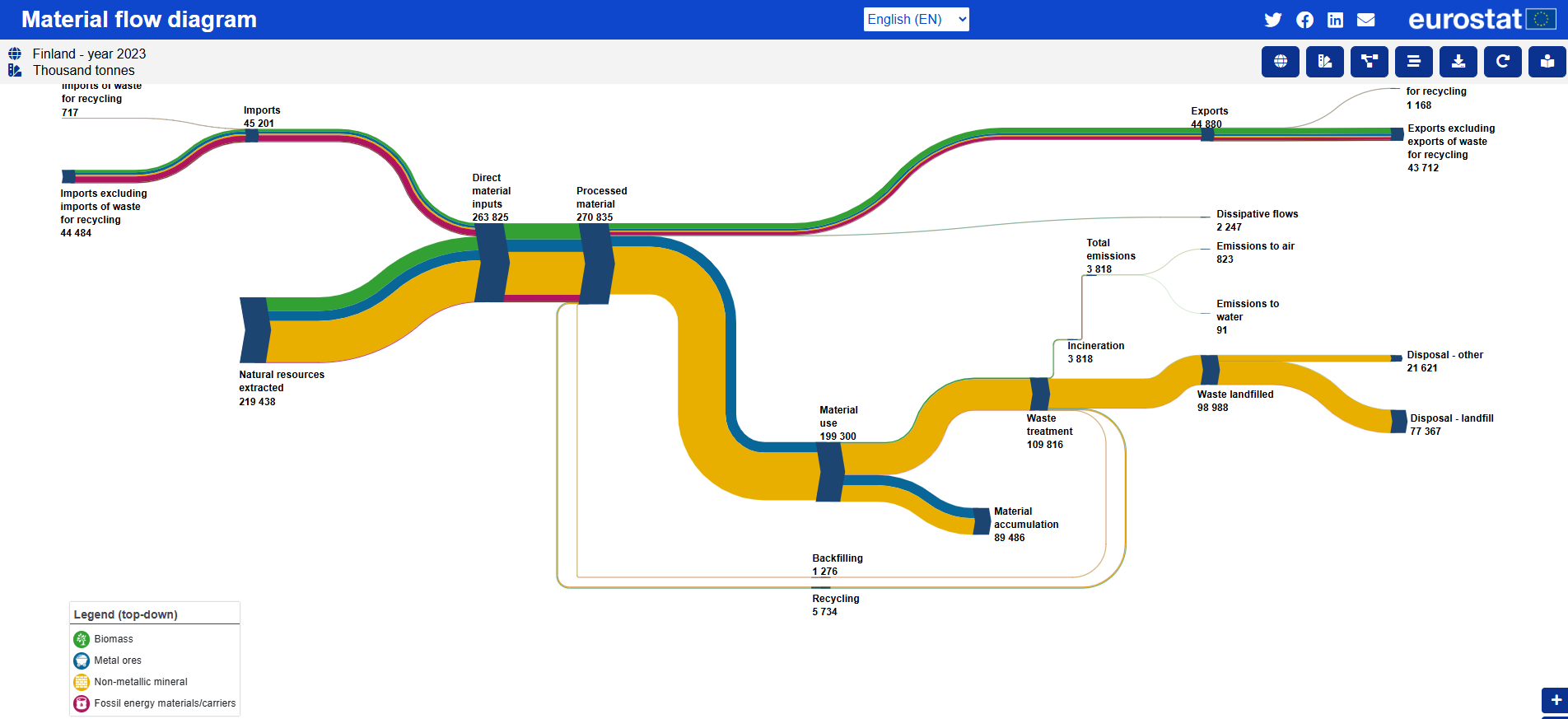
It seems that once excavated, it’s difficult to reuse the same soil in the same mine. No wonder the utilization rate remains low.
8 Likes
Buy, buy, now there are cheap goods available. Even megatrends behind them.

An Alma Media journalist has compared share prices to target prices; this week, especially the following are recommended for purchase:
Atlas Copco, because PE > 25
Siemens, because PE > 20
Rheinmetall, because PE > 65
Airbus, because PE > 30
Schneider Electric, because PE > 26
Siemens Energy, because PE > 60

19 Likes
The EU aims to significantly increase the production of critical raw materials in the coming years. Then there’s an outcry when Finland, a country where these raw materials are found in significant quantities by EU standards, happens to consume more natural resources than other member states… This is an interesting equation.
18 Likes
Can anyone tell me if Intellegon’s share trading volumes can be real amounts and not just bots trading among themselves? For example, even today, within the first half an hour, the trading volume has already been half of what it was on the highest trading day of the last month? Or could it be that regular people also trade shares back and forth this much?
3 Likes
What do you think is the reason for the high median wealth in the 75+ age group: is it that people have had a long time to accumulate wealth, or that all those who didn’t have that wealth have already passed away by that age, and the wealthy continue to thrive for another 10-15 years?
2 Likes
A small note.
On the forum’s Bought/Sold section, day after day, relatively most often, those stocks are bought that are falling the most. Today, for example, Intellego and UPM are very popular buys.
Instead, much less is invested in rising stocks. This is justified by saying that they are “too expensive”.
However, usually, stocks in a downtrend fall further, and rising stocks often rise for good reason, for a longer period. Intellego has been falling for a month now. It is said that the markets are always right, which I understand to mean that it’s pointless for a private investor to fight against their trends.
This psychological buying “cheap” (and persistently avoiding buying “expensive”) seems to be one of a private investor’s stumbling blocks.
50 Likes
This is not an insignificant, but rather a very crucial observation.
In my view, this is one indication that many investors no longer follow sentiments or fundamentals, let alone make calculations or analysis, but instead only look for “unjustifiably” cheap buying opportunities, in other words, betting that a single instrument will rise in the future. A kind of lottery, then.
Buying into rising assets is certainly psychologically difficult, but then again, no one has ever claimed investing is easy.
8 Likes
Good comment @Tokarczuk. If I hadn’t bought stocks at rising prices this year, my portfolio’s YTD would hardly show a 101% return today. So what did I buy at rising prices? I bought, for example, $IREN, $NBIS, $CIFR, even though all of them had already been rising for a while at that moment. All of these quickly started to look like they were trending big, so I decided to jump in. The idea was that if it looked like a longer trade, I’d ride the wave for a while, but now it’s starting to look like they’ll stay in the portfolio for a bit longer. And there may still be additions to these.
9 Likes
No, it’s gambling when you buy something rising just because it’s rising (e.g., Bitcoin)  unless you have a good technical analysis system for when to sell, then it’s not gambling. In a falling market, many lower their average price; many fundamental investors do this à la Lindström.
In 10 years, a 100% annual return would otherwise grow 10,000 euros to 10 million. I somewhat doubt its success, but there’s a goal. Slippage also grows quite large then.. (returns decrease).. An easier way to get 10 million is to get it at 70 years old with a 10% annual return, if you started young..
2 Likes
I was bothered by the inclusion of GRK Infra’s IPO in this group of sluggish stock market starts. The stock price has risen over 30% in half a year since the IPO. Quick profits could have been realized in the summer, if desired, after a rise of up to +45%. In my opinion, this hasn’t been such sluggish development, even though we have certainly taken a bit of a setback from the summer highs.
13 Likes
If a semantic evolution has occurred here and quick profit is considered the listing day in the spirit of 2021. A half-year quick profit is so ancient. A half-hour quick profit is heavyweight impact investing. 
3 Likes
You might be right. For some, long-term ownership apparently means that shares bought in the morning are sold off only in the afternoon, and eternal hold means that the sale is delayed until the next trading day due to some peculiar coincidence.
10 Likes