In Asia, nothing else is used, except in the poorest regions. You get exactly the kind of rice you want. Here, for example, are 10 quick selections for different ones 

5 Likes
Well, my own brewer is clearly a very basic model. 
1 Like
The risk paid off! You should have seen the boy’s face and tears when a SAAB key was revealed from the package.
He’s 10x worse of a Saabist than I am. And he has an impossible car fever. It motivates him to do gig work and learn how to manage money in general.
Whether giving a SAAB is caring or teasing is another matter 
(And I don’t usually just give a 2000€ gift. This was also a kind of technical solution. I had three cars in my name. This one became extra. I didn’t have the heart to sell it to a stranger, as such big repairs have been done to it, e.g., timing chain etc., that I wouldn’t have gotten my money back.)

128 Likes

Hopefully, when calling Stubb, he won’t notice that the country code is +358… 
28 Likes
Hi. Here’s a new blog post on copycat investing: Copycat sijoittaminen Scion Asset Managementin tyyliin – kannattaako matkia isoja nimiä? - Rahat Ojennukseen
1 Like
That is indeed an apt description of the past year. 
27 Likes


The straight uncle has all three horns up as soon as the old American gentleman says those certain little words. Strong is the charm 
2 Likes
Over two million Finns save and invest, but there’s still a way to go. A recent article from Statistics Finland (Tilastokeskus) states that the number of owners of mutual funds and listed shares in Finland rose to over two million last year: https://stat.fi/julkaisu/cm1hec3qa5v7e07w078ysh762. The number of owners increased by 82,000 during the year. Investing is most common in the 35–44 age group. The median value of holdings at the end of the year was approximately 6,000 euros. I myself save largely into equity funds, most of which are passive equity index funds. I like this model because costs remain low and investments are automatically diversified across various companies and geographical areas.
10 tips for starting regular saving and investing:
- Set a goal: why are you saving? Retirement, an emergency fund, your future or your children’s future?
- Start small, with an amount that suits you; even 50–100 €/month is enough. The most important thing is to start. Increase the monthly amount when your finances allow.
- Choose a cost-effective fund. Index funds often have the lowest fees.
- Diversify geographically. E.g., North America, Europe, Asia, and emerging markets.
- Automate saving. Set up a permanent monthly direct debit to the fund in your online bank.
- Stick to your plan even in a bear market. Save even when markets are volatile and you buy shares cheaper.
- Avoid unnecessary costs. Be wary of funds with high management fees.
- Monitor, but not too much. Check your portfolio, for example, 1–2 times a year, not daily. Avoid constantly staring at prices; let time do its work.
- Define your time horizon. Stocks are a long-term investment, in my opinion, at least 4–10 years. Invest for the long term. Stock markets fluctuate in the short term but yield returns in the long term.
- Study the basics, use reliable sources, and exercise sound judgment. For example, the Financial Supervisory Authority (Fiva), Morningstar, the Finnish Foundation for Share Promotion (Suomen Pörssisäätiö), Statistics Finland (Tilastokeskus), and independent financial media channels such as Kauppalehti, Talouselämä, Arvopaperi, in my opinion, offer good and impartial information. However, use healthy criticism in investment advice from banks and wealth management companies, as they may offer funds with high ongoing costs that are not always in the best interest of a beginner investor.
I especially want to encourage low-income and less affluent individuals to start saving and investing. For them, investing can be of the greatest benefit, as the long term and the compound interest effect can provide much-needed assistance to their personal finances. You can start with small amounts.
33 Likes
I disagree with this. These are a bit matters of opinion. 1-2 times a year  Oh, come on. I look dozens of times every day. And what’s wrong with that, if you get a kick out of it. And it doesn’t take anything away from anyone. And it doesn’t affect the portfolio’s return. It’s just an ingrained habit and a hobby. A nice hobby. An addictive one.
The other instructions were familiar and smart. I’ve talked about these things with many acquaintances. Some are receptive, some are not. I don’t push it, but I’m happy to tell about, for example, 50€/month index funds, if someone is just interested. And I tell them how it annoys me that no one told me about these things decades ago. For example, if I had put in 20 marks a month since I was a little girl, I might be laughing now.
15 Likes
Good list, but I have to elaborate a bit on point 10 regarding banks. Many banks eagerly market their expensive active funds to customers, instead of index funds. Index funds are not necessarily mentioned except very deep within the recesses of their websites, where few people venture.
As an example, the OP Maailma fund still offers an active fund that takes a view (costs 1.6%) and a passive index fund (0.39%). The results speak for themselves as to whether it’s worth trusting portfolio managers’ stock picking, but that doesn’t stop the bank from offering a cash cow to the uninformed.
Active:

Index:

11 Likes
I started investing through gateway theory, i.e., index funds, and moved to the toughest league (cryptocurrencies, risky stocks, and trading) with beginner skills. I am still in the tough league (in the stock pickers’ division) with slightly better than beginner skills.
I am at a loss. Maybe
28 Likes
Let’s put this here

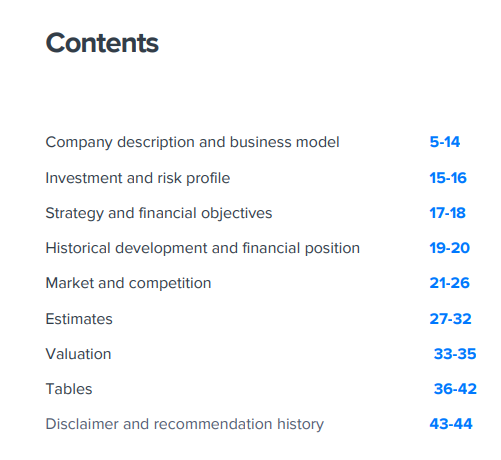
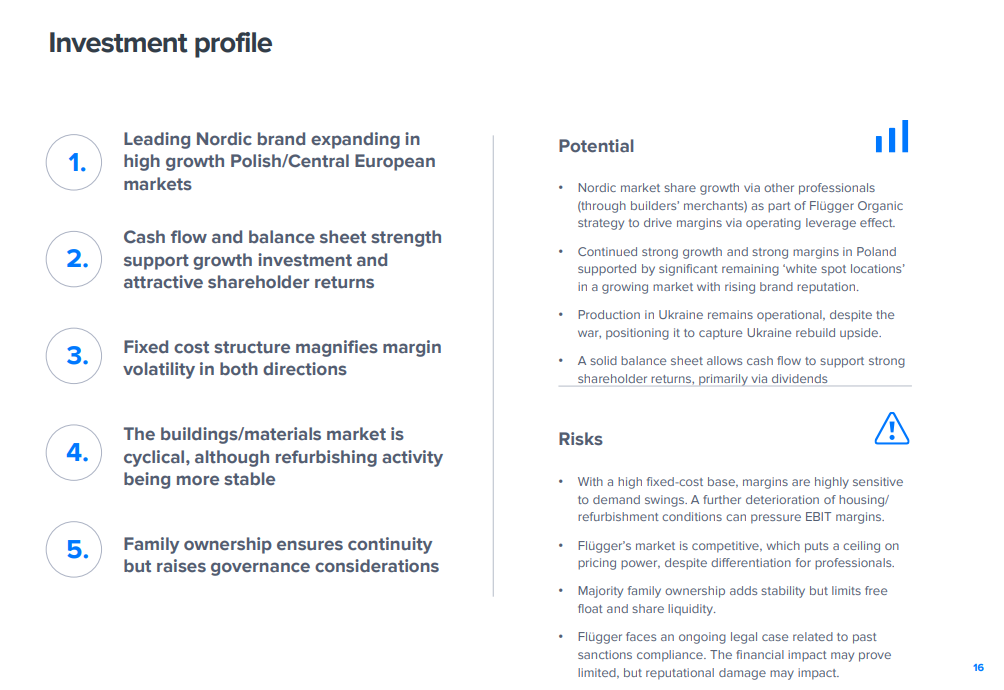
Philip Coombes and Philip Coombes of HC Anders Capital have prepared an extensive report on Flügger Group, which is a Danish listed company that manufactures and sells paints, wood preservatives, fillers, and tools. The company is a market leader in Denmark and strong throughout the Nordic countries. The well-known Flügger Farver stores are its main sales channel, and the company also grows through exports and its Eastern European business.
The actual PDF report is in English.
Flügger took a solid step forward in its 2024/25 recovery from a cyclical downturn that followed the Covid-19 induced demand spike and subsequent inflationary period. Management’s focus on the core business in the professional painter segment combined with controlled organic growth in higher-margin international markets can support continued moderate revenue growth and sustained profitability and EPS growth. We see a favorable risk-reward based on absolute and relative valuation and initiate coverage of Flügger with an Add recommendation and a target price of DKK 370.
Quoted from the report:

I spotted this here, of course:
9 Likes
And a supplementary tip number 11 for various rare exceptional situations:
- The sure way to become a millionaire is to go all in on an airline as a billionaire.
An old joke, but 1 - 10 are mostly, albeit with varying emphasis, okay. 
8 Likes
Related to this, I just realized a small milestone a moment ago, while improving the world again with an old friend over a couple of beers.
At some point, the conversation turned to housing deals and investments.
Two years ago, I sold a large chunk from my portfolio for a down payment on an apartment. A faint tear rolled down my cheek from that.
Now, two years later, the apartment has been paid off, and the portfolio is larger than it was then.
My faith in saving and the eighth wonder of the world, the compound interest phenomenon, has returned.
11 Likes
Alright, the culprit has been found. It was, surprisingly, the graphics card, the good old Radeon HD 7870.
It managed to hold on for 5 days after those cleanings, but now it wouldn’t start at all. 10 seconds after getting into Windows, a black screen, even though the computer was clearly still running in the background. It still worked in safe mode, but couldn’t handle actual Windows anymore. I even uninstalled the drivers, and even with defaults, the screen went black, sometimes even at the login screen.
I pulled out a proper warhorse from the depths of the cupboard, an ATI (!) Radeon HD 4870 from 2008  and immediately got into Windows without problems. After installing the drivers, I can now enjoy its maximum resolution of 2560 x 1440
 Connection via adapter DVI-D → HDMI
E:
Let’s try some first aid  new thermal paste and an even more thorough cleaning. The components do look okay.
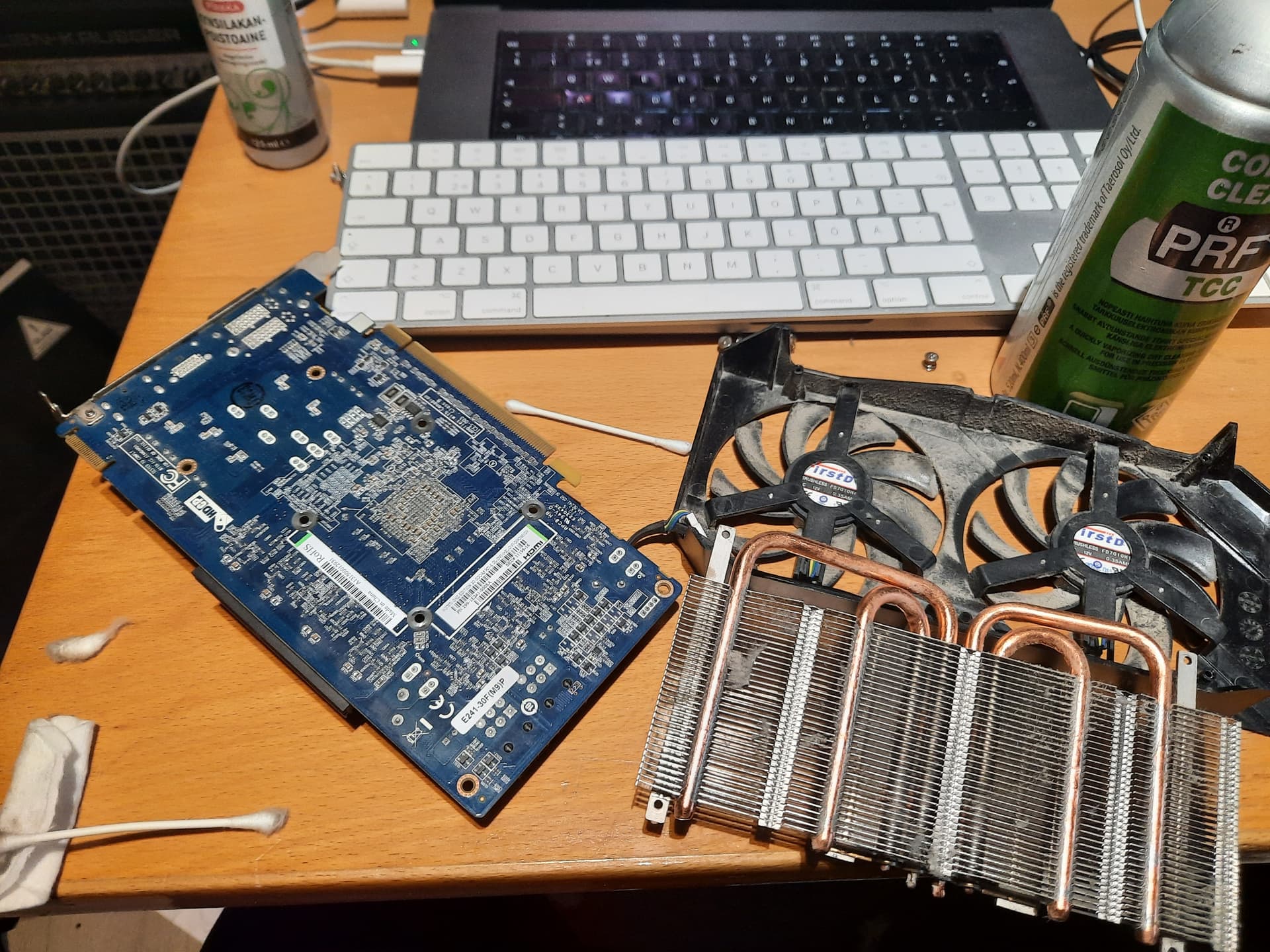
It got marginally further. When I opened File Explorer, a nice purple screen appeared and stayed there. It seems the graphics card’s RAM is at the end of its life, and these aren’t very easy to replace yourself
12 Likes
In the morning, a comment caught my eye from the local newspaper’s text message column, where it was stated, perhaps a bit sarcastically, “The Kela (Social Insurance Institution of Finland) and employment office branches have been removed from the locality, but luckily we’re getting a needle exchange point for drug users instead.“ It caused a little amusement, even though it’s a serious matter in itself.
21 Likes
This reminded me of the ‘Jyvät ja Akanat’ (Grains and Chaff) I’ve read in Suomen Kuvalehti over the years. I had to look for them, and now you can even find them online. 


13 Likes