
20 Likes
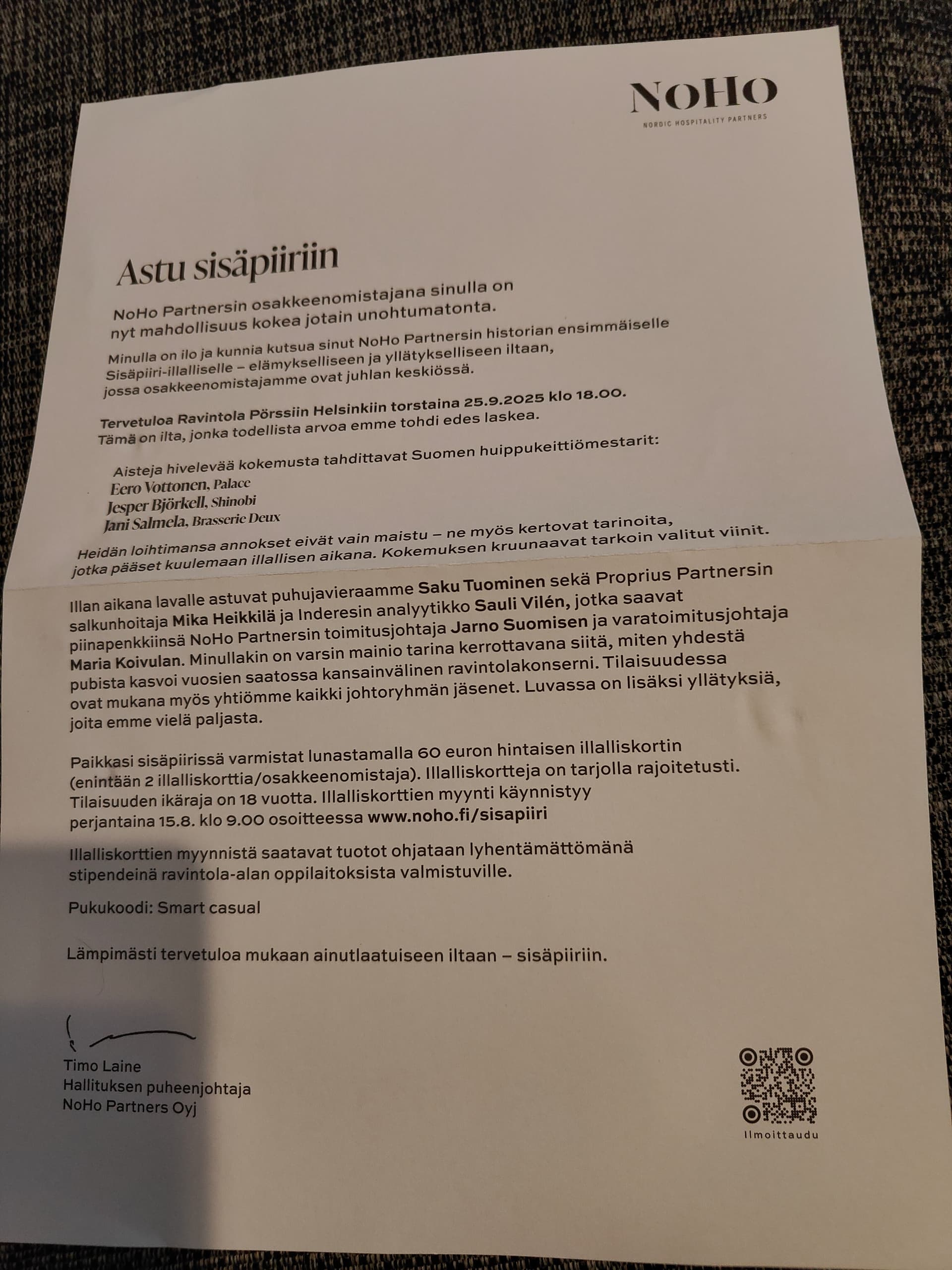
I already got excited when I received mail from NoHo, but instead of a free booze party, there’s a paid propaganda event on offer.
37 Likes
OP bonuses become taxable capital income if they are used for a service other than the one from which they accumulated.
7 Likes
Warning 
53 Likes
Well, that’s how it happened.. 
(disclaimer, only a hundred slips..  )
)
1 Like
Ritakallio (OP’s CEO) has stated about these that the bonus or other similar benefit will remain of equal value regardless of what the regulator comes up with.
Which was actually mentioned in that article as well:
\u003e OP Group stated in its annual report last year that it has prepared for changes in bonus taxation practices and that OP’s owner-customers will continue to receive at least the same level of financial benefits despite the legislative change.
16 Likes
Did the damages occur as a result of this waiting? I must say that I certainly wouldn’t have waited around; the marten would have been immediately evicted.
Most of it didn’t, because it had already moved in, so the entire attic would have had to be dismantled anyway. Evicting a marten like that is not a simple task, especially when there were several access routes at the beginning. Of course, if one were a hunter, one could have slaughtered it in the yard a few times. The best legal attempt was when we left Antti Tuisku playing on the radio for a week, but it didn’t help.
There were great arguments with the insurance company about this case, as they refused, for example, to cover the special permit application for capture. We then told them that it could then cause as much damage as it wanted, and they would have to pay for it. After this, surprisingly, willingness to pay for the application began to emerge from them.
@Sijoittaja-alokas can move the messages so as not to spam the thread. Thank you and sorry 
4 Likes
I didn’t even bother trying to find the article. I suspected it was paywalled, long, and boring. I don’t know if it was. Instead, I asked ChatGPT to summarize it. Quite sensible observations. And my behavior perhaps proves the article’s point.
The use of AI resembles the early days of the web. Everything was nice, easy to use, and free. Then came SEO pages, endless ads, and a lot of frustration for the user. Let’s enjoy this while it lasts.
Summary below
…
Key Takeaways
-
AI is changing how people navigate the web. Instead of clicking through to websites, users now get direct answers via AI tools (e.g., chatbots). This bypasses the traditional click-based model that drives traffic to content creators, undermining the open web’s economics.
-
Significant drops in web traffic
Analysis shows around a 15 % decline in human-generated search traffic over the past year. Category-specific hits were even steeper:
Reference sites: −15 %
Science & education: −10 %
Health websites: −31 %
-
The economic bargain is unraveling
The web’s model—free content monetized via advertising and driven by user traffic—is collapsing. AI intermediaries are consuming value without fairly compensating originators. -
Content creators are scrambling for new revenue modelsPublishers are entering licensing deals or suing AI companies (e.g., News Corp with OpenAI; New York Times with Amazon/OpenAI; Reddit with Google). Numerous legal cases so far favor AI firms under fair-use protections.
Technical solutions are emerging:
Cloudflare’s bot-control services allow site owners to manage how AI bots access content.Tollbit offers “bot paywalls” where AI access is metered and monetized.
ProRata’s Gist.ai redistributes ad revenue to original sites. -
Some optimism from Google
Google insists more content is now being indexed (up 45 % over two years), even if it’s viewed by bots rather than humans. It argues that outbound clicks—and thus user engagement—haven’t drastically fallen. -
The web’s survival depends on adaptation
While the article recognizes AI as a fundamental disruption, it stops short of declaring the web’s demise. Instead, it presents the crisis as a pivot point—suggesting that new agentic protocols, revenue-sharing mechanisms, licensing frameworks, and open standards might form the next chapter of the internet.
6 Likes
I am more bearish than I have ever been.
And I gain nothing from this view.
It’s just that there are different cycles in the development of humanity. The development of this current cycle raised living standards, but the future looks bleak for many reasons.
However, you want to ask for reasons: We have become accustomed to things being far too good due to economic growth and a long period of peace; with population growth, there have always been workers for all the self-evident current necessities for us, users of the modern slave economy.
In the future, the imperialism that has appeared in news stories means, at an individual level, a return in living standards to a point where it is worthwhile and necessary to do any work, etc., for one’s own livelihood.
2 Likes
Good, because you wouldn’t have earned much with your view in recent years  . In fact, an inverted- @TervanKypsyttelija ETF would have been a very profitable investment.
10 Likes
We are on my favorite topic. This is more broadly the reason why unpleasant issues, whether big or small societal phenomena, remain unresolved because no one wants to do anything about them. It’s easier to sit on an Ikea sofa in Marimekko clothes and tell others who should be responsible. Good examples include mental health problems, elderly care, behavioral and order disturbances in schools, children’s social media addictions, juvenile delinquency, substance abuse problems, difficulties in job searching and/or applying/getting into school/studies.
Before, all these things were done by oneself, with the support of loved ones or within the family circle. Nowadays, it is assumed that society takes care of them.
In the bigger picture, this means a lack of resilience, i.e., for example, if the electricity were out for a week, what would you do? Most people would cry out for society’s help, and certainly something would be done, but there wouldn’t be enough for everyone, at least not immediately. Preparation must be done in advance.
I don’t know if this had anything to do with your thought, but I think we are talking about things happening under the same phenomenon.
13 Likes
Here’s another ace up my sleeve
make deb-pkg

1 Like
Did it finally happen now, and did the money start moving from the US to cheap Nordic countries🥹
6 Likes
By the way, @Verneri_Pulkkinen, when you envisioned a Helsinki of 5 million inhabitants in fifteen minutes, let’s do a little calculation:
For our thought experiment, we’ll take as a model the new LOHAS Park residential area in Hong Kong (the name comes from the words Lifestyle of Health and Sustainability). Upon completion, approximately 58,000 inhabitants will live there in a total of fifty skyscrapers built on a 330,000 m² plot (i.e., one-third of a square kilometer). Image of the area under construction 建園春秋 / Wikimedia Commons:

For an entire square kilometer, the population density, built similarly, would thus be approximately 174,000. There are more densely populated places in the world, but I’m taking this as an example because it’s not a slum; rather, the apartments are modern, and diverse services and transport connections are available (e.g., its own metro station).
Finland’s population at the end of July was ~5.65 million, so if we build in the style of LOHAS Park, the entire population of Finland would fit into 32 square kilometers. This is about one-seventh of Helsinki’s land area.
I most humbly propose the name for this project as Ilkkapolis or Lifestyle of Hesuli and Sustainability. 
52 Likes
How would things be handled by preparing if there was a week-long power outage during the harshest frosts of February? The heating of all houses would stop everywhere at the same time. Fuel heaters and generators would quickly run out of stores. In 90% of houses, detached houses, and apartment buildings, the heating pipes would freeze, and heating could only continue after the broken pipes inside the concrete are replaced everywhere in the summer.
We have to rely on the functionality of public infrastructure, electricity distribution.
4 Likes
Interesting! Let’s correct that a bit:
An Owner’s K-Plussa membership can be joined by a Plussa member
- whose personal Plussa purchases from K Group stores amount to at least 3,000 euros over the preceding 12 months
AND
- who also owns at least 100 Kesko shares.
…the shareholder must own at least 1,000 Viking Line Abp shares…
.
.
.
Digital shareholder cards for 2025 will be activated for all shareholders who meet the above requirements in December 2024.
.
.
.
The shareholder card is personal and entitles the holder to free scheduled trips for 1 person (passenger ticket) and a normal-sized passenger car on all Viking Line ships. The travel offer is valid only when the trip has been booked in advance at least 12 hours before departure. The shareholder card is personal and is valid only for the cardholder. The card does not include free cabins or meals.
15 Likes
Supported Recycled Building and Finnish Traders’ Dormitory 
6 Likes
Life hack: If your car is missing a part, take a similar car from SAKA for a test drive and take the part from the test drive car for your own car. This advice was given by a SAKA salesperson.
26 Likes
That’s not true regarding the heating. Our home would heat up quite normally, although the other building would be dependent on a regular 12-volt battery.
3 Likes