I’ve been in Helsinki all week! The schedule was just so tight that there was no time for transitions.
8 Likes
You just invented a new way for Hesuli companies to save money. All of them can have the same CEO and management team.  #itcouldntgetanyworse
1 Like
This made me think.
How difficult it really is to assess the quality of companies?
For example, Neste is a painful example for many Finns. In 2021, the company was considered roughly the sovereign winner in renewables. No one else could produce biofuels or build a similar raw material procurement network.
Now, however, it turns out that the company has been a reasonably inefficient giant for years. When the market collapsed, a heavy cost structure was revealed.
Kempower was one of the stock market’s growth stars in 2023–24, which many considered truly high-quality. When the market became difficult, it was noticed that the company lacked proper sales expertise. Customers had come to them before! 
Or OmaSp. What a profitable bank! Well, it looked that way for a long time. In hindsight, it has become clear that risk management was practically completely forgotten. It’s easy to look efficient when a heavy risk management department hasn’t been unnecessarily hired to slow down loan portfolio growth!
92 Likes
I’ve been pondering this a bit while frantically putting together my master’s thesis on quality investing this winter. In many cases, it seems that a “quality” label is slapped on a company whose stock price is rising sharply. Then it’s slowly and painfully ripped off when the stock price falls. So I would make the claim: a rising stock price = “this company must be high-quality!”
This, in principle, has nothing to do with the quality of the business, although a high-quality business often leads to good stock performance. A quality company actually possesses a sustainable competitive advantage that enables it to achieve high profitability. The company has preferably proven this over many years, through crises. The problem, of course, is that one can believe for a long time that a company has a competitive advantage, and perhaps one starts digging for it to justify a stock price increase, until it’s revealed that the competitive advantage never existed 
27 Likes
Trump just started commenting on his big tariffs. Just signed them.
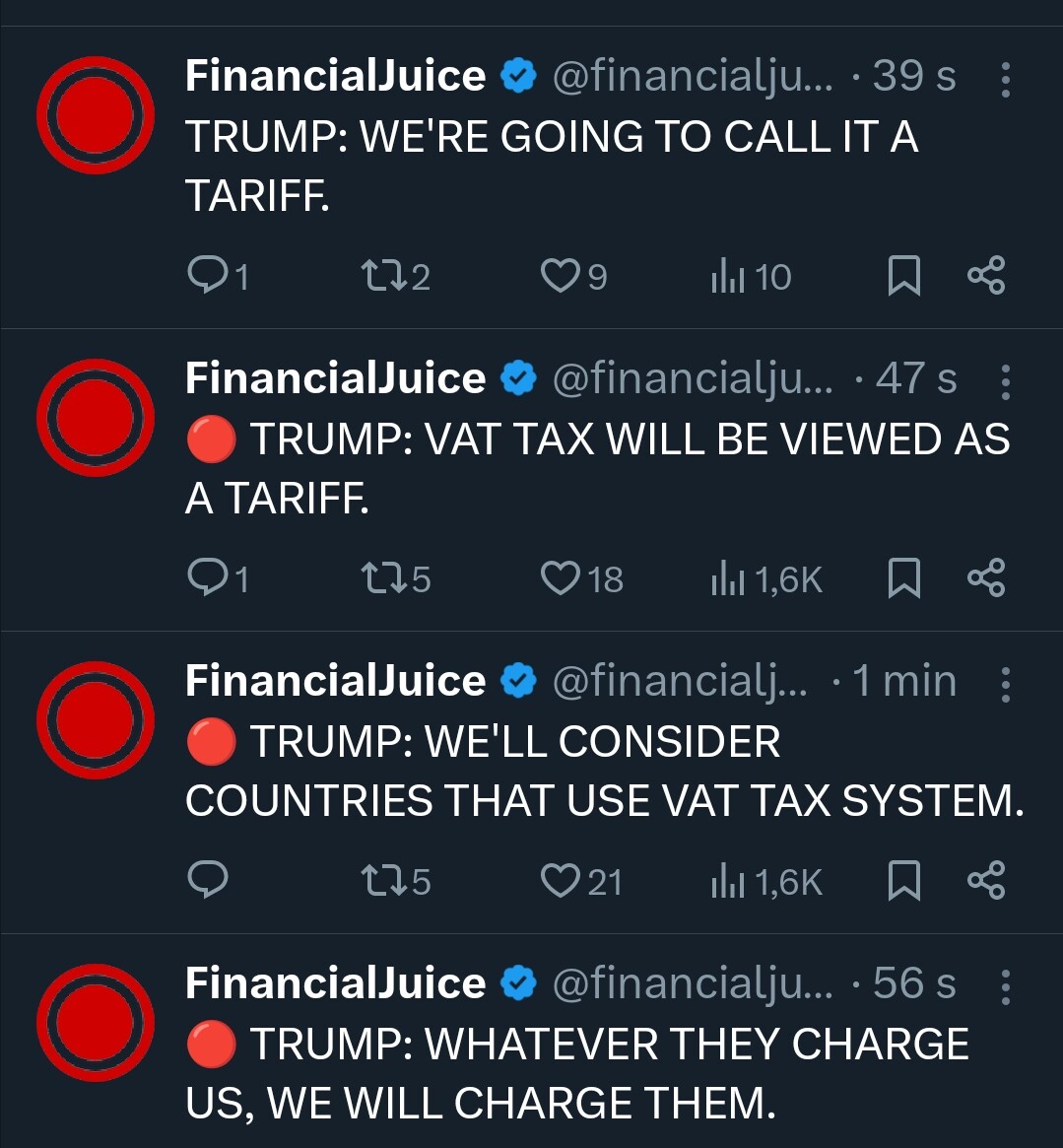
Edit

Bullish?
6 Likes
The same thinking can be applied to stock portfolios. Temporal layers tell, among other things, about the results of the corona panic, the zero-interest rate era, and Helsinki stock picking. And there is always a disreputable slum area, the so-called pipe-damaged renovator’s dreams, whose market value the owner refuses to accept.
1 Like
What does that “VAT tax will be viewed as a tariff” mean? The EU average VAT is about 21.8% with a quick Google search, so would the Americans slap a similar tariff on goods coming from the EU? But at the same time, they’re boasting that EU tariffs are only 2.5% and a big win. What’s going to come of this now..
1 Like
Yes, what’s completely missing there is management’s critical evaluation, i.e., foresight, regarding their own competitiveness and profitability, meaning knowing how to react when the result plummeted.
But those big shots always land on their feet if they’ve received millions in salaries and bonuses, so it’s probably all the same to them even if they get fired. They should pay performance-based compensation, not just bonuses, meaning paying for results afterwards.
Well, then you won’t get the best-paid ones  …
The difference between foresight and reaction can be well considered, for example, through a ‘shit emergency’…
1 Like
I was just calculating the portfolio holdings. Of the stocks, Evo and Optomed together are 102%. I should probably lighten up a bit…
Of course, the ETF portfolio is separate, but still.
15 Likes
I only have evo at 130%, but I’m not interested in selling at these levels. I would probably sell the leveraged holdings from around 1200 SEK.
4 Likes
150 users have already clicked the citizen’s initiative link in the forum members’ charity event thread!
Great! Warm thanks to all who signed the citizen’s initiative😊
4 Likes
Saku, you had an error there, so I corrected it. 
14 Likes
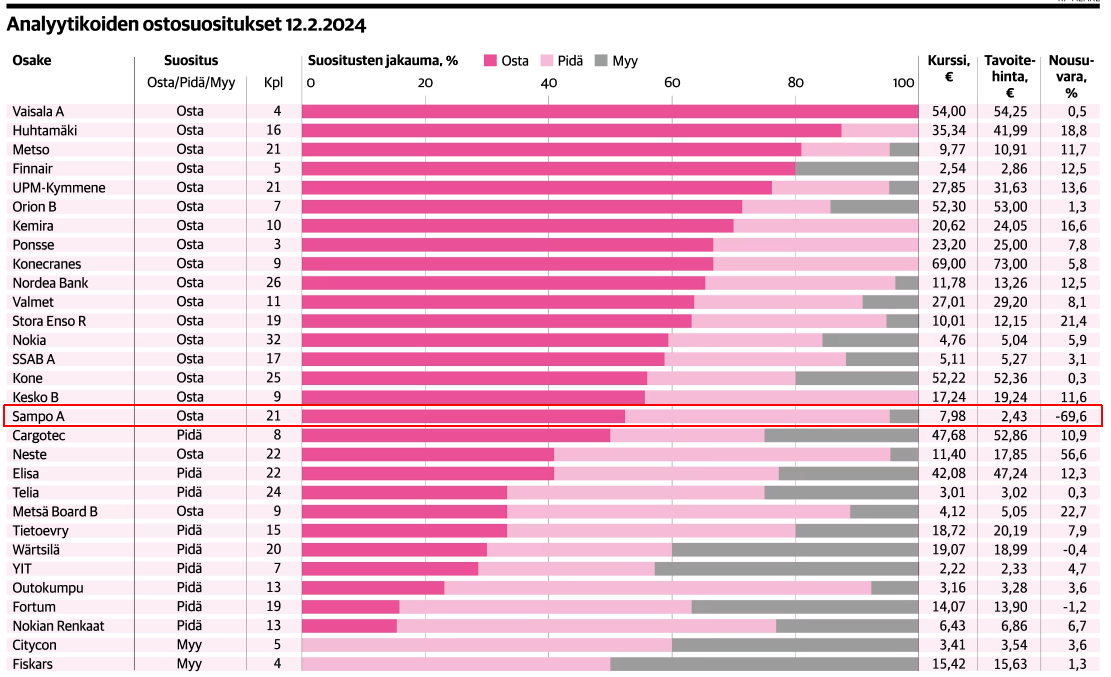

Does this now mean that Sampo’s shares must be sold off? 

6 Likes
No. It means that, according to the recommendation, you should aim to buy it at €2.43.
4 Likes
Were those purchase recommendations made the day before yesterday or over a year ago, as the screenshot claims..?
1 Like
The screenshot itself is from today’s Kauppalehti, who knows if those recommendations are from a year ago or last Wednesday. Kauppalehti - Guaranteed Quality™
1 Like
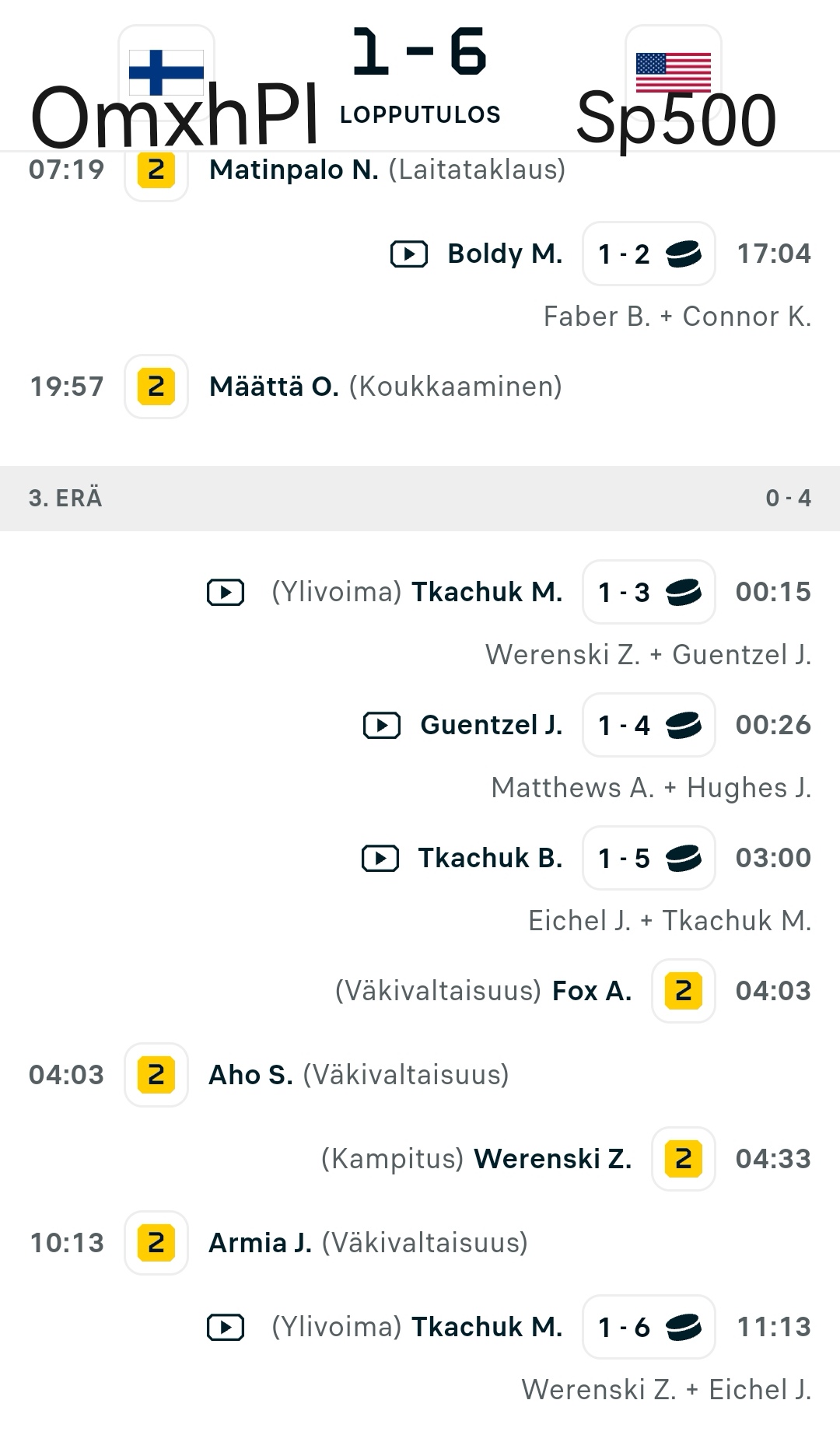
It really paid off to stay up 


36 Likes
Luckily, Joni at least kept a break of over two months, so that the reason for his attitude towards Siili wouldn’t be so obvious. 
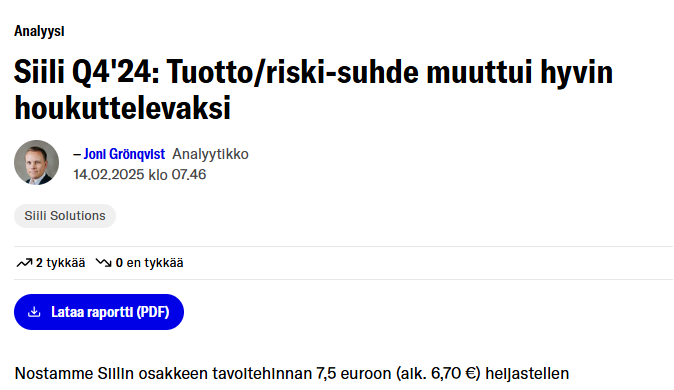
@Pohjolan_Eka, isn’t it true that if you’ve owned something, you can’t become an owner of it again and then you can complain when it messes up? Regards, ex-Biohitist, Konecranesist, Harvesterist, etc. 
11 Likes
EV/Sales 0.4x… I haven’t looked into this stock market’s hottest sector for a while, but maybe I should take a peek in that direction.
7 Likes
Well then, nothing else but sign here! Price 0e with a taillight warranty  Thanks and bye!
6 Likes