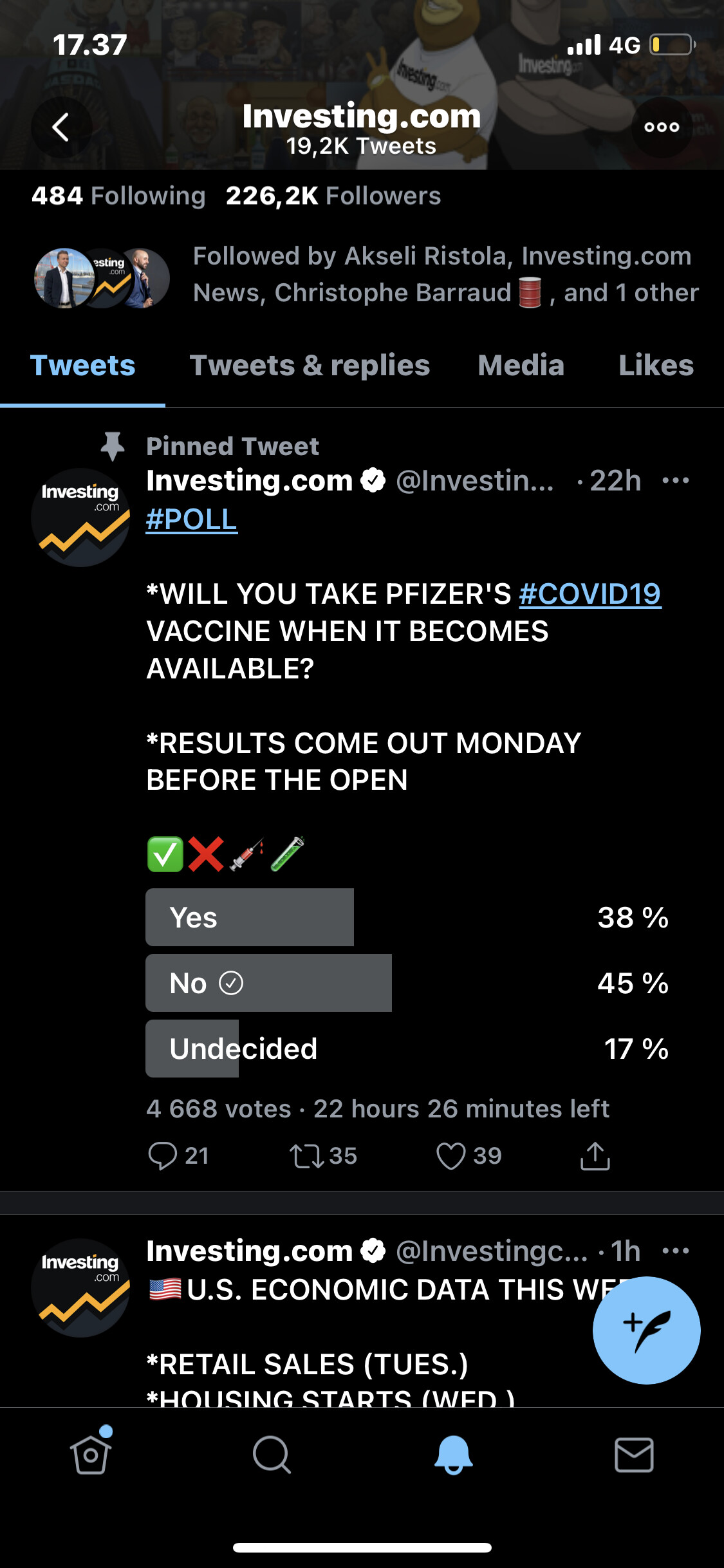
Has there been any discussion about this? Eradicating corona won’t speed up when people refuse to get vaccinated and continue to spread it in the environment. This will certainly not have a positive impact on the markets.
It seems that most of the respondents on Twitter are not in a risk group, at least not the elderly. And if 38% were to take the vaccine, it would provide herd immunity. Would I take the vaccine myself? I’d rather let the risk groups have it first, even though I trust the vaccine.
Didn’t the vaccine specifically provide protection to the person who received it? Now, the problem with masks is that the mask user protects other people from themselves, but cannot protect themselves from other people? The vaccine reverses this. If someone is so… “unkind” that they don’t get the vaccine, it doesn’t cause a problem for a reasonable person.
1 Like
@Passiivinen_Indeksim - There are plenty of these “nice, sensible people” in grocery stores and cafes right now, maskless, loudly criticizing weak-willed mask wearers. Because I am a wicked and evil person, I hope that someone I encounter who deliberately coughs in a crowd gets a moderate COVID infection. 
4 Likes
@DarkRoast It seems you have your terms mixed up. Strong authentication refers to authentication methods where an external entity verifies your identity. Examples include a bank or an operator. I don’t see a need for this after the user’s initial authentication has been done. In fact, even mobile banking can be accessed with just a username and password.
Yes, “strong authentication” generally refers to a single operation (e.g., login) occurring securely, for example, using two different methods (2-factor authentication). In this case, the service being used “strongly” authenticates the user behind it. Fixed username/password combinations do not meet this requirement, for very obvious reasons. I don’t know if stock brokerage is less regulated than banking services, as it seems to work with just username/password pairs.
When setting up accounts, it is certainly necessary to verify the user’s identity; some attacks have even been carried out by creating accounts with stolen identity documents. I believe a driving license is no longer accepted for creating accounts.
I disagree that strong authentication is not needed when using (banking) services after creating accounts. In (Finnish) online banks, you cannot transfer money out without confirming the operation with bank IDs. The best way is to use an authentication application or a mobile certificate. Paper password lists are starting to be phased out and have already been removed, for example, in Nordea’s case.
1 Like
What are the benefits/drawbacks of this negative working capital? Can it be simply considered as a rolling 0-interest debt that the company has received? Can someone elaborate a bit?
I’m mainly thinking about the point where customers pay immediately and the company’s own invoices have payment terms of probably 14-30 days.
1 Like
It is, by its very nature, a hell of a bad practice.
Usually, these payment term deteriorations are made during economic downturns, as if subcontractors wouldn’t have other difficulties then.
Difficulties arise especially if it’s also a long lead item for the subcontractor.
I’ve been wondering when we’ll move to payment terms of a couple of years, because why not?
Negative working capital is a great thing if a company has it. It allows a significant portion of the profit to be paid out as dividends even as the business grows.
Most companies do not have negative working capital, and therefore, as they grow, they have to finance the increasing working capital needs in some way. Either by allocating part of the profit to it or by using external capital.
Stretching payment terms was just a caricatured example to illustrate a broader point. The old Outotec was an example of a company with negative NWC. It received payments for large projects from customers well in advance of the costs being committed to a multi-year project.
Negative NWC only becomes a curse if the business starts to shrink. In that case, the contraction of the business ties up more capital.
3 Likes
This working capital dynamic, combined with the cyclicality of the mining industry, made Outotec such an exciting stock. When things went well, they went really well, and the cash register was overflowing. When things went badly, they went really badly, and the cash register was completely empty.
2 Likes
That is also a very significant burden in a crisis like this. You can get more information on this from NOHO, for example. The main benefit is that you don’t need as much external debt, as you can finance it with cash flows generated by your own operations. In principle, you borrow money from the parties to whom your expenses are directed.
This is practically realized precisely in the restaurant industry, airlines, large retail stores, online companies, etc. For example, Amazon has been able to use a negative working capital cycle for growth.
2 Likes
I came across this by chance. In the US, there’s even a concept like having too many stocks in your portfolio 
4 Likes
In the US, retirement savings are often mostly self-funded, so going 100% into stocks is a pretty big risk. Imagine if you had been forced to sell at the March lows just to fund your own life  Traditionally, it has been recommended to gradually shift from stocks to fixed-income products as the saver ages. However, now that fixed-income products have recently yielded poor returns and boomers haven’t found alternative investment products, it’s no wonder that the proportion of stocks is too high.
4 Likes
On the other hand, time diversification also works when selling. In the grand scheme of things, it wouldn’t have made much of a difference if, for example, a month’s living expenses had to be withdrawn at the March lows. Assuming, of course, that the portfolio is large enough to be intended to fund one’s living solely through it.
4 Likes
Combine this with the world’s most expensive healthcare and COVID-19. Sometimes, expenses don’t want to be diversified over time, especially in that “best country in the world.” Newspapers have occasionally sensationalized stories about medical bills amounting to hundreds of thousands last spring. Now, apparently, the state is already covering the costs.
1 Like
If I had built a typical retirement portfolio of defensive dividend payers, it might contain many companies whose stock prices have not yet recovered from the Corona crisis. A stock sell-off can last for several years, which is why dollar-cost averaging when selling is not a silver bullet that solves the high risk/volatility of stocks. In general, such a V-shaped index Flash Crash in March is quite exceptional, if one looks at history a little further back. It is entirely possible that the next crash could last, for example, 5 years, before prices recover. It would be quite painful if one had to sell savings accumulated for the rest of one’s life at a significant discount.
2 Likes
Combined with dividend cuts or suspensions. For example, former dividend aristocrat Shell cut its dividend by a third. The first cut since the Second World War. Combined with a -50% YTD stock price. Hopefully not too many people’s pensions were 100% in this.
6 Likes
According to the study, Morningstar’s lowest ratings - one or two stars - predicted quite well that a fund’s performance would remain weak in the future. However, the predictive power in the higher categories proved problematic.
So, there is some predictive power in these, as the poor ones will continue to be poor in the future.
3 Likes
When your portfolio hasn’t had cash for ages.

… And when you’re thinking about where to free up money for cash/a new stock pick.

45 Likes
When you haven’t had any stocks in your portfolio for a long time.
…And when you wonder how many double-digit price increases you’ve missed while waiting for a crash.
48 Likes
Life is hard for bears (short sellers). Yes, I admit that a cash slice (short position) has been opened again, and maybe it could be a bit more, but…
3 Likes