In a hurry, I bought at 17.20e in the morning rally In what timeframe can we expect a rise to 20e/share…
I feel like lightening my portfolio even further, based solely on the vibes I’ve been getting from this forum since summer. Is this the time when everyone has started buying stocks, the ‘Shoeshine boy’ story repeating itself almost 100 years later? All new investors have paper hands and a new downturn is about to begin, when GDP and stock prices run head-wet in different directions?
You said it. The news is full of how easy it is to buy stocks, coworkers are raving, people at surrounding tables in the cafe are talking about how easy money stocks are, a friend’s date partner praised their stocks, the internet is full of trading ads… what else…
Oh right, plus information about how small investors are buying like crazy and big players are slowly leaving the market and some have left completely…
Yes, today feels clearly traumatic when indices dropped by as much as one percent from yesterday and for the first time in a week, there’s any significant redness.
And then we zoom out to the bigger picture and realize that we are still just under ATH levels in the S&P 500 index, and even a further 150 points down would only be a healthy correction.
And if you look at the indices after the corona dip, it’s true that Stonks Only Go Up. Every dip has been bought up in a few days. My guess is that there’s still so much money “on the sidelines” that every slightly attractive buying opportunity brings more of it into the market, and a bigger correction would require something very dramatic.
Edit: And just like that, this dip was also bought up. It took a day, and now the S&P 500 is back at 3380+ levels.
I also think it’s quite possible, given that there are likely many new investors out there, that even a small correction could easily turn into a bit of an overreaction when panic strikes with collective force and credit limits are breached
But generally, a larger downturn/correction would require some completely new reason that comes almost out of nowhere and truly frightens people.
Or does it really? After thinking about it today, I came to the conclusion that a stock market crash happens when investors’ faith in stocks collapses - this has nothing to do with a company’s business or how well it performs, and that’s why even good companies come down with it. So all it takes is for people to see some factor in the market (e.g., Robinhood traders) that undermines confidence in the rationality of stocks.
Yes, but someone has to cause that trust to collapse. It doesn’t disappear out of nowhere. Stalling consumption, for example due to a lack of a stimulus package in the US in the coming months, could cause some minor pressure on the current exchange rate level, but even that is not enough for a collapse. There has to be some factor that would affect stock exchange companies’ ability to make a profit now and in the future very negatively. Or at least a widespread belief in it.
If some factor frightens risk capital away, then we’ll go. Even one big drop day might be enough to scare investors. On the other hand, the biggest cowards, i.e. professional investors, who didn’t join the rally then, are probably now maturing for the markets, and what would make them go back into their rabbit holes? Now that the markets have also received new information about companies’ resilience and ability to adapt to the new situation, there is hardly any danger of the same kind of uncertainty and fear without new big lockdowns or other unexpected big turns. And even then, will there still be the same kind of uncertainty for all companies? But what factor would scare them?
There have been a bit too many of those normal days lately… For example, Metacon has dropped almost 40 percent in about a month. Someone needs to tweet a bit
The ones I own and follow have been unpleasantly sawing back and forth, meaning I had decided that in the short term I wanted to add to all of them, but they haven’t dropped enough, nor risen enough to let them be. And I do intend to own some for longer, but I was planning to buy a few soon and get rid of them this year… That hasn’t progressed.
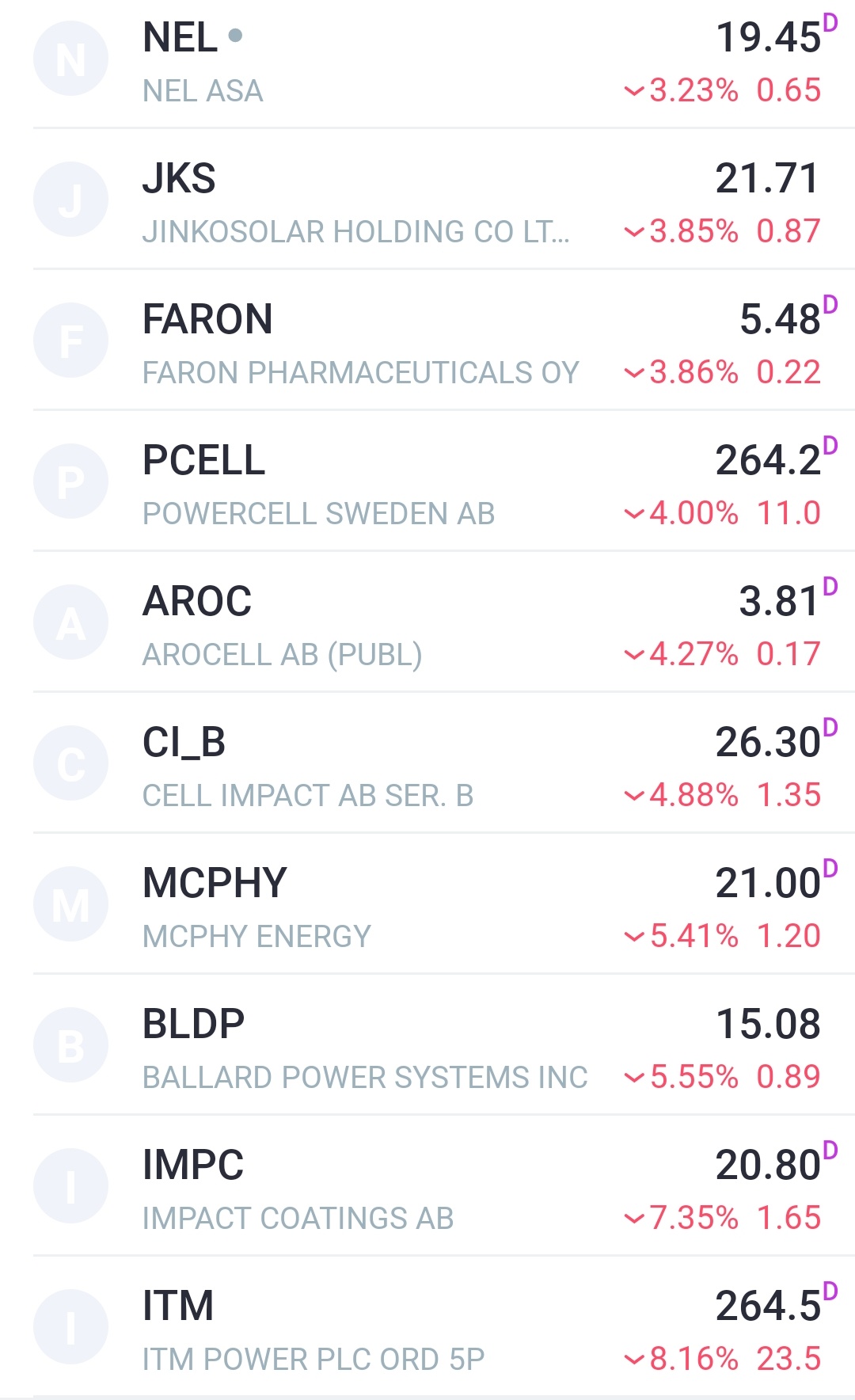
Examples of the sawing include NEL, Powercell, Fuelcell, Mcphy… Of these, all but Powercell I’ve considered holding for a longer time.
Similarly, I’ve been hoping for a dip in Dynacert, Faron, Sampo (below 30), Nokia, and Enphase. But they are all moving in an area that doesn’t trigger any actions.
I added a bit more Fortum yesterday when it went to €16.9, because I expect it to bring a lot of added value in the long term.
Let’s continue here so that Fortum’s own thread doesn’t become a general solar power production & storage thread.
@Tatu Could you briefly explain how the surplus production of your solar power can be utilized within your own system, if you don’t have an electricity storage (battery)? Of course, you can heat up a hot water tank anytime, but for example, in the summer when you are on a holiday trip with an electric car or at work, then…?
I’m very interested in this topic, as next week’s task is to hire an electrical designer to plan the electrification of the future residence
The clamp meters at the main switchboard monitor whether you are selling electricity to the grid or buying it. The settings allow you to direct “surplus solar power” to your desired destination. I use manual relay control to direct “free electricity” wherever I want. It’s worth buying this system directly from England to save a lot on the purchase price. At least 2 months ago, it was the best system the market offered.
Everything can be made to work wirelessly if the distances aren’t too long. I had to run some cables because the distances are longer on the farm.
But this clearly doesn’t solve the problem that when solar power should be most abundant during the day, it’s challenging to use. The electric car is being driven, laundry and dishes don’t magically jump into machines (which I don’t dare to set on timers to start when the house is empty due to fear of water damage), etc.
So, I still cry out for a battery pack. Or such a massive battery pack for an electric car that once it’s fully charged on a hot summer weekend, I can drive it for the whole work week
Yes, it solves it. A large hot water tank heats up during the day (or an electric car charges). Of course, if the car is only home in the evening and at night, the sun doesn’t help without batteries. I can charge during the day.
Is the system smart enough to, for example, first push electricity to the hot water heater, and once it’s heated (and the car’s battery charged if present), recognize that all consumption points are maxed out, and then start feeding electricity for “sale”?
Doesn’t the inverter handle this without any special tricks? The equipment is in parallel with the national grid and pushes constant power (=available production) to the point of use with correct parameters. This, of course, means that the point of use does not draw electricity from the grid company (assuming production is sufficient). At the point of use, water heaters warm up, the car charges, etc. When consumption decreases and falls below the amount of production, the excess production goes to the national grid. Why resort to relays?
In what timeframe can we expect a rise to 20e/share…