Well, at least we got one earnings warning that is not in Inderes’ model portfolio 
34 Likes
SEB’s comments:
Olli Koponen summarizes my own thoughts quite well. Project business is cyclical. Hopefully, better cycles are ahead!
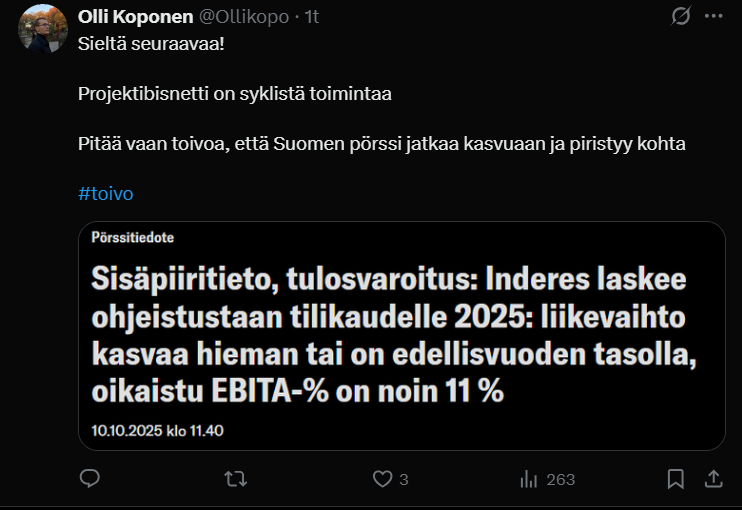
26 Likes
We are quietly building a world-class product. However, not enough money is directed to sales and marketing to achieve hockey stick growth.
What kind of marketing should Inderes direct more money towards?
Hasn’t Inderes, however, steadily increased its headcount over the years, i.e., invested? Apparently less during the current year, but the trend is likely still upwards. Share buybacks would certainly be desirable at these price levels.
7 Likes
If it’s alright, I’ll answer this by taking a slightly broader approach to explain my thinking more clearly.
A company’s natural life cycle involves growing organically to a larger scale when younger, and then maturing into a profitability-focused enterprise that seeks to maximize the annual sum of money returned to owners. Growing revenue never comes from nothing, so growth requires capital investment, which directly reduces shareholder dividends, in order to get a larger sum of money back as new business in the future. Growth investments can be used either to capture a larger share of existing markets or to expand the company’s total market. Additional growth becomes progressively more difficult because the company has to run faster and faster to achieve the same growth percentages as the absolute amount of revenue grows to a larger scale and the available market share to capture diminishes.
As growth slows, a mature phase is eventually entered, where the company’s investment narrative begins to emphasize profitability, and this kills future growth potential, as significant growth investments practically always require compromising profitability. Inderes is a mature company whose public goals include annually increasing dividends and exceptionally high profitability. Typically for a Finnish company, growth investments have been restricted at a very early stage, and even though many CEOs of Nordic listed companies have never heard of Inderes, instead of hiring sales personnel, 9 million euros have been distributed as dividends to the company’s owners over the last 5 years.
The faster organic growth phase of Inderes’ Research and Events side is now permanently over, and restarting it would require exceptionally drastic changes to the organization’s operations and stated profitability targets. Flat expert organizations, in general, face significant growth problems at the latest between 100 and 500 employees, because employee happiness is maximized, and they no longer have any incentives to take the risks required for growth. Active public communication and the cultivation of a strong unified culture have solidified the organizational structure into its current form, and Inderes has neither the ability nor the desire to go through a painful change process to make its organization more hierarchical in the way required for faster organic additional growth.
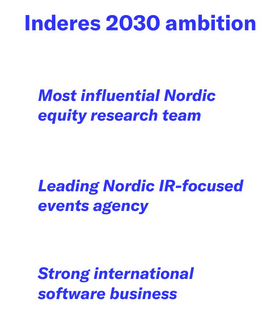
The excellently organized Capital Markets Day 2025 event was a good example of a mature company’s communication. Inderes recorded the organization’s ambitions for 2030, and everyone surely noticed that the stated ambitions completely lacked genuine ambition, leaving only abstract platitudes, which are usually hidden on the “mission & vision” slide in the organization’s intranet:
With the organic growth path blocked, inorganic growth remains. The challenge lies in finding suitable acquisition targets and Inderes’ exceptional corporate culture, which makes finding targets, negotiations, and integration challenging. Inderes also knows that most acquisitions historically fail, so not much future growth can be expected from this path either. Especially since Inderes carefully guards its own corporate culture, equal mergers or mega-deals are ruled out.
The biggest question mark at Inderes currently relates to the company’s software business. Inderes’ experts have succeeded in creating world-class software solutions, which in a positive scenario could well be more valuable than the entire current Inderes combined, but Inderes unfortunately may not be able to capitalize on this opened opportunity.
The software business operates with completely different logic compared to the expert business, and Inderes’ organization is not currently in a mental or strategic position to aggressively invest in maximizing software sales in Europe and America. With the current insufficient growth investments, the software division will still experience excellent strong growth for a few years by selling to existing customers with a low barrier to entry, but without significant additional investments, a similar growth disappointment as seen in the Research and Events side will soon be experienced, leading to a premature shift to profitability enhancement and the product’s mature milking phase, leaving the majority of the markets to other players.
At this stage, when something could still be done, I would personally recommend spinning off Inderes’ software business into its own company. This Inderes Software Oy should quickly seek external funding through targeted issues to Finnish private equity investors, from whom significantly more capital for growth would be obtained, and from new owners, valuable experience and expertise in rapidly scaling a software product to global markets, which Inderes currently lacks. Research and Events could be left as they are, as dividend-generating machines for happy experts, without any major changes to operations and activities.
Inderes is still the best thing that has ever happened to the Finnish investment scene and certainly one of the best employers in the industry for its employees, but if I look at the company purely through an investor’s eyes, then a few activist investors would be needed on the board to shake up the current structures, sharpen operations, and challenge the current organization to aim higher and embrace problems with big, intimidating goals.
81 Likes
Admittedly, when looking at the stock price, there is some truth to your writing. However, the world is complex, and making investments doesn’t always appear very straightforward within a company – that is, as profitable investments made with a reasonable return/risk ratio. The conquest of Sweden is a good example of this, and it hasn’t gone very well. So, the question isn’t always just about the desire to invest, but also about being able to execute investments well.
Perhaps more gas should be pressed in other Nordic countries too? With my previous message, I was looking for concrete examples of what would be practical, sensible investments with good upside relative to risk.
This is so that the discussion doesn’t remain solely at the criticism level, but rather guides the conversation in a constructive direction.
14 Likes
Growth will come in due course when the IPO window opens properly. The difficult thing about it is that it makes business development cyclical and growth is conditional on capital markets.
8 Likes
I don’t feel I have much added value to offer in the discussion about how growth investments should ultimately be carried out in detail at a practical level. Fortunately, the company has a highly paid operational management whose role is to worry about the details of execution every single workday. We investors can better comment on Inderes’ strategy and whether capital is allocated in the best possible way between different targets, as well as the distribution of profits to owners.
This would therefore be market cycle fluctuation, not actual growth, unless the market as a whole grows beyond the cycle. To achieve genuine and meaningful growth, new markets should be opened, especially outside the Nordic countries.
21 Likes
Well, not in detail, of course, but at least with a broader brush. As an entrepreneur myself, I might easily be interested in considering things from the other side of the table, even though I don’t have anything detailed to offer either, of course. But perhaps it’s wise to let the matter be and focus on the investor’s perspective, as you noted.
7 Likes
Why not use the “cash cows” you mentioned to finance the growth of this software business? I see no point in spinning it out and giving away stakes in what is potentially the company’s most valuable part to external financiers at the expense of current owners.
Inderes has specifically added this fast-scaling software business expertise to its board. So far, we only have evidence of exceptionally rapid growth for this new business, built from scratch. I don’t understand the basis for the claim that the company lacks the expertise to scale this business. So far, it looks excellent.
In my opinion, it’s completely absurd to state that the organic growth phase has now permanently ended. Especially the Finnish economy has been sluggish for several years now. Despite this, the company has managed to grow, albeit moderately. Wouldn’t it be more likely that growth continues in a normal market environment? In Finland, limits will naturally soon be reached. The importance of success in Sweden cannot be overemphasized, as the company has chosen it as its international opening. If Inderes succeeds in opening the game in Sweden, the company’s faster organic growth phase is only just beginning.
25 Likes
@studentcoverage_team Sami and Vilho have given their comments after Inderes’ negative profit warning. 
Inderes issued a negative profit warning and lowered its guidance for the current year on Friday, October 10. The company now estimates revenue to grow slightly or remain at the previous year’s level, and the adjusted EBITA margin to be around 11 percent. Previously, guidance was for revenue growth and margin improvement from the previous year (11.6%). The decline in guidance is due to weaker-than-expected project revenue, which has particularly impacted the event business and Swedish operations. Continued cost-saving pressures from customers have led to large events being scaled down and productions being postponed, which has weakened the outlook for the end of the year.
13 Likes
I’m sharing this in this thread as well:
The fifth “Life in the Committee” article has been published. In the dry text, I go through the results of the board survey conducted for the community. The most amusing part of the article is the summary made by artificial intelligence. “In our view…”
13 Likes
I believe I did answer the topics you raised in my message, but let’s try again.
So, my central thesis was that the cash from the ‘cash cows’ cannot be used for software business investments because those funds are already allocated to dividends that grow annually according to the strategy. As an additional note, the company also has a strong aversion to utilizing debt leverage, so not much loose capital is left to be directed towards growth.
I made a ‘slightly’ exaggerated image to explain what I think is wrong with this equation:
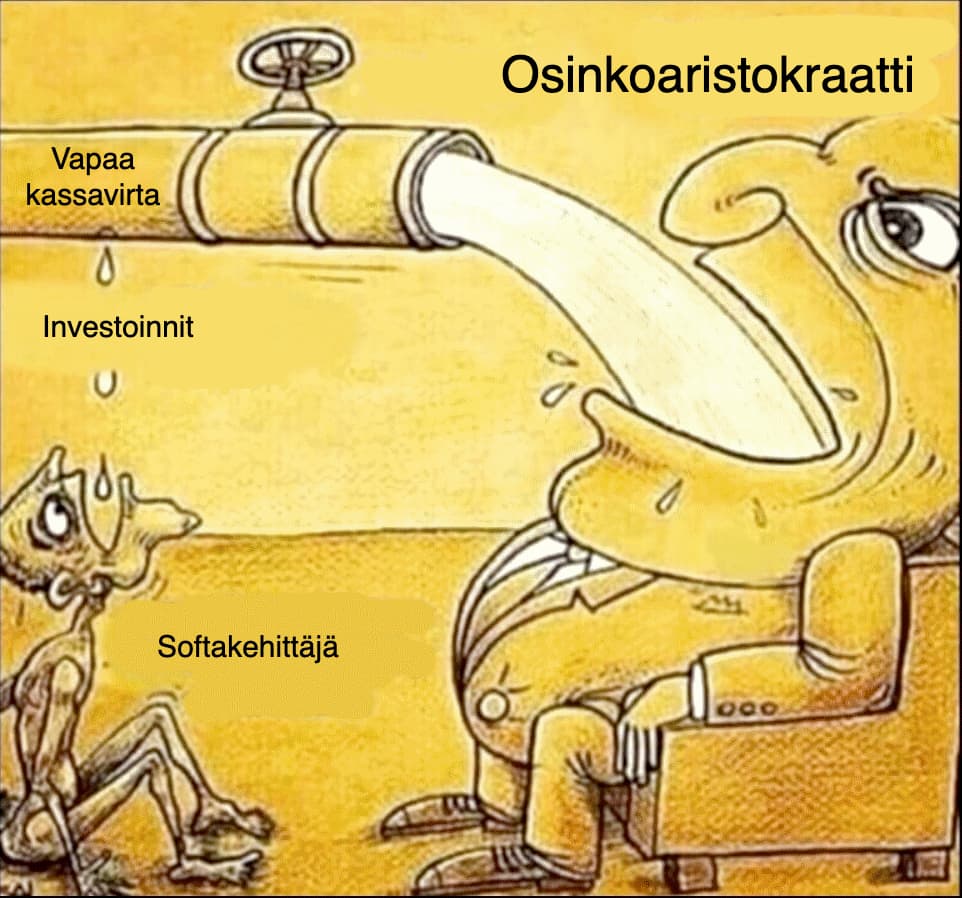
These roles should be swapped, and only minimal dividends, or preferably none at all, should be distributed as long as good investment opportunities are found.
So far, Inderes has not demonstrated the ability to expand its business organically in an international environment, and growth has been strongly driven by acquisitions (e.g., Financial Hearings and Streamfabriken). Expertise will certainly be gained from new board members, but it is difficult for a people-driven expert company to transform into a software-driven company, and there are many cautionary examples in the stock market of the challenges of similar situations. For example, Talenom, Solteq, Vincit, and Fondia. Talenom, most recently, is finally separating its software side into its own company, but Inderes, of course, does not have to repeat the same mistakes; it can also make that separation at an earlier stage 
Spin-offs create value by enabling the right kind of organization and focus on the company’s core business. With the current organizational structure, it is completely impossible for Inderes to expand, for example, into the critically important US markets, because the Events and Research sides could never be scaled up there, whereas from a Software perspective, such expansion should already be starting now to maintain strong 30%+ growth for the next 10+ years.
I don’t see a connection between the Finnish economy and organic growth, even though some temporary tailwinds are expected from the cycle in the future, and high inflation has enabled larger-than-usual price increases in recent years. There is very little left to gain in the Finnish market, unlike, for example, in Sweden, so significant permanent growth is unlikely to be achieved in Finland.
Revenue does not come from nowhere; faster organic growth in Sweden fundamentally requires larger growth investments than currently. Small growth investments are being made now, so only small organic growth is to be expected in the future, even if that small growth certainly has a long tail due to the large size of the market.
32 Likes
I agree that Inderes should invest to overcome the bottleneck caused by the Finnish market. However, I don’t believe that the current dividend policy prevents investments. Last year, Inderes distributed €1.6M to its owners (€1.485M in dividends, €0.15M in share repurchases) from approximately €3M in cash flow, but only invested about €0.3M through the balance sheet. My assumption is that most of the so-called investments come directly into the income statement as personnel expenses.
As an owner, I am satisfied with Inderes’ aversion to utilizing debt leverage. The software business has been built in the background for several years. You mentioned in a previous message that world-class diamond products have been made. These investments did not require a separate private equity investor or massive debt leverage. Why now? I assume that investments need to be increased, but I see no reason why the current model would not support making the necessary investments.
I recognize the challenge you mentioned regarding the company’s transformation. But the same change would have to be made as a spin-off, wouldn’t it? Inderes has tackled this during the current year by breaking down the organizational structure into three separate business units with their own go-to-market strategies. Presumably for precisely that reason, so that the whole cannot be taken to every market. I also hope that Inderes takes steps with its software business towards the US market, where the potential is enormous. The current strategy supports this possibility.
26 Likes
How did you conclude that there is no investment in the software side? Or that not enough is invested in it? To my understanding, the software side has precisely been the growing part of the business in the last couple of years. 
7 Likes
I think this is a very good challenge from Eka. As a minority shareholder, I would hope for growth investments, e.g., in the software business, instead of dividends.
At least the company is transparent to investors about its values and principles, e.g., not wanting to grow too fast, preferring to be good rather than big, etc.
But do these principles work optimally in the context of the software business?
10 Likes
I can’t help but put my spoon in this soup; within the quiet period, I will keep the discussion at the industry description level, and all figures are publicly available information. However, I see it as important to bring in some context about where this industry is going and more specific facts about Inderes’ background as well.
[quote=“Pohjolan_Eka, post:2398, topic:17104”]
instead of hiring sales personnel, over the last 5 years, 9 million euros have been distributed as dividends to the company’s owners.
[/quote]Eka, you sometimes have a somewhat high-flying way of picking only those bits of information that support your chosen narrative 
Here, for example, you omit to mention that at the same time we have invested directly 12 MEUR from the balance sheet, on top of which product development investments of approx. 4 MEUR have gone through the income statement. This has largely built the foundation for international operations and the current software business. Profitability has unfortunately almost halved along the way, partly due to investments, partly due to their failures, and partly due to the cycle turning. And a significant portion of that 9 million is also share repurchases. Those could have been invested too, but I’m not sure if that would have led to a better outcome for the shareholders.
As a shareholder, I could equally be critical of the fact that at the same time as so much has been invested, these investments have only managed to slightly more than double the company’s revenue (which is not remarkable growth in 5 years); furthermore, significant top-line growth has been stagnant in recent years and the bottom line has not developed. Market shares, however, have grown significantly as we are growing in a shrinking market (this mainly lays the groundwork for later value creation, but market shares don’t pay dividends yet ).
Regarding sales. This portfolio of approx. 430 listed company clients (plus a huge number more through the partner channel) was not built by simply waiting for orders next to a fax machine. We know quite well how to sell to this rather critical niche customer base, and if the equation were as simple as just hiring more salespeople, we would have already done it. Nevertheless, every day we rack our brains for faster go-to-market models to unlock vendor locks, entrenched processes, conservative operating models, etc.
But equally, the idea that we could push the gas pedal more, especially once the recipe for international growth is found, is possible. I admit that we are characterized by making relatively considered investments, rather than pursuing hockey stick growth with extreme risk-taking, aiming for all or nothing. Our appetite for risk generally increases with leverage as the scale grows and as soon as we achieve successes. Our philosophy is to rather grow steadily by 20% per year for 10 years than to aim to become a unicorn in a few years (both are perfectly valid ways to build a company!). Dividend distribution can and should still be questioned in the future. Good to hear that shareholders have support and faith in investing in the business!
An essential part of this discussion is bringing in the industry context and customer perspective, which @Timo_Huhtamaki has commendably brought into the discussion earlier. We could certainly be better at describing it in our own communication, so I’m taking this opportunity to outline it now that curious eyes are presumably present. In my opinion, this is a crucial theme from the shareholders’ perspective. This is a very narrow, nascent market, so it’s understandably difficult to grasp the industry context from the outside, and most of this work is not visible to the community in any way.
My view is largely based on hundreds of hours of presence in the field with customers, in our teams, and in various industry forums, as well as on public information about what has happened in the sector. So now we are talking about the IR (Investor Relations) market, which accounts for approx. 60% of our revenue, and this portion of Inderes has been largely built with investments made over 5 years (alongside milking the dividend machine). This is a slightly different game to play than the analysis market, but strongly synergistic with our analysis business.
The IR industry is undergoing a global transformation, where a new category called IR (investor relations) is only just emerging. This is a very young market. In my opinion, a transformation is currently underway in customer buying behavior, technology, and the competitive landscape.
In the first phase of this transformation (present moment), customers are consolidating their purchases to fewer providers in the name of efficiency and simplicity. Point solution providers and generalists (often compliance/governance or communications-background generalists who also do IR) are falling out of this game, or specialists are becoming targets for acquisitions (a significant M&A wave has been seen in the sector). Those selling bundled packages are succeeding, and partly with this, we are also beating all international competitors larger than us.
In the second phase, the offering technologically integrates into a single user interface, data flows through the solutions, and synergies between products are realized. In other words, a kind of IR enterprise resource planning (ERP) system is built, allowing all key IR processes to be managed through a single user interface. Inderes’ IR Suite addresses this. Furthermore, only one global player in the industry has presented a similar type of solution. The space is becoming increasingly tighter for generalists.
In the third phase, when all key IR functions and related data run on the same platform, it will be possible to start building truly value-adding AI agents that will begin to automate those IR work processes that are no longer worth doing manually. A big leap in customer productivity will be achieved.
So our ambition is no less modest than to be one of the winners in this transformation at an international level. And if you consider that such a small shop from Finland is setting out to build this case, facing some global houses (some gigantic generalists pushing into IR) as well as private equity-backed competitors, then there’s quite a bit of ambition involved. At least for us, just enough.
In the industry and customer context, it is essential to note that Events and Software are quite tightly interconnected businesses, both at Inderes and with many of our main international competitors. In a scenario of differentiation, both would lose their competitive advantage, perhaps even significantly. From the perspective of ongoing purchase consolidation / bundling of offerings in the industry, these are an integrated part of the offering in our chosen strategy. Events generates a vast amount of data that feeds back into the software. If customers buy these together and it is more sensible from the customers’ perspective to integrate the offering tightly rather than separate them, then that is the direction we are heading. Furthermore, an increasingly larger portion of volume activities on the Events side will be more software-based in the future, meaning that boundary blurs. Overall, categorizing Inderes’ Events or even Research as purely expert work, as you suggest, contradicts what we actually sell to customers. The reality of all businesses is some kind of activity operating in the ‘tech-enabled services’ landscape; some scale, some less so, and a large part is currently unscalable but will be made scalable in the future. (It’s impossible to put Inderes’ parts into ready-made categories, as evidenced by Nasdaq placing us on the Consumer Digital Services list alongside Netflix).
We aim to build Inderes and its offering according to what best solves customer problems (even if sometimes it means we do less scalable things), and the current software offering has largely been built on this premise. Still, we try to avoid following what is currently beautiful, scalable, and glittering in the capital market. When the customer (and the customer’s customer) is forgotten from the equation, we often go astray. Of course, it is part of continuous strategic work to assess to what extent these different business operations are kept separate and together, how the overall entity should be managed, to what extent go-to-market is done with sharp choices vs. a broader offering… big questions! The preceding explanation describes the current view of the market and how we position ourselves in relation to it. And this relatively strong vision of where this market is headed can, of course, turn out to be completely wrong.
Your presented dividend rant aligns with the prevailing narrative in Finnish media that criticizes companies for lack of growth, and is a textbook description of typical company development stages. However, in my opinion, it misses the mark in that this team and Inderes is anything but a typical company😊
120 Likes
And that’s what every parent says about their own child
41 Likes
Well, now with explicit permission, or rather, even out of necessity. Conveniently on dividend day.
As an owner, I would hope for more flexibility from the management and board regarding the ratio of dividends to share buybacks in profit distribution, based on Inderes’ market price. If Inderes can be acquired from the market at a lower or significantly lower price than its intrinsic value, I would hope for a larger allocation to buybacks and fewer dividends.
Profit Distribution: Annually growing absolute profit distribution, which includes dividend distribution and share buybacks (unchanged).
As I understand it, the aforementioned company’s profit distribution policy would allow for this, and is presumably worded intentionally to enable it. Understandably, many owners probably see “growing profit distribution” as primarily meaning dividends, but communicating about this would also clarify things.
The current market price, in my incompetent opinion, would strongly support a significantly larger allocation of profit distribution to share buybacks – at the expense of a smaller dividend.
31 Likes
True 
And true also from the perspective that every company as an individual is a snowflake.
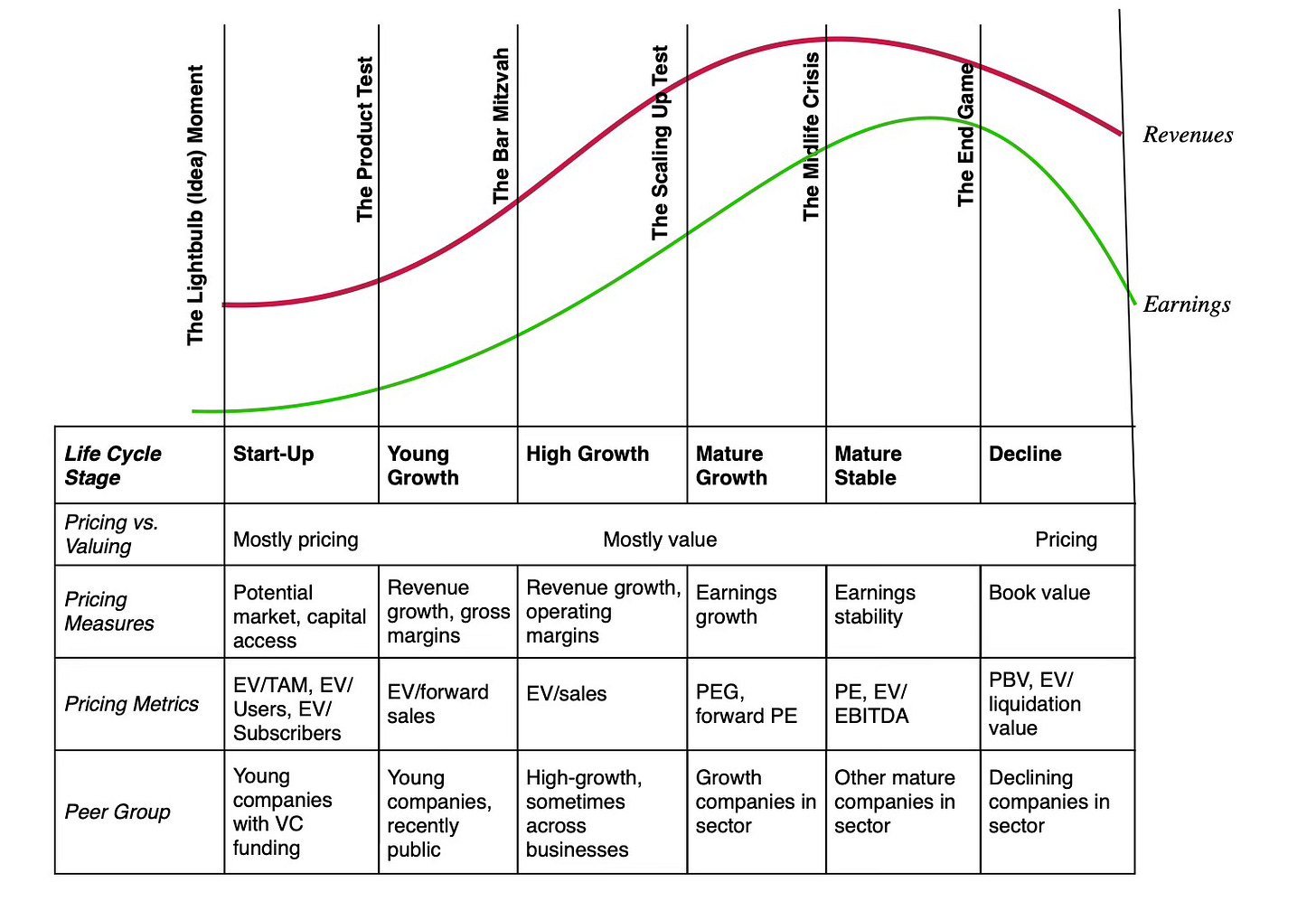
Damodaran’s frameworks, among others, can help us structure the world from a holistic perspective and help find reference points in the context of individual companies. I myself use this image a lot, but emphasizing that (unlike in human life) a company can move in different development stage squares in both directions; development does not have to be linear from left to right, and rarely is it. It also depends on the choices of the company and its owners where to position itself. And if one cannot regularly renew into growth segments, then operations in this changing world may not be on a sustainable footing.
24 Likes
Hello Mikael,
These discussions, unfortunately, do tend to blossom during quiet periods, but of course, it is the company’s own choice to maintain those quiet periods when communication must be restricted and investor discussions take a slightly more open turn.
It is true that Inderes entered the market with a slower growth philosophy, emphasizing annually increasing profit distribution and strong distributable cash flow. In listing materials and subsequent communications, the scarcity and moderation of investment needs have been specifically highlighted, so in my opinion, based on public materials, it is not incorrect to suggest that for Inderes, it is important to first distribute growing profits to owners each year, and only then consider if there is anything extra left to invest in growth.
Acting differently would, of course, require changing Inderes’ stated long-term goals from annual growth in profit distribution. Of course, as became clear from the previous discussion, this typical Finnish company operating model is quite accepted and even desired among dividend-hungry Finnish investors.
I admit that I don’t have in-depth knowledge of how analysis and events are practically sold to listed companies, but based on my own observations, there are still a huge number of listed companies in the Nordics that have never even heard of Inderes. With a layman’s logic, it’s difficult to buy products and services if you don’t know they are available.
One could therefore imagine that organic growth would accelerate if Inderes hired strong sales and marketing professionals who hopefully know how to use more than just a fax machine. This is how other listed companies abroad at least seem to operate: if more sales are desired, salespeople are hired, but perhaps this doesn’t work in Finland, and as you said, Inderes is anything but a typical company 
Your broader view on the markets and their development was truly interesting to read and sounds like a credible trajectory. When Events and Software were presented as strongly separate units at the Capital Markets Day, I, and apparently many others based on previous discussions, had been left with the impression that these would not be commercially bundled. Now, if these are indeed strongly linked, then Software is highly unscalable and naturally deserves significantly lower multiples.
This would then only underscore the need to start expanding into new markets already at this stage, because otherwise, in a few years, we will be in a situation where Software’s growth stagnates to the sluggish level of Events, and to achieve additional revenue growth for Inderes, acquisitions will again be needed, which have a lower probability of success. Empirically, it is easy to state that once a growth organization shifts out of growth mode, restarting organic growth rarely succeeds without significant simultaneous market pull.
Categorizing me as part of the mainstream narrative is usually a pretty losing bet. I completely disagree with that, and I believe Finnish companies generally invest too much and distribute too little of their profits to owners. I wouldn’t want to see another Fortum foreign adventure, Elisa’s AI shenanigans, and whatever else Nokia does every year in R&D without generating any concrete cash flow. This also applies to US mega-techs, such as Tesla, Alphabet, and Meta.
Instead, I don’t think it’s controversial at all to state that Finnish small companies, like Inderes, invest far too little in growth and therefore fail to grow to a significant size.
This has turned Hesuli into a ‘boomer company stock exchange,’ where the best firms don’t even want to come, and where companies mostly end up just cashing in on small investors when the ‘listing window’ is open during the peak of a cycle.
This cannot be the investors’ fault, at least, because we are not offered alternatives. Whether you buy Inderes, Evli, or even Orthex, the outcome for your portfolio is largely indifferent. You always get the same 5% dividends and single-digit revenue growth percentage, unless an economic crisis or M&A happens during the review period.
36 Likes