Interesting, I’ll look into that. It shouldn’t appear like that. What browser and phone is that?  @Ruoto
@veronmaksaja that’s coming, stay tuned!
Interesting, I’ll look into that. It shouldn’t appear like that. What browser and phone is that? @Ruoto
@veronmaksaja that’s coming, stay tuned!
OK! The phenomenon is visible on Chrome and Brave browsers, for example, at least.
Yeah, that’s not in production yet! It’ll be included in the next update!
Is it possible to hope for an adjustment to the font sizes of the forum’s mobile layout? When you make the font larger from the profile (presbyopia, what’s that?), the main navigation grows significantly, but the discussion list and text content only grow by about ~50-70% of the navigation’s font size. The size changes somewhat but doesn’t seem to change in the same proportion as the main navigation.
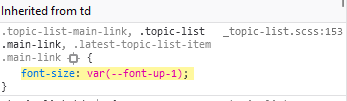
With normal width, the CSS seems to say:
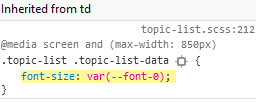
And when narrowed to tablet and phone width:
So, this is not a problem on a laptop, but when the resolution of those mobile devices is something like 4000 times some pixels on a few inches, I would like a bit more scale in that adjustment. Those devices try to make everything so small. 
(tested: Samsung Galaxy S10+, S20 FE, Tab S5e.)
EDIT:
IMHO, especially in tablet use (~10" screen), the list headings and the text content of individual threads can easily be increased by ~25% without problems because in those mobile layouts, the text section practically takes up the entire width of the screen.
I can check, I just think the content section might get too cramped if it’s expanded further, I’ll test it out!
I finally updated my UPM forecasts in my own Excel spreadsheet, segment by segment, partly using Inderes’ UPM company report from June 15, 2022, and especially its income statement table.
I must say, it was a laborious task for a change. Especially with the Fibres and Other Operations segments, I had to puzzle over Inderes’ forecast figures for a while.
Eventually, I concluded that UPM’s Leuna biorefinery (UPM Biochemicals business) under construction and its future contribution are still included in the Fibres segment by Inderes, even though UPM has changed its segment reporting since the beginning of this year and transferred the business in question (temporarily) under the Other Operations segment.
I’m not sure if I deduced correctly, so I ask Antti for clarification on the matter.
What I’m trying to say is that I, myself, try to utilize the (enormous) background work done by the analyst in my own forecasts, even though that work only appears as forecasted figures in Inderes’ report. Therefore, from an investor-client’s perspective, it would be desirable if Inderes’ forecasts, e.g., by segment, were consistent in content with the company’s reporting method. It would be so much easier to compare/check my own forecasts against the analyst’s forecasts and thereby perhaps make necessary changes to my own forecasts.
You are right. This is a pure error that I apparently made due to carelessness on the balance sheet date when I revised the segment split in connection with the report. I will correct the German refinery from Fibres to Other operations in connection with the Q2 report. Of course, this will not affect the group-level numbers.
I looked at Verkkokauppa’s latest update and rubbed my eyes, wondering if this company had fallen so quickly. I had to go back and check the course and recommendation history for the past year.
19.7.2021 Recommendation: Add, target price €9.30
19.7.2021 Share price: €8.48
Today, 15.7.2022, target price €4.00, share price slightly below €4
The target price is for >12 months ahead.
That 12-month target price is problematic in that, as seen, the medium-term economic cycle is quite difficult to predict, but on the other hand, when predicting 12 months ahead, the time window is short enough that the target price starts to fluctuate strongly if the economic cycle changes. The target price follows the share price, and the recommendation history often becomes a roller coaster ride following the share price curve.
A target price looking a quarter ahead (better visibility) or, on the other hand, a target price looking several years ahead (smoothes out short/medium-term fluctuations) might be more “justifiably” determinable. Or at least for a shorter target price, a roller coaster movement could be more easily accepted, and a target price looking several years ahead would not need to be updated as often, because the focus is then on the longer game. The current target price falls between these. Analysts rarely have any idea where things will actually be in a year. The real visibility is much closer, because the market environment can change several times in a year.
In my opinion, a long-term investor should consider the value of the stock over several years. A short-term trader might look a few months ahead rather than a year. The 12-month estimate is an in-betweener.
I pondered this issue somewhat differently for Harvia too in this thread (and in Harvia’s thread), but it didn’t really generate responses. The topic might be a bit difficult…
On the other hand, this is not a huge problem, as long as one remembers to approach the target price with the understanding that it certainly does not represent the “true” value of the stock in a long-term portfolio most of the time, and probably not even the value 12 months ahead if the market environment changes. But that doesn’t mean that just because it’s always been done this way, it couldn’t be done better in the future and somehow solidify that target price system. The focus of everything should be that different parts of the analysis (including the target price component) serve the investor as well as possible and create more added value than confusion. 
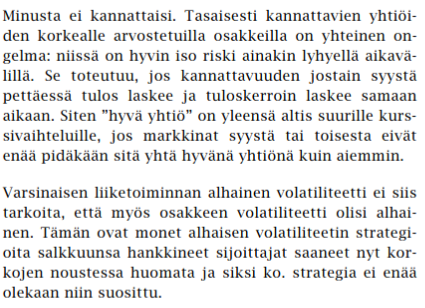
Anders Olderburg talks wisely about the stock risk of so-called good companies, whose profitability is relatively stable, in the latest Seligson fund review. One should not yet conclude whether a stock’s risk is high or low based on the stability of the business.
This message got stuck in my bookmarks amidst the busy earnings season, so I apologize for the slow response. Although equity risk is one of the four components of the risk metric, this particular component is considerably broader than current valuation multiples and consists of several different parameters (e.g., the suitability/reliability of the valuation methods used and the liquidity of the stock). In our opinion, it did not necessitate a change in Harvia’s risk rating, although a strong case could have been made for it. The parameters of the metric are iterated when deemed necessary, but the smallest changes do not always result in a changed risk rating. In the table itself, it is worth noting that the analyst builds their recommendation around current pricing, so strongly linking the risk metric to the current price would lead to a situation where price movements would move the block on both axes of the metric. In my opinion, it is entirely appropriate to consider whether this risk metric is trying to be overly multidimensional by considering both business and equity risk. Interpreting that table clearly causes certain challenges, so we have room to improve in this matter. Perhaps differentiating business risk and equity risk would help here?
I would ask for a little flexibility on that point, because if low risk requires truly low exposure to changes in financial conditions, “low” risk investment targets can be very difficult to find. For example, US government bonds are often used as a benchmark for risk-free returns, but their market price also falls rapidly when interest rates rise.
Very good point. It is true that linking risk to share price / valuation multiples would make the risk meter move more often. But when the risk is stated in the inderes.fi stock window in the same table as the target price and recommendation, which are moved quite often, it would be logical and obvious to the reader that the risk component would also be updated along with the other metrics.
Displaying the metrics in the same table implies that the metrics are updated at the same frequency and have an interdependency. The recommendation is tied to the stock price at the time of the update. The target price is tied to the information available at the time of the update regarding outlook and market. By the same logic, the risk in the table should be updated to reflect the prevailing information at the time of the update.
Just as the target price and recommendation are stated to look approximately 12 months ahead, logically the risk metric should also describe the stock’s risk over the same period. If the risk looks further or shorter, it should be clearly communicated to the reader.
If and when the current risk metric looks approximately 12 months ahead, valuation multiples and macroeconomics are emphasized, and the importance of company quality decreases. A high-quality company performs well over cycles, but even it is not immune to a sudden correction of high valuation multiples or a selling wave caused by market disturbance.
Excellent idea!
Titling business risk and stock risk as separate categories would remove reader confusion about what the current “risk” title describes. Now, some might perceive it as an assessment of stock volatility in a 12-month outlook, while others might perceive it as business stability and defensiveness.
It might sound like nitpicking, but perhaps presenting risk in terms of “lower” and “higher” would be more descriptive when talking about stocks. As you said, absolutely low-risk investments are hardly found on the stock exchange.
You shouldn’t take these comments of mine as criticism, but rather as a reader’s “user experience” in reading and understanding these metrics. Your analysis is sound. This is about these few metrics and their presentation, which summarize your analysis. Your content is read by people who have invested for decades as well as those who are just starting to invest, so sometimes even individual wordings can be important for the investor to understand what is being discussed and what is meant.
I read Inderes’ updated UPM report on 21 July 2022. I suspect that the contribution of the Leuna biorefinery is now completely missing from Inderes’ forecasts (see Income Statement, Other operations).
Could you please check this?
Regarding Other Operations, I had botched the revenue part with a link error in Excel, and Leuna was indeed missing from the revenue.  My apologies for this. Leuna has been modeled into the EBIT of Other Operations, so the reported earnings figures were correct. I have now corrected the revenue in the report, as the error only concerned revenue and thus had no impact on the outlook.
I recommend taking the Leuna forecasts with a grain of salt, as it involves a new type of technology (cf. it took some time, about a decade ago, to get the Lappeenranta biofuel plant to full cruising altitude) and nothing has been said about the targeted start-up curve. Therefore, making forecasts for it is very difficult.
Blogs now have 2 writers. This FAQ page is now in production: https://www.inderes.fi/fi/ukk
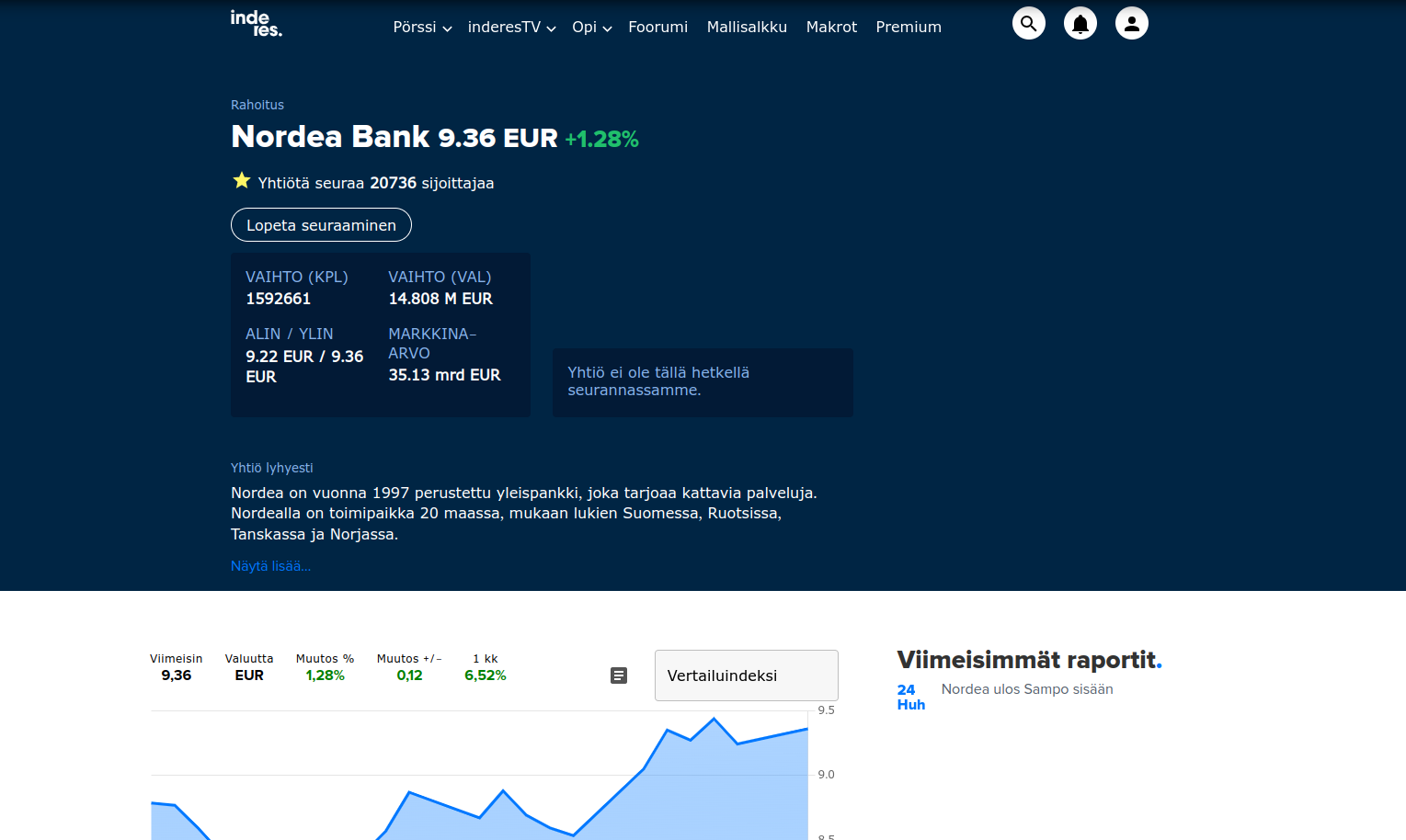
@Pohjolan_Eka requested adding market cap to the company page even if the company is not under coverage:
FAQ can be found in the footer:
This has been awaited!!! 
From now on, the 4 latest videos will be shown in the company page highlights Also changed so that Inderes’ estimate is shown as the company’s market value, but if the company is not under coverage, then the basic number of shares * share price.
What does this mean in practice? Do you show the market value (i.e., shares * price) instead of shares * target price?
Or is “forecast” a forecast of the number of shares, meaning rights issues/share buybacks are taken into account?
Yeah, there they correct their own, for example
Forum:
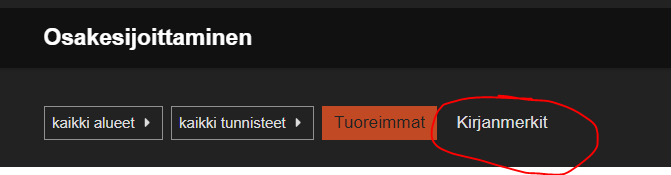
Is anyone else having an issue where some threads seem to disappear from the bookmark list? So, I have a fair number (probably 30 threads) of bookmarks, and when I click “Bookmarks” to go to the browsing view, not all of them show up in the list. They occasionally drop out of it. Then, when I go to a “dropped thread,” the thread management still shows the thread as being in my bookmarks.
So, this forum’s reading view is what I’m talking about:
The problem is in that view, where they keep dropping out… or maybe I’m just really blind
I think this has been going on for quite a while, maybe a couple of years?
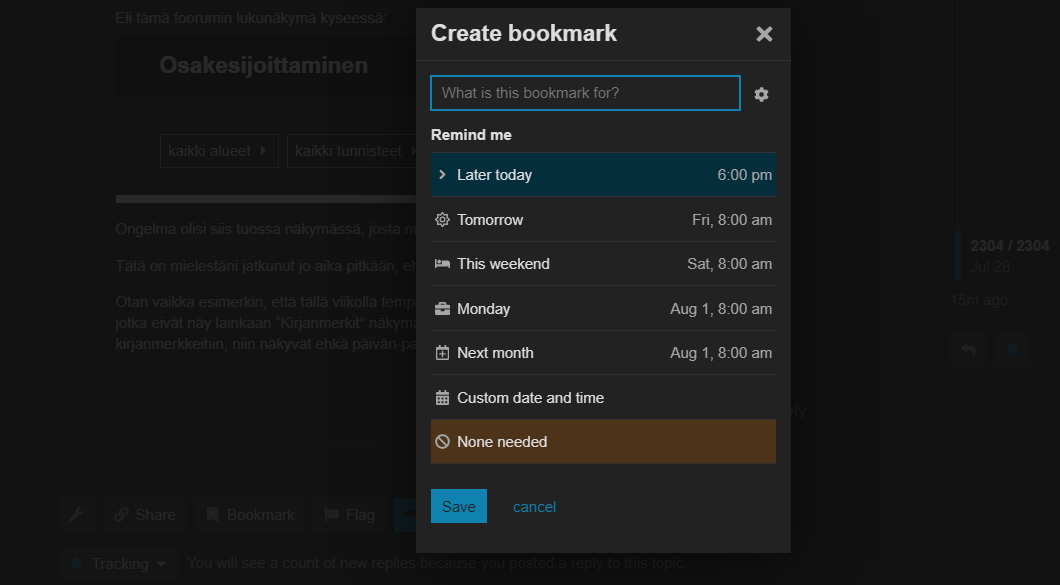
For example, this week, at least the Tietoevry thread and the Stockmann thread are acting up; they don’t appear in the “Bookmarks” view at all. If I remove them and re-add them to bookmarks, they might appear for a day or two until they disappear from the view again.
Is it possible that you selected “remind me tomorrow” here, so it will disappear tomorrow once the reminder is made?
Someone else, I think @tai9, also reported a similar issue.