[quote="Kaunohammas, post:7524, topic:59288"]\nWould any Huhtamäki investor like to briefly go through their thesis for the investment case?\n\n[/quote]
Let’s give it a try. For context, I have noticed that Huhtamäki has been gaining visibility on X and through analyst reports as autumn has progressed. Hesuli (Helsinki Stock Exchange) is having a historic record year for growth, but at the same time, Huhtamäki’s share price just keeps getting cheaper. At the time of writing, analysts’ target prices are hovering around 37 euros on average, while the share price is around 29.6 euros. Most analysts are giving a Buy recommendation. At the same time, Huhtamäki has risen this autumn to become a crowd favorite on the lists of most-bought shares.
I am not just replying to the quoted message, and this won’t be short. But I am stepping forward as one of the many who have studied the company, to the extent that my own abilities and time permit. And what could be more interesting as a Finn as autumn darkens than a rising dividend yield and a falling knife.
I cannot say anything with certainty or credibility about profit growth. But professionals seem to expect it, while the market is somewhat more skeptical for now. Below is my own modest reflection on the investment case as a whole to support the discussion. The message is quite long and therefore divided into subheadings for readability. If the format doesn’t appeal to you, I recommend skipping straight to the end of the message or even bypassing it entirely.
Introduction
The numerical examination in this post focuses primarily on the perspective of net income and P/E-based valuation from 2015 onwards. EV-based metrics would provide a more comprehensive picture, but the conclusions are largely the same. The chosen perspective is easy to understand, and I am more confident regarding the data. Huhtamäki is a stable company whose financial stability and capital structure have been fairly stable during the review period, so the comparability of EPS and P/E across the years is reasonably good. I naturally encourage a more versatile examination than this.
Huhtamäki is a very global company. It manufactures a diverse range of food, drink, and hygiene packaging. Different business areas have their own specific characteristics and profiles. However, I won’t even attempt to go down to the segment level here, but rather look at the company as a whole. I recommend a more detailed angle of examination than this.
As a disclaimer, the data has been gathered from a few different places. Mostly it has been taken by hand directly from annual reports and sometimes from Kauppalehti/Inderes. I consider it entirely possible and even probable that there is an error somewhere, that some figure has been restated retrospectively in the annual reports, or that some data source has been left unupdated due to time constraints. This is purely for entertainment, and I take no responsibility for errors. Apologies for the language choices, efficiency is a point of honor.
1. Historical Development 2015–2025E
Even though the share price stays put, a mere glance at the financial figures shows that things have been happening under the hood. Slow, but steady and stable growth of fundamentals. Revenue has developed, and at the same time, the EBIT percentage has been brought up by a percentage point. Free cash flow is currently on a quite healthy footing, but regarding its development, it’s good to remember that the company was in a different investment phase 10 years ago. Therefore, special attention is not paid to its development.
Table: 2015–2025E

Figure: Relative development (2015=1). Revenue, EBIT, Share price, Earnings per share (EPS), Dividend per share (DPS).
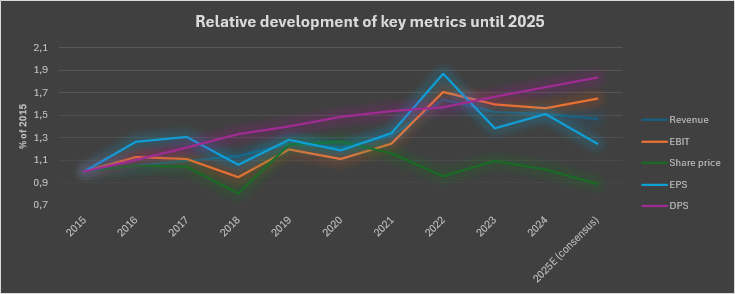
Over the 10-year review period, Huhtamäki’s revenue has grown from around 2.8 billion euros in 2015 to around 4 billion euros in 2025E (+47%, CAGR 3.92%). At the same time, reported EPS (diluted) has grown from 1.42 euros (2015), peaked at 2.65 euros (2022, see below), and ends up at the forecasted 1.77 euros (2025E) this year. Forecasts at this point of the year are likely already quite accurate for 2025E, and Q3 was uneventful. So in this writing, I assume there will be no major surprises for 2025.
In 2022, revenue grew by as much as 25% and EPS even more. This was an interesting outlier. I didn’t find anything groundbreaking for the analysis, but according to the company’s own reporting, the background was mainly driven by (1) the positive impact of exchange rates (~6.5%) and (2) compensating for inflation in pricing supported by sales volume growth (~15%). These were supported by acquisitions (Elif) minus the divestment of Russia. You can’t squeeze a huge amount out of this, but it raised the thought that Huhtamäki’s customer contracts seemed to have a flexible cost side when inflation exploded. That is a good thing for a defensive stock with an already fairly low profitability.
However, you can notice from the figure that one line is going in the wrong direction. Namely, the share price. What is this really about?
2. Valuation 2015–2025E
When the gap between EPS and share price changes, it naturally points to a change in valuation multiples. Collected below are both reported and adjusted P/E ratios from 2015 to the present day.
Table and Figure: P/E (calculated from the table based on diluted EPS), adjusted P/E (calculated based on adjusted EPS),


To understand the past pricing, we need to take a time travel trip back. Back to 2015, a year when Juha Sipilä’s government had just taken office and the Greek debt crisis was shaking Europe. This didn’t slow Huhtamäki down: it had been growing both its revenue and, in particular, its margin at a good pace well before 2015. Profitability improved sharply between 2012 and 2017. The EU plastics directive of 2015–2018 and sustainability as a megatrend made Huhtamäki’s story and continuous growth believable. Contemporary accounts of that world from an investor’s perspective show Huhtamäki’s major customers, such as Starbucks (2018) and McDonald’s (2018), one by one announcing the phase-out of plastic straws and a commitment to fiber-based products. Huhtamäki was on a strong upward trajectory, with a regulation-driven demand boom ahead of it.
Now, that future is already the past. Although the company has clearly managed well, the years 2023–2025 in particular have proven difficult for growth. The narrative is changing. Instead of a history lesson, investors are naturally only interested in what kind of valuation is justified, or if we will see an inevitable return to the mean—a statistical regression familiar from the stock market. At this point, let’s address the difference between market and analyst recommendations.
3. Analysts vs. Market: Growth and Valuation Multiples
When looking at revenue and EPS growth from recent years (below), we get a handle on the company’s current valuation. The company’s financial growth has been very close to zero since 2023—most recently, we received the Q3 2025 figures. The quarter’s comparable revenue change was -1%. In 2024, revenue shrank by -1.0%, and in 2023 by as much as -6,9%. It seems the engine is starting to sputter and the previous growth story is a distant memory—or is it?
Table and Figure: Revenue growth and adjusted EPS growth. The 5% threshold and the year 2023 are highlighted.
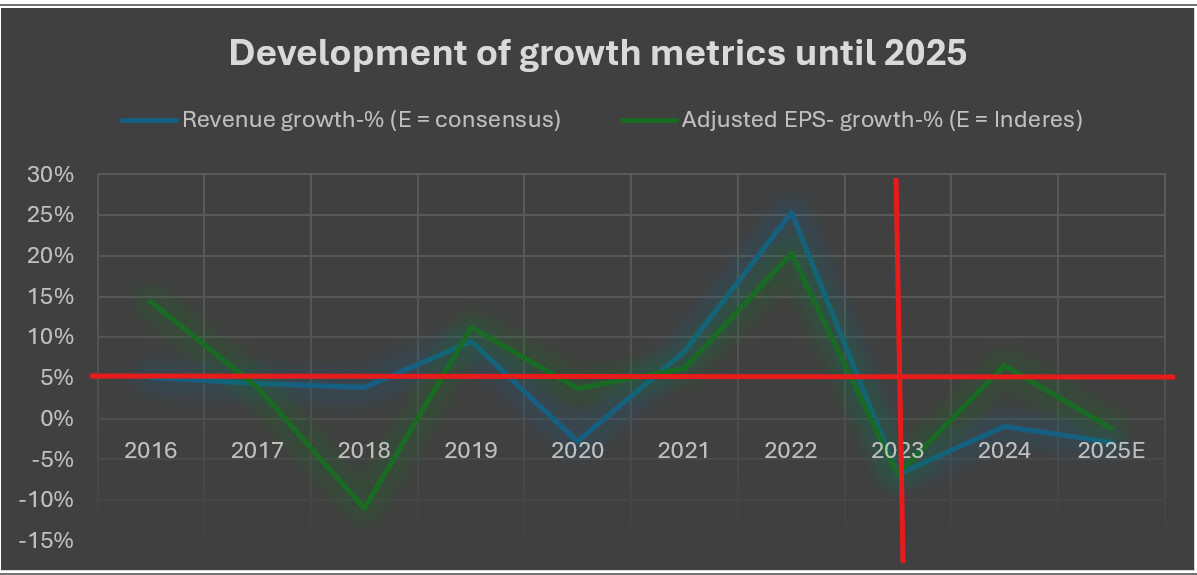
That is a difficult question. Far too difficult for myself. The market is pricing in low growth, but professionals (analysts) expect revenue growth to return to a reasonable level (3–4%) and significant profitability growth, especially for the coming years. As the figure below attempts to illustrate, consensus forecasts expect a clear earnings improvement for 2026–2027. One analysis firm (Inderes) talks about a CAGR growth of about 8% for the years 2026–2028. The consensus expects reported EPS to be €2.6 in 2027 (2025E: 1.8), and for 2028E reported EPS to exceed three euros. Significant improvement, then.
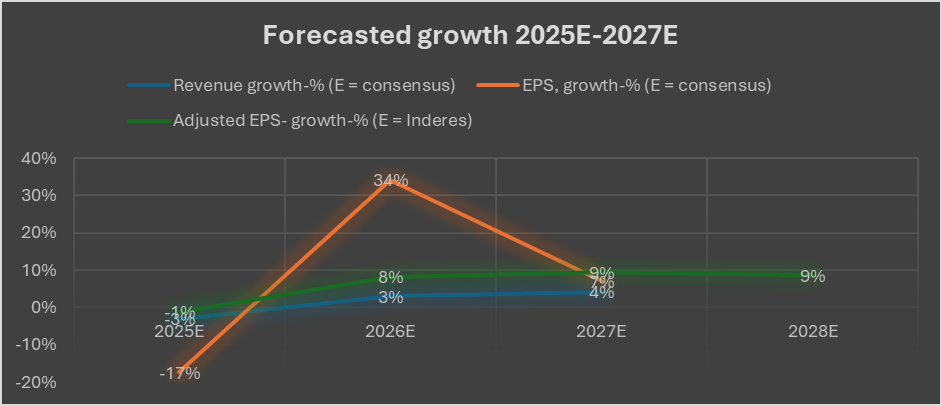
And that’s not all. While earnings grow, valuation multiples are naturally expected to undergo a correction. When both earnings (P) and the multiple (P/E) are corrected, the stock price shifts into the next gear all at once, leaving investors with nothing but taillights in their field of vision. I will take a direct quote from Inderes’s latest report as an example—not as a challenge in any way, because I couldn’t say it any better myself. But it illustrates the point.
- “Despite the stalling of growth in recent years, we believe Huhtamäki deserves growth company multiples, and historical P/E multiples around 16x are not unreasonable for the company in our view - -”
So here we are, at a crossroads. In a way, at the core of investing. On one hand, market expectations are low, but on the other hand, a clear improvement in profitability and consequently rising valuation multiples are expected. Now that we have discussed Huhtamäki’s history, I will highlight here the P/E multiples of Huhtamäki’s competitors compiled by a few analyst firms:
- Analyst #1 Average 2026E: 9.7, 2027E: 9. Median 2026E: 10.4, 2027E: 10
- Analyst #2 Average 2026E: 11.6, 2027E: 10.4. Median 2026E: 12, 2027E: 10.5.
While Huhtamäki is further than ever from its peak multiples, it still has some distance to catch up with competitors. They are waiting somewhere around ten, down-to-earth. In which direction will Huhtamäki’s journey continue? Here—in the growth potential of revenue and earnings—lies the current nut to crack. Let’s ponder this topic next.
4. Historical Growth
I have calculated to the best of my ability—yes, entirely by myself without a language model, whether that is more reliable or not—that over a 10-year period Huhtamäki’s realized growth (CAGR) has been as follows:
- Revenue 3.92%/year (2015–2025E)
- EPS 2.22%/year (2015–2025E) or 4.66%/year (2015–2024)
- Adjusted EPS 4.31%/year (2015–2025E) or 4.94%/year (2015–2024)According to Kauppalehti’s data, the company’s DPS (dividend per share) has grown throughout its history from 1996 to 2025, going from €0.17 (1996) to €1.1 (2025) almost every year. Consequently, the CAGR is 6.69% per year over the entire period. Although this performance deserves a tip of the hat, one could argue that the payout ratio is flexible. If the “wild growth years” are behind us, mere dividend history is not the best metric for projecting the company’s future earnings growth from here to eternity, since distributable funds will hit a ceiling at some point.
I’ve been pondering the figures above. This is not a forecast, but a thought: Huhtamäki may be the best company in its industry, but its 10-year historical growth is below 5% by any measure. The market has served up some very bitter pills for it over the past few years, though has packaging demand really been that weak? The market is extremely competitive. Even though scale is an advantage as the name implies, many segments feature competitors larger than Huhtamäki, such as Amcor (revenue of approximately USD 15 billion). Huhtamäki’s ability to consolidate the market is likely limited within the framework of its net debt target (2–3x EBITDA, Q3 2025 2x) to smaller targets under EUR 500m.
In addition, giant customers like McDonald’s, Nestlé, Starbucks, and Unilever (note: names published some time ago; I can’t say if they are currently relevant) are very demanding buyers. If a packaging supplier had pricing power in this industry, it would have been visible in the profitability of Huhtamäki & co. for a long time.
5. Assumptions and Determination of Fair Value
Moving from these foundations into subjective territory, i.e., the value of the share right now. After a bit of reflection, I decided to approach the development through three scenarios, of which I consider the middle one the most likely. Let’s start with the acceptable P/E first.
Acceptable valuation multiple
If we calculate the theoretically acceptable P/E (GGM: old, but faithful) using the following parameters, we arrive at an acceptable P/E ratio of 11.04. It is in line with competitors and is roughly the right level for a company whose growth is around 3% (inflation). However, this is just a starting point. We can, of course, grant Huhtamäki a quality premium in light of better development.
P/E = \t((DPS/EPS) x (1+g)) / (k - g)
DPS\t1.1\t2025 actual
EPS\t 1.77 \t2025E, consensus (26/10/2025)
g\t3.00 %\tModern EPS growth average
k\t8.80 %\tInderes
10–15 is a suitable range considering competitors and the company’s profile.
“Stable” EPS
Secondly, we need a stable EPS. Since the company has demonstrated its storm-resilience, we can this time take the average of the 2025E–2026E EPS, which is about 2 euros, as a starting point for a weak situation. It is a slightly stronger level than at present, but corresponds well to the realized average during the “mature” years 2020–2025E.
Scenarios and allocated probabilities
Based on the above, we create three different scenarios. In the weak scenario, the acceptable P/E is 10 and the stable EPS is 2 euros, meaning growth is close to zero. In the base scenario, the acceptable P/E is 13 and the stable EPS is 2.3. In the strong scenario, the P/E is 15 and the stable EPS is 2.6 euros.
With these parameters, we conclude that Huhtamäki’s share value is 20–39 euros. At the same time, we notice that the market is currently pricing the company closer to the base scenario (around 30 euros), while analysts expect something between the moderately strong and strong scenarios (over 35 euros).
Huhtamäki has shown strong resilience in a poor market, but at the same time, growth has recently been a challenge. This is a pure guess, but as a cautious estimate, I allocate a 10% probability to the weak scenario, a 70% probability to the base scenario, and a 20% probability to the strong scenario.
Results

Based on these assumptions and a very skillfully weighted average, I infer that the fair value of the share (insofar as it can deviate from the market value) could be around 31 euros. Thus, it is slightly higher than the market price of the share. This is supported by my own DCF model prepared with moderate assumptions, which I am not attaching here due to its complexity. As a cautious, skeptical investor who has been let down by forecasters many times, I am satisfied with the estimate. I let out a sigh of relief that the company is reasonably priced at the current rate.
6. Conclusions and Reflections
Now that I spent a few hours on this, what did I actually get out of it?
Well, not necessarily much of anything. Or that depends on the reader. Personally, I view Huhtamäki’s recent price trend as the market starting to transition the company from a growth company to a “slow grower” profile as defined by Peter Lynch. In the maturity phase and with the profile changing, historical multiples are no longer the best point of comparison; peers in a mature growth phase might be more suitable benchmarks. The company’s business is very capital-intensive, competition is fierce, and despite long contracts, customers are demanding. Even though the company is generally considered a quality dividend aristocrat, let’s be realistic. If you invested in this 10 years ago at €33.5, many alternative investment targets have left it far behind.But. Now that those words are out of the way, I think Huhtamäki is a geographically and segment-wise well-diversified, high-quality managed company. The balance sheet is in good shape, and its historical track record of steady performance is indisputable. While there may not be a true economic moat in the products, market entry barriers are, in my view, significant due to production facilities, technology, customer relationships, and regulatory expertise.
The following is not a sign of a good investment – perhaps even quite the opposite – but I confess to having bought Huhtamäki recently at around 30 euros for my defensive equity savings account. It’s not going to be the next tenbagger, but it fits well into a cautious, long-term portfolio. I don’t consider the stock particularly cheap in the ”screaming buy” category, and I wouldn’t be surprised if we have to wait for the target price. But based on its long history, bought from these levels, I would dare to expect at least a reasonable 7% annual return (dividend \~4% + earnings growth \~3%) with moderate risk and gradually a seemingly non-existent downside. Whether that is enough and whether the investment suits one’s own portfolio is entirely up to the investor.
But then there is still the upside. The world is complicated, and I have no way of predicting it, not by a long shot. But at this valuation, a good outcome is a few percentage points on the top line, one or two on the bottom line. So not tens, like with more expensive growth companies, or hundreds, like with Tesla. I have identified the following catalysts behind the highest forecasts:
- Improvement in market conditions and demand (volume growth, currently free capacity);
- North American purchasing power is growing rapidly, end-user consumption is reflected in packaging demand;
- Successful efficiency measures (EUR 100m 2024-2026 program coming to an end);
- Development of the product portfolio towards more profitable products;
- Sustainability and regulation of fiber packaging instead of plastics; and
- Increasing sales in the smaller customer segment (“global local”).
If these materialize, the upside can be higher and approach a 10% annual return. That is already a pretty good return for this level of risk. If you have enough patience and the excitement in life comes from somewhere other than the stock market, buying Huhtamäki at these figures should let you sleep well at night. In the words of a legendary investor, the best investments for many of us are precisely those that we don’t have to worry about daily.
These are pretty much my own thoughts. Although the valuation exercise in point 5, printed with Inderes’ digital ink in the message, is very simple – perhaps even amusing to someone wiser – I have largely arrived at the same conclusion from different perspectives. Everyone is justified in completely disagreeing with everything presented. There may be errors in the numbers and facts, and I authorize the esteemed forum members to freely correct and rectify them.
This is not an investment recommendation, but merely shouting on a forum. It is better to get acquainted with the industry and the market, do your own analysis, and read professional reports.